
South Asia Intelligence Review
Derailing the Lifeline
On November 29, 2025, an improvised explosive device (IED) planted on the railway track detonated shortly before a train was expected to arrive in Quetta, the provincial capital of Balochistan. “Around one and a half feet of the track was blown up in the blast,” a railway official said.
On November 24, 2025, the Peshawar-bound Jaffar Express escaped an armed attack in the Bolan Pass area of Kachhi District in Balochistan. Railway officials said the Jaffar Express departed Quetta for its destination, Peshawar, on schedule, and after crossing Mach station, near Aabigum, suspected Baloch insurgents opened fire on the train from the nearby mountains. Security personnel, including Railways Police travelling on the train, immediately retaliated. However, after a brief exchange, the insurgents escaped from the area. It was the sixth attack on the Jaffar Express between Quetta and Sibi during just two months.
On November 16, 2025, the Jaffar Express escaped a bomb attack in the Shaheed Abdul Aziz Bullo area of Nasirabad District. According to Police officials, unidentified attackers had planted an explosive device on the railway track in the Shaheed Abdul Aziz Bullo area to target the Peshawar-bound train that was travelling from Quetta, and later detonated it. However, the train passed the area safely, and no loss of life was reported. Railway officials said a portion of the track was damaged due to the blast, as a result of which railway traffic between Quetta and the rest of the country was suspended. The Baloch Republican Guards (BRG) ‘spokesperson’ Dostain Baloch claimed responsibility for the attack.
On October 29, 2025, suspected Baloch insurgents attacked the Jaffar Express in the Dera Murad Jamali town of Nasirabad District, firing multiple shots and launching four rockets at the passenger train. However, Security Forces (SFs) retaliation forced the insurgents to escape. In the attack, several train compartments sustained minor damage, but no casualties were reported.
On October 24, 2025, a Pakistan Railways worker was killed in a bomb blast near a railway crossing in Dera Murad Jamali area of Nasirabad District. The explosion occurred near the Pat Feeder Canal bridge, shortly after the pilot engine of the Jaffar Express had crossed the railway track. The train and pilot engine, however, narrowly escaped the damage, though the blast damaged the railway track and claimed the life of a worker.
On October 7, 2025, at least seven people were injured after a blast on a railway track derailed four bogies of the Jaffar Express near the Sultan Kot village in the Shikarpur District of Sindh, while it was en route from Rawalpindi to Quetta via Jacobabad. The BRG claimed responsibility for the attack. In a statement issued by BRG ‘spokesperson’ Dostain Baloch, the group declared that its fighters targeted the train because it was carrying personnel of the “occupying Pakistani Army.” The spokesperson claimed that several soldiers were killed and injured in the explosion.
On September 23, twelve people, including women and children, were injured as a blast derailed six bogies of the Jaffar Express near Spezand town in the Dasht tehsil (revenue unit) of Mastung District in Balochistan. Muhammad Kashif, Pakistan Railways’ Quetta Division public relations officer, disclosed that a railway track was blown up with explosives in Spezand town, derailing six bogies. “The train was coming from Peshawar to Quetta and there were 270 passengers on board,” he added.
With a rise in terrorist attacks over the past few years, Pakistan, especially Balochistan has seen a series of incidents with Baloch insurgents attacking and blowing up train tracks, targeting the country’s transport infrastructure in order to hurt the economy where it inflicted most hurt for Pakistan. While the Jaffar Express has been particularly targeted repeatedly, the wider Rail network across Pakistan has also come under recurring attack. According to partial data compiled by the South Asia Terrorism Portal (SATP), the current year, 2025, had already recorded 18 attacks on the Railways, so far (data till November 30, 2025), out of which 14 were reported from Balochistan with 66 fatalities, while the remaining four attacks were reported in Sindh. Meanwhile, in 2024, only two incidents of such attacks on the Railways (all in Balochistan), were recorded, in which 27 persons were killed.
Railways in Pakistan have been attacked on at least 176 occasions since March 2000 (data till November 30, 2025). Of these, 166 attacks have been recorded in just two Provinces: Sindh and Balochistan, with 93 incidents in Balochistan and 74 in Sindh. 197 fatalities have been recorded in these166 attacks, with 161 killed in Balochistan and 26 in Sindh. While six attacks on railway infrastructures were reported in Khyber Pakhtunkhwa, one attack was recorded in Punjab in which 12 persons were killed.
The major concentration of attacks on the Railways, which primarily occurred in Balochistan and adjacent Districts of Sindh – is the result of separatists operating there, and engaging in different patterns of economic subversion. Attacking the Railways is one of several such tactics. While Baloch nationalist groupings like the Balochistan Liberation Army (BLA), Baloch Republican Army (BRA) and BRG have been engaged in attacks on Railways inside Balochistan, Sindhi groups, such as the Sindhudesh Liberation Army (SLA), which is fighting for the establishment of an independent Sindhu Desh, liaise with Baloch groups in the fight against the Federation.
2025, so far, has already crossed the record for fatalities in such incidents of all previous years, with 18 attacks resulting in 66 fatalities. Between 2010 and 2014, the worst time for the Pakistan Railways, with 104 attacks on trains, tracks and stations, resulted in the deaths of 65 persons, mostly passengers, and injuries to more than another hundred.
A single incident of train hostage-taking on March 11, 2025, changed the whole equation of train attacks in Pakistan. On March 11, BLA cadres ambushed the Jaffar Express at the Dhadar area of Bolan Pass in the Bolan District of Balochistan, halting the train and taking around 400 passengers hostage. With much confusion about the fatalities in the initial hour, on March 14, the Government confirmed that 31 persons, including 23 Security Forces (SFs) personnel, lost their lives. The Director General (DG) of Inter-Services Public Relations (ISPR) Lieutenant General Ahmed Sharif Chaudhry confirmed that all 33 terrorists involved in the attack on the Jaffar Express were killed.
However, on March 14, BLA announced that it had executed all 214 Pakistani military hostages taken during the seizure of the Jaffar Express train. The group accused the Pakistani state of ignoring its demands and refusing to engage in serious negotiations for the hostages’ release. In a statement released to the media, BLA ‘spokesperson’ Jeeyand Baloch claimed that the group had given the Pakistani Army a 48-hour ultimatum to negotiate a prisoner exchange. However, he asserted that Pakistan, displaying “traditional stubbornness and military arrogance,” avoided meaningful dialogue and failed to “acknowledge the situation on the ground. As a result of this stubbornness, all 214 hostages have been executed”.
The Jaffar Express attacks reflect a shift in insurgent tactics and intensity, to inflict fear on the state, rather than just impose economic and infrastructural losses. These attacks are a multi-layered assault: derailments caused by IEDs or track sabotage not only lead to a halt of goods’ transportation for days, spoiling perishable goods and disrupting supply chains, but also demonstrates the state’s inability to protect one of its most visible and important infrastructure projects.
This tactical shift has been particularly noticeable over the last year, after a suicide bomber blew himself up near the ticket counter of the Quetta Railway Station on November 9, 2024, killing at least 31 persons, including 17 SF personnel, and injuring more than 60, including 46 SF personnel. The Majeed Brigade of the Baloch Liberation Army (BLA) claimed responsibility for the attack. “This morning, a Fidayee attack was carried out on a Pakistani Army unit at Quetta Railway Station as they were returning via Jaffar Express after completing a course at the Infantry School,” BLA ‘spokesperson’ Jeeyand Baloch stated. According to the BLA, the suicide bomber Rafiq Bizenjo targeted Army personnel from multiple regiments, including the Punjab Regiment, Northern Light Infantry, Sindh Regiment, Frontier Force, Baloch Regiment, and Azad Kashmir Regiment. The soldiers had recently completed training at the School of Infantry and Tactics in Quetta, Jeeyand Baloch added.
The Jaffar Express, which runs between Quetta city in Balochistan and Rawalpindi city in Punjab, has been targeted repeatedly primarily because of its route through the highly sensitive and conflict-prone provinces of Balochistan and Sindh. The importance of the Jaffar Express for Balochistan is multifaceted, touching on economic, social, logistical, and symbolic dimensions. It is a vital lifeline for Balochistan, the largest province by area, and one of its least developed. The Jaffar Express provides a crucial and relatively affordable link to the country’s economic heartland. Attacks on the train constitute a form of retaliation by the insurgent groups, even as they prove their resilience, and highlight the brutality of the state’s counter-insurgency campaigns and enforced disappearances of Baloch civilians. Attacks on the Jaffar Express are a direct challenge by the Baloch insurgents, to the state’s authority, in their fight against injustice and enduring grievances.
J&K: Ominous Silence?
On November 7, 2025, two unidentified terrorists were killed as Security Forces (SFs) foiled an infiltration attempt along the Line of Control (LoC) in the Keran Sector of Kupwara District in Jammu and Kashmir (J&K).
In the intervening night of October 13-14, 2025, SFs killed two terrorists, foiling an infiltration bid along the LoC in the Machil sector in Kupwara District. A joint operation was launched after suspicious movement was detected along the LoC. SFs opened fire, and the bodies of two terrorists were recovered in the morning. Weapons and equipment were recovered.
On September 28, 2025, two terrorists were killed during an infiltration bid at the LoC in the Keran sector of Kupwara.
On September 8, 2025, a terrorist was killed in the Gudder area of Kulgam District.
According to data compiled by the Institute for Conflict and Management (ICM), since Operation Sindoor, a total of 34 fatalities has been recorded in J&K, including seven SF personnel and 27 terrorists. By comparison, before Operation Sindoor, 57 fatalities, including 28 civilians, nine SF personnel, 19 terrorists and one in the Not Specified category, were reported since January 1, 2025. The data exposes any claims of ‘zero terrorism’ in J&K, clearly demonstrating that there is no absence of terrorist activities in the region, as Over Ground Workers (OGWs) and armed cadres retain an active presence. The claim of the deterrent value of Operation Sindoor would also come under question, as both incidents and infiltration attempts continue unabated.
Indeed, National Security Advisor (NSA) Ajit Doval on October 31, 2025, described J&K as a continuing “theatre of proxy war,” emphasising that the relative lull is tactical rather than permanent.
It has been almost six months since India’s audacious Operation Sindoor (which commenced in the early hours of May 7, 2025, and was “suspended” on May 10) – a tri-service precision strike that dismantled nine terrorist camps across Pakistan and Pakistan-occupied Jammu and Kashmir (PoJK). The Operation was launched in response to the Pahalgam terrorist attack, and targeted and struck the Lashkar-e-Taiba (LeT) headquarters in Muridke and the Jaish-e-Mohammad (JeM) headquarters in Bahawalpur in Punjab Province in Pakistan, while simultaneously crippling multiple infiltration launchpads across PoJK. Though Operation Sindoor was one of India’s most comprehensive counter-terrorism offensives, and despite its success in destroying all targeted locations, sporadic incidents of violence continue across J&K. Fatalities have been recorded in J&K in each month since the conclusion of Operation Sindoor, underscoring the persistence of low-intensity conflict in the Valley. These prominently included:
May 13, 2025: SFs killed three LeT terrorists – Shahid Kuttay, Adnan Shafi and one unidentified militant – in an encounter in the Zinpather Keller area of Shopian District.
May 15, 2025: Three JeM terrorists – Asif Ahmed Sheikh, Amir Nazir Wani, and Yawar Ahmed Bhat – were killed in the Nader Tral area of Awantipora in Pulwama District. SFs recovered three AK-series rifles, twelve magazines, three grenades, and other war-like stores from the site.
May 22, 2025: An Army trooper, Gaykar Sandip Pandurang (32) was killed and another two personnel were injured during an encounter in the village of Singhpora in the Chatroo area of Kishtwar District.
June 24, 2025: One terrorist was killed and another injured when Army troops opened fire on a suspicious movement in the Barat Gala area of the Keri sector of Rajouri District.
June 26, 2025: A foreign JeM terrorist was killed in an encounter in the Bihali forest of the Basantgarh area in Udhampur District, where his body was recovered along with an AK-series rifle, ammunition, and explosives. Three of his associates, however, managed to escape.
June 29, 2025: Two terrorists were killed in an encounter in Rajouri District.
August 1-2, 2025: In two consecutive days of operations, SFs killed two operatives of The Resistance Front (TRF) an offshoot of LeT- in the Akhal Forest area of Kulgam District.
August 9, 2025: Two Army soldiers were killed and another two injured during an encounter with terrorists in Kulgam District.
August 13, 2025: An Army trooper was killed during a gun battle near the LoC in the Churanda area of Uri sector, Baramulla District.
August 27, 2025: Army Havildar Ikbal Ali was killed during an operation in Kupwara District.
August 27-28, 2025: SFs killed four terrorists – two on August 27 and two on August 28 – during operations in the Gurez Sector of Bandipora District.
The September-November period (top) recorded at least another seven fatalities (all infiltrators).
Media reports based on unconfirmed official disclosures suggest that 131 terrorists remain active in the region, including 122 Pakistani nationals and nine locals. Further, the unholy trinity of LeT, JeM, and Inter-Services Intelligence (ISI) appears to be regrouping, rearming, and recalibrating with covert logistical support from the Pakistani state. Their overarching agenda fuses religious extremism with irredentist aspirations and calculated geopolitical opportunism. The ISI’s current strategy seems focused on stalling – using the lull to rebuild militant cadres, re-establish infiltration corridors, and synchronise cross-border operational capabilities in preparation for a potential escalation.
Preliminary, though unofficial, disclosures to the media by various investigating agencies relating to the November 10, 2025, car bomb which exploded near the Red Fort in Delhi indicate that the suicide bomber, Dr. Umar ul Nabi, a doctor from J&K, was part of a JeM module comprising educated professionals, including several other medical practitioners, three of whom have also been arrested by the National Investigation Agency (NIA) which is investigating the case. The investigation continues, with more arrests expected, along with the earlier dismantling of a related JeM sleeper cell in J&K and the involvement of OGWs. The trail of this case began on October 17, 2025, when JeM propaganda posters were found pasted in Srinagar’s Nowgam area. Police arrested the persons who put up the posters, Nisar Ahmed Dar, a labour contractor from Nowgam; 19-year-old Yasir-ul-Ashraf from Bunpora; and 25-year-old Maqsood Ahmad Dar from Bunpora, on October 19, in Nowgam. Their interrogations led to the detention of 24-year-old cleric, Mufti Irfan Ahmad Wagay from Nadigam village in Shopian the same day, at the Nowgam mosque. Further probes exposed a 22-member terror module, resulting in the November 5 arrest of Doctor Adeel Ahmad Rather in Saharanpur, Uttar Pradesh; the November 8 arrest of Doctor Muzamil Ahmad Ganie in Faridabad, Haryana; and November 9-10 arrests of Doctor Shaheen Saeed in Faridabad, and Zameer Ahmad Ahanger, 29, from Wakoora village in Ganderbal, J&K.
Terrorism in the region appears to have gone deeper underground, in increasingly clandestine networks that are extending their influence and activities beyond J&K.
At the same time, LeT and JeM appear to be shifting tactics and geography, to sustain prolonged militant pressure in the Valley. LeT has moved its operational base from Muzaffarabad in PoJK to Khyber Pakhtunkhwa (KP), near the Afghan frontier. By mid-2025, construction had begun on the Markaz Jihad-e-Aqsa in Lower Dir in Pakistan – a vast complex to train elite fidayeen squads (Daura-e-Khas) and general recruits (Daura-e-Lashkar). Under LeT chief Hafiz Saeed’s deputies, LeT has revived stipends for ex-commanders, reactivated sleeper cells in South Kashmir, and reframed Kashmir as a “global Muslim cause” to attract recruits from madrassas and diaspora networks. LeT’s survival plan now includes dispersal after the Operation Sindoor strikes, more intensive rebranding as humanitarian fronts, regrouping deeper within Pakistan to evade precision targeting, and sustained funding through narcotics and diaspora channels.
Concurrently, JeM is expanding the Markaz Shohada-e-Islam in KP under ISI protection. In September 2025, nearly 5,000 cadres gathered in Peshawar under a ‘religious’ banner, pledging revenge against India. Meanwhile, backed by INR 3.9 billion in fundraising, JeM is experimenting with drone-assisted infiltrations via the Shakargarh Bulge and training Afghan returnees for Improvised explosive device (IED) ambushes. Further, JeM Amir Masood Azhar has initiated the “313” project, to develop 313 centres, each at a cost of PKR 12.5 million, to decentralise and expand the organisation and make the group more resilient against future strikes. As of November 2025, JeM had already established or was constructing 20 new centres, with posters and videos promoting the full 313 as a “grand jihad revival.” Funds also support safe houses for Azhar and his family, amid unconfirmed reports of 10 relatives killed in the Operation Sindoor strikes. The number “313” draws from Islamic history and militant symbolism, commemorating the 313 companions who fought alongside Prophet Mohammad in the Battle of Badr (624 CE), and paying homage to Al-Qaeda’s elite commando unit, Brigade 313, which operates as a “shadow army” coordinating with groups like JeM, LeT, and the Haqqani Network. This linkage is expected to enhance JeM’s appeal for global recruitment and ideological alignment with the transnational jihad.
On November 29, Deputy Inspector General (DIG) of Border Security Force (BSF) Vikram Kunwar stated,
After the BSF destroyed many terror launchpads along the border during Operation Sindoor, Pakistan government shifted all such facilities to the depth areas… About 12 launchpads are working from the depth areas of Sialkot and Zaffarwal, which are not exactly on the border. Similarly, 60 launchpads are working in the other depth areas away from the border.
JeM has also established its first women’s wing, Jamaat-ul-Mominaat, led by Saeeda Azhar, the sister of JeM chief Masood Azhar. The first known arrest linked to this network was that of Dr. Shaheen Shaheed, in the Faridabad District of Haryana, India, one of the key accused in the November 10, 2025, Red Fort blast.
Women cadres are now increasingly being drawn into roles involving recruitment, propaganda, and logistical coordination, allowing the outfit to enhance greater operational flexibility and evade conventional security scrutiny. The move to KP – terrain marked by rugged mountains and Afghan proximity – offers terrorists natural cover and complicates India’s surveillance and strike capabilities. However, the deeper geography will also hinder direct targeting in J&K. Emerging patterns point to hybrid tactics: drone-dropped arms, narco-smuggling via Afghan routes, and reactivation of sleeper cells- in J&K and beyond. With over 14 infiltration attempts since January 1, 2025, according to SATP, the Valley faces a prolonged phase of low-intensity but sustained militant pressure. Adding to the complexity, drone incursions along the LoC and International Border have surged sharply since September 2025. Multiple sightings in Samba, Jammu, Kupwara, Ramgarh, and Baramulla Districts are attributed to a LeT unit commanded by Shamsher. These UAVs have conducted aerial reconnaissance over security posts and strategic ridgelines, likely scouting landing zones for suicide attackers or weapon payload drops. Intelligence assessments link this to the narco-terrorist network, where profits from cross-border drug trafficking are repurposed to procure drones and sustain operations. This convergence of narcotics, terrorist finance and technology reflects the new face of hybrid warfare. With these tactics, it appears that major terrorist groups seek to retain focus on the Valley.
The relative calm in J&K may prove deceptive, given the steady undercurrent of militant and subversive activity within, as well as the steady build-up of terrorist infrastructure, resources and cadres in Pakistan. Although large-scale attacks have declined, efforts by terrorist networks to regroup continue. Local and non-local terrorist threats persist, even as efforts to adapt to the increasingly difficult operational environment are visible. The lull in J&K, moreover, cannot be disassociated from wider Islamist terrorist plots in India, and the Red Fort bombing may suggest a coordinated escalation of intent and capability beyond the Valley.
Weekly Fatalities: Major Conflicts in South Asia
November 24-30, 2025
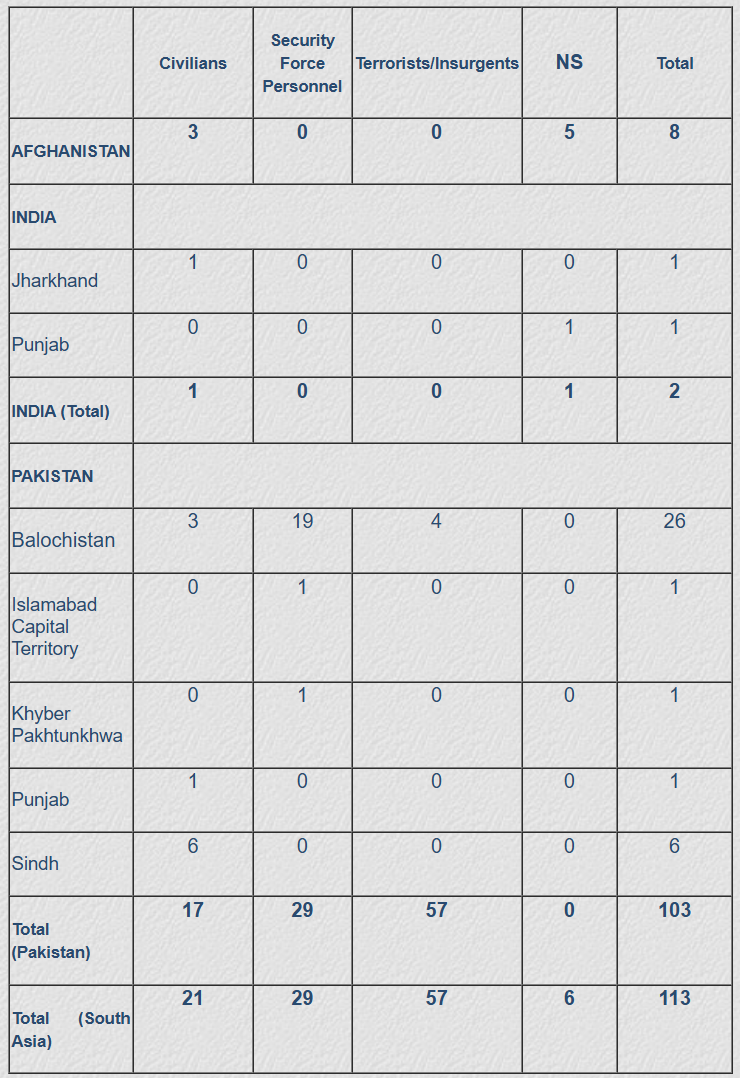
Provisional data compiled from English language media sources.