
Special Report: Surprise PRC Military Exercise Around Taiwan
Introduction
The People’s Republic of China (PRC) conducted large-scale military exercises that simulated a blockade around Taiwan from December 29–30. The exercise, named Justice Mission 2025, was the second exercise of its kind in 2025. The PLA began conducting blockade exercises around Taiwan with increasing frequency after Taiwanese President William Lai Ching-te’s inauguration in May 2024.
Justice Mission 2025 rehearsed operational elements of a campaign to isolate Taiwan while using the rehearsal to enhance the PRC political and psychological pressure on Taiwan and its allies. The exercise emphasized the use of naval and coast guard assets to enforce a blockade around Taiwan and rehearsed counter-intervention operations. The exercise did not involve PLA Navy (PLAN) aircraft carriers, suggesting that it was intended to practice only part of a larger blockade operation. The exercise reportedly included rehearsals of amphibious and air assault operations off Taiwan’s east coast as well as long-range rocket fire. PRC propaganda emphasized the blockade aspects of the exercise, but it may also have been intended to practice combining blockade/interdiction missions with operations that would support a decapitation strike or invasion of Taiwan. The PRC used the exercises as a coercive signal intended to weaken Taiwanese morale and deter Taiwanese leaders from policies that support Taiwanese sovereignty and self-defense.
Key Takeaways
Justice Mission 2025 simulated a blockade of Taiwan’s major port cities and the interdiction of Taiwanese energy imports.
The PRC deployed 14 China Coast Guard (CCG) vessels during the exercises, indicating that the CCG will play an important role in a blockade or quarantine of Taiwan. The CCG would likely interdict non-military vessels during a blockade to create a veneer of legitimacy under the pretext of “law enforcement” operations.
The exercise was likely rehearsing cooperation between the CCG and the PLAN in such activities since PLAN vessels operated together with CCG ships.
The exercise also reportedly rehearsed activities relevant for an invasion of Taiwan including air and amphibious assaults and long-range rocket fire.
Justice Mission 2025 primarily involved assets with significant precision strike, anti-submarine, and anti-surface vessel capabilities and practiced counter-intervention operations to support a PLA blockade of Taiwan.
The exercises likely rehearsed only one component of a multi-domain PLA effort to isolate Taiwan.
PRC messaging framed the Justice Mission 2025 exercises as a reaction to US and foreign encroachment on PRC sovereignty. PRC propaganda serves the secondary purpose of intimidating “Taiwan independence” advocates and delegitimizing Taiwan’s government.
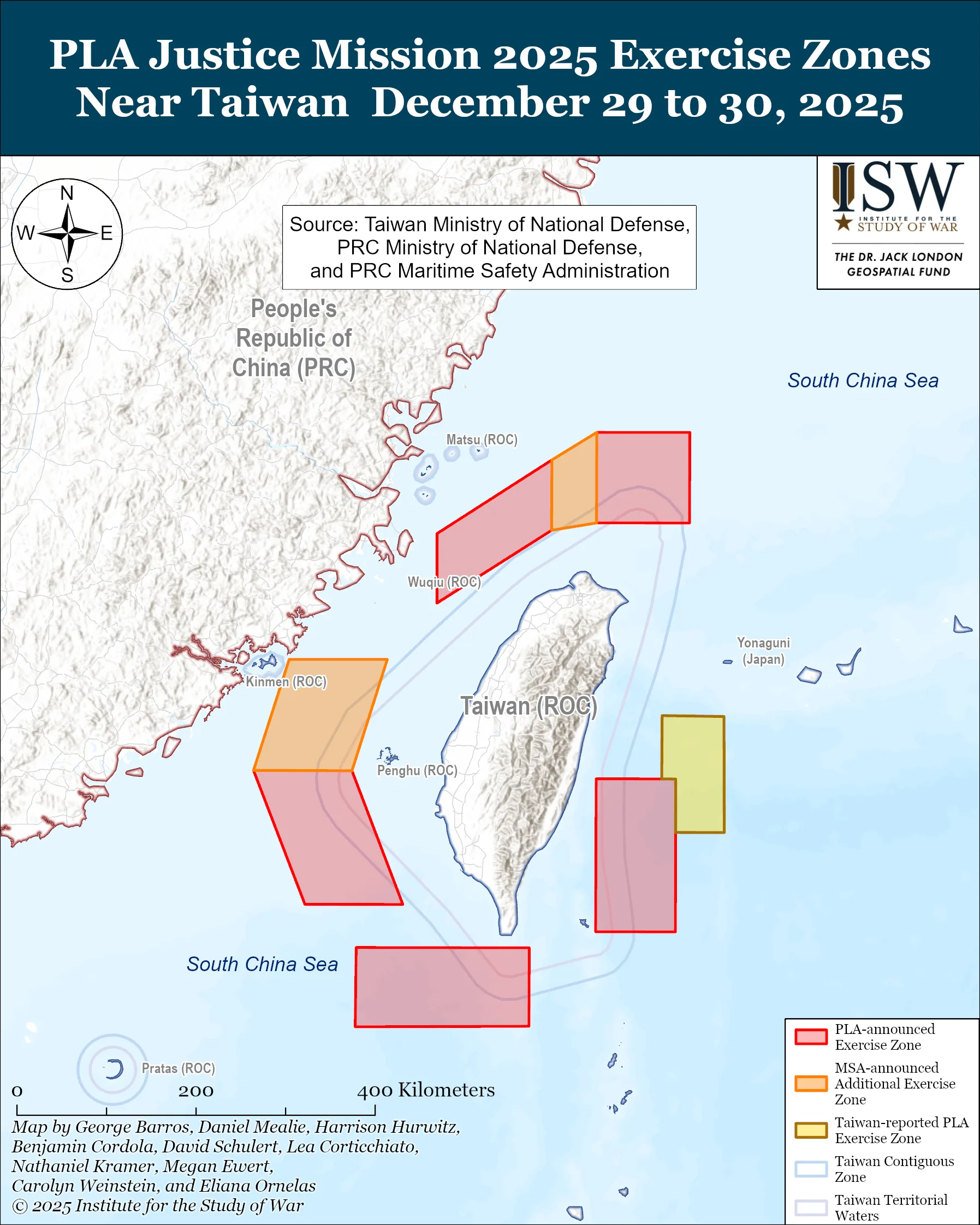
Justice Mission 2025 simulated a blockade of Taiwan’s major port cities and the interdiction of Taiwanese energy imports. The exercises occurred in eight zones surrounding Taiwan’s main island. The PLA officially announced five of the zones, which correspond to major cities and ports—two south of Taiwan, two north of Taiwan, and one east of Taiwan.[1] The PRC Maritime Security Administration (MSA) issued two additional warnings for a zone west of Taiwan and a zone between the two northern zones, claiming that the exercises would extend to those areas.[2] Taiwan’s Ministry of National Defense (MND) announced an eighth exercise zone adjacent to the single zone east of Taiwan where it expected the PLA to conduct further exercises.[3] The exercises involved 18 PLAN vessels from the Eastern Theater Command (ETC), 14 of which were deployed in the waters north, south, and east of Taiwan and four of which operated 160-170 nautical miles east of Taiwan’s southernmost point.[4] The exercises also included 201 air sorties, 125 of which crossed the median line between the PRC and Taiwan.[5] PLAN forces north of Taiwan likely simulated a blockade operation against Keelung—a major port city adjacent to Taipei. PLAN vessels in the south assumed positions that could prevent foreign forces from entering the Taiwan Strait while interdicting Kaohsiung—Taiwan’s largest port.[6] The PRC media outlet Global Times claimed that PLAN forces arrayed east of Taiwan practiced blocking an intervention force from reaching the island, likely by blockading the port city of Hualien.[7]The PLA likely positioned assets in key maritime and air traffic routes to demonstrate its ability to disrupt these connections through military force and practice the movements necessary for doing so.[8] PLA documents discuss implementing a “key point” blockade by defining enemy centers of gravity and concentrating forces in those areas.[9] Taiwan is vulnerable to a blockade and isolation campaign because it relies overwhelmingly on energy imports, most of which arrive via Kaohsiung Port.[10] PRC state media released a video of the exercises that mentioned “cutting off power” as one of the exercises’ objectives.[11]
The PRC deployed 14 China Coast Guard (CCG) vessels during the exercises, indicating that the CCG will play an important role in a blockade of Taiwan. The CCG would likely interdict civilian vessels during a blockade to create a veneer of legitimacy under the pretext of “law enforcement” operations. The MND identified the 14 CCG ships around Taiwan on December 29.[12] The CCG released images of its patrol paths around Taiwan, Matsu, and Wuqiu.[13] Two ships each patrolled the Wuqiu and Matsu island groups, according to the MND.[14] Ten CCG ships were observed around Taiwan, of which approximately eight sailed within Taiwan’s contiguous zone, according to an MND map. CCG-released maps showed that CCG patrols came within 1.6 nautical miles of Wuqiu and 1.3 nautical miles of Matsu, within the prohibited waters of both islands.[15] Taiwan does not claim a full 12 nautical mile radius of territorial waters around those islands due to their proximity to the PRC but claims a smaller area of “prohibited waters” that is functionally equivalent to territorial waters. Ship tracking data from Starboard Maritime Intelligence showed an additional CCG ship patrolling in restricted waters around Taiwan’s Pratas Island on December 29. The CCG said that its ships around Taiwan conducted drills on “joint protection of fishing activities, identification and verification, as well as interception and detention operations,” while patrols around Wuqiu and Matsu focused on “identification and verification as well as control and expulsion operations.”[16]
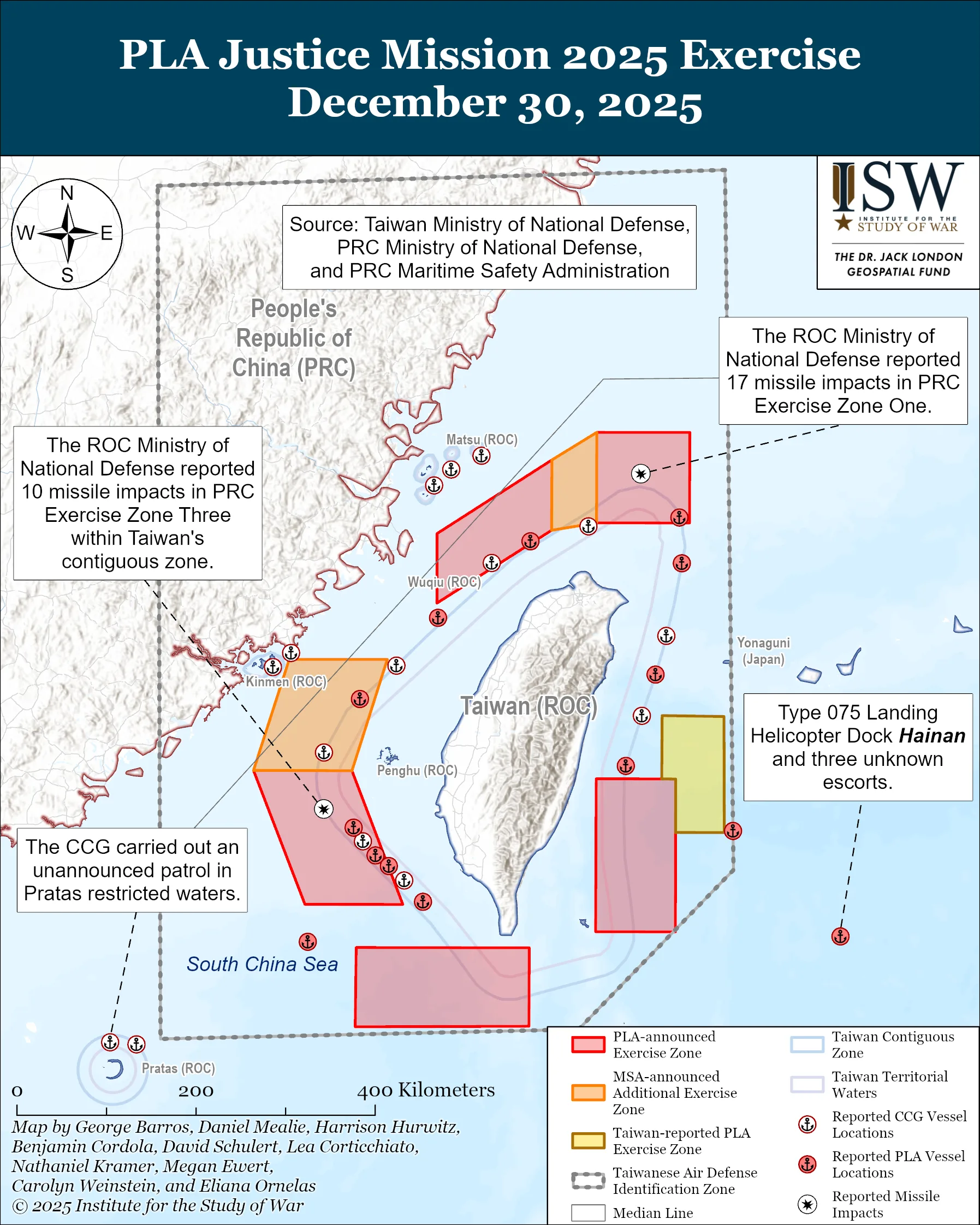
The MND identified 15 CCG ships continuing to operate in the same areas on December 30.[17] These included eight ships in Taiwan’s contiguous zone, two around Wuqiu, three around the Matsu Islands, and two around Pratas. This is the first reported time that CCG ships have patrolled around Pratas Island during a PLA blockade exercise.
CCG involvement in the exercise is consistent with the PLA’s large-scale blockade exercises since May 2024 and reflects efforts to coordinate CCG and PLA assets in a blockade of Taiwan. The PRC will likely use the CCG to intercept Taiwanese commercial and non-military government vessels during a blockade while using the PLAN to enforce an anti-access/area denial strategy against foreign powers coming to Taiwan’s aid. MND officials said on December 29 that CCG ships had conducted operations in shipping lanes off eastern Taiwan in the days prior to Justice Mission 2025, including maritime law enforcement drills, vessel boarding, and vessel seizure exercises.[18] The CCG ships around Taiwan largely operated near PLAN ships, suggesting coordination between the two, similar to the PLAN-CCG coordination around South China Sea disputed features.
The PLAN-CCG model of cooperation in the South China Sea typically involves the CCG taking the lead in direct engagement with foreign vessels for “law enforcement,” while the PLAN maintains an outer perimeter or tails foreign military vessels and aircraft. The PRC has recently worked to increase PLAN involvement in island-control operations in the South China Sea, however, including one incident in August 2025 in which a PLAN destroyer and CCG cutter collided while trying to block a Philippine ship near Scarborough Shoal.[19] The PRC may entrust blockade operations against small, lightly populated Taiwanese islands such as Wuqiu, Matsu, and Pratas solely to the CCG, and pair the CCG with PLAN ships against more populous and well-fortified targets.
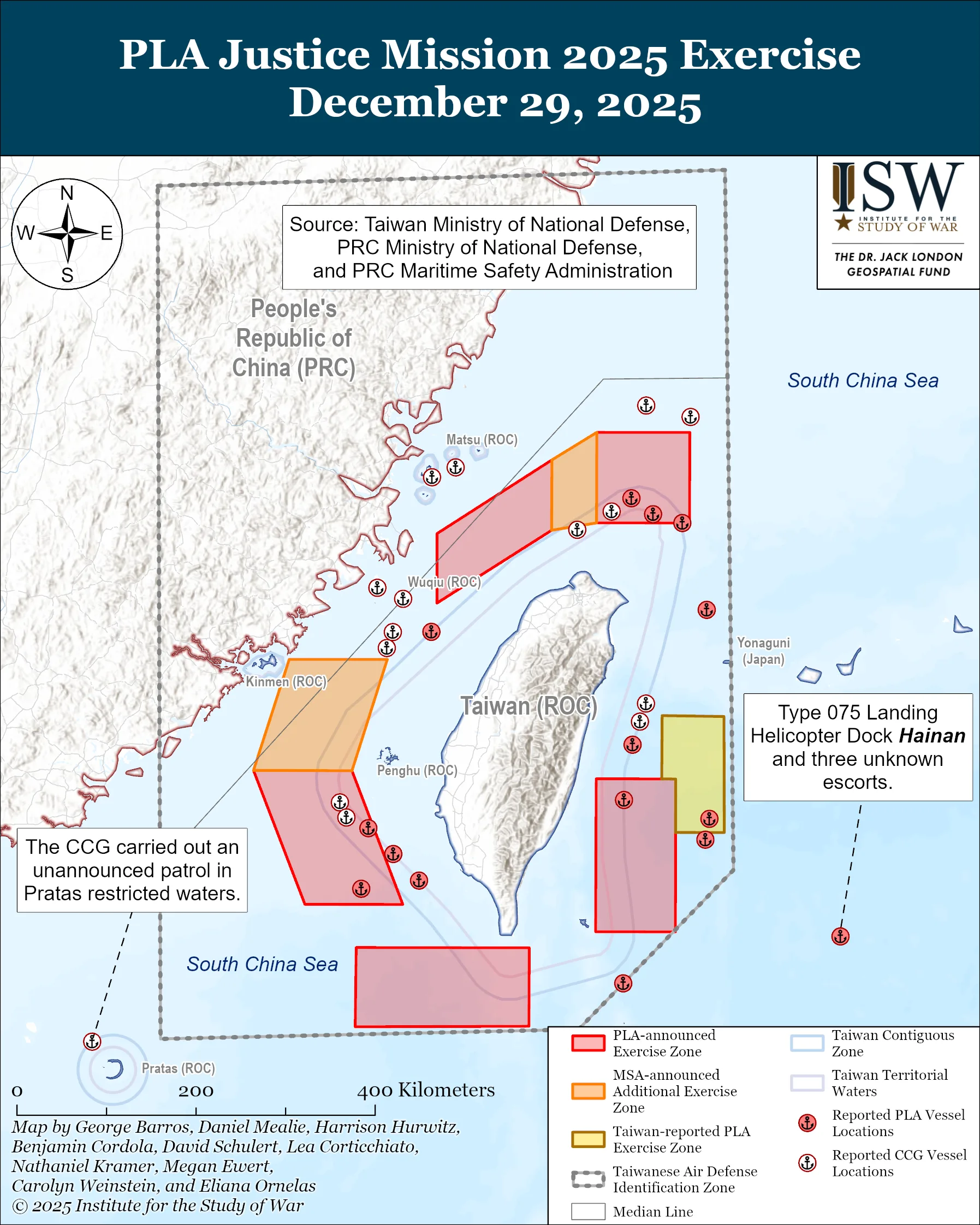
The exercises primarily deployed assets with significant precision strike, anti-submarine, and anti-surface vessel capabilities that simulated counter-intervention operations to support a PLA blockade of Taiwan. Some of these assets could also support an assault of the island should the PLA aim to rapidly transition from an exercise to a military operation or drill the movement of assets needed for an amphibious invasion. The ETC stated that it deployed an unknown number of H-6 bombers that would be used to strike targets east of the first island chain, the closest to the PRC of three Pacific island groupings.[20] Some variants of the H-6 can carry up to six anti-ship cruise missiles that can target enemy surface combatants up to the second island chain, holding at risk US Navy assets that attempt to approach Taiwan from US bases in the Pacific.[21] The PLAN Type 075 landing helicopter dock (LHD), Hainan, with an escort of three PLAN vessels of unknown types, also transited the first island chain via the Bashi Channel between Taiwan and the Philippines to simulate counter-intervention operations east of Taiwan.[22] This is the first exercise around Taiwan to include Type 075 vessels.[23] PLA Daily claimed that Hainan’s task group coordinated with the bomber formation to simulate anti-ship strikes.[24]
The PLAN’s deployment during Justice Mission 2025 suggests an anti-submarine warfare (ASW) configuration due to the presence of at least five Type-054A guided missile frigates with upgraded active sonar systems to detect stealth submarines and Hainan’s deployment of helicopters with ASW capabilities (the PLA Daily‘s explanation of the LHD’s function in the exercise notwithstanding).[25] US supremacy in the undersea domain is a serious obstacle to a potential PLA effort to isolate Taiwan.[26] The PLA may have been practicing preventing US submarines from breaching a PLAN blockade of Taiwan while coordinating air-based standoff strikes against US surface vessels.
Hainan’s task group could also support efforts to insert PLA forces into Taiwan in the event of a contingency. The PLAN additionally deployed the Type 071 Landing Platform Dock (LPD) Longhushan, which can deploy amphibious assault vehicles and landing craft, to an unknown location east of Taiwan during the exercises.[27] PLA Daily claimed that Hainan’s task group also drilled “long-range rapid assaults” during the exercises.[28] A Type 075 LHD could deploy helicopter-borne air assault units or amphibious landing craft to seize key positions on Taiwan.[29] The PLA may have simulated the movement of LHDs and LPDs east of Taiwan to provide an air assault or amphibious assault vector against Taiwan’s east coast during an invasion of the island or simply to exercise air and amphibious assault capabilities in conjunction with a blockade/interdiction effort.
Justice Mission 2025 also drilled live-fire capabilities to support either a blockade or an invasion. PLA documents discuss implementing a firepower-strike complex as part of a blockade to eliminate key military infrastructure.[30] The PLA assumes that a “joint firepower strike campaign” that uses precision missiles to degrade key components of an enemy operational system—such as command and control nodes—would significantly degrade Taiwan’s ability to defend itself ahead of an amphibious invasion.[31] The ETC released footage of several PHL-16 370mm multiple launch rocket systems (MLRS) firing in the waters north and south of Taiwan.[32] The PHL-16 can fire guided rockets up to 280 km and can carry a tactical ballistic missile with a range of 500 km, putting all of Taiwan within its maximum range if deployed on the PRC’s east coast.[33] The live-fire drills likely aimed to simulate precision strikes against Taipei and Kaohsiung by striking the waters adjacent to these cities.[34] Some PRC sources also emphasized decapitation and precision strikes as a major theme of Justice Mission 2025.[35] The PLA may have sought to drill saturating Taiwan’s capital with precision missile strikes in a “decapitation” operation.
The exercises likely simulated only one component of a larger, multi-domain PLA effort to isolate Taiwan and prevent the island’s relief. Justice Mission 2025 notably did not feature any of the PLAN aircraft carriers, which have participated in previous exercises surrounding Taiwan.[36] The PLAN normal carrier escort vessel—the Type 055 destroyer—was also absent from the exercise. The PLAN would likely use these assets in longer-range operations during a Taiwan contingency. PLAN carrier groups could act as the outer layer of a blockade in the Western Pacific, blocking intervention by the United States or other allies and threatening US sea lines of communication (SLOC) in the Pacific. The PLAN drilled this kind of operation in June 2025, deploying carriers Shandong, Liaoning, and their escorts to areas of the west Pacific astride SLOCs between Taiwan, Japan, and the US military base in Guam.[37]
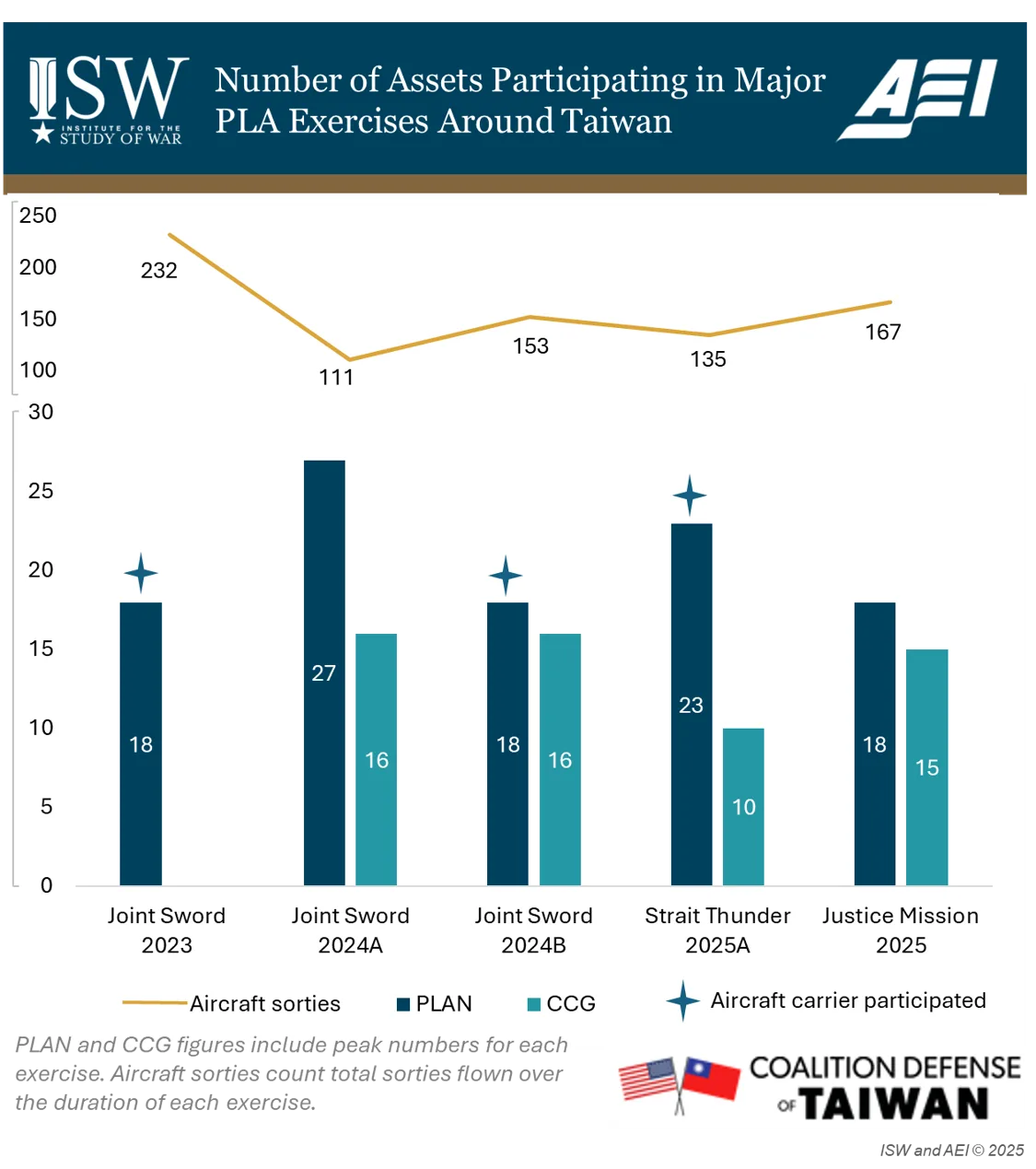
PLA activities during Justice Mission-2025 came closer to Taiwan than they had in previous exercises, creating a tighter blockade and the impression of increased pressure. The exercise had a record seven designated operation zones, not counting the additional zone announced by Taiwan’s MND, which were larger than those in past exercises and overlapped in places with Taiwan’s territorial waters. PLA exercise zones last overlapped with Taiwan’s territorial waters during the August 2022 drills, following then-US House Speaker Nancy Pelosi’s visit to Taiwan. Large restricted zones can enhance a blockade even if there are not enough ships in the area to control access through the zone, because many ships and planes will still comply with PRC navigational warnings. The exercise zones covered nearly the entire length of the Taiwan Strait, cutting off the most direct flight and sailing routes between Taiwan and its outlying Kinmen and Matsu islands.
Most of the PLAN and CCG ships around Taiwan entered Taiwan’s contiguous zone during the exercise. The CCG ships also patrolled less than two nautical miles from the outlying islands Wuqiu and Matsu. The live-fire drills on December 30 fired missiles closer to Taiwan than previously observed, with Taiwan reporting that all 10 missiles fired into the southwestern Zone Three landed in Taiwan’s contiguous waters, between 12 and 24 nautical miles from Taiwan. PRC propaganda messaging about its encirclement exercises since Joint Sword 2024B in October 2024 has stressed that the PRC will continue to escalate with every “provocation” by Taiwanese “separatists.”[38] PLA activities in such exercises have gradually “closed in” around Taiwan since President Lai Ching-te’s inauguration in May 2024. It is unclear how future PLA exercises will escalate now that they have breached Taiwan’s contiguous zone, the last buffer zone surrounding Taiwan’s sovereign territory.
PRC messaging framed the Justice Mission 2025 exercises as a reaction to US and foreign encroachment, a common propaganda narrative used to legitimize PRC claims over Taiwan. PRC propaganda serves the secondary purpose of intimidating “Taiwan independence” advocates and delegitimizing Taiwan’s government. PRC rhetoric framed the exercises as a warning to Taiwan’s governing Democratic Progressive Party (DPP) against cooperation with other countries and enhancing Taiwan’s self-defense.[39] One PRC poster for the exercise depicted arrows striking green worms, an apparent reference to similar illustrations released in April 2025 depicting Taiwanese President William Lai Ching-te as a “parasite.”[40] These depictions align with PRC references to the “Green Terror,” a common propaganda narrative that portrays Lai as a dictator to delegitimize the DPP.[41]
PRC messaging emphasized an intent to isolate Taiwan from foreign partners. PRC Ministry of Defense (MOD) spokesman Zhang Xiaogang warned the DPP on December 29 against relying on foreign countries to achieve independence.[42] The PRC placed explicit blame on the United States, which it accused of escalating tensions with recent arms sales to Taiwan and obstructing cross-strait unification to contain the PRC.[43]
PRC warnings against foreign interference in Taiwan are also likely aimed at Japan. Justice Mission 2025 follows an ongoing diplomatic spat between Japan and the PRC over Taiwan, which began after Japanese Prime Minister Sanae Takaichi suggested on November 7 that a Taiwan contingency could call for the deployment of Japan’s Self Defense Force.[44] The PRC demanded that Takaichi retract the statement and has since exerted pressure on Japan to deter its support for Taiwan. The PRC also objected to Japan’s statement that it would place missiles on its Yonaguni Island near Taiwan and has issued frequent statements against Japan’s militarization.[45] The PRC likely intends Justice Mission 2025 to serve as a deterrent against Japan’s participation in regional security architecture, especially pertaining to Taiwan.
PRC messaging likewise aims to intimidate Taiwan by creating the impression that Taiwanese resistance is futile. The PRC released a slew of propaganda posters showing the PLA’s encirclement of Taiwan—a common psychological warfare tactic coinciding with the PRC’s blockade exercises. One poster depicted a knotted rope resembling a noose and a PLA Daily article similarly described PRC encirclement around Taiwan as “tightening.”[46] China Military Bugle—a PRC military press account—posted a similar poster on X (formerly Twitter) showing an outstretched hand wrapping a chain around Taiwan.[47] This messaging likely aims to demoralize and intimidate Taiwanese leadership and population. PRC messaging also aims to convey the strength of PRC forces by showcasing capabilities related to an amphibious invasion. The PLA ETC released posters depicting PRC missiles, helicopters, battleships, and jets surrounding Taiwan and cutting off its foreign connections. Another poster referenced tactics that the PRC could use to isolate Taiwan, including cutting off internet access and blocking ports.[48]
Justice Mission 2025 may result in the spread of PRC-aligned narratives within Taiwan. Kuomintang (KMT) Chairwoman Cheng Li-wen used the exercises to advance criticisms of Lai, accusing him of escalating cross-strait tensions in a statement echoing common PRC narratives of Lai and the DPP.[49] The PRC benefits from the spread of such messaging, which denigrates the Lai administration.
The PRC has established a precedent of staging drills in response to US-Taiwan cooperation, including Nancy Pelosi’s visit to Taiwan in 2022 and William Lai’s visit to the United States in 2023.[50] The PRC has increasingly sought to emphasize the rapid nature of its military exercises around Taiwan, including the “snap” PRC military drills in March 2025. The PRC used the US State Department’s removal of the phrase “we do not support Taiwan independence” from its website as a pretext to stage “snap” military drills.[51] The PRC times its drills around significant developments in US-Taiwan relations to delegitimize such interactions and frame its aggression toward Taiwan as Taiwan’s own fault.
Conclusion
The PRC announced the successful completion of Justice Mission-2025 on December 31 and framed the exercise as a test of the PLA’s integrated joint operations and combat readiness.[52] Each iteration of blockade exercises around Taiwan improves the PLA’s ability to rapidly execute its plans to bring Taiwan under PRC control. Future exercises may emphasize blockade layers that this event did not foreground. Taiwanese and US military planners should assess PLA activity across the full series of blockade exercises to build a complete picture of what a comprehensive operation to force Taiwan under PRC control would entail. Allowing exercises such as Justice Mission-2025 to deter the United States from militarily and politically supporting Taiwan will only embolden the PRC and encourage further aggression.