
Korean Peninsula Update, January 22, 2026
Toplines
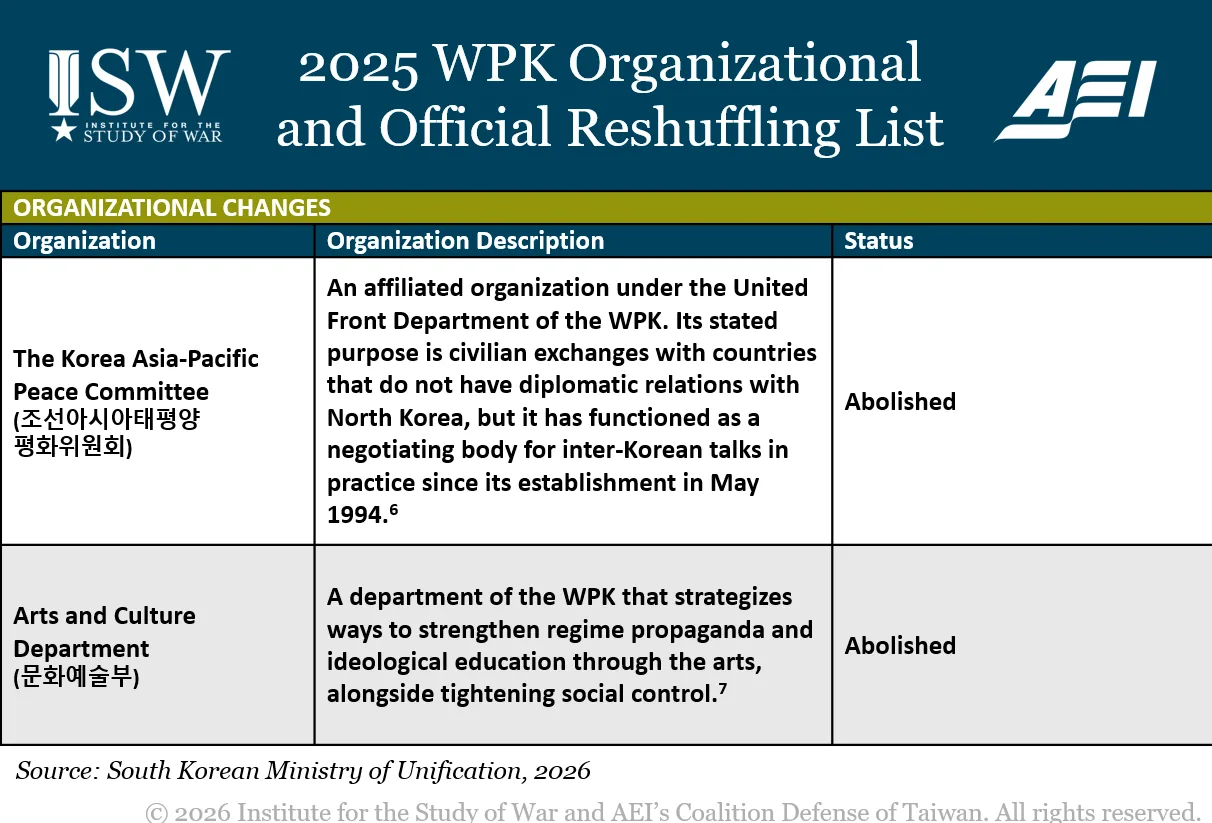
North Korea abolished an organization historically responsible for inter-Korean affairs amid organizational restructuring, according to a South Korean Ministry of Unification (MOU) report. The removal may signal a further downgrade of organizations responsible for inter-Korean diplomacy in line with Kim Jong Un’s continued hostile rhetoric toward South Korea. The MOU report indicated that North Korea dissolved the Korea Asia-Pacific Peace Committee, which was under Bureau 10 of the Workers’ Party of Korea (WPK), formerly known as the United Front Department (UFD).[1] The UFD led North Korean efforts to conduct espionage against South Korea and facilitate inter-Korean exchanges.[2] Former South Korean Minister of Unification Kim Yung-ho claimed in May 2024 that the UFD was downgraded to the bureau level after being reorganized as “Bureau 10,” which is responsible for psychological warfare targeting South Korea. The structural shift followed Kim Jong Un’s declaration in 2023 that North Korea would abandon unification with South Korea. Reports speculated as early as September 2024 about the possibility of North Korea disbanding the Korea Asia-Pacific Peace Committee, and the MOU report confirms the official elimination as of 2025.[3] The committee functioned as an intermediary for inter-Korean talks.[4] The committee’s role in inter-Korean exchanges continued under Kim Jong Un, including organizing the 2019 summit between Kim and former South Korean President Moon Jae-in.[5] The official removal of the committee likely contributes to stalled inter-Korean exchanges and may reinforce Kim Jong Un’s anti-South policy and rejection of inter-Korean dialogue, despite South Korean President Lee Jae Myung’s repeated calls for talks.
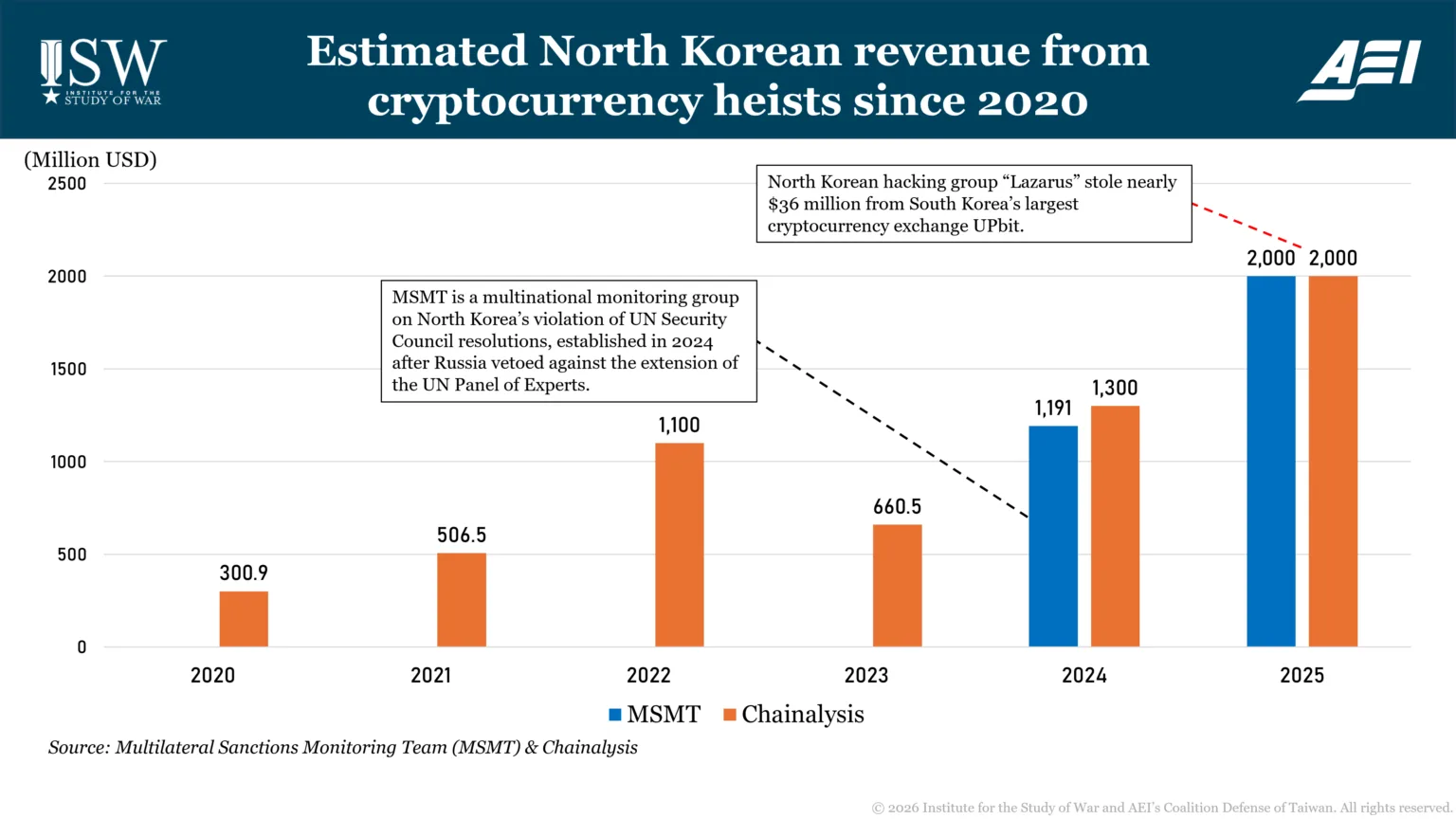
North Korean hackers generated over two billion US dollars in 2025, an increase of nearly one billion US dollars from 2024.[8] North Korea may seek to further develop its hacking capabilities and expand operations against the United States and South Korea to circumvent US and UN sanctions. US State Department Principal Deputy Assistant Secretary Jonathan Fritz announced on January 12 that North Korea stole over two billion US dollars in cryptocurrency in 2025, accounting for approximately 6.7 percent of North Korea’s estimated GDP in 2025 (29.94 billion US dollars).[9] The 2025 figure is nearly double the 2024 figure and nearly triple the 2023 figure, indicating the development of North Korean hacking capabilities.[10] International sanctions monitoring group Multilateral Sanctions Monitoring Team (MSMT) reported in October 2025 that the North seized roughly 2.84 billion US dollars between January 2024 and September 2025.[11] The FBI announced on January 8 that North Korea began employing new tactics to access US institutional and personal data. The FBI stated that North Korean hacking group Kimsuky employed “Quishing,” a method using malicious QR codes to target mobile devices.[12] Kimsuky also created fraudulent websites impersonating major logistics companies in South Korea to trick users into installing malicious applications.[13]
ISW-CDOT previously assessed that cryptocurrency heists have become a critical revenue stream for North Korea.[14] Pyongyang will likely continue to advance and refine its techniques using increasingly sophisticated deception tactics. North Korea would likely use the illicit revenue to further Kim Jong Un‘s policy objectives, including enhancing military capabilities. North Korea can more easily bypass US and UN economic sanctions in cyberspace, providing opportunities for Pyongyang to generate revenue that cannot be easily blocked.
The South Korea-Japan summit on January 13 revealed divergent approaches to North Korean denuclearization.[15] Policy inconsistencies between Seoul, Tokyo, and Washington could lead to misalignment on efforts to counter Pyongyang. South Korean President Lee Jae Myung and Japanese Prime Minister Sanae Takaichi pledged to strengthen bilateral and trilateral security cooperation during their summit on January 13.[16] Their joint statement framed denuclearization goals differently, however. Lee referred to the denuclearization of the “Korean Peninsula,” while Takaichi specified efforts to denuclearize “North Korea.”[17] South Korea omitted direct reference to North Korea, unlike Lee’s previous Tokyo summit in August 2025 when both countries emphasized the need to jointly respond to “North Korea’s nuclear and missile threats.”[18]
This language divergence may reflect different strategic approaches to North Korea by South Korea and Japan. Takaichi emphasized strengthening Japan’s security posture against North Korean missile tests near the Japanese waters in the East Sea (Sea of Japan).[19] Japan also seeks to resolve issues surrounding the abduction of Japanese nationals by North Korea in the 1970s and 1980s.[20] Lee’s stance contradicts Takaichi’s, however. Lee has promoted “de-escalatory” policies conducive to resuming a dialogue with North Korea.[21] Lee’s omission of an explicit reference to North Korean nuclear threats likely reflects his desire to avoid North Korean protests.
Washington’s absence from North Korea policy further complicates trilateral coordination. The US Embassy in Seoul has cycled through three different chargés d’affaires since January 2025.[22] The US National Security Strategy published in December 2025 omitted any mention of North Korea.[23] This contrasts with the United States coordinating the Camp David trilateral declaration in 2023. The United States, South Korea and Japan agreed to strengthen security coordination, including on North Korea’s security threat, through the Camp David trilateral declaration in August 2023.[24]
Key Takeaways
North Korean “Anti-South” Policies: North Korea abolished the Korea Asia-Pacific Peace Committee responsible for inter-Korea affairs, which may signal a further downgrade of organizations responsible for South Korean relations in line with Kim Jong Un’s anti-South policies and rhetoric.
North Korean Illicit Activity: North Korean hacking groups generated over two billion US dollars in 2025. North Korea could use its hacking capabilities to circumvent international sanctions and fund its military expansion.
Trilateral Relations: The South Korea-Japan summit revealed divergent approaches on North Korean denuclearization. Policy misalignment between the United States, Japan, and South Korea could impede trilateral efforts to counter North Korea.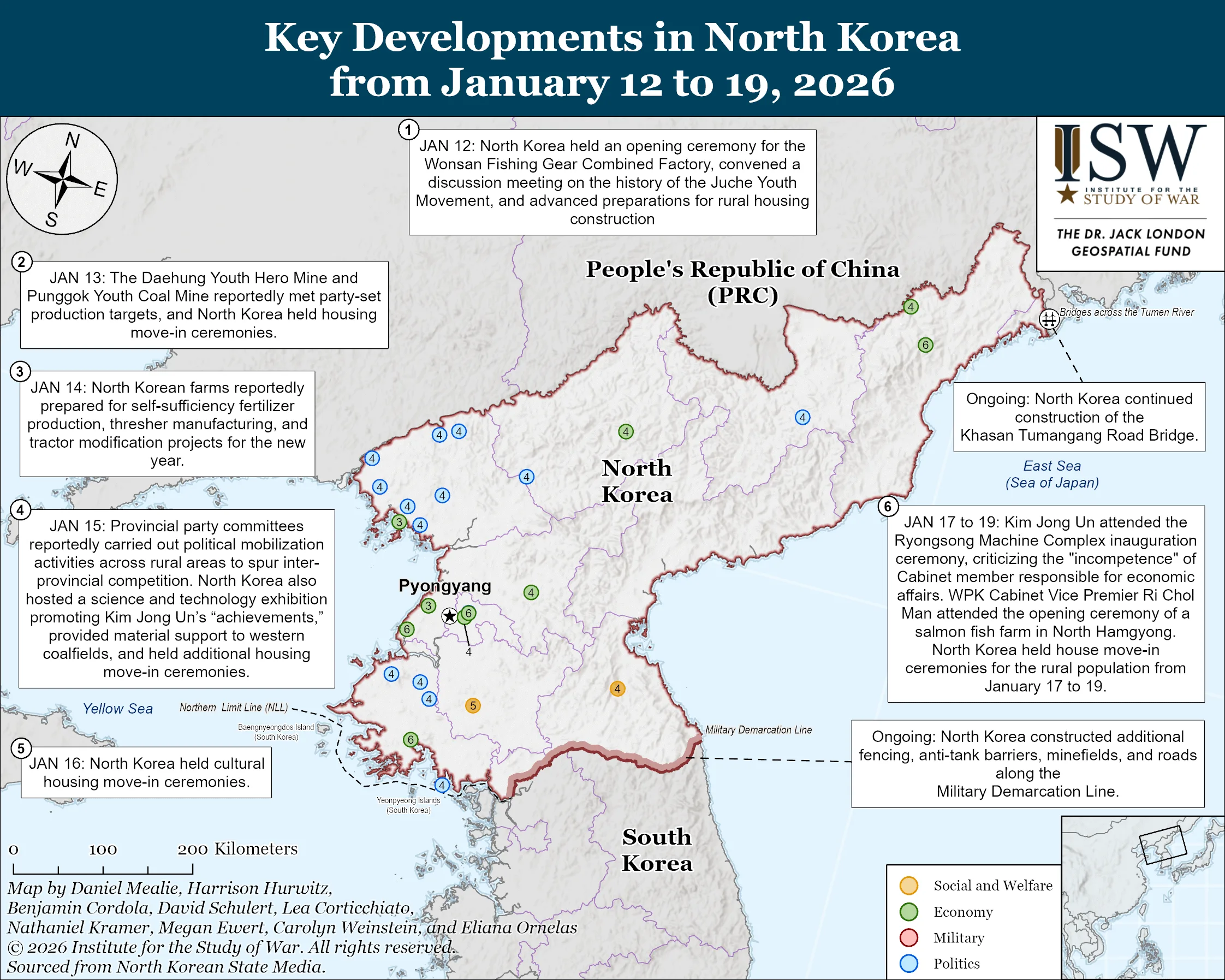
North Korean Domestic Politics
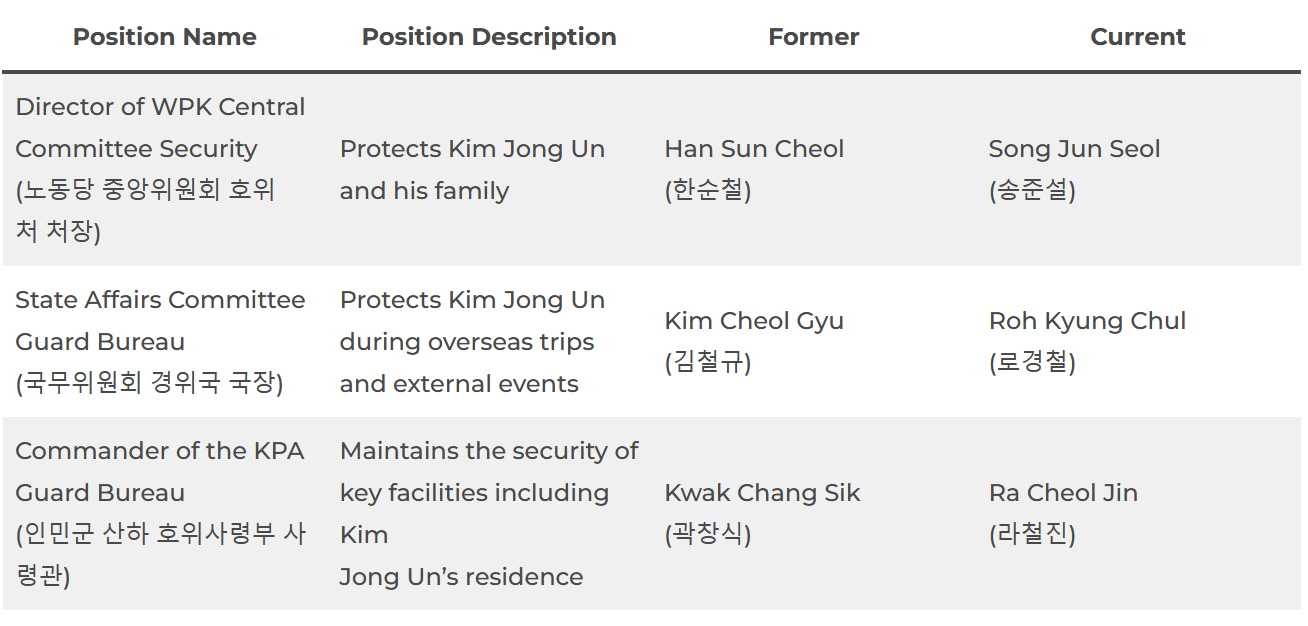
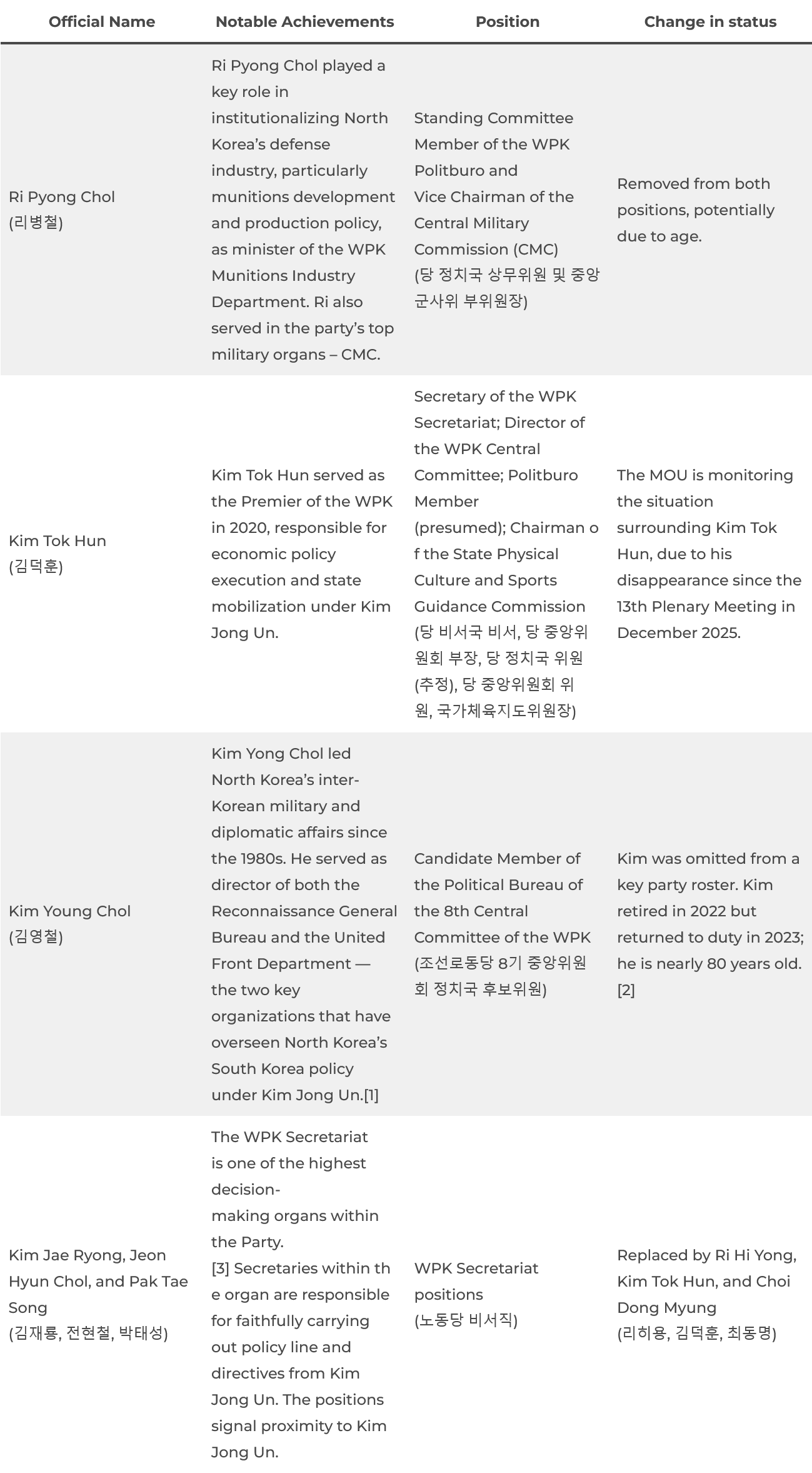
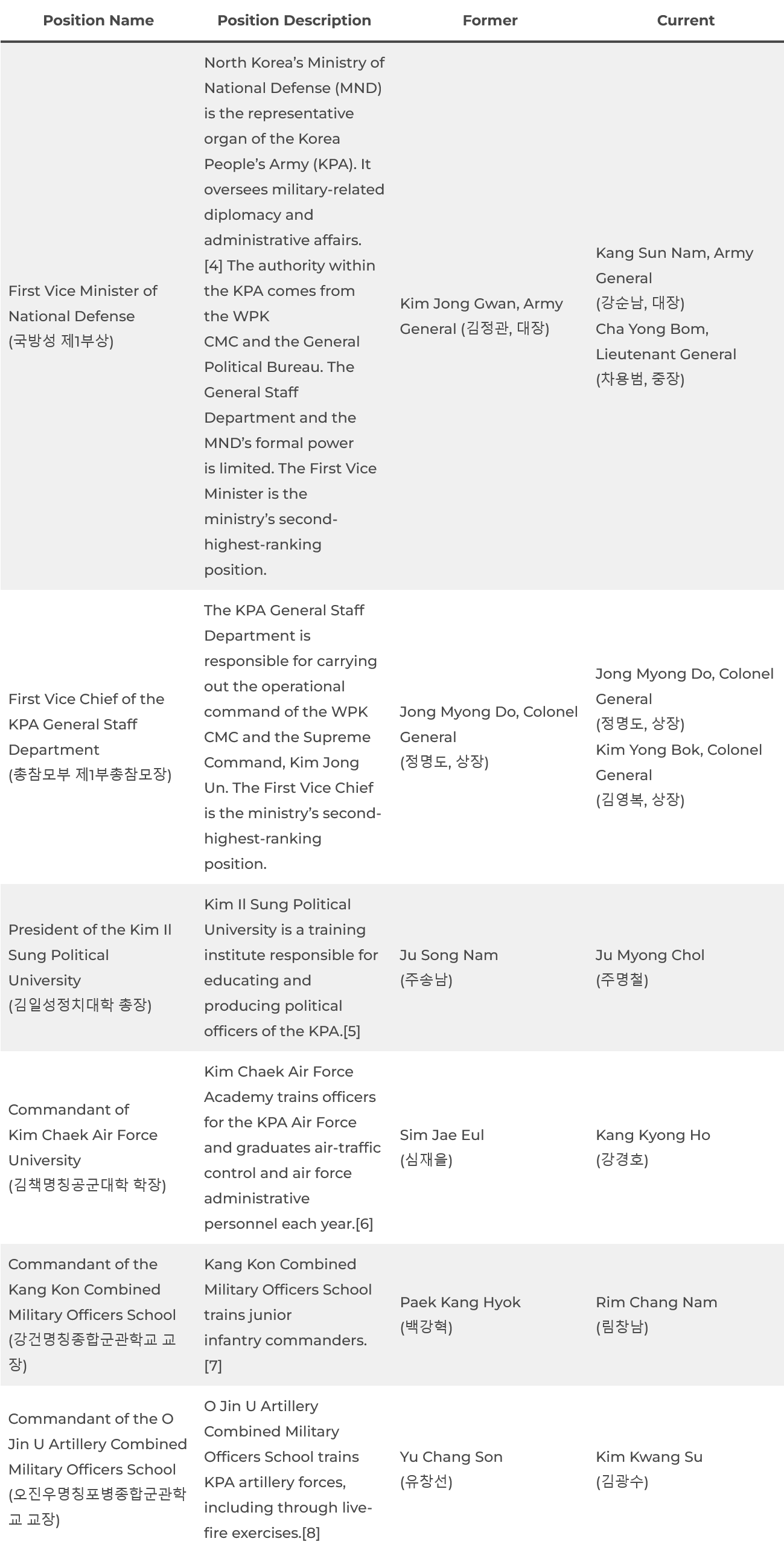
North Korea reshuffled security leadership positions and senior members of the WPK between 2023 and 2025, according to the South Korean MOU.[25] Some of the changes appear to be routine, while others may reflect Kim Jong Un’s concerns about his personal security. The MOU reported on January 13 that WPK General Secretary Kim Jong Un has replaced leaders in three of the four key organizations responsible for his personal security. The change aligns with the South Korean National Intelligence Service’s (NIS) assessment in October 2024 that Pyongyang had tightened Kim’s security protocols, reportedly in response to heightened concerns over assassination threats. An MOU official noted that the rapid turnover in sensitive security posts is especially noteworthy.
The report also indicated potential shifts involving key party figures, including Vice Chairman of the WPK Central Military Commission Ri Pyong Chol and Candidate Member of the Politburo of the WPK 8th Central Committee Kim Yong Chol. Ri oversaw North Korea’s defense-industrial and munitions development portfolio as head of the WPK’s munitions policy from 2019 to 2025.[26] Kim has managed North Korea’s inter-Korean military and diplomatic affairs since the 1980s, serving as director of both the Korea People’s Army (KPA) Reconnaissance General Bureau and the United Front Department–two major spy organizations responsible for North Korea’s South Korea policy. Both officials are now nearly 80.[27]
Security Officials
Party Officials
Military Officials
North Korean Military Developments
See toplines.
North Korean Foreign Relations
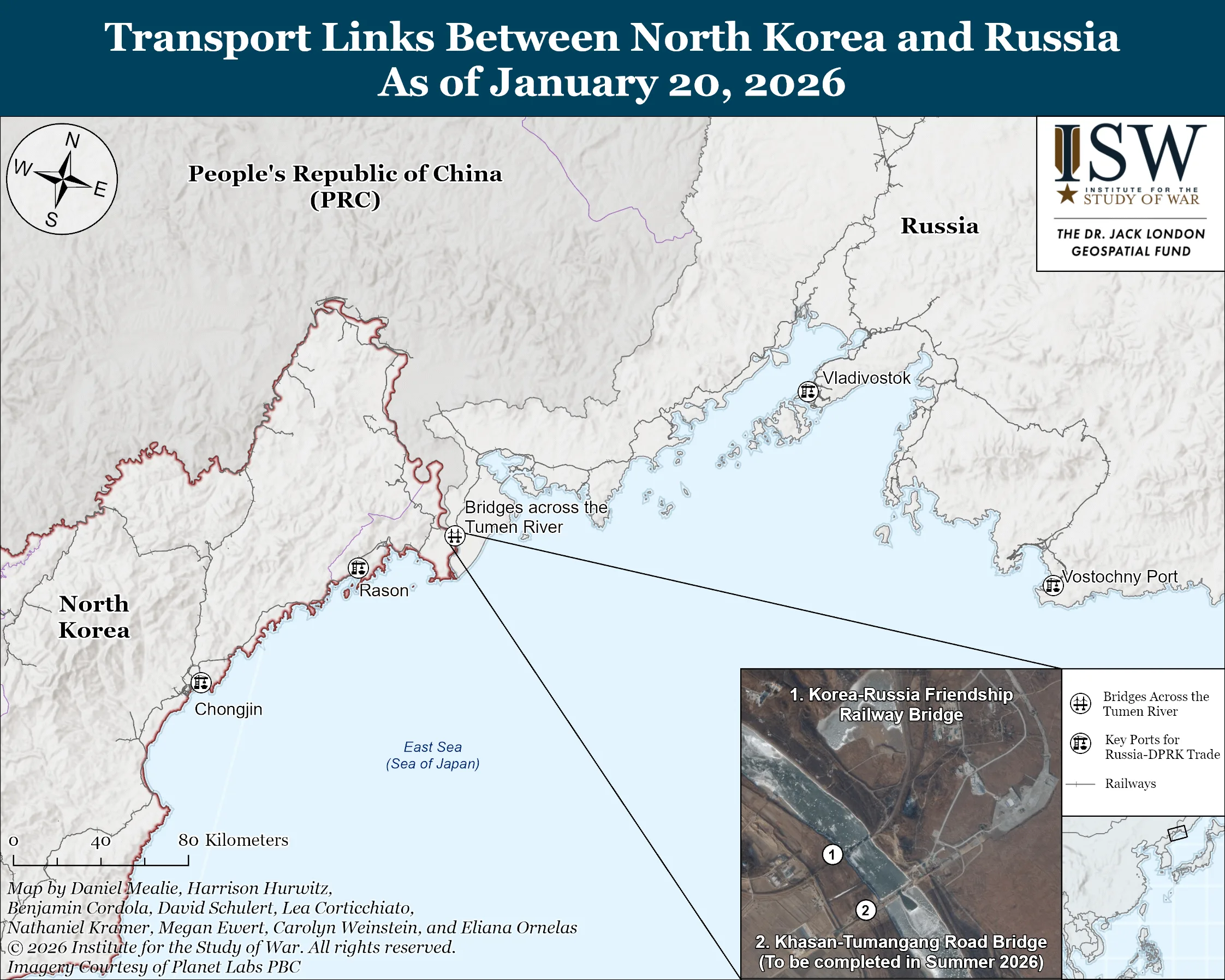
The tourism ministry of Russia’s Primorsky Krai announced that a bridge over the Tumen River to North Korea will be completed by the summer of 2026, bringing an increase in cross-border tourism. North Korea and Russia have significantly expanded economic and military cooperation since Russia’s invasion of Ukraine, giving North Korea an economic lifeline amid strict international sanctions. Primorsky Krai Tourism Minister Natalia Naboychenko said in an interview on December 30 that the planned bridge would increase the flow of trade and tourism between the countries.[28] She said that over 4,000 Russian tourists traveled from Vladivostok, the capital of Primorsky Krai, to North Korea in 2025 and that demand for tourism to North Korea was increasing. She said North Koreans currently travel to Primorsky Krai mainly to participate in business meetings, trade exchanges, and sports and cultural events. Construction of the 850-meter-long bridge began in April 2025. The bridge will cost 111 million US dollars and will be the first road bridge between North Korea and Russia, connecting the border towns of Khasan, Russia, and Tumangang, North Korea, allowing for nonstop travel by car or bus. The only direct land route between Russia and North Korea at present is a railway bridge.[29]
The construction of cross-border transportation infrastructure is part of a dramatic expansion of Russia-North Korea cooperation since the start of Russia’s invasion of Ukraine in 2022. North Korea is one of Russia’s key supporters in the war, becoming the only country to openly deploy troops to Russia in October 2024. North Korea signed a mutual defense agreement with Russia in June 2024, adopted Russian rhetorical justifications for the war, and supplied between 35 and 70 percent of the ammunition that Russia currently uses in the war, according to Ukrainian intelligence in October and November 2025.[30]
The bridge will facilitate increased trade for both civilian and military purposes, including allowing shipments of military equipment in both directions by truck. Civilian economic exchanges, including increased tourism, can benefit North Korea’s military development by raising government revenue. North Korea has already reaped considerable benefits from its support of Russia, including billions of dollars in arms sales, the transfer of Russian technology, lessons learned about military operations and production, and an increase in trade with Russia that mitigates the economic impact of heavy international sanctions.[31] Russia also dropped its opposition to North Korea’s nuclear weapons program in 2024. The North Korea-Russia partnership has additionally helped North Korea reduce its reliance on the People’s Republic of China (PRC), which was previously North Korea’s only military ally and is still its main economic backer.
North Korean Influence Operations
Nothing significant to report.
Inter-Korean Relations
WPK Central Committee Deputy Director Kim Yo Jong on January 13 rejected a proposal by South Korea’s MOU to resume communication following North Korea’s accusation of a South Korean drone infiltrating its airspace on January 11.[32] North Korea will likely use the incident to justify ongoing military modernization. Kim’s statement came after an unnamed MOU official said that “there may be room to ease inter-Korean tensions and resume communication” regarding the alleged drone incursion.[33] The official added that the ministry will continue to push for inter-Korean dialogue “even if there is only one-percent chance” of success.[34] Kim Yo Jong called South Korean hopes to improve inter-Korean relations “unrealizable delusions.”[35] Kim Yo Jong added that the relationship will not change even if “the head of state runs around overseas begging for favors,” likely referring to South Korean President Lee Jae Myung’s summits with Chinese Communist Party (CCP) General Secretary Xi Jinping and Japanese Prime Minister Sanae Takaichi on January 5 and 13, respectively.[36] Lee urged the PRC and Japan to help ease tensions on the Korean Peninsula in his summits with the respective states. Kim Yo Jong further demanded that South Korea “acknowledge” and “apologize” for violating its sovereignty and warned of responses beyond reciprocity.
ISW-CDOT previously assessed that North Korea will likely continue to reject South Korea’s proposal for a joint investigation into the drone incident and instead use the situation to further reinforce its anti-South narrative ahead of the 9th Party Congress in 2026. North Korea has accelerated the modernization of its military capabilities, including long-range missiles capable of reaching the US mainland, since Kim Jong Un labeled South Korea an “enemy state” in 2023.[37]
South Korean Domestic Politics
President Lee’s cabinet members proposed conflicting responses to North Korean accusations regarding South Korea’s alleged drone incursion. Lee appears focused on providing transparency to the South Korean public while refraining from responding directly to North Korea. South Korean Minister of Unification Chung Dong-young said on January 14 the South Korean government could take “corresponding measures” once a joint military-police investigation task force identified the operator of the drone.[38] Chung implied that South Korea could convey regret in a similar manner as Kim Jong Un did following the fatal shooting of a South Korean civil servant by North Korean forces in September 2020.[39] Kim in 2020 said he felt “very sorry” for “disappointing” South Korea in a form of an apology letter sent to the Blue House. North Korea then shared results of its investigation.[40] South Korean National Security Adviser Wi Sung-lac said the MOU was getting “ahead of itself” and expressed doubt that the situation would improve inter-Korean relations.[41] Wi stated the government must consider past incidents of North Korea’s drone infiltration into the South before developing a response.[42]
Chung and Wi have adopted conflicting viewpoints on Seoul’s ideal North Korea policy. The split is largely centered on responding to Pyongyang’s “hostile two-state” rhetoric.[43] Chung has proposed accepting the reality of two separate Korean states, while Wi has rejected the framing as incompatible with the government’s official position.[44] Chung likely attributes current hostility to the previous administration’s policies and appears to believe that reversing those policies will bring Pyongyang to the negotiating table.[45] His statements emphasizing Seoul’s rejection of unification through absorption or regime change likely aim to counter North Korea’s characterization of South Korea as an existential threat. Wi, however, likely views Chung’s preemptive, conciliatory approach as undermining South Korea’s defense posture, particularly given the low probability of North Korean reciprocity or meaningful dialogue.
President Lee has likely avoided publicly endorsing either Chung’s or Wi’s approach to prevent the internal disagreement from appearing as a policy split. Lee previously expressed willingness to apologize for a South Korean military drone reportedly entering Pyongyang’s airspace in 2024 under the Yoon administration, while acknowledging fears of public backlash labeling him a “North Korean sympathizer.”[46] The current government’s immediate response and the establishment of an investigative task force mark a shift from Yoon’s approach in 2024. Lee also criticized the South Korean military for failing to detect the drone moving northward and criticized the act, stating “this is basically the same as starting a war. It’s no different from firing shots into North Korean territory.”[47] Lee has yet signaled whether or not he would issue an apology as North Korea demanded.
The Lee Jae Myung Administration is discussing restoring the military agreement between South and North Korea.[48] North Korea is unlikely to respond to South Korea’s unilateral push for the agreement’s restoration. South Korean National Security Advisor Wi Sung-lac announced on January 14 that the administration is reviewing the restoration of the 9.19 military agreement.[49] The Moon Jae-in administration signed the military agreement with WPK General Secretary Kim Jong Un in 2018.[50] It aimed to halt hostile military acts between North and South Korea, increase trust, and demolish military facilities within the Demilitarized Zone.[51] Pyongyang terminated the agreement in 2023 after Seoul nullified a section of it following North Korea’s launch of a military surveillance satellite. Yoon Suk-yeol completely suspended the agreement in 2024.[52] Wi stated that this review is a direct order from President Lee.[53] Lee pledged for the restoration of the agreement during his campaign and has consistently expressed his intention to do so since his election.[54] Unification Minister Chung Dong-young also remarked that the restoration of the agreement would signify Seoul’s lack of hostile intent toward Pyongyang and signal the administration’s willingness to create an environment for dialogue through preemptive measures.[55] North Korea, however, is unlikely to respond to South Korea’s unilateral restoration of the 9.19 military agreement.[56]
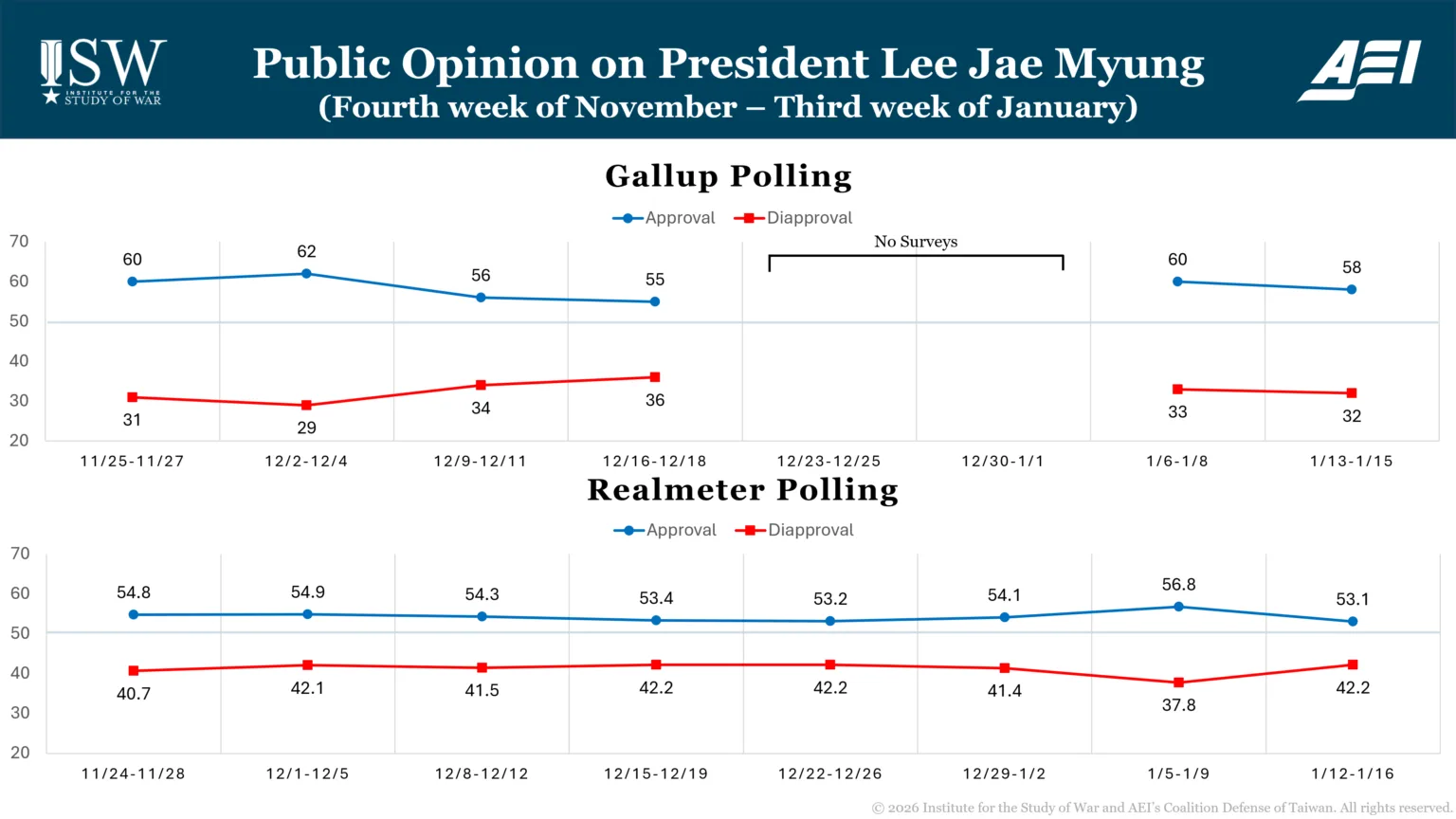
President Lee saw a slight drop in his approval rating for the third week of January. Political controversies and poor economic performance likely played a role in Lee’s approval rating, despite positive public assessments of recent summits with foreign leaders. Gallup reported that Lee received a 58-percent approval rating, a 2-percent drop from the previous week.[57] Gallup stated that respondents who disapproved of Lee cited “poor economic policies.”[58] South Korea has faced a sharp rise in import prices following the undervaluation of the Korean won against the US dollar since Lee’s inauguration in June 2025.[59] Polling agency Realmeter also reported a drop in Lee’s approval rating to 53.1 percent.[60] Realmeter stated that the January 5 summit with the PRC and the January 13 summit with Japan resulted in positive evaluations, but partisan issues on reforming or abolishing the prosecutors’ office and corruption scandals involving ruling Democratic Party members had a greater negative impact.[61]
Counter-North Korean Coalition Building Efforts
See toplines.