
South Asia Intelligence Review
Turning points
After the elected Prime Minister Sheikh Hasina was ousted from Bangladesh in August, 2024, the country sunk into chaos and turmoil for 18 months. Amidst rising disorders, the results of the 13th National Election, declared on February 13, 2026, by the Bangladesh Election Commission (EC), gave a clear victory to the Bangladesh Nationalist Party (BNP) and its allies. Out of 297 results declared, the BNP-led alliance won 212, with BNP alone winning 209 seats, and the Gano Odhikar Parishad, the Bangladesh Jatiya Party (BJP) and the Ganosamhati Andolan securing one each.
The Islamist radical Jamaat-e-Islami (JeI)-led alliance secured 77 seats, with JeI winning 68, the National Citizen Party (NCP) securing six, Bangladesh Khelafat Majlis two, and Khelafat Majlis one. JeI, with its best electoral result in history, emerged as the principal opposition party. Another Islamist party, Islami Andolan Bangladesh secured one seat, while seven candidates were elected as independents. It is significant that, despite the fact that the Awami League was banned and disallowed participation in the elections, the NCP- which sparked the agitation that toppled the Sheikh Hasina Government – has been reduced, at best, to a marginal force by the elections, and the JeI has also performed well below the expectations of its own leaderships.
The status of three seats in the-300 strong Jatiya Sangsad has been withheld, as polling in Sherpur-3 was postponed following the death of a candidate, and the results of Chittagong-2 and Chittagong-4 were kept pending under a High Court directive.
The results, seemingly show a clear mandate given to BNP, under the leadership of Tarique Rahman, the eldest son of the former (now deceased) Prime Minister Khaleda Zia and former late President General Ziaur Rahman. Rahman returned to Dhaka after a 17-year exile, on December 25, 2025. The death of Khaleda on December 30, 2025, followed by Tarique Rahman’s take-over of the party as Chairman on January 9, 2026 (he had been the acting Chairman since February 2018), was a strong indicator of BNP’s internal political cohesion. Khaleda’s death acted as a catalyst, re-igniting popular sentiment towards BNP and its allies.
The vandalism that followed the students’ unrest and the frequent attacks on the symbols of the Liberation War by the protestors [for instance in Meherpur District alone, 300 sculptures commemorating Liberation and its heroes were damaged], have had a deep impact on BNP supporters, who have always lauded Ziaur Rahman, the BNP founder as one among Bangladesh’s leading freedom fighters.
In a clear message that the anarchy under Mohammad Yunus’ Interim Government would have no place under the new regime, in his first statement after the declaration of results, Tarique observed, on February 14,
Our position is clear. Peace and order must be maintained at any cost. No wrongdoing or unlawful activity will be tolerated. Regardless of party, religion, race, or differing opinions, under no circumstances will attacks by the strong against the weak be accepted. Justice will be our guiding principle. If the rule of law is not established, all our efforts will be in vain. In upholding the rule of law, whether in government or opposition, regardless of differing views, the law must be equal for every citizen of Bangladesh.
Interestingly, JeI is an old ally of BNP, and had earlier backed BNP-led coalitions in 1991 and 2001. JeI, however, formed its own non-BNP alliance in the run-up to the present elections, confident that it had transformed itself into a significant political force over the past decade and a half, from the anti-Liberation pariah that it had become because of its collaboration with the Pakistani forces in the war crimes of 1971. As reported in June, 2023, in the preceding 15 years the number of the party’s permanent members increased from 23,863 to 73,046, a threefold rise. JeI also recorded a threefold rise in the number of its activists, which leapt to 639,000 from 221,000 over the same period. Significantly, with the ouster of Sheikh Hasina and banning of Awami League on May 10, 2025, BNP emerged as the ‘new target’ for Jamaat and its cohorts, with strident accusations of corruption against the BNP. On January 29, 2026, Jamaat Chief, Shafiqur Rahman accused BNP of corruption and extortion during its last term, asserting,
If I am a politician and take money from people, yet insist I should not be called an extortionist, that’s unfair. Stop extortion, and no one will call you an extortionist. But if you continue, you must face the consequences of that label.
BNP, on the other hand, has been attacking JeI for ‘distorting history’. On February 3, 2026, BNP Joint Secretary General Ruhul Kabir Rizvi stated, “When the Pakistani forces carried out atrocities against our mothers and sisters, you (Jamaat) did not call those acts oppression. You did not even acknowledge those brutalities as crimes. Instead, you supported them and provided patronage… In a few days, you may even say that Ghulam Azam (founder of the anti-Liberation collaborationist Razakar Bahini and Al Badar) himself was the proclaimer of independence. You can say that too, because you never step back from telling lies.” Earlier, on January 28, 2026, Mahdi Amin, senior BNP member accused Jamaat of exploiting religious sentiments to win votes, citing promises of heaven, oaths on the Holy Quran, and financial inducements.
JeI and BNP cadres fought violent street battles over the months preceding the elections. A total of 276 activists were injured in clashes between JeI and BNP in 2025, and another 40 were injured in clashes between the student organisation affiliated with JeI, the Islami Chhatra Shibir (ICS) and the student organisation affiliated with BNP, Jatiotabadi Chatra Dal (JCD) in 2025. A further 128 leaders and activists have been injured in clashes between the BNP and JeI in 2026 (data till February 12, 2026).
Bangladesh experienced rampant lawlessness under the Interim Government of Mohammad Yunus. According to the Ain o Salish Kendra (ASK), 102 people were killed in political violence in 2025, adding to 100 in 2024. ASK noted, further, that 165 people were killed in mob lynchings between January and October in 2025, adding to 128 in 2024. Such lynchings were not new, but escalated dramatically after the fall of the Sheikh Hasina Government. There were 51 lynching fatalities in 2023, 36 in 2022, and 28 in 2021, indicating a nearly five-fold increase in four years.
Islamist radicals were also given a free hand by the Yunus government after August 2024, giving a measure of impunity to JeI and its allies. Significantly, least 700 inmates, including convicted Islamist militants fled from jail, including 70 Islamist extremists and death row convicts. Crucially, as reported on December 4, 2024, Inspector General of Prisons Brigadier General, Syed Mohammad Motaher Hossain disclosed that 174 known figures, including 11 top listed criminals, gangsters and extremist group leaders, obtained bail from courts after August 5. Prominent among them was Ansarullah Bangla Team (ABT) ‘chief’ Jashimuddin Rahmani; Abdus Salam Pintu [BNP member and Harkat-ul-Jihad Islami Bangladesh (HuJI-B) aide]; Abdullahil Aman Azmi and Ahmad Bin Quasem (both JeI, with ISI linkages).
Nevertheless, even after getting complete state support, re-inventing the Razakar narrative, playing a major role in ouster of Sheikh Hasina, banning Awami League, tying up with the so-called “students’ face”, NCP, and mudslinging against BNP, the Jamaat could only scrape together 77 seats in the National Election.
In its first reaction to the election results, on its verified Facebook page, on February 13, Jamaat expressed dissatisfaction over the electoral process, criticising the Election Commission for not publishing voter turnout figures and alleging that a section of the administration displayed bias in favour of a ‘major political party’. JeI’s ally, the Bangladesh Khelafat Majlis ‘Chief’, Mamunul Haque went to the Election Commission building on February 13, to file a complaint alleging irregularities in vote counting in the Dhaka-13 constituency and alleged that ballot design flaws led to a significant number of his votes being declared invalid.
Eventually, however, the electoral logic prevailed, and JeI accepted the people’s mandate, with its leader stating that respecting the popular verdict was essential in a “genuine democratic journey.” Some of the other Islamists parties also gave somewhat cordial statements. Hefazat-e-Islam expressed the hope that, under Tarique Rahman’s leadership, the new government would move forward in running the country with honesty, competence and responsibility, and play an effective role in ensuring overall development, justice and good governance in the country. However, Islami Andolan Bangladesh’s Nayeb-e-Ameer, Syed Faizul Karim, was defeated in the Barishal-6 constituency by BNP candidate Abul Hossain Khan, and IAB’s Chief Sayed Mihammad Rezaul Karim alleged there had been “irregularities and some disorder”.
The outcome for JeI, albeit under conditions of the artificial exclusion of the Awami League, cannot be entirely unsatisfactory. The last election Jamaat participated in was 2008, where it won just two seats. 77 seats in the present Jatiya Sangsad can only be cause for some alarm among the democratic constituency, as JeI advocates violent jihad, the overthrow of democratic government and its replacement with Sharia law, and a visceral hatred for India. The election outcome transforms this radical Islamist force from a marginal player into a normalised political stakeholder.
Tarique Rahman, on the other hand, has sought to articulate a relatively balanced position, as a leader of his country and also towards India and other countries of importance. On February 12, he conceded that “mistakes” had been made by his party in the past, but promised a new era of clean politics, including a “top down, no tolerance.” In foreign relations, he articulated a “Bangladesh First” posture, declaring that “the interests of our people come first,” and that his government would pursue an “independent and self-respecting foreign policy.” He added, further, that India was “indispensable due to its geography” and that his government would “respect India’s interests,” positions that diverged dramatically from the rigid posture of confrontation Yunus’ Interim Government had adopted.
The electoral outcome in Bangladesh promises a relative measure of stabilisation, after more than 18 months of spiralling disorder, progressive radicalization and the spectre of the increasing restoration of a noxious military and intelligence collaboration with Pakistan. In the absence of the Awami League, the people of Bangladesh have cast an overwhelming vote in the next party associated with a broadly liberal-democratic nationalist ideology. It remains to be seen whether good governance, economic management and political stability help consolidate democratic legitimacy, or whether Bangladesh will yield again to deepening structural polarization.
Odisha: Impending Collapse
On February 6, 2026, at least 15 Communist Party of India-Maoist (CPI-Maoist) cadres, including a most-wanted Maoist couple, Niranjan Rout aka Nikhil, and his wife Ankita aka Rashmita Lenka aka Indu, both ‘State Committee Members (SCMs)’, the second-highest tier in the hierarchy after the Central Committee (CC) of the CPI-Maoist, carrying a cumulative reward of INR 11 million on their heads, surrendered along with 13 other cadres in Rayagada District of Odisha. The group belonged to the ‘Bansadhara-Ghumusar-Nagabali (BGN) division’ of the banned outfit. The Maoist cadres also laid down 14 weapons including two AK-47, five Self-Loading Rifles (SLRs), one Sten gun, INSAS (Indian Small Arms System) assault rifle and .303 rifle each, along with four single shot guns. The Maoist couple had a cash reward of INR 5.5 million each. Nikhil, active in the bordering areas of Rayagada, Gajapati and Kandhamal Districts for the last two decades, had reportedly come in contact with some Naxalite sympathisers after the 1999 Super Cyclone and joined the banned outfit then. After the top three in Odisha’s CPI-Maoist ranks – Ramachandra Reddy aka Chalapathi, Modem Balakrishna and Ganesh Uikey – were killed by the Security Forces (SFs) in 2025, Nikhil had taken over command but was compelled to surrender as the Naxalite outfit had become rudderless in recent months.
Over just the past year, at least 15 Central Committee Members (CCMs) have been killed and another six have surrendered across different states. The Naxalites (Left Wing Extremists, LWEs) are now facing a leadership vacuum, with only four CCMs reportedly operating in Chhattisgarh and Jharkhand.
On the same day, February 6, four CPI-Maoist cadres surrendered and laid down one SLR, two .303 rifles and a gun before Police in Odisha’s Kandhamal District. The four cadres were all party members, active in Kandhamal and Boudh Districts and carried a total cash reward of INR 1.06 million.
On February 5, 2026, a senior female CPI-Maoist cadre, Mamata Podiami aka Mamita aka Soni (26), surrendered to the Police at Jeypore in Koraput District. Mamata, an ‘Area Committee Member (ACM)’ from Bijapur, Chhattisgarh, was involved in several violent activities along the Odisha-Chhattisgarh border. She handed over one 7.62 mm SLR with 10 live rounds and was carrying a bounty of INR 550,000 on her head at the time of her surrender.
On February 4, 2026, a CPI-Maoist ‘ACM’ surrendered before the Police in Malkangiri District. The surrendered cadre was identified as Sukhram Markam aka Suresh aka Yogesh (32), a ‘commander’ of the Kangerghati Area Committee, with a bounty of INR 2.1 million on his head. He also surrendered one SLR rifle, ammunition, Improvised Explosive Devices (IEDs) and other Maoist materials. A native of Sukma District in Chhattisgarh, Sukhram joined the CPI-Maoist in 2010 and rose through the hierarchy after training in ideology, weapons handling and guerrilla tactics. He was allegedly involved in several violent incidents across Odisha and Chhattisgarh.
On February 3, 2026, a Local Guerrilla Squad (LGS) member of the CPI-Maoist surrendered before the Rourkela Police in Sundargarh District. The surrendered Maoist was identified as Umblen Honhaga aka Prabhu (18), a native of Halamuli village under Chhotanagra Police limits in the West Singhbhum District of Jharkhand. He was active in Saranda Forest, a Maoist-hub, and was associated with the CPI-Maoist’s South Chhotanagra division, an LGS member.
The surrenders in the opening weeks of 2026 reflect the success of sustained counter-insurgency pressure, targeted rehabilitation incentives, and strengthened security governance, along with the psychological impact on cadres, who are now increasingly weighing the costs of continued insurgency against viable alternatives in mainstream society.
At least 22 Naxalites have surrendered in the State since the beginning of the current year, thus far (data till February 15, 2026). According to partial data compiled by the South Asia Terrorism Portal (SATP), 29 Naxalites had surrendered in Odisha in 2025, in addition to 21 in 2024 and five in 2023. The total number of surrendered Naxalites in the state since March 6, 2000, when SATP began documenting LWE-related violence, stands at 7,365.
Meanwhile, SFs in the state arrested 13 Naxalites in 2025, in addition to the seven in 2024 and five in 2023. The total number of arrested Naxalites in the state since March 6, 2000, is 1,608.
One security trooper was killed in 2025, while SFs eliminated eight Maoists in the state. No fatality was recorded in 2024 in the SF category, as well as in 2023; however, SFs eliminated seven Maoists in 2024 and six in 2023. A low of one SF fatality was recorded in 2005, 2014, 2018, 2019 and 2025; on the other hand, a low of one Maoist fatality was recorded in 2002. At peak, 77 fatalities were recorded in the SF category in 2008, while 42 Maoist fatalities were recorded in 2016. 228 SF fatalities and 334 Maoist fatalities have been recorded in Odisha since March 6, 2000.
The SF:Maoist kill ratio remained in favour of the SFs, at 1:8 in 2025. Without losing any of their troopers, the SFs eliminated seven Maoists in 2024 and six in 2023. The kill ratio was 1:2.33 in 2022. The overall kill ratio since March 6, 2000, favoured the SFs at 1:1.50. The most favourable ratio was recorded in 2018, at 1:18.
One civilian was killed through 2025 in Odisha, as compared to three such killings each in 2024 and 2023. The 2025 fatality was the lowest in this category since March 6, 2000. A high of 62 civilian fatalities was recorded in 2010. A total of 379 such killings have been recorded since March 6, 2000.
Odisha witnessed a marked reduction in insurgent sabotage and disruptive activities such as arson, large-scale explosions and bandhs (shut down strikes). No major incidents involving three or more fatalities have been reported in the last two years, and incidents of grenade or IED usage have become less frequent and more isolated – often pre-empted by security interception.
SFs recovered arms and ammunition on 27 occasions in 2025, in addition to 29 such recoveries in 2024 and 31 in 2023. The total number of recoveries since June 2, 2014, stands at 679. In the current year, five incidents of arms recovery have already been recorded (data till February 15, 2026).
Significantly, overall Maoist-linked incidents decreased to 39 in 2025, from 50 in 2024. 48 such incidents were recorded in 2023.
Fatalities in 2025 were recorded in two Districts – Kandhamal (eight) and Sundargarh (two). In 2024, four Districts registered fatalities – Kandhamal (six), Boudh (two), and Malkangiri and Nabarangpur (one each).
According to SATP data for 2025, based on assessments of underground and over-ground activities of the Maoists, of Odisha’s 30 districts, one district – Kandhamal – remained in the moderately affected category; and Sundargarh in the marginally affected. By comparison, in 2024, one district, Kandhamal, fell in the ‘moderately affected’ category, while four districts, Bargarh, Boudh, Malkangiri and Nabarangpur, were ‘marginally affected’.
In 2026, the waning influence of the CPI-Maoist in Odisha was dealt a serious operational and symbolic blow due to the intensification of the surrender and rehabilitation momentum that had been building since late 2025.
On February 6, 2026, during a press conference held in Kandhamal, Southern Range Inspector General of Police (IGP) Niti Shekhar announced that Boudh District had been officially declared 100 per cent CPI-Maoist-free. Boudh had remained a Maoist-affected district for over 15 years. Although it was earlier declared Maoist-free in 2015-16, renewed Maoist activities led to the district once again being categorized as Maoist-prone. IGP Shekhar further asserted that sustained security operations and coordinated efforts had succeeded in breaking the backbone of Maoist groups in Odisha, leading to the complete elimination of Maoist influence in Boudh district.
On February 5, 2026, Deputy Inspector General (DIG) of Police Kanwar Vishal Singh confirmed that Koraput had followed Malkangiri District, which was declared Naxalite-free a day earlier. In a significant development, Mamata Podiami’s surrender marked Koraput District, once a major hotbed of LWE, as officially Naxal-free.
Following the surrender of Sukhram Markam in Malkangiri, Additional Director General (ADG) of Police, anti-Naxal operations, Sanjeeb Panda claimed, on February 4, 2026,
With sustained security operations and development activities reaching deep into remote areas, Maoist activities have now been contained and we declare the district free from Maoist influence. However, there is no room for complacency. Forces will remain on high alert and intelligence-based area dominance exercises will continue.
Malkangiri became the third district under the south-western range, after Nuapada and Nabarangpur, to be declared ‘Maoist-free’. It is useful to note that, on January 20, 2026, the Odisha Police claimed Nuapada had become a Naxal-free district, following the surrender of nine CPI-Maoist cadres, including two ‘Divisional Committee Members (DVCMs)’, who carried a combined bounty of INR 4.7 million, in the Gariabandh District of Chhattisgarh on January 19, 2026. Their surrender assumed particular significance as all of them were operating in the Nuapada District of Odisha, which shares a border with Chhattisgarh.
Further, days after declaring Nuapada District free from Maoist influence, Odisha Police extended the same status to Nabarangpur on January 23, 2026, following the surrender of the last nine active Maoist cadres of the region in neighbouring Chhattisgarh. For decades, Nabarangpur had been plagued by LWE activities, recording several violent incidents. These included the assassination of former Biju Janata Dal (BJD) Member of Legislative Assembly (MLA) Jagabandhu Majhi and his Personal Security Officer (PSO) P.K. Patro, on September 24, 2011, and the attack on the Kundei Police Station in Raigarh Block, on July 16, 2010. On January 23, 2026, ADG Sanjeeb Panda thus declared,
They had been active in Nabarangpur district of Odisha and Dhamtari in Chhattisgarh under the Odisha state committee of CPI (Maoist). With their surrender, we believe Nabarangpur is now free of Maoist presence. However, we will continue to remain vigilant.
These developments marks a significant achievement for Odisha Police, aligning with the Centre’s target of eliminating LWE nationwide by March 31, 2026. According to official and media reports in early 2026, of Odisha’s 30 districts, Kandhamal remained the alone among the recently classified as Maoist-affected under the Centre’s Security Related Expenditure scheme. This compares with a peak, when around 23 districts reported Maoist influence in 2010. Even as recently as 2025, two districts still had some degree of activity. By early 2026, this geographical reach contracted sharply, marking a substantial strategic shift.
The National Investigation Agency (NIA) took action against the Maoists in the State on two occasions. In the most recent development, on December 11, 2025, NIA submitted a chargesheet naming 11-armed CPI-Maoist cadres who were involved in looting around 4,000 kilograms of explosives during its transportation to a stone quarry in a forested area under K. Balang Police Station limits in Sundargarh District on May 27, 2025. According to a statement issued by NIA, all 11 cadres of the banned organisation were charged under various sections of Unlawful Activities Prevention Act (UAPA), the Arms Act and the Explosive Substances Act. During investigations, NIA had found the accused to have been actively involved in a criminal conspiracy, planning and execution of the loot of around 200 explosive packets, each containing 20 kilograms of explosives. The agency, which took over the case from the local Police in June, found that the looting was part of a CPI-Maoist conspiracy to disturb the nation’s security and stability. The CPI-Maoist cadres who were arrested included Jarja Munda aka Kulu Munda, Anmol aka Sushant aka Lalchand Hembram, Ramesh aka Pritam Manjhi aka Anal Da.
Despite dramatic gains, structural vulnerabilities continue to characterise several interior districts. The overlap of development deficits, tribal marginalisation, and difficult terrain, particularly in districts such as Kandhamal, create conditions that Maoist remnants could exploit. For instance, Kandhamal’s dispersed tribal habitations, poor road connectivity, and limited access to health, education, and banking services have historically reduced the visibility of the state in remote pockets.
On January 31, 2026, a report revealed that development works in Kandhamal had come to a standstill due to the non-functioning of the District Planning Committee (DPC), resulting in a complete halt in project approvals and the utilisation of funds under a key infrastructure scheme. The prolonged suspension of the scheme raised concerns among residents, particularly in interior areas, where urgent needs for basic infrastructure such as roads, bridges, and safe drinking water, remain unfulfilled. District BJD president Padmanabha Behera demanded the immediate constitution of the DPC and the release of pending grants. He also warned that if the state government failed to address the issue at the earliest, the BJD would launch a mass agitation. Such governance gaps, if prolonged, could create vulnerabilities that extremist groups have historically attempted to exploit, particularly in previously LWE-affected regions. The state government has not publicly announced any action on Behera’s demand for the immediate constitution of the DPC and the release of pending grants. Conspicuously, on February 3, 2026, Union Minister of State for Home Affairs Nityanand Rai informed Parliament that Kandhamal was the only remaining Maoist-affected district in Odisha.
However, cross-state mobility remains a persistent operational risk. Odisha shares porous forested borders with Chhattisgarh (Sukma-Bijapur-Bastar belt) and Andhra Pradesh (Alluri Sitarama Raju region), long recognised as Maoist strongholds. While kinetic operations have significantly reduced Maoist capabilities, development consolidation and sustained inter-state security coordination are essential to prevent the re-emergence of insurgent influence in vulnerable pockets.
Media reports dated February 11, 2026, quoted ADG Panda as stating that fewer than 50 Maoists remain active in the state. Among them was CPI-Maoist ‘SCM’ Sukru aka Krishna (49), a native of Malkangiri, presently active in Kandhamal.
Despite the perceptible decline in insurgent violence, enduring deficits in police strength and area coverage persist, underscoring the need for sustained and carefully calibrated policy intervention. According to the latest Bureau of Police Research and Development (BPR&D) data, as on January 1, 2024, Odisha had 126.50 Police personnel per 100,000 population, significantly below the inadequate national average of 154.96. The Police/Area Ratio (number of policemen per 100 square kilometers) is just 37.73, as against the national average of 65.78. Both the State and national averages on the Police/Area ratio are below the sanctioned strength, at 44.81 and 83.81, respectively. The sanctioned strength for the States’ Police is 69,780, but 58,752 personnel were in position, a deficit of 15.80 per cent. In addition, the sanctioned strength of the apex Indian Police Service (IPS) Officers in the State is 195, but just 132 officers were in position, a deficit of 32.30 per cent, which considerably weakens the executive supervision of the Force. Moreover, out of 684 Police Stations in the State, at least three had no vehicles and three had no telephones.
The Maoist insurgency in Odisha continues to contract across nearly all measurable dimensions: fatalities have remained low, the geographical spread has shrunk, surrenders have increased at crucial moments, and coordinated operations by the SFs have targeted leadership and logistical nodes. The strategic goal articulated by central and state agencies to declare Odisha Naxal-free by March 2026 now appears increasingly attainable, as evidenced by recent declarations that districts such as Boudh, Koraput, Malkangiri, Nabarangpur, and Nuapada have been cleared of insurgent presence.
Nonetheless, caution is warranted. The persistence of a small cadre of external insurgents, periodic intelligence alerts, and the continued need to maintain security infrastructure even after major surrenders, indicate that declaring total victory would be premature.
As 2026 unfolds, sustained Company Operating Bases (COBs) expansions, NIA-financial disruptions, and rehabilitation will likely seal the insurgency’s fate, provided capacity gaps in policing and development are bridged. The impending collapse is near, provided that the current strategic momentum is sustained.
Weekly Fatalities: Major Conflicts in South Asia
February 9-15, 2026
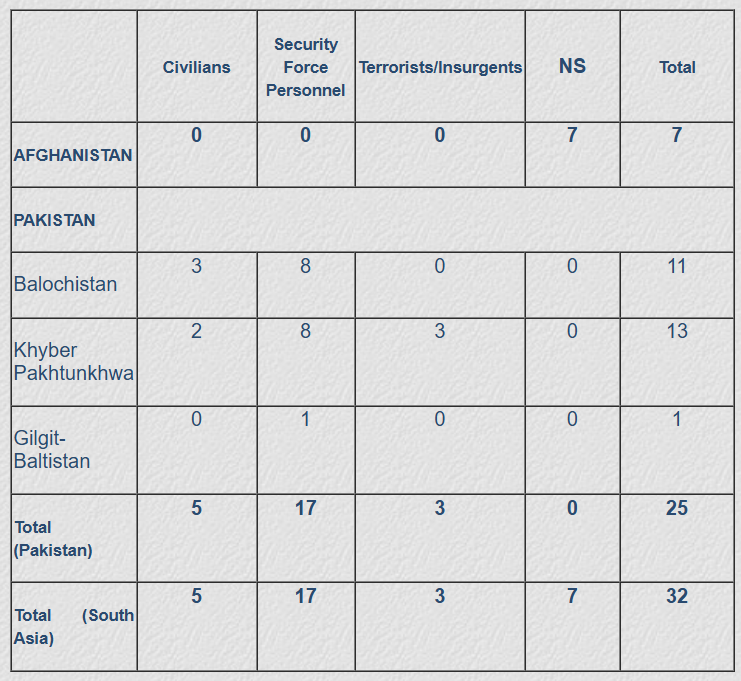
Provisional data compiled from English language media sources.