South Asia Intelligence Review
Quiescent Punjab
Terrorism-related incidents in Punjab, Pakistan’s heartland province, recorded relatively lower levels of violence after successive increases over the preceding two years. According to partial data compiled by the South Asia Terrorism Portal (SATP), Punjab recorded a total of 36 terrorism-linked fatalities [two civilians, two Security Force (SF) personnel and 32 terrorists] in 14 terrorism-related incidents of killing in 2025, as against 59 fatalities (nine civilians, four SF personnel and 46 terrorists) in 27 terrorism-related incidents of killing in 2024, a 38 per cent decrease in overall fatalities. 2023 registered a total of 48 terrorism-related fatalities (seven civilians, four SF personnel and 37 terrorists) in 27 terrorism-related incidents of killing. It is useful to recall that the highest terrorism-related fatalities in the province were reported in 2013, at 1,656 while the lowest were reported in 2022, at 11.
Other parameters of violence also declined accordingly. There were 24 terrorism-linked incidents in 2025 as against 54 in 2024. This is the highest number of such incidents since 2017, when there were 99 incidents. In particular, incidents of killing decreased from 27 in 2024 to 14 in 2025. The number of major incidents (each involving three or more fatalities) decreased from five in 2024 to four in 2025, and the resultant fatalities from 28 to 22. Similarly, the number of explosions decreased from six in 2024 to three in 2025.
Blasphemy cases saw a decline trend in 2025, but mainstream radical Islamist groups created havoc. The far-right Tehreek-i-Labbaik Pakistan (TLP), notorious for disruptive and violent protests, took the provincial capital city, Lahore, and adjourning areas hostage in October 2025. On October 9, TLP launched a mass protest march from Lahore and Faizabad to Islamabad under the “Labbaik Ya Aqsa Million March” banner, calling for a rally outside the United States (US) Embassy against the “first phase” Gaza ceasefire deal. The protest prompted a robust security response from Pakistani authorities. The Government imposed Section 144 in Rawalpindi to ban public gatherings, suspended mobile data services in Islamabad and Rawalpindi, and deployed shipping containers and heavy police contingents to seal the federal capital’s red zone. Clashes broke out in Lahore on October 10 when police raided TLP’s headquarters on Multan Road to arrest TLP Chief Saad Rizvi. TLP supporters retaliated with stone-pelting and iron bar attacks, while police used tear gas to disperse the crowd. At least three Policemen were injured. Rizvi’s claim of 11 deaths remains independently unverified, and the Police confirmed no fatalities.
On October 24, the Federal Interior Ministry notified a ban on TLP, declaring that the Federal Government had “reasonable grounds” to believe the religio-political party was connected to terrorism. Earlier, on October 17, the Punjab provincial Cabinet approved the imposition of a ban on TLP and forwarded a summary to the Federal Government for further action. On October 28, the Federal Ministry of Interior placed the names of 290 leaders, financiers and hardcore activists of TLP on the Provisional National Identification List (PNIL) to prevent them from travelling abroad. Those on the list include TLP chief Saad Rizvi, his brother Anas Rizvi, and 21 senior office-bearers wanted in multiple cases registered in Lahore, Sheikhupura and other districts. On November 13, the Punjab Government issued directives to freeze all assets and properties belonging to TLP. Meanwhile, Punjab Police fail to track TLP chief Saad Rizvi and his brother Anas Rizvi, despite the launch of large-scale operation against the party in mid-October 2025, in Muridke, and the two are still absconding. Despite the ban and action, TLP’s ideology and support base persists among the already radicalised segments of Pakistani society, feeding Government fears of resurgence.
On February 20, 2026, to further contain terrorism-related activities in the province, the Punjab Home Department issued a list of 89 proscribed organisations and unregistered charitable institutions, warning citizens that giving charity to these entities would be treated as a crime under the Anti-Terrorism Act, 1997. According to a statement issued by the Punjab Home Department spokesperson, anyone assisting the banned organisations involved in terrorism or anti-state activities “will face legal action” as it was a crime under the Anti-Terrorism Act, 1997. The list primarily includes militant, sectarian, and separatist groups, many of which are also banned at the Federal level by the National Counter Terrorism Authority (NACTA). The most prominent global terrorist groups in the list are Al Qaeda, Daesh (Islamic State), and TTP. Sectarian outfits include Lashkar-e-Jhangvi (LeJ), Sipah-e-Sahaba Pakistan (SSP), Sipah-e-Muhammad Pakistan (SMP), and Tehreek-e-Labbaik Pakistan (TLP). The list included Baloch separatist groups such as the Balochistan Liberation Army (BLA), Balochistan Liberation Front (BLF), Balochistan Republican Army (BRA), Lashkar-i-Balochistan (LiB), Balochistan Liberation United Front (BLUF), Balochistan Musallah Defah Tanzeem (BMDT) and Balochistan Raaji Aajoi Sangar (BRAS); Sindhi separatist groups such as Sindhu Desh Revolutionary Army, Sindhudesh Liberation Army (SLA) and Jeay Sindh Qaumi Mahaz (JSQM). India-oriented groups, generally active in the Jammu and Kashmir (J&K) region, such as Lashkar-e-Taiba (LeT), Jaish-e-Mohammed (JeM), and their charitable fronts like Jamaat-ud-Dawa (JuD) and Falah-e-Insaniat Foundation (FIF) are also listed. Pashtun rights group Pashtun Tahafuz Movement (PTM) is also among the inclusions.
Meanwhile, on February 20, 2026, the Punjab Police’s Crime Control Department (CCD) issued a comparative assessment of crime for the post-May period of 2024 and 2025, asserting substantial gains following CCD’s operationalisation in May 2025. The data indicates sharp declines across several categories, particularly in Lahore. Murder cases dropped from 361 to 220 (39 per cent), and attempted murder from 812 to 504 (38 per cent). Dacoity fell from 35 to 15 (57 per cent), and house dacoity from 33 to six (82 per cent). Robbery recorded the most dramatic reduction, declining from 8,213 to 1,823 (78 per cent). Theft within boundary walls fell by nine per cent and burglary by 44 per cent, while motorcycle and car snatching declined by 69 per cent and 50 per cent, respectively.
Province-wide figures reflected comparable trends. Murders decreased from 3,952 to 3,022 (24 per cent), attempted murders by 18 per cent, dacoity by 60 per cent, and robbery by 53 per cent. Theft within boundary walls declined by 17 per cent and burglary by 27 per cent. CCD also pointed to operational costs, reporting that 19 police personnel were killed and 167 injured in the line of duty during this period.
These claims have, however, been accompanied by serious allegations regarding the methods employed. On February 17, 2026, a fact-finding report by the Human Rights Commission of Pakistan (HRCP) accused CCD of adopting a systematic policy of staged encounters and extrajudicial killings. The Department rejected these allegations, asserting that it operates strictly within the Constitution, the Police Order 2002, and applicable criminal procedure laws. It maintains that arrest remains the primary objective, and that any use of force is governed by the principles of legality, necessity and proportionality, with lethal force deployed only as a last resort in the face of armed resistance and imminent threats. CCD further contended that the prevalence of heavily armed criminal groups necessitated defensive force to protect both personnel and civilians.
The HRCP report, however, presents a starkly different picture. It documents 670 encounters resulting in 924 deaths in just eight months, between April and December 2025, while only two security personnel were killed during the same period. This extreme imbalance – averaging more than two fatal encounters each day – combined with the uniformity of operational patterns across districts, was seen as indicative of an institutionalised practice rather than isolated excesses. By comparison, HRCP’s annual report for 2024 recorded 341 suspects killed in encounters across Punjab and Sindh combined over an entire year, suggesting that CCD operations in a single province more than doubled this toll within a shorter timeframe.
The geographical distribution of these encounters further underscores their scale. Lahore accounted for 139 incidents, followed by Faisalabad with 55 and Sheikhupura with 47. In terms of offence categories, those accused of dacoity constituted the largest group of fatalities (366), followed by robbery (138), narcotics offences (114), and murder (99).
HRCP concluded that these patterns constitute violations of both domestic law and Pakistan’s international human rights obligations. Under the Torture and Custodial Death (Prevention and Punishment) Act 2022, every custodial death must be investigated by the Federal Investigation Agency under the supervision of the National Commission for Human Rights. The fact-finding mission found no evidence of consistent compliance with this requirement; in at least one case, it was the court, rather than the authorities, that directed an investigation. Mandatory magisterial inquiries under Sections 174-176 of the Code of Criminal Procedure also appeared to have been bypassed. HRCP has consequently called for a high-level judicial inquiry.
CCD was established on February 26, 2025, under Chief Minister Maryam Nawaz’s “Safe Punjab” initiative, as a specialised unit of the Punjab Police operating alongside the regular police and the Counter Terrorism Department. It is mandated to tackle organised and heinous crimes, including land grabbing, extortion, kidnapping for ransom and dacoity, and is empowered to establish police stations, register FIRs and conduct independent investigations. Headed by an Additional Inspector General and headquartered in Lahore, it operates with an annual budget of PKR 5.56 billion (2025) and a strength of over 4,250 personnel.
The Department was created against a backdrop of escalating organised crime in 2024. Police data indicated that 273 gangs were active across Punjab, with 1,451 suspects identified. Of these, only 491 had been arrested, leaving 960, many considered highly dangerous, at large. Subsequent reporting suggested that CCD adopted an aggressive operational posture. According to figures cited by Daily Times on August 9, 2025, 815 suspects were killed or injured in encounters within four months of the Department’s establishment – 480 killed and 335 injured. As compared to the four months preceding, serious crime was reported to have declined by 40 per cent, from 16,500 cases prior to CCD’s launch to 10,100 by July 2025. Robbery and dacoity fell from 5,071 to 2,600, murder from 384 to 289, car theft from 7,900 to 5,378, and theft from 3,100 to 2,000.
Official claims regarding overall crime reduction have, however, been contested. Addressing a gathering in Gujranwala on December 6, 2025, Chief Minister Maryam Nawaz Sharif asserted that crime had declined by 70 to 80 per cent in 2025 compared to 2024, crediting the CCD. A Geo News fact-check, comparing data for January-December 2024 with January-December 2025, found that overall reported crime declined by only two per cent. While some categories saw sharper reductions-gang rape down by 44 per cent and dacoity with murder by 42 per cent – others showed more modest declines: rape by 8.28 per cent, murder by 18.56 per cent, blind murder by 24.34 per cent, kidnapping for ransom by 22.54 per cent, vehicle theft by 29 per cent, and kidnapping of women for forced conversion and marriage by 9.41 per cent.
The available evidence thus presents a complex picture. While CCD data indicates substantial reductions in selected categories, aggregate trends are far less dramatic, and the methods attributed to the Department raise serious concerns. Critics argue that an excessive reliance on encounter-based policing risks undermining due process and reflects a failure to invest in investigative capacity, resources and intelligence systems essential for sustainable crime control.
Though terrorism and crime indicators in Punjab presently reflect a phase of relative containment, the structural drivers of violence remain intact, creating significant potential for re-emergence.
Bihar: Institutionalised Peace?
On February 19, 2026, Suresh Koda aka Mustakim, a senior leader of the Communist Party of India-Maoist (CPI-Maoist) carrying a bounty of INR 300,000, surrendered before the Special Task Force (STF) and the Deputy Inspector General of Police (DIGP) in Munger District, handing over two INSAS (Indian Small Arms System) assault rifles, one AK-47, one AK-56 rifle and 505 rounds of ammunition, including 215 INSAS, 197 Self-Loading Rifle (SLR) and 93 AK-47 cartridges. Ten magazines were also recovered. Koda was a ‘commander’ of a Special Area Committee (SAC) and a member of the Bihar-Jharkhand Special Zonal Committee (BJSAC) of the Jharkhand-Bihar Zone of the CPI-Maoist. Sixty criminal cases were registered against Koda in Munger, Lakhisarai and Jamui Districts, including the 2008 and 2010 killings of village watchmen, a 2012 explosion at the Khaira Block Office, and the 2014 abduction of workers in Jamui. He was also linked to the 2017 murder of a deputy mukhiya’s husband in Lakhisarai, multiple killings in 2018 including two brothers in Barhat and an Sashastra Seema Bal (SSB) jawan, arson attacks on construction vehicles in 2018 and 2021, murders in 2019 in Chanan, and the 2021 killing of a newly elected mukhiya in Munger. He was involved in several armed encounters with STF and Commando Battalion for Resolute Action (CoBRA) forces between 2016 and 2022.
The surrender, described by senior Police officials as the “last armed capitulation,” preceded the State’s declaration that Bihar was effectively “Maoist-free,” with no active armed squad operating in any of the 23 districts once categorised as Left Wing Extremism (LWE)-affected. This declaration capped a year of unprecedented operational dominance.
In 2026, so far, one Maoist has surrendered in the State (data till February 22). During the corresponding period of 2025, no Maoists had surrendered. At least five Maoists were arrested through 2025, in addition to one arrested in 2024, six in 2023 and three in 2022.
Further, 19 Maoists were arrested in 2025, in addition to 20 in 2024, 33 in 2023 and 52 in 2022. No arrest has been reported in 2026, thus far (data till February 22).
Meanwhile, according to partial data collated by the South Asia Terrorism Portal (SATP), Security Forces (SFs) killed three Maoists in the state in 2025, and four in 2022. No Maoist fatality has been reported in 2024, 2023, as well in the current year, 2026.
The last SF fatality in the state was reported on February 14, 2019, when a Central Reserve Police Force (CRPF) Sub-Inspector, Raushan Kumar, was killed in a landmine blast triggered by CPI-Maoist cadres during a combing operation in the Langurahi Forests in Gaya District. Since then, SFs have killed 25 Maoists. These numbers indicate that, over time, SFs have established comprehensive domination over the Maoists Bihar.
SF successes on the ground have led to visible improvements in the security situation. Civilian fatalities went from one in 2024 to nil in 2025. Zero fatalities were also recorded in the civilian category in 2023 and 2022. Since March 6, 2000, when SATP started documenting data on LWE-linked violence across the country, a high of 46 civilian fatalities in the state was recorded twice, in 2000 and 2010.
According to SATP, Bihar recorded no Maoist-related fatalities in civilian and SF category in 2025. This extended the downward trajectory visible since 2021, but with a qualitative shift: while earlier years reflected occasional residual fatalities despite low incident counts, 2025 saw the complete absence of lethal violence.
Sporadic incidents persisted as recently as 2023-24, including isolated exchanges of fire and arrests in the forested belts along the Bihar-Jharkhand border. By contrast, through 2025, not a single landmine blast, ambush, targeted killing, or arson attack was successfully executed.
The absence of fatalities among civilians is particularly significant. Historically, Maoist activity in Bihar – especially in districts such as Gaya, Aurangabad, Jamui and Lakhisarai – was characterised by selective assassinations, levy-enforcement violence, and periodic retaliatory attacks against informers. The disappearance of such patterns underscores the collapse of coercive enforcement capacity.
Equally notable is the absence of SF casualties. Improved route sanitisation, intelligence-led operations, and pre-emptive recoveries have reduced operational vulnerability to near zero within the state’s borders.
In comparison to the corresponding period in 2024, arrests rose significantly, while incidents of violence fell to zero. The absence of a single reported Maoist attack in 2025 marks a qualitative shift from containment to the dismantling of operational capacities.
2025 also saw intensified recovery operations targeting arms, ammunition, and Improvised Explosive Device (IED) fabrication infrastructure.
On January 8, 2025, a major cache of landmines and IED-making materials was recovered from the Chhakarbandha Forests in Gaya District, suggesting that the Maoists had contemplated a “Chhattisgarh-type” high-casualty attack. The recovery included cylinders packed with explosives, pressure cookers configured as bombs, and tiffin IEDs. Subsequent operations in March and May yielded multiple IEDs in Gaya and Aurangabad, including five pressure IEDs neutralised at Laduiya Pahad on May 6, 2025, and eight four-kilogram IEDs in the Nagobaar Forest on March 21, 2025.
Cumulatively, dozens of IEDs, detonators, gelatine sticks, and fuse wires were seized across Gaya, Jamui, Aurangabad and Banka Districts in 2025. These recoveries indicate that, while kinetic attacks were absent, Maoist intent as well their latent strike capabilities persisted.
Arrests of significant operatives further eroded organisational coherence. On January 12, 2025, ‘regional commander’ Rahul Yadav aka Vikas Ji aka Bakra Vikas was arrested near an automobile showroom on the Rafiganj-Shivganj Road under Rafiganj Police Station limits in Aurangabad District. On June 5, 2025, and June 7, 2025, respectively, Jamui Police arrested Naresh Ravidas aka Patal Ravidas [involved in the January 5, 2005, killing of Munger Superintendent of Police (SP) K.C. Surendra Babu and five other Police personnel in the Bhimabandh Forest area], from Teliyadih village under the Jhajha Police Station area in Jamui District, and Sarita Soren aka Sita Soren, a long-absconding female cadre linked to a 2010 attack in Chakai, from Karma village in Jamui District. On October 29, ‘area commander’ Nisha Manjhi was arrested from her hideout at Gonauli village in the Valmikinagar area of West Champaran District, after years underground.
Surrenders also gained momentum. On June 20, 2025, Akhilesh Singh Bhokta aka Patarki, a ‘sub-zonal commander’ in Gaya District carrying an INR 300,000 reward, surrendered and subsequently facilitated the recovery of 60 IEDs. On July 27, 2025, Hakka Sai, a wanted cadre with a INR 200,000 bounty, laid down arms in Munger District. Cumulative pressures culminated in a cluster of surrenders in December 2025, and Suresh Koda’s capitulation in February 2026.
Incidents of arson and levy-related intimidation – once hallmarks of Maoist activity in Bihar – were largely confined to legacy cases. For instance, investigations into extortion from the North Koel Canal construction in Aurangabad led to the arrest of five cadres of the Jharkhand Jan Mukti Parishad (JJMP), a splinter group of the CPI-Maoist, in the Mali and Nabinagar Police Station areas of Aurangabad District on March 25, 2025. A joint team also seized several firearms and ammunition from the arrested individuals, including three .315-bore rifles, one Sten gun, one country-made rifle, 13 live bullets, one walkie-talkie, seven military uniforms and other items. No successful levy-driven arson attack was recorded in 2025.
Historically, Maoist dominance in Bihar was concentrated in Gaya, Aurangabad, Jamui, Banka, Nawada, Munger, Lakhisarai, and parts of Rohtas and West Champaran Districts. By 2012, 23 districts were officially categorised as LWE-affected. In 2025, operational activity, limited largely to recoveries and arrests, was confined to forested tracts along the Bihar-Jharkhand border, particularly Chhakarbandha (Gaya), Madanpur (Aurangabad), and Jamui’s forested interiors. West Champaran saw sporadic arrests linked to earlier attacks, but no fresh mobilisation. Importantly, Jamui District, once a Maoist bastion, witnessed peaceful polling in villages such as Chormara in November 2025, reportedly the first incident-free voting in 25 years. The symbolic transformation of a once-bombed school into a polling station underscored the collapse of coercive Maoist influence.
Security gains were complemented by infrastructure expansion. As of February 2026, 1,814 kilometres of roads and 72 bridges had been completed in eight previously LWE-affected districts under the Road Connectivity Project for LWE Areas. A residual 24 kilometres and three bridges were targeted for completion by March 2026. Improved connectivity has facilitated economic integration, reduced isolation of forested hamlets, and enabled faster SF deployment – eroding Maoist tactical advantages derived from terrain.
The National Investigation Agency (NIA) remained active in Bihar through 2025, focusing on revival attempts and arms procurement networks. In total, at least four significant NIA actions – including chargesheets and field recoveries – were recorded in 2025, reflecting continued vigilance against ideological and logistical revival attempts.
On January 15, 2025, NIA chargesheeted Rajesh Kumar Sinha aka Uday Ji aka Shailesh Srivastav, in a case relating to arms supply to CPI-Maoist cadres. The same day, it filed a supplementary chargesheet against senior Maoist leader Pramod Mishra aka Sohan Da aka Madan Da aka Bibi Je aka Baba in connection with AK-47 recovery in West Champaran. During the course of further Investigation, it was established that the Pramod Mishra was propagating the CPI-Maoist ideology and organising arms and ammunition for the group.
On February 22, 2025, NIA chargesheeted Bihari Paswan for attempts to revive the Maoist presence in the Magadh zone. Further, on April 9, 2025, NIA teams recovered two IEDs from the Bhusiya Forest area in Gaya District during a joint operation with the STF and CRPF.
More recently, on January 28, 2026, NIA filed a chargesheet against Lakshman Paswan, an accused in a Bihar-based attempt to revive the banned CPI-Maoist organization in the Magadh zone. Paswan, who was arrested by NIA from Lutua in Gaya District, Bihar, in August 2025, is the fifth person to face charges under the Indian Penal Code (IPC) and the Unlawful Activities Prevention Act (UAPA) in this connection. He is alleged to have actively collected levies from businesses to provide logistical support to Maoist cadres and to have organized meetings aimed at recruiting and inciting new members.
These proceedings highlight that, while armed squads may have dissolved, residual overground and support networks remain active and under scrutiny.
Despite the declaration of Bihar as “Maoist-free,” several structural risks persist: Cross-Border Linkages: Proximity to Jharkhand, where Maoist presence continues, poses risks of spill-over or temporary sheltering of cadres. Ideological Residues: NIA investigations into revival attempts underscore the persistence of sympathiser networks and potential urban overground workers. IED Legacy Threat: Recovery of large IED caches suggests that undetected explosive materials may remain hidden in forest belts. Socio-Economic Vulnerabilities: Historical grievances relating to land, caste inequities, and resource access – central to Maoist mobilization – require sustained developmental redress.
Moreover, splinter outfits such as the Jharkhand Jan Mukti Parishad (JJMP) have intermittently attempted levy collection, though without the organisational depth of CPI-Maoist.
In a strange turn of events, Aurangabad Police were jolted by the discovery that a wanted CPI-Maoist cadre had successfully infiltrated both the district administrations and the Police’s media coordination groups on an instant messaging platform. The breach came to light on August 20, 2025, when Gaya Police arrested Alok Sharma, who was accused in two Maoist-related cases registered at Banke Bazar and Deo Police Stations. Police sources disclosed that Sharma had long been on their radar for his involvement in several major Maoist incidents in Gaya and Aurangabad and had even been arrested earlier, in similar cases. By slipping into the media coordination groups, Alok allegedly gained access to sensitive updates on Police movements and administrative decisions in real time. His arrest exposed the infiltration, sparking a wave of alarm within both the Police and the district administration.
Though consolidation of SF dominance across Bihar is visible, the State continues to reel under critical shortages in the strength and quality of its Police Force. According to the latest Bureau of Police Research and Development (BPR&D) data, as on January 1, 2024, the State’s police-population ratio (policemen per hundred thousand population) was an abysmal 80.15, the lowest in the country, and almost half the national average of 154.96. The police-population ratio for both the state and the national average is far below the sanctioned ratios of 133.40 and 197.44, respectively. There is a vacancy of 68,062 Police personnel (39.91 per cent) against the sanctioned strength of 170,516 in Bihar. Moreover, of a sanctioned strength of 242 apex Indian Police Service (IPS) officers in the State, 17 posts (7.02 per cent) were vacant. Of the 1,096 Police Stations in the state, 187 had no telephones.
2025 marks a watershed in Bihar’s counter-Maoist trajectory: zero fatalities against civilians and SFs, 19 arrests, multiple surrenders of senior leaders, and systematic dismantling of arms caches. The February 2026 surrender of Suresh Koda symbolises the formal end of organised armed Maoist presence in the state. Yet, the declaration of “Maoist-free” status must be interpreted as an operational assessment rather than a permanent condition. Sustained vigilance, continued intelligence coordination, and developmental deepening are imperative to prevent relapse.
If 2025 represented the culmination of a prolonged counter-insurgency campaign dating back to the 1970s, 2026 must consolidate these gains through institutional resilience. Bihar’s experience demonstrates that calibrated force, legal action, surrender-cum-rehabilitation policies, and infrastructure expansion – executed with synergy – can dismantle entrenched insurgent ecosystems. Whether this transition endures will depend not merely on the absence of violence, but on the state’s capacity to institutionalise peace.
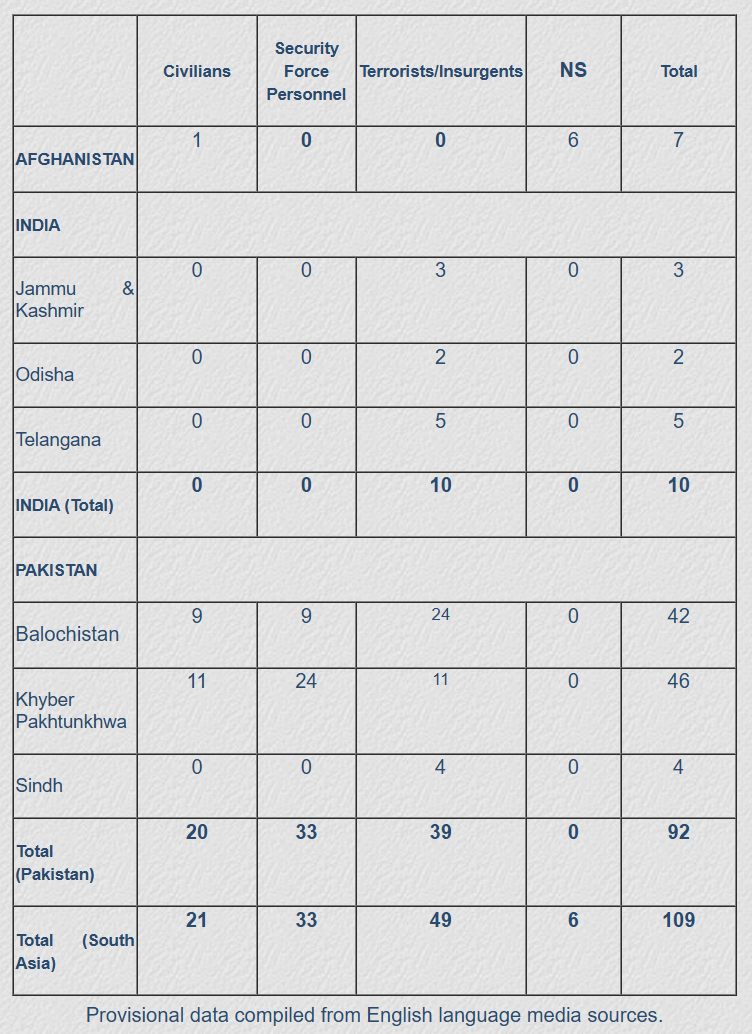
Weekly Fatalities: Major Conflicts in South Asia
February 16-22, 2026