
Iran Update Morning Special Report: March 2, 2026
Key Takeaways:
The combined force continues to degrade Iran’s retaliatory capabilities. Satellite imagery captured on March 2 shows damage to a missile base near Najafabad, Esfahan Province. The imagery shows three impact points likely caused by bunker buster bombs.
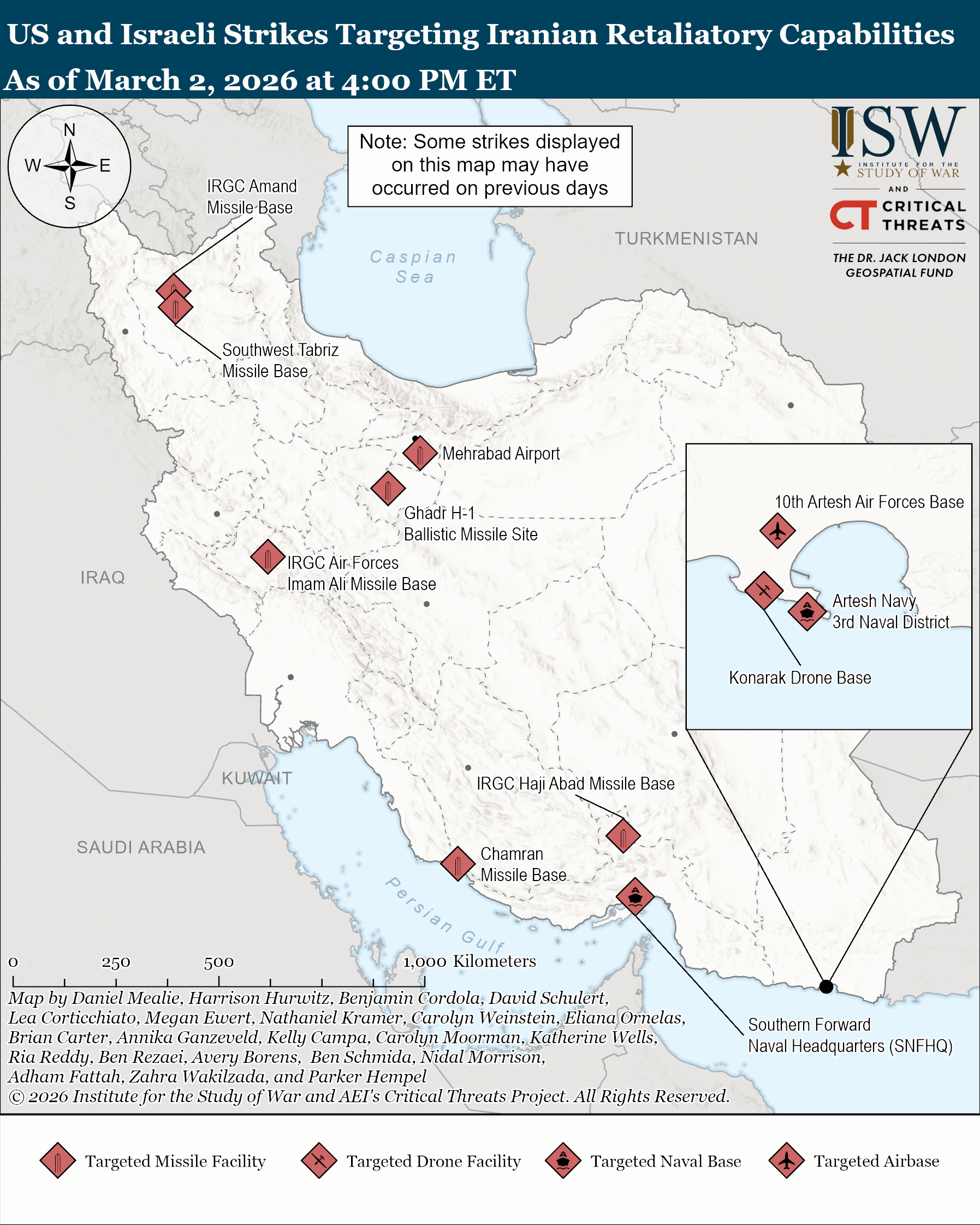
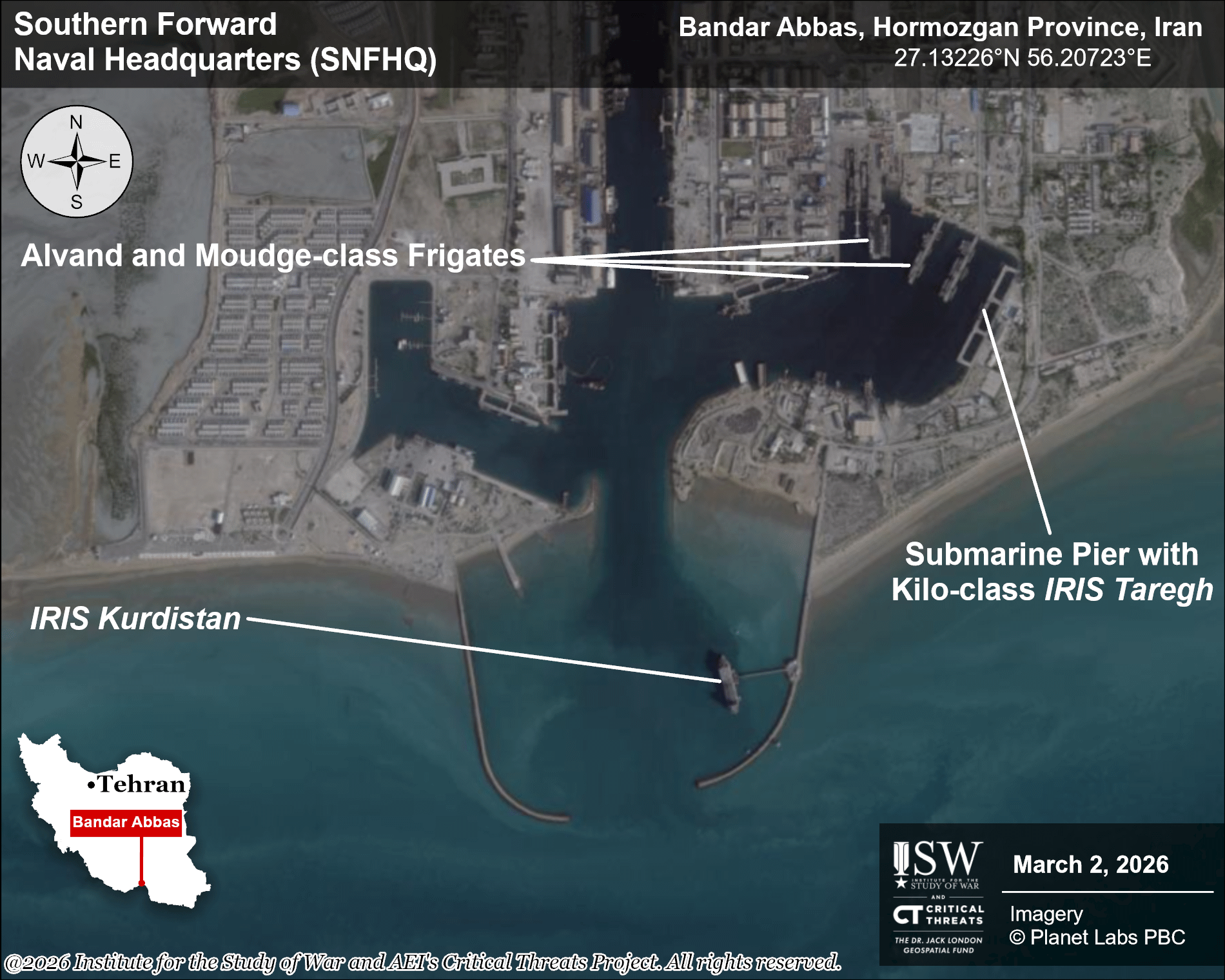
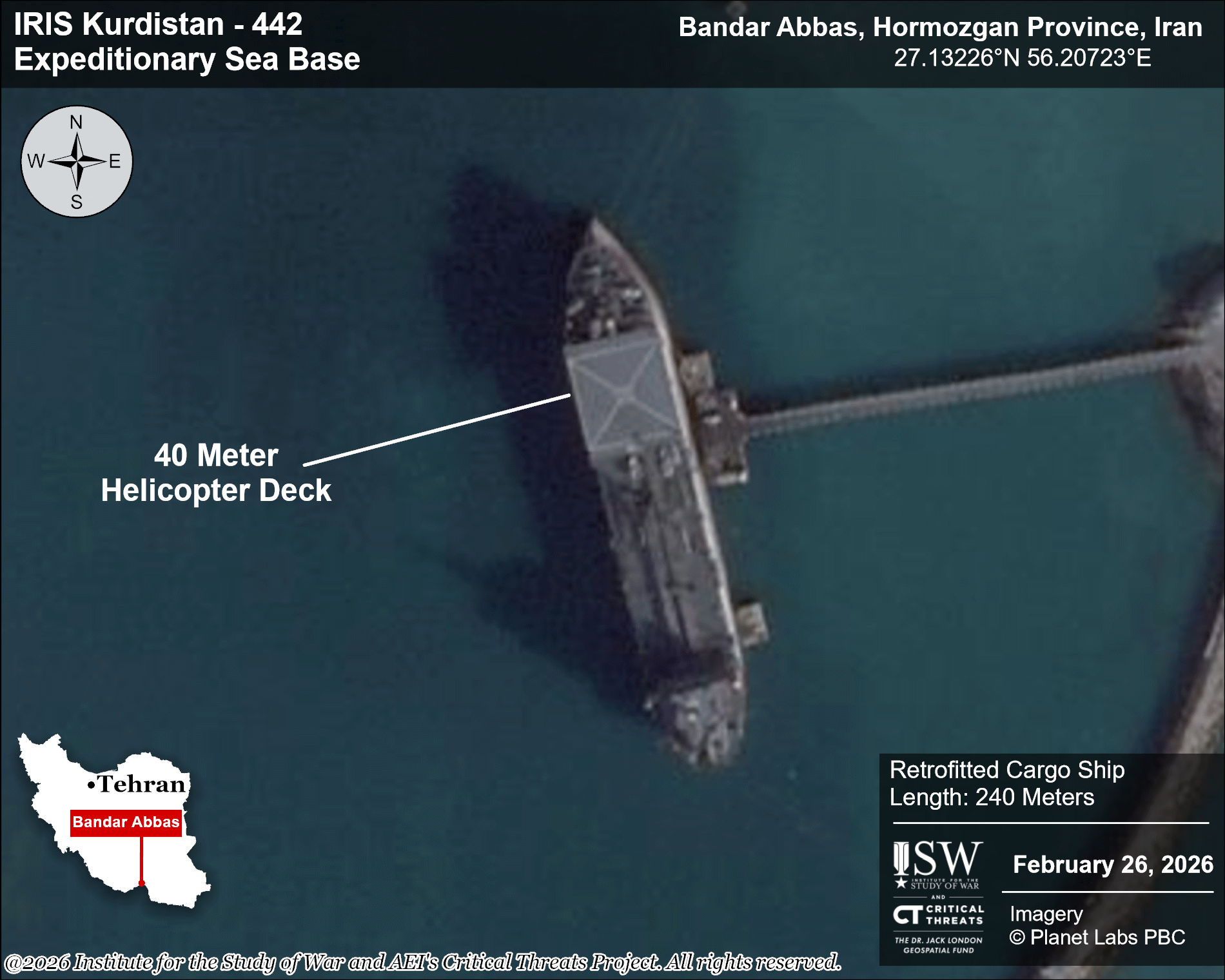
The combined force has continued to attack Iranian naval assets in order to prevent Iran’s navies from being able to conduct retaliatory attacks against international shipping and US Navy vessels. Commercially available satellite imagery shows that the combined force struck the Artesh Navy IRIS Kurdistan in the Bandar Abbas Port in Hormozgan Province. Geolocated imagery also shows a smoke plume at the IRGC Navy 3rd Naval District in Bandar Mahshahr, Khuzestan Province. Bandar Mahshahr is located at the north of the Persian Gulf.
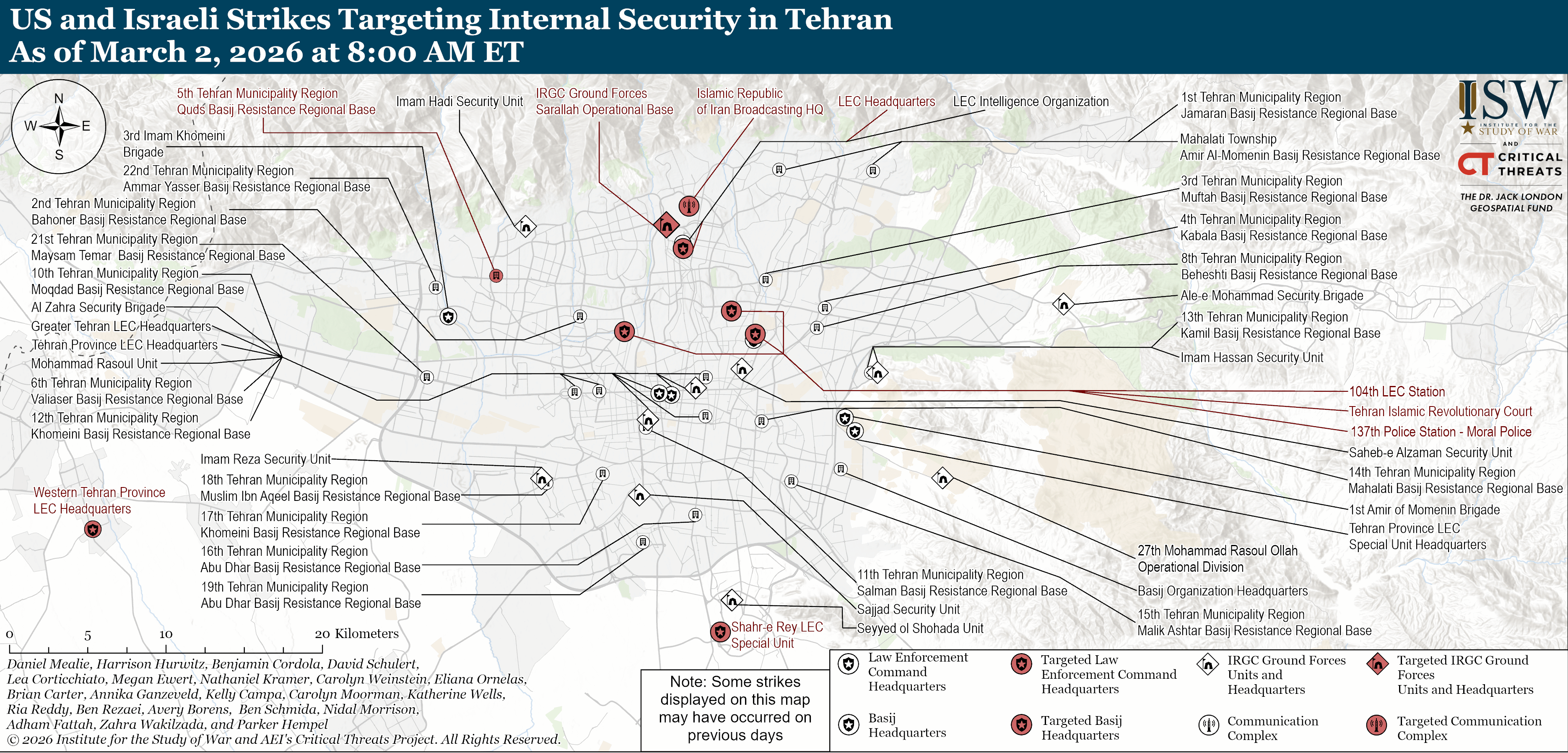
The combined force continued to target Iran’s internal security apparatus. Commercially available satellite imagery shows that the combined force damaged a building at the Fifth Tehran Municipality Quds Basij Resistance Regional Base in northwestern Tehran in airstrikes on March 1. This base is one of the 23 Basij regional bases in Tehran. These bases operate under the IRGC Ground Forces Mohammad Rasoul Ollah Provincial Unit, which operates under the IRGC Ground Forces Sarallah Headquarters.
The IDF assesses that Iran is attempting to launch larger and more coordinated missile barrages at Israel but is struggling to do so because of IDF strikes on Iranian missile launchers. The IDF estimates that Iran has launched between nine and 30 missiles per attack over the past day, in contrast to between two and three missiles per attack on February 28. The IDF had destroyed about half of Iran’s missile launchers as of March 1.
US sources told a US journalist that Iranian Shahed drones are “so far the most dangerous threat.” The sources stated that Iranian Shahed drones are getting through some air defenses. CTP-ISW has not observed reports of drone impacts in Israel, but Iranian drones have struck several Gulf countries. Iran has primarily used ballistic missiles to attack Israel but has relied on drones to attack Gulf countries.
Iran is increasingly targeting energy infrastructure in Gulf countries, likely to impose a cost on international markets to compel the United States and its partners to pursue a ceasefire before achieving their objective of toppling the regime. Iran’s attacks on Gulf energy infrastructure may cause the Gulf states to retaliate and join the conflict.
Hezbollah launched rockets and drones targeting the Israel Defense Forces (IDF) Mishmar al Karmel missile defense site in Haifa, northern Israel, on March 1. The IDF launched retaliatory airstrikes targeting Hezbollah leadership in Beirut’s southern suburbs and Hezbollah sites across Lebanon on March 1 and 2. The strikes killed Hussein Mekeld and Mohammad Raad.
Toplines
US and Israeli Air Campaign
The combined force has achieved air superiority over Tehran City and has conducted waves of airstrikes concentrated in Tehran City. Israeli Defense Minister Israel Katz announced on March 1 that the Israel Defense Forces (IDF) Air Force is striking targets in Tehran with “stand-in” munitions and that IAF fighter jets are dropping munitions directly over their targets for the first time in the war.[i] An Israeli military correspondent stated that the IDF had previously been deploying stand-off weapons from a distance and with smaller warheads.[ii] Katz announced that the IAF will conduct “continuous powerful strikes” in Tehran City.[iii]
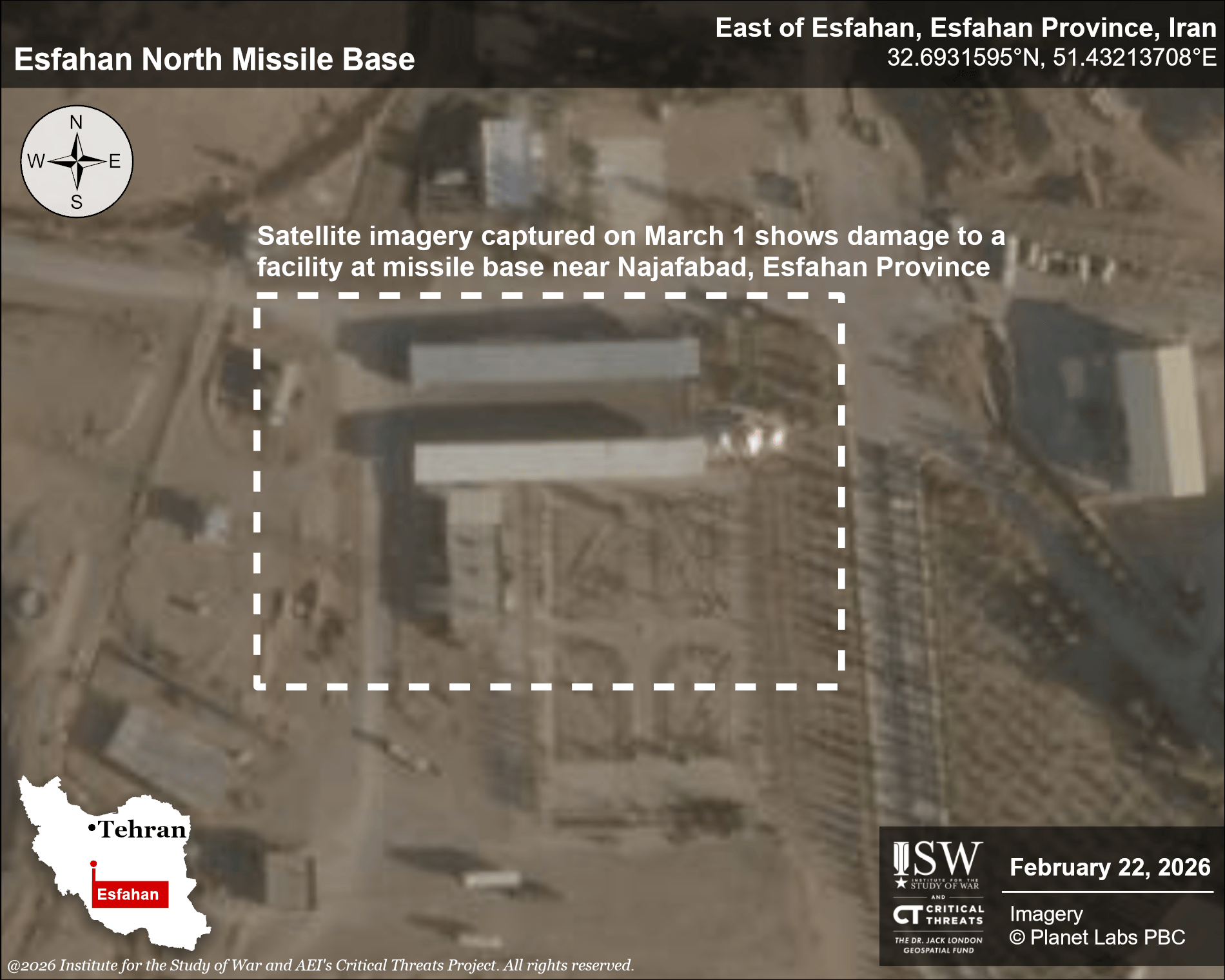
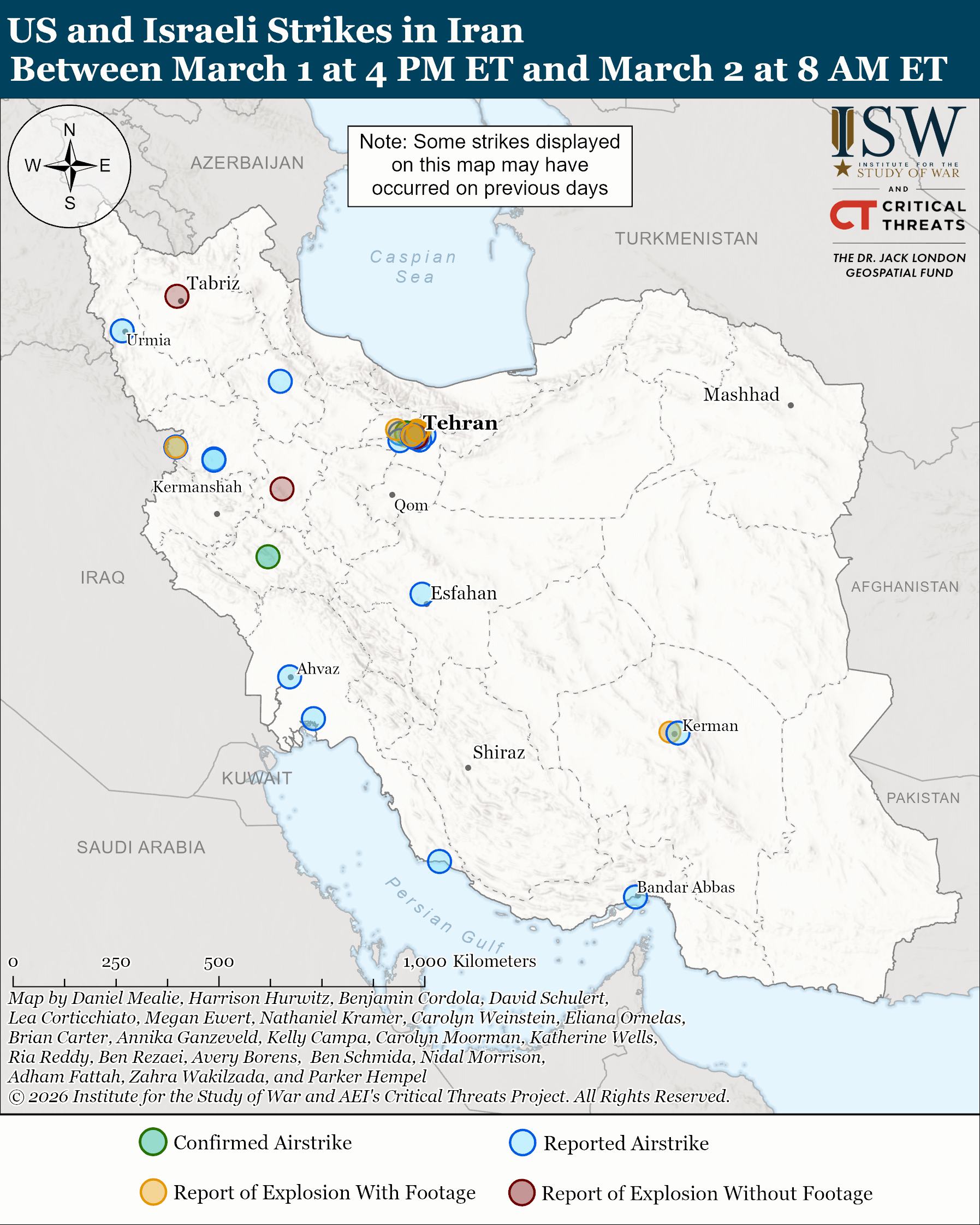
The combined force continues to degrade Iran’s retaliatory capabilities. Satellite imagery captured on March 2 shows damage to a missile base near Najafabad, Esfahan Province. The imagery shows three impact points likely caused by bunker buster bombs. The IDF also struck the Yazd Missile Base in Yazd Province and the Khorgu Missile Base north of Bandar Abbas, Hormozgan Province.[xi] The IDF struck the Yazd Missile Base during the June 2025 Israel-Iran War to destroy Khorramshahr ballistic missile storage facilities.[xii] Khorramshahr missiles have a range of between 2,000 and 3,000 kilometers.[xiii]
The combined force has continued to attack Iranian naval assets in order to prevent Iran’s navies from being able to conduct retaliatory attacks against international shipping and US Navy vessels. Commercially available satellite imagery shows that the combined force struck the Artesh Navy IRIS Kurdistan in the Bandar Abbas Port in Hormozgan Province. Bandar Abbas Port is home to the IRGC Navy Headquarters, the IRGC Navy 1st Naval District, and the Artesh Navy Southern Forward Naval Headquarters.[xiv] Commercially available satellite imagery also shows an unspecified Alvand-class frigate on fire in the Bandar Abbas Port. Geolocated imagery also shows a smoke plume at the IRGC Navy 3rd Naval District in Bandar Mahshahr, Khuzestan Province. Bandar Mahshahr is located at the north of the Persian Gulf.
The combined force continued to target Iran’s internal security apparatus. The IDF killed numerous senior Intelligence Ministry officials, including the Intelligence Ministry internal security deputy (see below).[xv] Commercially available satellite imagery shows that the combined force damaged a building at the Fifth Tehran Municipality Quds Basij Resistance Regional Base in northwestern Tehran in airstrikes on March 1. This base is one of the 23 Basij regional bases in Tehran.[xvi] These bases operate under the IRGC Ground Forces Mohammad Rasoul Ollah Provincial Unit, which operates under the IRGC Ground Forces Sarallah Headquarters.[xvii] The IDF struck the Sarallah Headquarters on March 1.[xviii] OSINT accounts have reported explosions at another Basij base and two LEC sites in Tehran Province and one LEC site in Kurdistan Province since CTP-ISW’s last data cutoff at 4:00 PM ET on March 1.[xix] Read more about the structure of Iran’s internal security apparatus in CTP’s December 2021 Iranian internal security report Whatever It Takes to End It.
The United States and Israel have continued to mobilize forces. US Joint Chiefs of Staff Chairman General Dan Caine stated on March 2 that “this is not a one-night operation.”[xx] Caine stated that the United States is continuing to send reinforcements and that “additional forces” will arrive in the Middle East today.[xxi] The IDF stated on March 2 that it has mobilized approximately 110,000 reservists.[xxii]
Decapitation Campaign
US President Donald Trump told Fox News on March 2 that the US-Israeli combined force killed 49 senior Iranian leaders in the first round of strikes on Iran on February 28.[xxiii] The Israeli Air Force (IAF) confirmed on March 2 that the combined force killed senior Iranian Intelligence Ministry officials, including Deputy Intelligence Minister for Israel Affairs Yahya Hamidi and Espionage Division head Jalal Pour Hossein.[xxiv] An Iranian open-source analyst reported that the IAF also killed Intelligence Ministry Internal Security Deputy Seyyed Yahya Hosseini Panjaki.[xxv] The analyst stated that Panjaki was responsible for the Intelligence Ministry’s targeted killings abroad, including killings of journalists and political activists.[xxvi] CTP-ISW recorded an airstrike in the vicinity of the Intelligence Ministry in Tehran on March 1.[xxvii]
Iranian President Masoud Pezeshkian appointed Islamic Revolutionary Guards Corps (IRGC) officer Majid Ibn Reza as the acting Defense and Armed Forces Logistics Minister on March 2 after the combined force killed former Defense and Armed Forces Logistics Minister Brigadier General Aziz Nasir Zadeh on February 28.[xxviii] Majid Ibn Reza previously served as the chief executive for the Social Security Organization of the Armed Forces (SATA), which is a subsidiary of the Defense and Armed Forces Logistics Ministry.[xxix] The US Treasury sanctioned a SATA subsidiary company in 2020 for facilitating Iran’s illicit oil trade to generate billions of US dollars in revenue for SATA to fund pensions, insurance, and welfare services for IRGC, Artesh, and Law Enforcement Command (LEC) personnel.[xxx]
Iranian Retaliation
The IDF assesses that Iran is attempting to launch larger and more coordinated missile barrages at Israel but is struggling to do so because of IDF strikes on Iranian missile launchers.[xxxi] The IDF estimates that Iran has launched between nine and 30 missiles per attack over the past day, in contrast to between two and three missiles per attack on February 28.[xxxii] The IDF also noted that Iran’s effort to conduct larger attacks has caused larger pauses between each wave of Iranian missile attacks. The IDF announced a wave of Iranian missile attacks around 0:00 AM ET and another wave of missile attacks around 5:00 AM ET on March 1.[xxxiii] The IDF noted that Iran is struggling to conduct larger attacks because the IDF is systematically targeting Iranian missile launchers. The IDF had destroyed about half of Iran’s missile launchers as of March 1.[xxxiv] A nuclear analyst assessed on March 1 that Iranian security personnel may be abandoning missile launchers when they hear a drone or after conducting a single launch.[xxxv]
US sources told a US journalist that Iranian Shahed drones are “so far the most dangerous threat.”[xxxvi] The sources stated that Iranian Shahed drones are getting through some air defenses. Iran has spent years and tremendous resources developing Shahed drones and provided Russia with Shahed drones for its invasion of Ukraine. CTP-ISW has not observed reports of drone impacts in Israel, but Iranian drones have struck several Gulf countries.[xxxvii] Iran has primarily used ballistic missiles to attack Israel but has relied on drones to attack Gulf countries.[xxxviii] The combined force struck several Iranian drone launch sites and storage facilities, some of which appeared to contain Shahed-136 and Shahed-129 drones, in southeastern Iran on March 1.[xxxix] Ukrainian officials have offered to share their experience with the United States and Israel on how to counter Iranian Shahed drones.[xl]
Iran is increasingly targeting energy infrastructure in Gulf countries, likely to impose an economic cost and compel the United States and its partners to pursue a ceasefire before achieving their objective of toppling the regime. Iran reportedly struck the Jebel Ali power station complex in Dubai, the United Arab Emirates (UAE), on March 1.[xli] The station is the UAE’s largest power production and desalination plant with a capacity of 2,060 megawatts.[xlii] Iranian drones also attempted to strike the Ras Tanura oil refinery in Saudi Arabia on March 2, but Saudi forces intercepted the drones.[xliii] The Ras Tanura oil refinery is Saudi Arabia’s largest oil refinery and houses the Saudi state-owned national oil company Saudi Aramco.[xliv] Iran previously targeted Saudi energy facilities in September 2019.[xlv] The Ras Tanura complex is also a vital export terminal for Saudi crude oil. Iran also targeted an energy facility in the Ras Laffan Industrial City in Qatar, which is a major Qatari hub for liquefied natural gas.[xlvi]
Iran has also targeted industrial facilities in the Gulf. Iran struck the Aluminum Bahrain Company in Riffa, Bahrain, on March 2, which is one of the world’s largest aluminum smelters.[xlvii] Aluminum smelters are key for national defense because they produce aluminum for military aircraft, armored vehicles, and ships.[xlviii] An Iranian drone struck the Mesaieed industrial zone in Qatar, which houses Qatari petrochemical and manufacturing facilities.[xlix]
Iran’s attacks on Gulf energy infrastructure may cause the Gulf states to retaliate and join the conflict. Unspecified Saudi officials told the Wall Street Journal on March 2 that Saudi Crown Prince Mohammed bin Salman previously identified attacks on Saudi Arabia’s oil facilities as a red line.[l] A geopolitical risk analyst told the Wall Street Journal that Iran’s attacks on the Gulf states’ “economic centers of gravity…could become increasingly existential” for the Gulf states.[li] The Emirati government previously warned that the UAE will not sit “cross-armed” in the face of Iran’s attacks and will review its options.[lii] Saudi Arabia similarly noted that it will take all necessary measures to defend its security, including by possibly responding to Iranian attacks.[liii]
Iranian Supreme National Security Council (SNSC) Secretary Ali Larijani stated on March 2 that Iran will not negotiate with the United States.[liv] Larijani’s statement comes after US and Arab officials told the Wall Street Journal on March 1 that Larijani has made an effort to resume talks with the United States.[lv]
Axis Response
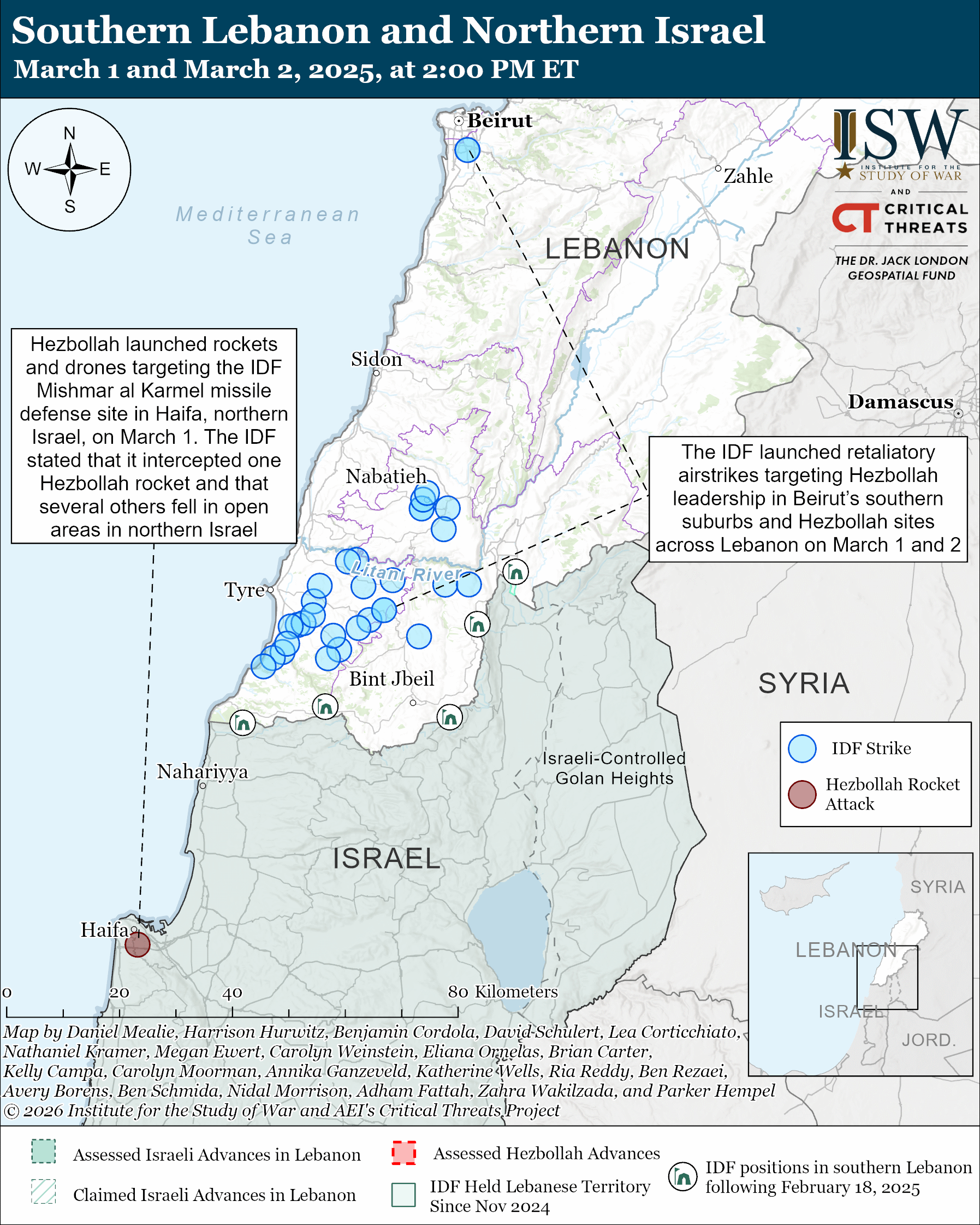
Hezbollah launched rockets and drones targeting the IDF Mishmar al Karmel missile defense site in Haifa, northern Israel, on March 1.[lvi] The IDF stated that it intercepted one Hezbollah rocket and that several others fell in open areas in northern Israel.[lvii] Hezbollah confirmed the attack on March 1 and stated that the attack was in retaliation for the combined force’s killing of Iranian Supreme Leader Ali Khamenei.[lviii]
The IDF launched retaliatory airstrikes targeting Hezbollah leadership in Beirut’s southern suburbs and Hezbollah sites across Lebanon on March 1 and 2.[lix] The IDF struck dozens of Hezbollah headquarters across Lebanon, including a headquarters belonging to Iranian forces.[lx] The IDF also struck Hezbollah weapons depots and other Hezbollah military sites across Lebanon.[lxi] The IDF strikes on Beirut’s southern suburbs killed:
Hussein Mekeld. Mekeld served as the head of Hezbollah’s intelligence headquarters in Beirut.[lxii]
Mohammad Raad.[lxiii] Raad was the head of Hezbollah’s Loyalty to the Resistance Bloc and a member of Hezbollah’s Shura Council.[lxiv] Raad also served as the head of Hezbollah’s Parliamentary Oversight Council.[lxv] Raad helped found Hezbollah’s Lebanese Union of Islamic Students.[lxvi] He was a leading figure in Hezbollah and a staunch party ideologue, formerly chairing Hezbollah’s Political Council.[lxvii] He had served as a Hezbollah parliamentarian since 1992.[lxviii] The United States sanctioned Raad in 2019 for his role in Hezbollah’s Shura Council and for using his political position to benefit Hezbollah.[lxix]
Other Activity
US Central Command (CENTCOM) announced that Kuwaiti air defense systems mistakenly shot down three US F-15E fighter jets over Kuwait on March 1.[lxx] CENTCOM reported that all six aircrew ejected from the fighter jets and have been recovered safely.[lxxi]