
China & Taiwan Update, December 23, 2025
Toplines
The United States announced its largest-ever arms sale to Taiwan, which will aid Taiwan’s efforts to implement an asymmetric defense strategy, on December 17.[1] The sale amounts to approximately 11.1 billion US dollars and includes 82 HIMARS rocket systems, 420 M57 ATACMS missile systems, 60 M109A7 self-propelled howitzers, and an unknown number of Altius 700m and 600m unmanned loitering munitions, Javelin anti-tank missiles, and TOW anti-tank missiles.[2] The White House and State Department both stated that the sale enhanced US national security interests by maintaining the military balance in the Taiwan Strait and ensuring peace and stability in the Indo-Pacific.[3] The scale of this arms sale illustrates that the United States remains committed to Taiwan’s national defense, particularly in providing precision munitions and unmanned systems to implement an asymmetric defense strategy. An asymmetric defense of Taiwan would involve deploying low-cost systems and precision strike capabilities to achieve mission kills on critical systems, such as PLA amphibious assault craft, and deny PLA access to the Taiwanese coast.[4]
The systems included in the sale will markedly improve Taiwan’s defense capabilities if delivered in a timely manner. The HIMARS and ATACMS will allow Taiwan to strike PLA positions on the mainland coast and as the PLA transits the 150-200km strait toward Taiwan.[5] This capability could complicate PLA efforts to concentrate force on its eastern coast and in the Taiwan Strait prior to an amphibious invasion of Taiwan.[6] The M109A7 155mm self-propelled howitzer is also a significant upgrade for Taiwan’s artillery corps, which largely deploys towed 105mm artillery.[7] The M109A7 will improve the range and precision of Taiwan’s artillery while also enhancing resilience to counter-battery fire due to its high mobility.[8] The Altius loitering munitions will also enhance Taiwan’s anti-armor capabilities, with both drones boasting long ranges and large payloads that could hold PLA armor at risk before they reach Taiwan’s shores.[9] Taken together, the procurement emphasizes precision, mobility, and unmanned systems that Taiwan seeks to leverage to offset PLA advantages in size by imposing high costs on any PLA effort to concentrate significant forces for a cross-strait invasion.
The United States has yet to deliver approximately 20 billion US dollars in arms to Taiwan and has pushed back the delivery timeline for several systems, including the F-16V fighter jet.[10] Taiwan decreased its purchase of M109A7 howitzers from 168 to 120, with 60 planned for this procurement—which will run from 2026 to 2033—to help prevent further backlogs from occurring.[11] Taiwan’s opposition party, the Kuomintang (KMT), has pointed to delays in US arms deliveries to question increasing government spending on defense.[12] Further delays on the US side would harm Taiwanese security by decreasing Taiwan’s confidence in the value of US support and depriving Taiwan’s military of systems it requires to implement an asymmetric defense strategy.
Taiwan will fund the procurement of HIMARS, M109A7 howitzers, Altius drones, TOW missiles, and Javelin missiles with its largest ever Special Budget for Asymmetric War.[13] Taiwan’s regular defense budget will cover the remaining cost of the procurement, which largely contains repair parts and command and control equipment.[14]
A constitutional crisis in Taiwan risks preventing the passage of the special defense budget in the short term. Failure to pass the budget in a timely manner will undermine Taiwanese efforts to implement an asymmetric defense strategy and harm international perceptions of Taiwan’s resolve. Taiwanese Premier Cho Jung-tai refused to cosign KMT- and Taiwan People’s Party (TPP)-led amendments to the Fiscal Allocation Act on December 16.[15] The Executive Yuan’s opposition to the amendments involves the diversion of tax revenue from the central government to local governments, which would drain the central government of funds for national defense and other national priorities.[16] KMT and TPP legislators have accused Cho of failing to fulfill his constitutional duties as premier by refusing to cosign the bill.[17] KMT and TPP caucus leaders expressed their intent to initiate impeachment proceedings against both Cho and President Lai Ching-te.[18]
Taiwan’s Constitutional Court is unable to rule on the legality of the amendments because only eight of its fifteen seats are currently filled. The KMT-controlled Legislative Yuan (LY) passed a law in 2024 that requires at least ten judges to sit on the court to rule on issues of constitutionality. KMT legislators have blocked Lai’s nominations to the court, resulting in the prolonged lack of a quorum.[19] The Constitutional Court’s inability to rule on Lai’s actions and the disagreement on the limits of the premier’s power threatens a constitutional crisis that may paralyze the legislature until it is resolved. The crisis could prevent the Special Budget for Asymmetric War from passing in a timely manner without significant changes. Lai can dissolve the LY and trigger new elections if the LY passes a vote of “no confidence” against Cho. New legislative elections would prevent the special budget from reaching the floor of the LY until after the elections are over.
KMT and TPP opposition to the special budget risks perpetuating the perception that Taiwan is not committed to its own national defense. Without the special budget funding, Taiwan’s military cannot procure the systems it needs to orient its defense posture toward asymmetric war and implement critical lessons learned from contemporary conflicts.
Key Takeaways
United States-Taiwan ties: The United States announced its largest-ever arms sale to Taiwan, which will significantly aid Taiwanese efforts to implement an asymmetric defense strategy.The sale includes key precision munitions and unmanned systems.
Taiwanese politics: A constitutional crisis in Taiwan risks preventing the passage of the special defense budget in the short term. Failure to pass the budget promptly will undermine Taiwanese efforts to implement an asymmetric defense strategy.
Cross-Strait Relations
Taiwan
The PRC use of embassy staff to target Taiwanese citizens abroad constitutes an expansion of its coercive efforts to suppress Taiwanese sovereignty and international representation. Taiwanese National Security Bureau (NSB) Director Tsai Ming-yen said on December 17 that the PRC has deployed personnel in embassies and consulates abroad whose function is to harass Taiwanese citizens and disrupt exchanges between Taiwan and host countries.[20] Tsai did not specify the countries where the PRC has deployed these personnel for information security reasons.
The presence of dedicated personnel to harass Taiwanese citizens abroad carries the possibility that the PRC attempts to kidnap and prosecute Taiwanese people that it accuses of being separatists. PRC embassy and consulate staff have a history of participating in surveillance, intimidation, and violence against those that the PRC deems dissidents or separatists.[21] The PRC’s Operation Fox Hunt—a worldwide transnational repression program whose aim is to forcibly repatriate fugitives and critics of the CCP—involves the use of consulates as bases of operations.[22] Employees of the PRC Embassy in Prague planned an aggressive physical confrontation against Taiwanese then-Vice President-elect Hsiao Bi-khim during her visit in March 2024.[23] The confrontation ultimately did not occur, though the PRC agents surveilled and stalked Hsiao throughout her itinerary.
The PRC use of Taiwan-focused embassy personnel to conduct transnational repression coincides with intensifying lawfare efforts, indicating growing aggression toward advocates of Taiwan’s sovereignty. The PRC Supreme People’s Court issued a legal directive in June 2024 that threatens advocates of Taiwanese independence with criminal penalties up to the death penalty.[24] The TAO launched an email address and reporting column for people to relay tips about separatists to PRC authorities.[25] The PRC included DPP legislator Puma Shen on its list of Taiwanese independence “diehards” on October 28 and announced a criminal investigation into his pro-Taiwan activities.[26]
Taiwan’s LY convened the inaugural ceremony of the Taiwan-Asia Pacific Parliamentary Unmanned Vehicle Alliance on December 19.[27] The cross-party alliance, which includes representatives from government, industry, and academia, aims to leverage the power of the legislature to promote the development of Taiwan’s domestic drone industry into a pillar of national economic and technological strength. The alliance focuses on improving drone unmanned vehicle legislation and conducts international cooperation at the legislative level to increase foreign demand. Policies to support the domestic drone industry contribute to the Taiwanese government’s goal of reaching an annual production capacity of 180,000 drones by 2028.[28]
Foreign demand for Taiwanese drones contributes to the development of Taiwan’s production capacity. The Taiwan Excellence Drone International Business Opportunities Alliance (TEDIBOA), a government-backed drone industry advocacy organization, signed a memorandum of understanding (MOU) with the Polish Chamber of Unmanned Systems on December 10 to strengthen ties between both countries’ drone industries.[29] TEDIBOA works to integrate Taiwanese companies into the drone supply chain and foster cooperation with countries that want to diversify away from PRC inputs. Poland accounted for approximately 60 percent of Taiwanese drone exports as of August 2025.[30]
The ability to produce drones on a mass scale is critical for Taiwan’s self-defense as the importance of drones in modern warfare grows. The emphasis on drone production coheres with Taiwan’s commitment to investing cheap, numerous, and mobile systems to counter the PLA.
China
PRC researchers have successfully created a prototype for an extreme ultraviolet (EUV) light source platform in spite of trade restrictions limiting PRC access to advanced semiconductor technologies. This highlights PRC efforts to bolster its chip production capacity and manufacture increasingly advanced semiconductors. EUV machines are used to finely etch circuits on the most advanced semiconductor chips, and they are more advanced than deep ultraviolet (DUV) machines. Dutch company ASML is the only entity in the world to manufacture EUV machines and has restricted PRC access to its most advanced technologies to limit PRC AI development. Researchers at the Chinese Academy of Sciences’ Shanghai Institute of Optics and Fine Mechanics, led by the former ASML head of light source technology Lin Nan, created an operational EUV machine, however.[31] The PRC is still far from reverse engineering the most advanced semiconductors, but this prototype puts the PRC years ahead of expectations as ASML CEO Christophe Fouquet had stated in April that the PRC needed many years to develop EUV technology.[32]
The Dutch government banned ASML from selling EUV machines to the PRC in 2019, required permits to sell DUV models to the PRC in 2023, and further restricted DUV machine sales in 2024.[33] The Financial Times reported on December 18 that PRC fabs have acquired machinery by sourcing components overseas and used third-party services to upgrade DUV machines in spite of restrictions on ASML goods and services.[34] The PRC is working to bolster domestic chip production and reduce its technological dependence on the West, and this case illustrates PRC technological leapfrogging by recruiting elite scientists and circumventing trade restrictions. The PRC is still years away from using EUV machines to manufacture chips, but its rapid advancements pose an increasing threat to Taiwan’s “Silicon Shield,” the deterrent maintained by the global reliance on Taiwanese chips.
TikTok and ByteDance have signed binding agreements with Oracle, Silver Lake, and MGX to create a US joint venture. Axios first reported that an internal memo from TikTok CEO Shou Zi Chew confirmed the news and that the deal will close on January 22.[35] The proposal to create a US joint venture was first publicized in September 2025 and that a copy of the TikTok algorithm will be trained only on American data and overseen by the new joint venture TikTok USDS Joint Venture LLC while ByteDance retains ownership over the proprietary TikTok content algorithm.[36] Oracle is a tech company that will manage US user data, Silver Lake is a private equity firm that focuses on tech investments, and MGX is a UAE state-owned investment firm focused on AI investment.[37] These three companies will each hold a 15 percent stake, ByteDance will retain a 19.9 percent stake, and ByteDance affiliates will hold the remaining 30.1 percent.[38]
The Protecting Americans from Foreign Adversary Controlled Applications Act (PAFACAA) defines “controlled by a foreign adversary” as having indirectly or directly at least a 20 percent stake.[39] ByteDance’s direct ownership is under the 20 percent threshold but it may exert control over its affiliates, and ByteDance ultimately retains ownership over the algorithm. The Trump administration has stated that the deal complies with the law.[40] The chairman of the House China committee, Republican Representative John Moolenaar, expressed concern and noted that divestment was not the PAFACAA’s only requirement—cooperation and operational ties between the new joint venture and ByteDance is also prohibited under the law.[41] The PRC Ministry of Foreign Affairs did not comment on whether the PRC government approved the TikTok deal.[42]
Northeast Asia
Japan
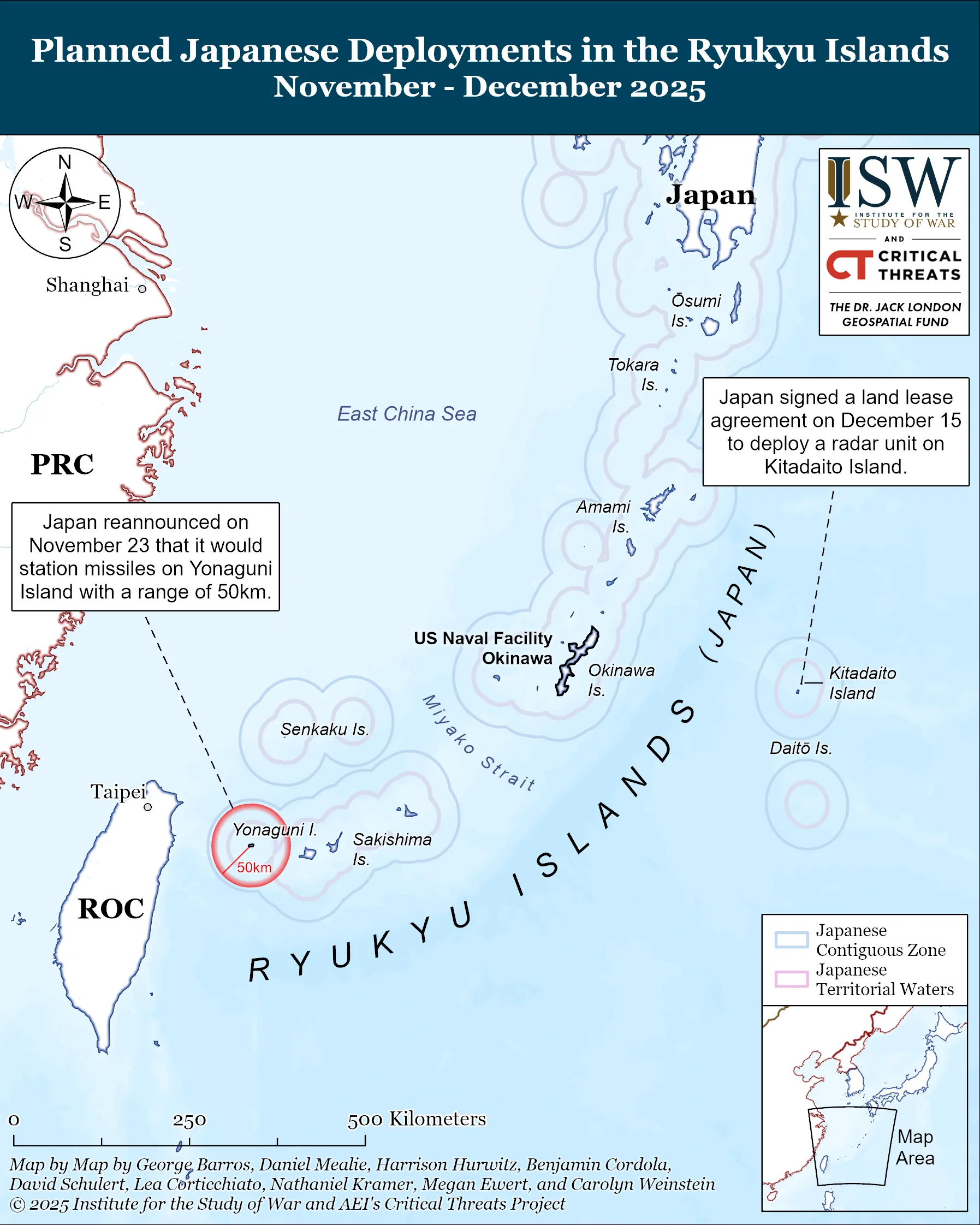
The PRC criticized Japan’s plans to increase its military footprint on remote islands. Japanese media reported that the Japanese Ministry of Defense has signed a land lease agreement to deploy a radar unit on Kitadaito Island, the easternmost island of Okinawa Prefecture.[43] The plan includes deploying a mobile warning and control radar and approximately 30 Japan Self Defense Force (JSDF) personnel.[44] The deployment was made available under the supplementary budget, which the National Diet passed on December 16.[45] Japanese Defense Minister Shinjiro Koizumi said that the deployment is in response to increased air and maritime activities around Japan conducted by neighboring countries.[46] PLA Air Force and Russian Air Force aircraft and the PLA aircraft carrier Liaoning recently operated around Okinawa between December 6 and 12.[47]PRC Foreign Affairs Ministry spokesperson Guo Jiakun criticized Japan’s plans to expand military presence on remote islands, which includes the deployment of medium-range missiles on Yonaguni Island that Koizumi announced on November 23.[48] Guo linked the deployments to Japanese Prime Minister Sanae Takaichi’s statement on November 7 that indicated the possible mobilization of JSDF in response to a hypothetical PRC invasion of Taiwan and claimed that Japan may be making provocations to create pretexts for its military expansion.[49] Koizumi asserted that the plan to deploy the radar unit is defensive in nature and consistent with common international practice, however.[50] The radar unit could enhance Japan’s ability to monitor PLA activities in the area since PLA vessels frequently transit the Miyako Strait.
South Korea
South Korea urged the PRC to support the restoration of inter-Korean affairs. The PRC remains silent on the North Korea nuclear issue, however. South Korea’s First Vice Foreign Minister Park Yoon-joo met with PRC Executive Vice Foreign Minister Ma Zhaoxu on December 18 during their 11th PRC-ROK Senior-Level Strategic Dialogue in Beijing.[51] Park urged Beijing to play a role in “fostering conditions to resume dialogue with North Korea,” while Ma reaffirmed that the PRC would continue its “constructive role” in maintaining peace and stability on the Korean Peninsula.[52] The two sides also exchanged views on the PRC’s maritime installations in the Yellow Sea and ways to revitalize cultural exchanges.[53] The PRC has been constructing steel structures within the bilateral Provisional Measures Zone (PMZ), an overlapping area of disputed waters, claiming they are for “fishery” purposes.[54] South Korea has lodged protests citing the PMZ agreement, but the PRC has continued the construction. The dialogue followed the November 1 summit between CCP General Secretary Xi Jinping and South Korean President Lee Jae Myung, which the two states have framed as a diplomatic reset.[55]
South Korea appears to view Beijing as a potential intermediary to Pyongyang. The PRC has deepened engagement with North Korea following the September 3 summit between Xi and Workers’ Party of Korea (WPK) General Secretary Kim Jong Un.[56] The PRC has shown heightened diplomatic support for North Korea, including opposing additional international sanctions, dispatching CCP Premier Li Qiang to attend the October 10 WPK military parade that featured nuclear weapons, and removing references to North Korean denuclearization from its latest defense white paper.[57] The PRC also omitted any reference to North Korea in its meeting readout with Park.[58] The PRC’s growing silence on North Korea suggests a tacit acceptance to Pyongyang’s nuclear status and a departure from its longstanding policy of promoting denuclearization while maintaining neutrality on the Peninsula.[59] PRC-North Korea economic cooperation has also expanded, with bilateral trade reaching a six-year high in December 2025, alongside reports of the PRC exporting sugar and drone-related technology.[60] South Korea has refrained from protesting this cooperation, likely to avoid destabilizing relations with the PRC. The PRC could further normalize its support for North Korea and undermine nonproliferation efforts on the Korean Peninsula.
The South Korean Lee Jae Myung administration will bifurcate its North Korea policy discussion channels with the United States. Lee has decided to take further preemptive actions on North Korea by accepting the Unification Ministry’s (MOU) engagement plan. An unnamed high-level official in the Lee administration stated on December 16 that Seoul decided to bifurcate dialogue channels with Washington between the Ministry of Foreign Affairs (MOFA) and the MOU. The MOFA will primarily oversee North Korea’s nuclear issues, while the MOU will manage inter-Korean dialogue, exchanges, and cooperation.[61] The MOU on December 15 indirectly expressed dissatisfaction with the MOFA-led discussion format by declining to attend a high-level meeting on the United States-South Korea summit factsheet.[62] The administration also plans to formalize monthly vice-ministerial meetings for the first time since 2005.[63] MOU Minister Chung Dong-young has consistently maintained that the MOU should serve as the lead agency for North Korea policy. The MOU has proposed relations-building measures, such as a downsizing of US-South Korea combined military exercise, a restoration of civilian cooperation, and a relief of economic sanctions, to ease hostile relations with North Korea.[64] MOFA Minister Cho Hyun stated on December 19 that the ministries share “the same goal,” while differing only in “methodology,” in an effort to downplay internal friction.[65] Cho added that the government would establish a unified North Korea policy through consultations with the MOU.[66]
South Korean President Lee Jae Myung formalized the MOU’s leading role in North Korea-related affairs during a joint briefing on December 19.[67] The MOU seeks to take the lead in resolving issues by promoting the Ministry and South Korea as a direct party to inter-Korean relations. The United States has not yet issued a position regarding the Korean Peninsula strategy, nor has it responded to the separation of channels. Seoul’s dual-track channel will likely complicate the detailed coordination process with Washington. The MOU’s demands on the US-South Korea combined military exercise and easing of sanctions, particularly, may expose a fundamental strategic rift in North Korea policy between the two allies.
Europe
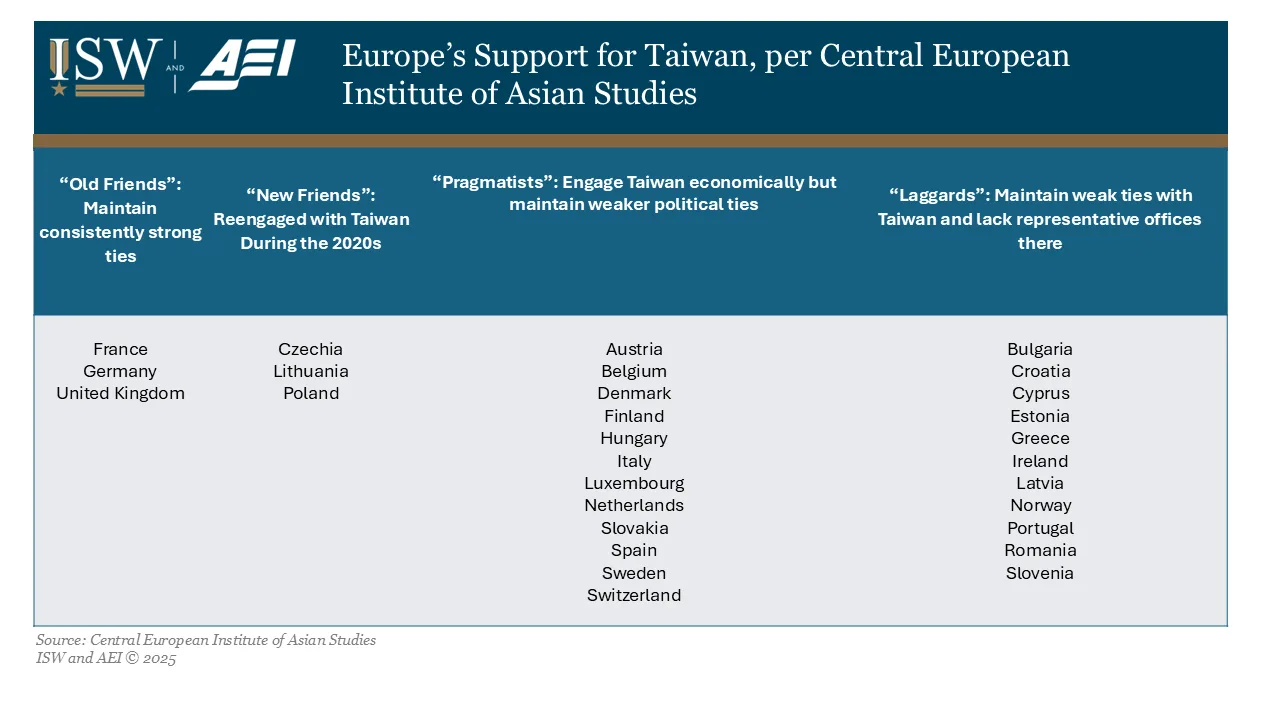
European think tank Central European Institute of Asian Studies (CEIAS) released a report finding that EU-Taiwan mutual visits have increased sixfold since 2019. These findings reflect Europe’s efforts to balance economic engagement with the PRC against diplomatic support for Taiwan. CEIAS demarcated European states into four categories: “old friends” maintaining consistently strong ties with Taiwan, “new friends” that reinvigorated cooperation in the 2020s, “pragmatists” with strong economic but weak political ties, and “laggards” with no representative offices in Taiwan.[68] The report’s executive summary stated that “Taiwan’s central role in critical supply chains—particularly in advanced technologies such as semiconductors—has further elevated its importance in European strategic thinking, while uncertainty surrounding U.S. foreign policy has reinforced incentives for more autonomous and diversified cooperation.”[69] The report recommended that Taiwan and Europe continue to deepen their ties across political parties and diversify beyond semiconductors to build economic ties.[70]The PRC is actively working to erode Taiwan’s international support, including by offering economic inducements to dissuade countries from recognizing Taiwan. Taiwan’s only formal diplomatic ally in Europe is the Holy See.[71] Other states that recognize Taiwan globally include Belize, Paraguay, Guatemala, Haiti, St. Lucia, St. Kitts and Nevis, St. Vincent and the Grenadines, and Eswatini, as well as Pacific island states Tuvalu, Palau, and the Marshall Islands.[72]
Iran
Iranian government officials and media criticized the PRC for supporting the UAE in its dispute with Iran over three islands near the Strait of Hormuz. Iranian rhetoric compared the disputed islands to Taiwan and accused the PRC of maintaining a “double standard” on territorial sovereignty issues. PRC Foreign Minister Wang Yi met with his UAE counterpart Sheikh Abdullah bin Zayed in Abu Dhabi on December 12. Wang expressed PRC support for the UAE’s “efforts to peacefully resolve the issue over the three islands of Greater Tunb, Lesser Tunb, and Abu Musa” in the joint readout of the meeting.[73] The UAE and Iran both claim sovereignty over the three islands, which are strategically located near vital shipping lanes through the Strait of Hormuz.[74] Iran has effectively controlled the islands since 1971 and maintains military forces there.[75] Iranian Ministry of Foreign Affairs (MFA) spokesperson Esmaeil Baghaei condemned the joint statement, criticizing the “unfounded and wrong claim. . . in the final statement of the Chinese foreign minister’s visit to the UAE.”[76] Ahmad Naderi, a hardline member of Iran’s parliamentary presidium, accused the PRC of hypocrisy and maintaining a “double standard” by claiming sovereignty over Taiwan as a non-negotiable issue while supporting the UAE’s push for negotiations over the islands.[77] Several Iranian state-affiliated newspapers also criticized the PRC’s statement as hypocritical and compared the disputed islands to Taiwan.[78]
Iranian officials and media have criticized the PRC for using similar language supporting negotiations over the islands in past PRC-UAE joint statements. The Iranian MFA summoned the PRC ambassador and stated that it expected the PRC to “revise its stance on this matter” after a PRC-UAE joint statement expressed support for the UAE seeking a “peaceful solution” to the dispute in June 2024.[79] PRC MFA spokesperson Mao Ning stated that the PRC-UAE joint statement was “consistent with China’s position” in a press conference later that week.[80] Two members of Iran’s parliamentary presidium criticized the PRC after a PRC-Gulf Cooperation Council (GCC) joint statement included similar language in December 2022: Ahmad Naderi said that the PRC “should not talk too much” and mentioned Taiwan in a statement on social media, and Alireza Salimi called CCP General Secretary Xi Jinping “naïve” and warned PRC leaders “not to be fooled” by the GCC countries.[81] The Iranian deputy foreign minister for the Asia-Pacific also summoned the PRC ambassador in protest.[82] Reformist Iranian newspaper Arman Daily ran a front-page story entitled “Taiwan Independence: A Legal Right” arguing that the PRC would have to accept de jure Taiwanese independence after the joint statement.[83] The PRC has not yet issued any response to Iran after the Iranian officials’ remarks.
Iran’s highly public criticisms of PRC sovereignty claims diverge substantially from its usual rhetoric. Iran does not recognize Taiwan as an independent country, and it endorses the PRC’s “One-China Principle” under which the PRC claims sovereignty over Taiwan.[84] Iran is not likely to recognize Taiwan in the near future, but its rhetoric illustrates willingness to publicly pressure the PRC and possibly extract concessions on other issues.
The PRC maintains significant interests in both Iran and the UAE. Iran is a major oil supplier, and the UAE is a significant target for PRC investment and a re-export hub for PRC exports, including goods routed through the UAE to avoid tariffs.[85] The PRC also relies on Iran to oppose Western involvement and influence in the Middle East. The PRC reportedly supported Iranian-backed Houthi fighters materially, also encouraging them to continue attacks on Western commercial shipping while refraining from attacking PRC ships.[86] The PRC is also currently pushing for a conclusion to free trade negotiations with the GCC and will likely maintain its support for the UAE as these negotiations continue.[87] The PRC will likely maintain moral and material support for Iranian belligerence against Western powers in the region and continue purchasing low-cost Iranian oil while also deepening diplomatic and economic ties with the UAE and other GCC states to develop the bloc as a hub for PRC industry and investment. The PRC is unlikely to publicly take sides between Iran and the UAE or the GCC, instead balancing economic and strategic relationships with both.
Americas
The PRC has reportedly demanded that shipping company COSCO receive a controlling stake in CK Hutchison’s port sale, which includes two Panama Canal ports, to BlackRock. The Wall Street Journal reported on December 16 that the PRC has threatened to block the deal unless this condition is met.[88] The Wall Street Journal cited unnamed sources who stated that the PRC initially advocated equal partnership for COSCO but has since demanded a majority stake.[89] COSCO is a PRC state-owned enterprise (SOE) that also maintains a sixty percent stake in Peru’s Chancay megaport.[90] COSCO is also affiliated with the PLA, to which it has furnished support for naval operations.[91] Bloomberg reported in July 2025 COSCO sought veto power to overrule decisions contradicting the PRC’s interests, citing unnamed sources.[92]COSCO’s majority stake in Panama Canal ports risks increasing PRC state access to a key strategic waterway. ISW-CDOT previously assessed that the PRC would likely view the sale of the two Panama Canal ports as a victory for the United States in terms of influence over global shipping and sea lines of communication.[93] Panama previously failed to renew its membership in the PRC’s Belt and Road Initiative in February 2025, indicating it may be distancing itself from economic engagement with the PRC.[94] The PRC will likely continue to obstruct CK Hutchison’s sale of the ports to maintain its foothold in Panama.