
China & Taiwan Update, January 23, 2026
Toplines
The PLA flew a surveillance drone through Taiwanese airspace over Pratas (Dongsha) Island on January 17, possibly the first confirmed PLA violation of Taiwan’s territorial airspace in decades. The PRC is escalating incursions into Taiwanese-administered airspace and waters to assert its sovereignty, test Taiwan’s response, and erode Taiwan’s threat awareness. Taiwan’s Ministry of National Defense (MND) condemned the incursion as a “serious disruption of regional peace” and stated that it directed the local garrison to enhance its alert levels, though the drone flew beyond the range of Pratas’ air defenses.[1] The drone was a WZ-7 “Soaring Dragon,” according to an unnamed national security official.[2] The PLA Southern Theater Command announced the flight as “normal flight training” with drones in airspace near “China’s Dongsha Island.”[3]
The drone flight was likely the first violation of Taiwan’s airspace by a PLA aircraft in many years and could have triggered a Taiwanese military response. Taiwanese then-Defense Minister Chiu Kuo-cheng said in 2022 that Taiwan changed its definition of an enemy “first strike” against Taiwan to include intrusions by aircraft and drones into Taiwan’s territorial airspace.[4] The MND also presented guidelines in October 2025 to clarify the protocol for military personnel to intercept drones.[5] Purportedly civilian PRC drones have violated Taiwan’s airspace over the outlying Kinmen and Matsu islands on multiple occasions in recent years, including during the August 2022 military exercises that followed then US House Speaker Nancy Pelosi’s visit to Taiwan.[6] ISW-CDOT was unable to verify conflicting reports that some of the 2022 drone incursions were conducted by military rather than civilian drones.[7] A PLA drone briefly flew near enough to the Matsu airport in July 2024 to disrupt flights but did not enter Matsu’s airspace.[8] Dozens of PRC high-altitude balloons have floated through Taiwanese airspace in recent years, including 13 so far in January 2026.[9] The balloons likely carried surveillance equipment but did not trigger a Taiwanese military response, because they flew too high to easily intercept and because they are not considered military aircraft.[10]
The drone incursion likely targeted Pratas to test Taiwan’s response to an airspace violation without triggering unwanted military escalation. Pratas is a small, relatively remote island that hosts a small garrison of Taiwanese marines and coast guard personnel but has no permanent civilian population. Taiwan’s outlying islands are generally easier targets than Taiwan itself, because of their proximity to the PRC and because Beijing likely expects Taiwan (and the United States) would hesitate to risk war to defend them.
The Pratas drone incursion is latest escalation in the PRC’s multifaceted campaign to gradually erode Taiwan’s sovereignty and threat awareness. The China Coast Guard (CCG) began regular incursions into restricted waters around Kinmen in February 2024, and around Pratas in February 2025.[11] The CCG has portrayed these incursions as normal law enforcement operations to give the impression that the PRC has legitimate jurisdiction and de facto control of those areas. Such incursions also serve a cognitive warfare purpose by portraying Taiwan as unwilling or unable to defend its territory. Normalizing maritime and aerial incursions around Taiwan makes it more difficult for Taiwan to identify genuine threats and thus enhances the PRC’s tactical surprise if it chooses to invade.
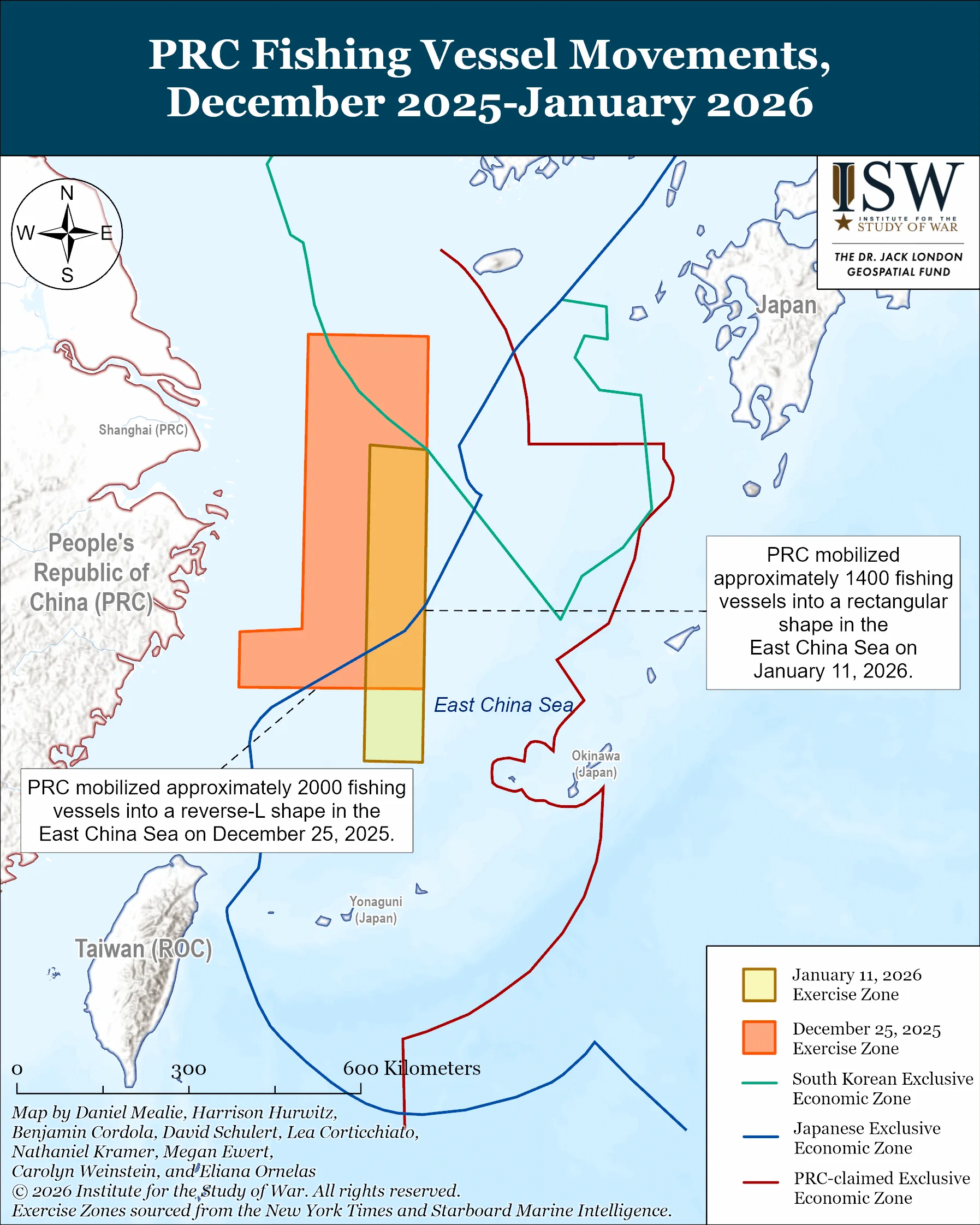
PRC fishing vessels mobilized in a large formation in the East China Sea, possibly for a military exercise. The mobilization is likely intended to highlight the prevalence and capabilities of the China Maritime Militia (CMM). The New York Times reported that approximately 1,400 vessels mobilized from the PRC to the west and waters off Japan from the east between January 9 and 12, holding position in a rectangular shape on January 11. This formation resembled a similar exercise in the East China Sea on December 25, 2025, in which approximately 2,000 ships mobilized into a reverse L-shape.[12] The New York Times cited Asia Maritime Transparency Initiative Director Greg Poling, who argued that the mobilizations were not consistent with normal fishing boat movements and were likely “state-directed.”[13]
The two formations show how the PRC could use thousands of coordinated CMM boats to support military operations, such as a blockade, and shape the maritime environment. The CMM, frequently used to enforce PRC claims in the South China Sea via blocking maneuvers and de-facto occupation, comprises the largest such fleet in the South China Sea.[14] Foreign Policy Research Institute fellow Lonnie Henley told the New York Times that fleets of fishing vessels likely could not act as a blockade due to the small size of individual vessels; they could interfere with foreign warship movement during a military contingency, however.[15] CMM vessels can provide support to directly state-affiliated vessels, including CCG ships; this cooperation occurred in 2024, when the CCG rammed a Philippine vessel in the South China Sea.[16] The ostensibly civilian nature of CMM vessels allows the PRC to maintain deniability and protect the vessels under international law, despite the CMM’s affiliation with the PLA.[17] The PRC may use CMM vessels in a “cabbage strategy” involving layers of vessels both surrounding Taiwan and insulating it against foreign intervention during a military contingency.[18]
The mobilization comes amid an ongoing PRC-Japan diplomatic spat regarding Taiwan’s defense. The PRC may have selected this location to mobilize the CMM as a show of force against Japan following Japanese Prime Minister Sanae Takaichi’s comments that a PRC attack on Taiwan would precipitate a “survival-threatening situation” and that Japan would likely be drawn into a Taiwan contingency.[19] Taiwanese officials have noted the ship movements and called for joint responses with regional partners.[20] Japan’s coast guard and defense ministry declined to comment on the vessels’ presence.[21]
The PLA is practicing its ability to execute a decapitation strike against Taiwan’s political leadership. The PLA may be integrating tactical lessons from the US operation to capture Venezuelan President Nicolas Maduro with these exercises. The PRC’s state broadcasting service released footage on January 17 of an unspecified PLA unit conducting a training exercise that drilled “decapitation strikes” using precision munitions and special operations forces.[22] The video showed reconnaissance drones designating targets which were then destroyed by precision munitions launched from J-16 fighter jets.[23] A separate video depicted a special operations forces nighttime raid on an unidentified building complex described as a “decapitation” operation.[24]
The training exercises exhibited several similarities to the US Delta Force’s raid to capture Venezuelan President Nicolas Maduro on January 3. The PLA special operations forces practiced clearing the target building of guards and eliminating “terrorists.”[25] The J-16 is one of the few PLA aircraft capable of mounting electronic warfare (EW) pods, a capability that the United States Navy’s EA-18 Growler used to suppress Venezuelan air defense radar during the January 3 raid.[26] The PLA may be using these exercises to integrate lessons from the US operation and enhance their readiness to conduct multi-domain decapitation strikes. PRC interest in a decapitation strike predates the US operation in Venezuela, however.[27]
The PLA likely practiced a decapitation operation against Taiwan’s political leadership that could form a key component of a blockade or invasion of Taiwan. The PLA recently deployed a Type 075 Landing Helicopter Dock (LHD) off the coast of Taiwan during its Justice Mission 2025 exercises from December 29 to 30 to practice “long-range rapid assaults.”[28] Justice Mission 2025 also simulated precision strikes against Taipei.[29] The PLA could include a decapitation operation as part of a blockade of Taiwan, to facilitate Taiwanese capitulation or paralyze Taiwan’s ability to respond to PLA aggression.[30] The PLA has previously drilled this capability and has constructed a mock-up version of Taiwan’s presidential palace and its surrounding environment in Inner Mongolia for simulations.[31] It is unclear if the PLA has an elite special operations force unit like Delta Force that could reliably execute such an operation, however.[32]
Taiwan’s military police is improving its ability to prevent a PLA decapitation strike from succeeding. The PLA would likely face significant obstacles in a decapitation strike against Taiwan. Taiwanese media reported on January 18 that the 202 Military Police Command added a new battalion to its structure specialized in air defense missions.[33] The 202 military police command is responsible for defending the presidential palace and the residence of Taiwan’s president and vice president.[34] Taiwan’s military police also announced that it was planning to procure 21 Stinger man portable air defense systems (MANPADS) to enhance its ability to target helicopters and plans to equip its forces with the domestically produced T112 rifle to improve its firepower.[35] These measures are likely designed to counter the possibility of a PLA helicopter-borne special operations forces raid that aims to kill or capture Taiwan’s political leadership.
The PLA would likely face more substantial obstacles impeding a decapitation strike against Taiwan than US forces faced when capturing Maduro. Taiwan’s air defense network is likely more advanced than Venezuela’s due to its deployment of the Patriot missile system and the National Advanced Surface-to-Air Missile System (NASAMS) as well as several mobile air defense batteries that Taiwan has domestically produced.[36] Taiwan’s air force is also more modernized and larger than that of Venezuela.[37] The PLA lacks special operations forces experience and has a limited number of EW aircraft that would be required to emulate the US operation in Venezuela.[38]
Key Takeaways
PLA Military Activity: The PLA flew a surveillance drone through Taiwanese airspace over Pratas on January 17, possibly marking the first confirmed PLA violation of Taiwanese territorial airspace in decades. The PLA is escalating military activity around Taiwan to assert PRC sovereignty, test Taiwanese responses, and erode Taiwanese threat awareness.
CMM mobilization: PRC fishing vessels mobilized in a large formation between January 9 and 12 in the East China Sea. This mobilization could be for an exercise off the waters near Japan, possibly signaling continued PRC displeasure with Japanese Prime Minister Sanae Takaichi.
PLA Decapitation Strike Exercises: The PLA is practicing its ability to conduct a decapitation strike against Taiwan. The PLA may be incorporating lessons learned from the US operation against Venezuelan President Nicolas Maduro.
Taiwanese Military Enhancement: Taiwan’s military police added a new battalion specialized in air defense missions to its structure on January 18. This could improve Taiwan’s overall capabilities to disrupt PLA decapitation strikes.
Cross-Strait Relations
Taiwan
The United States and Taiwan announced a trade agreement on January 16 that will lower US tariffs on Taiwan in exchange for massive investment from Taiwan’s semiconductor industry to shift semiconductor production to the United States. The deal is unlikely to diminish Taiwan’s importance to the global semiconductor supply chain. The US Department of Commerce stated that the deal includes 250 billion US dollars’ worth of investment from Taiwan’s semiconductor industry in the United States in exchange for lowering tariffs to 15 percent.[39] Taiwan’s government also promised to guarantee another 250 billion US dollars in credit to allow smaller Taiwanese tech companies to invest in the United States. Taiwan’s Executive Yuan (EY) referred to this as the “Taiwan model” and contrasted it with the direct investments that the Japanese and South Korean governments promised in negotiations with the United States.[40]
Taiwanese President William Lai Ching-te touted the deal as a major win for both Taiwan and the United States and claimed it illustrated the strength of US-Taiwanese bilateral relations.[41] Lai also stated that the deal will improve cooperation in the defense and AI sectors.[42] Taiwan’s EY stated that as long as the “main peak” of Taiwan’s semiconductor industry remained in Taiwan, such deals would not undermine Taiwan’s “silicon shield.” The “silicon shield” concept maintains that Taiwan’s importance to the global semiconductor supply chain provides incentives for its allies to aid its defense and disincentives for the PRC to invade.[43] This trade deal may allow Taiwan to increase its defense cooperation with the United States and ensure that tariff issues are no longer obstacles to productive bilateral relations.
Taiwan’s main opposition parties, the Kuomintang (KMT) and the Taiwan People’s Party (TPP), have criticized the deal for “gutting” Taiwan’s semiconductor industry and spending large amounts of money to improve the US economy.[44] United States Commerce Secretary Howard Lutnick stated on January 16 that the United States aims to move 40 percent of Taiwan’s semiconductor manufacturing capacity to the United States by the end of 2028.[45] Taiwan’s semiconductor industry accounts for approximately 90 percent of global manufacturing of the most advanced semiconductor chips on the market. Taiwan is also a global leader in chip design.[46]
Taiwan’s MND increased its planned drone procurement from 50,000 systems to 200,000 in its Special Budget for Asymmetric War. The increase reflects the budget’s importance to Taiwan’s efforts to implement an asymmetric defense strategy. Taiwanese Minister of National Defense Wellington Koo gave a closed-door briefing to the Legislative Yuan’s Foreign Affairs and Defense Committee on January 19 outlining the procurement plan under the special budget.[47] The MND also released a public announcement that it plans to procure 200,000 unmanned aerial vehicles (UAVs) and 1,000 unmanned surface vessels (USVs) with the special budget’s funds.[48] Taiwanese media had previously reported in July 2025 that the MND planned to procure only 50,000 UAVs in the near future.[49] Taiwanese media reported that the MND will procure 1,554 Altius 700m anti-armor drones and 478 Altius 600 reconnaissance drones through the budget from the US defense company Anduril.[50] The MND did not specify the type of UAVs or USVs it would procure other than the Altius systems.
Taiwan must drastically increase its existing UAV and USV stockpiles if unmanned systems are to form a key component of Taiwan’s defense concept. It is likely that the opening days of an invasion of Taiwan would see significant drone usage on both sides, particularly of USVs due to the maritime nature of an amphibious campaign. Increasing Taiwan’s drone procurements through the special budget will allow Taiwan’s military to more effectively integrate unmanned systems into an asymmetric defense of Taiwan and ensure it can sustain the use of unmanned systems during a defensive campaign.
Failure to pass the special budget in a timely manner and without significant cuts may impair Taiwan’s ability to acquire the systems it needs to effectively implement an asymmetric defense strategy. Unmanned systems are a crucial component of an asymmetric defense concept because they will allow Taiwan’s military to target crucial elements of a PLA landing campaign, such as its amphibious assault vessels, throughout the Taiwan Strait with relatively low-cost systems and minimal risk to its own personnel. The special budget continues to face opposition from the KMT and TPP, however.[51]
The United States House of Representatives passed increased funding to address Indo-Pacific defense, including funding for Taiwan and the Philippines. The funds are intended to address PRC threats to US Indo-Pacific interests including influence operations, among other PRC threats. A January 15 readout stipulated that 35.9 million US dollars will go to American Institute in Taiwan, the de-facto United States embassy in Taipei. It also earmarked 2.3 billion US dollars in funding for foreign military financing grants and loans to Taiwan and a 400-million-US-dollar fund for “countering PRC influence.”[52] Funding for these initiatives will flow through the US State Department and Treasury.
The US Congress has shown continued bipartisan support for Taiwan’s defense.[53] The House Appropriations Committee released the 2026 Consolidated Appropriations Act on January 19.[54] The Appropriations Act earmarks one billion US dollars for the Taiwan Security Cooperation Initiative (TSCI) and 150 million US dollars to replace defense articles and reimburse defense services provided to Taiwan.”[55] The TSCI authorizes support to “enable Taiwan to maintain sufficient self-defense capabilities.”[56] Taiwan’s Vice Minister of National Defense Hsu Szu-chien also said that four other arms sales in addition to those announced in December 2025 are pending notification to Congress, indicating ongoing US efforts to support Taiwan’s defense.[57] US arms deliveries to Taiwan still face a significant backlog, however.[58] The US House of Representatives on January 20 introduced the Providing Our Regional Companions Upgraded Protection in Nefarious Environments (PORCUPINE) Act as a means of improving the speed of arms sales to Taiwan by designating Taiwan a “NATO-plus” country.[59]
Two US warships conducted the first US transit through the Taiwan Strait of 2026. The US guided missile destroyer USS John Finn and survey ship USNS Mary Sears sailed through the Taiwan Strait from January 16-17.[60] A statement from the US 7th Fleet on January 20 described the transit as “routine” and intended to uphold the freedom of navigation of all nations in the strait. The statement said that the transit occurred in an area beyond any country’s territorial sea. A spokesperson for the PLA Eastern Theater Command (ETC), which oversees the Taiwan Strait, said on January 17 that the ETC deployed navy and air force troops to monitor the transit.[61] The PRC did not condemn the transit, as it has previously, however.
The United States has conducted Freedom of Navigation Operations (FONOPs) through the Taiwan Strait and parts of the South China Sea multiple times per year since the mid-2010s to challenge illegal maritime claims by the PRC and other countries in the region.[62] The annual number of US FONOPS through the Taiwan Strait peaked at 13 in 2020 but declined to three in 2025.[63] US partner states such as Japan, the United Kingdom, and Australia have conducted significantly more Taiwan Strait FONOPs in recent years, however, showing increased burden-sharing among US-allied states in the region.[64] The PRC claims the entire Taiwan Strait as being under its jurisdiction (including territorial waters, contiguous zone, and Exclusive Economic Zone).[65] Territorial waters only extend 12 nautical miles from a state’s coastline or territorial sea baseline, however, leaving a corridor in the middle of the strait where no country has a right to restrict the passage of foreign ships.
A Taiwanese appellate court sentenced a Taiwanese resident to eight years in prison for creating organizations under the direction of the CCP’s United Front.[66] The PRC uses the United Front to infiltrate and influence Taiwanese politics and society to erode Taiwan’s sovereignty. The United Front is a whole-of-government and -society effort by the CCP to co-opt non-government segments of society that the PRC deems subject to its rule.[67] It frequently targets various sectors of Taiwanese society through civil organizations, as well as academic exchange programs, business communities, ancestral hometown associations, and co-opted Taiwanese online influencers.[68]
The accused, Zhou Manzhi, was born in the PRC and entered Taiwan in 2003, marrying a Taiwanese national and obtaining Taiwanese residency in 2004.[69] Taiwan’s High Court found that Zhou founded the “Chinese Patriotic Party” and established two civil organizations under the direction of PRC United Front operative Cui Guowei.[70] Zhou’s organizations targeted PRC nationals married to Taiwanese citizens and first- and second-generation PRC immigrants to Taiwan, encouraging them to support the CCP and to vote for the PRC’s favored candidates in Taiwanese elections.[71] PRC influence operations target these PRC immigrants in Taiwan to cultivate pro-PRC political support, and United Front disinformation efforts exploit Taiwanese immigration issues to undermine Taiwanese President William Lai Ching-te’s administration.[72] PRC state media accounts spread online disinformation about Taiwanese immigration policies towards PRC nationals married to Taiwanese citizens to attack and delegitimize the Lai administration in 2025.[73]
United Front political influence operations targeting Taiwanese voters likely aim to garner support for the PRC’s preferred candidates in important upcoming local elections in November. The PRC carried out significant disinformation and election interference operations during Taiwan’s local elections in 2018 and 2022.[74]
Taiwan’s High Court sentenced a man, surnamed Chiao, to six months in prison on January 20 for attempting to bribe a Mainland Affairs Council (MAC) official to obtain classified information for a PRC intelligence agency.[75] Chiao reportedly sought classified information on MAC research related to flights across the Taiwan Strait and defense topics while working as an EVA Air representative in the PRC from 2012-2014.[76] Taiwanese authorities convicted Chiao for offering a MAC official a 3,150-US-dollar bribe for sensitive information, which the official refused.[77] Authorities confiscated around 4,300 US dollars in illicit gains from Chiao.[78]
PRC espionage operations target the Taiwanese government and military to acquire sensitive information on Taiwan’s defenses and to discredit it and undermine its authority by corrupting Taiwanese soldiers and government officials through bribery.[79] The MAC official’s refusal to accept a bribe from Chiao likely significantly reduced the effectiveness of this PRC espionage operation for both objectives.
China
Canadian Prime Minister Mark Carney and CCP General Secretary Xi Jinping signed a trade deal on January 16. The PRC may seek to portray itself as a responsible partner amid Canadian displeasure with the United States. Carney agreed to cut Canada’s 100 percent tariff on PRC-made electric cars and increase the number of PRC-made vehicles imported. The PRC will in turn significantly reduce its tariffs on Canadian canola seeds and will allow visa-free entry for Canadians travelling to the PRC.[80]Xi and Carney both emphasized the importance of positive PRC-Canada trade relations to their respective economies and agreed to jointly safeguard global security.[81] The trade agreement could indicate the PRC’s desire to exploit frustrations between the United States and its allies. The PRC may be attempting to drive a wedge between the United States and Canada, a key “Five Eyes” intelligence-sharing ally and economic partner. The PRC seeks to show itself as a responsible global partner in contrast to the United States.
Northeast Asia
North Korea
The PRC and North Korea have recovered their pre-pandemic level trade volume as of December.[82] The PRC General Administration of Customs reported that PRC-North Korean trade in December 2025 was the highest recorded since November 2017.[83] The two countries reported 310 million US dollars in trade for December, a 30-million-US-dollar increase from November. PRC-North Korea trade has experienced a steady upward trend since the COVID-19 pandemic.[84]
The PRC and North Korea will likely continue to expand their trade relationship in 2026. The PRC is constructing a new large-scale trade complex in Dandong, a city on the PRC-North Korea border.[85] North Korea is continuing to smuggle goods such as vehicles, grains, and oil through the PRC.[86] North Korea will likely seek to expand its trade relations with Russia as well, indicated by the ongoing construction of North Korea’s first road-bridge connecting it to Russia.[87]
North Korea’s trade cooperation with the PRC comes amid a possible downturn in PRC-North Korean political relations. Worker’s Party of Korea (WPK) General Secretary Kim Jong Un did not mention Xi Jinping’s name in his January 9 New Years Greetings, a significant omission and deviation from the norm. The omission of Xi’s name could indicate that Kim is prioritizing the relationship with Moscow more than the relationship with Beijing at the moment. Russia currently fully acknowledges and supports the Kim Jong Un regime, while the PRC remains hesitant to broaden its engagement. Kim likely considers Russia a better partner as a result. The omission of Xi’s name may also reflect Kim’s discontent with Beijing regarding its recent diplomatic engagement with Seoul. Xi Jinping met with South Korean President Lee Jae Myung on January 5 and agreed to enhance PRC-South Korean bilateral cooperation.
Southeast Asia
Philippines
Japan and the Philippines signed the Acquisition and Cross-Servicing Agreement (ACSA) on January 15 as part of the two countries’ ongoing efforts to increase defense cooperation.[88] The PRC opposes Japanese defense cooperation efforts and will likely attempt to break any coalitions Japan forms. The ACSA allows the Japan Self-Defense Force (JSDF) and the Armed Forces of the Philippines (AFP) to provide each other supplies, excluding weapons, and services during exercises, trainings, and disaster relief operations.[89] The ACSA builds on the Reciprocal Access Agreement signed in July 2024, which allows Japan and the Philippines to deploy forces to each other’s territories. Japanese Foreign Minister Toshimitsu Motegi also announced on January 15 that Japan will provide the Philippines with multi-role response vessels and initiate new projects in the Philippines under the Official Security Assistance, which include boat shelters for the Philippines Navy and coastal radar systems.[90]
PRC Foreign Affairs Ministry spokesperson Guo Jiakun reiterated the PRC’s opposition to international cooperation that “target third parties” and accused Japan of attempting to justify its remilitarization and expansionist agenda on January 16.[91] Guo also commented that Japan has an unpaid “blood debt” to the Philippines for its occupation during World War II, likely an attempt to undermine the coalition.[92] The PRC has consistently opposed Japan’s deepening military cooperation with other countries. The PRC is likely concerned that deeper cooperation between the JSDF and the AFP may obstruct the PRC’s territorial claims in the East and South China Seas and its activities around Taiwan.