China & Taiwan Update, February 13, 2026
Toplines
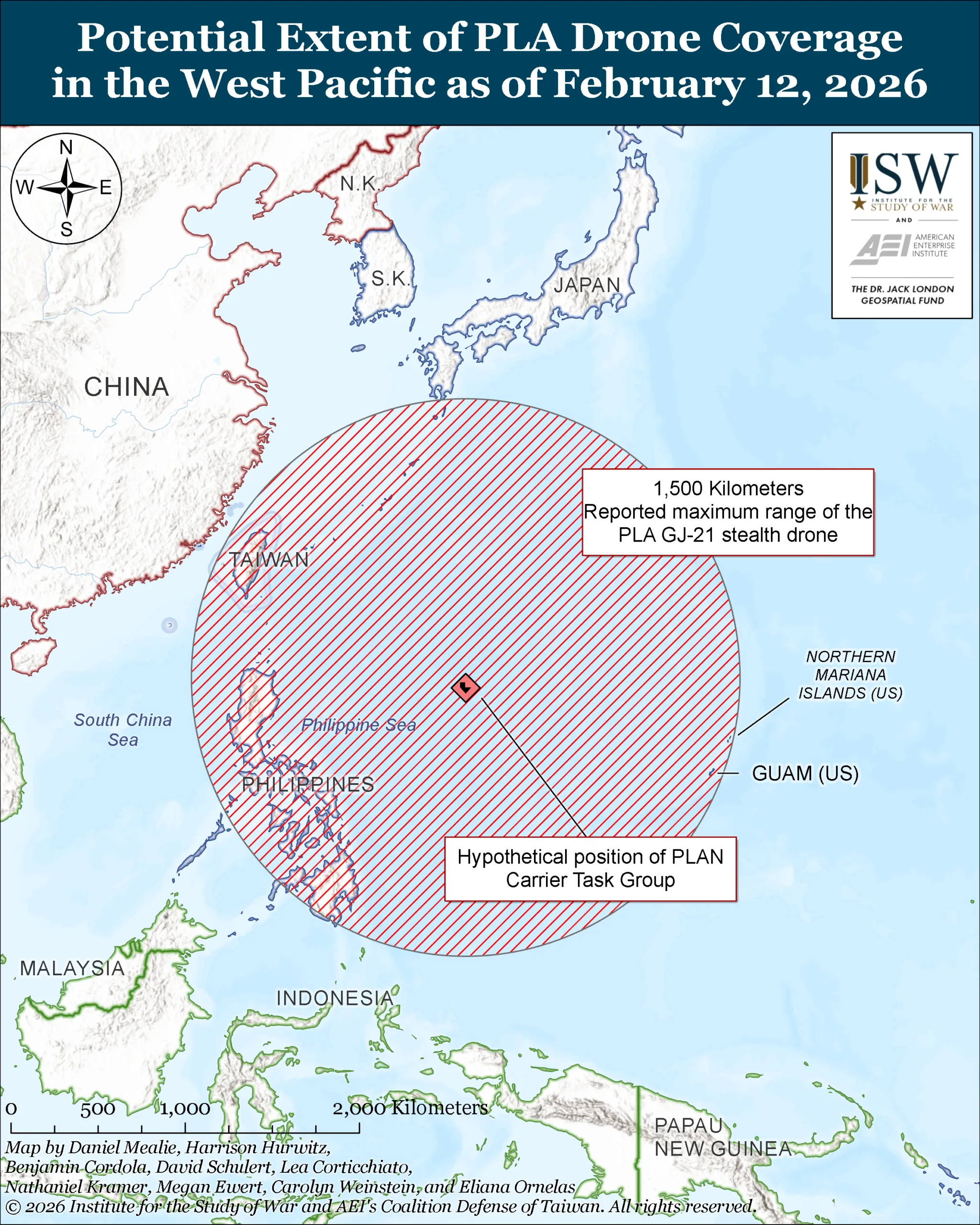
The PLA’s newest amphibious assault vessel, the Type 076 landing helicopter dock (LHD) Sichuan, could be equipped with as many as six GJ-21 naval stealth drones. The Type 076 will likely use the GJ-21 to support long-distance PLA Navy (PLAN) deployments. Photos circulating on Chinese social media showed Sichuan at an unknown location with a cloth-draped aircraft on its flight deck, which the South China Morning Post speculated may be a GJ-21.[1] Sichuan is the first amphibious assault vessel of its kind to be equipped with an electromagnetic catapult launch system, making the vessel able to launch large, fixed-wing aircraft.[2] PRC sources described Sichuan as a “drone carrier” in November 2025 during its first sea trials.[3] The GJ-21 is the naval variant of the GJ-11 “Sharp Sword” reconnaissance and strike drone, which has a range of at least 1,500 kilometers and can carry a 2,000 kilogram payload and advanced radar equipment.[4] South China Morning Post cited a military expert who claimed that Sichuan could deploy as many as six GJ-21 drones from its deck.[5] Sichuan displaces around 50,000 tons and can carry 1,000 marines and two air-cushioned landing craft (LCAC) for amphibious operations.[6]
Sichuan and future ships of its class could use the GJ-21 to support long-distance deployments of large PLAN task groups by enhancing their survivability and strike capacity. ISW-CDOT previously assessed that Sichuan would likely remedy existing weaknesses in the PLAN carrier fleet once it commissions.[7] PLAN carriers Shandong and Liaoning lack catapult launch systems and cannot deploy larger airborne warning and control systems (AWACS).[8] Sichuan could accompany either carrier on a long-range deployment and use the GJ-21 in a reconnaissance and intelligence role to improve the situational awareness of the PLAN’s surface forces when they are outside the range of land-based sensors. This would allow Shandong or Liaoning, and their respective escorts, to operate more effectively at longer distances from the PRC. Shandong and Liaoning have both deployed astride the sea lines of communication (SLOCs) between Taiwan, Japan, and Guam in the Western Pacific in 2025.[9] Sichuan and the GJ-21 could support this kind of deployment and increase the threat that a PLAN surface fleet poses to US and partner forces aiming to relieve Taiwan during an invasion or blockade.
ISW-CDOT previously reported that the PLA has increased its efforts to integrate unmanned systems into its concept of operations for amphibious landings.[10] Sichuan’s possible deployment of several GJ-21 drones is a continuation of this trend, although ISW-CDOT continues to assess that the Type 076 will likely play a greater role in far seas operations than in close-range amphibious landing support missions. The GJ-21 could conduct shaping operations ahead of a main amphibious landing, such as reconnaissance of beach defenses or precision strikes against these defenses.[11] The GJ-21’s stealth design could improve its ability to penetrate Taiwan’s air defense network while conducting these operations, enhancing their effectiveness.[12]
The PLA may be improving its ability to use unmanned aerial vehicles (UAV) to conduct aerial resupply missions for its ground forces. The PLA could use this capability to enhance over-the-beach (OTB) resupply, a potential logistical weak point during an invasion of Taiwan. PRC state media released footage of the YH-1000S transport drone making its maiden test flight on February 2.[13] It reported that the drone uses a hybrid engine system with electric and gas power, which improves the drone’s range and short takeoff and landing capability.[14] PRC aviation experts claimed that the drone has a maximum cargo capacity of 1,000 kilograms, a 1,600 kilometer flight range, and can take off and land on improvised runways, such as grass fields or dirt roads.[15]
The PLA could use the YH-1000S to rapidly scale its OTB resupply during an amphibious invasion due to the drone’s large carrying capacity and short takeoff and landing capability. OTB resupply will likely be a critical mission for the PLA, especially before its initial landing forces seize a working port facility.[16] The PLA will likely have to rely heavily on roll-on, roll-off ferries and other commercial ships to conduct OTB resupply due to its lack of military sealift. Such civilian ships are especially vulnerable to Taiwanese interdiction, however, due to their lack of defensive armament.[17] Diversifying the vectors of OTB resupply to include UAVs may increase the PLA’s resilience to Taiwanese interdiction efforts during the initial phases of a landing campaign. It is possible that these drones could launch from the PLAN’s amphibious assault vessels or its aircraft carriers, although the PLA has not demonstrated this capability.
Key Takeaways
PLA capabilities: The PLA’s newest amphibious assault vessel, the Type 076 landing helicopter dock (LHD) Sichuan, could be equipped with as many as six GJ-21 naval stealth drones. The Type 076 will likely use the GJ-21 to support long-distance PLA Navy (PLAN) deployments.
PLA capabilities: The PLA may be improving its ability to use unmanned aerial vehicles (UAV) to conduct aerial resupply missions for its ground forces. The PLA could use this capability to enhance over-the-beach (OTB) resupply, a potential logistical weak point during an invasion of Taiwan.
Cross-Strait Relations
Taiwan
The US House of Representatives advanced two bills to promote US-Taiwanese space cooperation and bolster US efforts to counteract PRC coercion against Taiwan. The House Committee on Science, Space, and Technology advanced the Taiwan and American Space Assistance Act (TASA Act) on February 4 as an amendment to the NASA Reauthorization Act of 2026. The TASA Act would allow the US National Air and Space Administration (NASA) and National Oceanographic and Atmospheric Administration (NOAA) to collaborate with Taiwan on satellite, atmospheric, and space exploration programs.[18] The bill must now be passed by the full House, and then the Senate, before the president can sign it into law.[19] The House also passed the PROTECT Taiwan Act on February 9. The PROTECT Taiwan Act stipulates that the United States will seek to exclude the PRC from international financial institutions if Beijing threatens “Taiwan’s security, economic system, or social system” and US interests.[20] The bill will be passed to the Senate and ultimately the presidency for final approval.[21]Both bills can enhance Taiwan’s security and international participation. Space and satellite cooperation could particularly enhance maritime and communications security. Taiwan has explored using low-earth orbit (LEO) satellites equipped with synthetic aperture radar (SAR) as a means of detecting PRC vessels illegally approaching Taiwan.[22] Taiwan has similarly sought LEO satellites as a means of enhancing communications redundancy amid PRC attempts to sever its undersea internet cables.[23]
China
The PRC may increase engagement with certain leaders from the main Taiwanese opposition party, the Kuomintang (KMT), to advance key Taiwan-related policy goals in 2026. The CCP held its annual Taiwan Work Conference from February 9-10.[24] The meeting convenes top officials from Taiwan policy agencies to formulate a comprehensive approach toward Taiwan for the year.[25] Taiwanese news outlet Liberty Times cited an unnamed source in Beijing on February 8 who identified four core policies that the conference would focus on: uniting “patriotic” forces in Taiwan and preventing the United States from arming Taiwan; promoting the integration of PRC-Taiwanese supply chains and weakening US-Taiwanese supply chains; strengthening the legal basis for unification and punishing supporters of Taiwan independence; and establishing a special task force that utilizes United Front work and cyberspace to damage the Democratic Progressive Party (DPP) in Taiwan’s upcoming municipal elections.[26] The United Front is a whole-of-government and -society effort by the CCP to co-opt non-government elements that the PRC deems subject to its rule, which includes Chinese diaspora populations and Taiwanese people.
PRC coverage of the annual meeting focused on a speech by Wang Huning, the CCP’s fourth-ranked official and chief idealogue. Wang is the deputy leader of the CCP’s Central Leading Group for Taiwan Affairs, making him the party’s top decision maker on Taiwan policy after CCP General Secretary Xi Jinping.[27] Wang in his speech emphasized promoting cross-strait exchanges, attracting Taiwanese businesses to the PRC, and advancing cross-strait integration.[28] Wang earlier met with KMT Vice Chairman Hsiao Hsu-tsen on February 4 during a CCP-KMT think tank forum in Beijing.[29] Liberty Times, a DPP-aligned Taiwanese newspaper, cited unnamed sources in Beijing who claimed that Wang urged Hsiao and the KMT to advocate for unification more strongly, block US arms purchases, and prioritize supply chain integration with the PRC over the United States. Hsiao denied the veracity of the Liberty Times report and claimed that he and Wang did not discuss any political issues.[30]
Alignment between Wang’s alleged talking points with Hsiao and the reported Taiwan policy goals outlined in the Taiwan Work Conference likely reflects the CCP view that engagement with certain KMT leaders—especially segments that favor closer cooperation with the PRC—is a tool to achieve desired outcomes in Taiwanese politics. Hsiao, KMT Chairwoman Cheng Li-wun, and other KMT officials denied Liberty Times reporting that they took any instructions from the CCP, however, and the KMT is suing the publication for false reporting about the recent exchanges and alleged discussions about a future meeting between Cheng and Xi Jinping.[31] Liberty Times defended its reporting.
The US Department of Justice revealed that convicted PRC operative Yaoning “Mike” Sun surveilled then-Taiwanese President Tsai Ing-wen during Tsai’s visit to the United States in 2023. US authorities arrested Sun in December 2024, and a federal court sentenced him to four years in prison on February 9 for illegally acting as an unregistered agent of political influence for the PRC.[32] Sun worked as campaign manager for councilwoman Eileen Wang of Arcadia, California, in 2022, and worked from at least 2022 to January 2024 to influence local politics in the PRC’s favor.[33] Sun worked with another convicted PRC agent, John Chen, to prepare reports on Wang’s election for PRC government officials and solicit funds from the PRC to combat “anti-China forces,” including supposed pro-Taiwanese independence and “Chinese secessionist forces” in the United States.[34] The PRC uses the term “secessionist” to describe Taiwanese people who oppose its annexation of Taiwan.[35] Sun’s sentencing announcement revealed that he sent real-time updates on then-Taiwanese President Tsai’s movements to a PRC consular official during Tsai’s visit to California in April 2023.[36] Sun also photographed pro-Tsai demonstrators and sent the photos to the official.[37]
The PRC uses its agents abroad, including diplomatic officials, to surveil and harass high-ranking Taiwanese leaders travelling abroad. A PRC military attaché ran a red light and nearly caused a car crash while tailing Taiwan’s then-Vice President-elect Hsiao Bi-khim during her visit to Czechia in March 2024.[38] Three PRC diplomats also reportedly planned (but did not carry out) a “demonstrative” (presumably non-lethal) car crash targeting Hsiao, likely to intimidate her and other Taiwanese leaders.[39] The PRC aims to suppress Taiwan’s international diplomatic engagements and silence Taiwanese political leaders who have spoken out about the PRC’s coercive efforts against Taiwan, along with PRC dissidents and other supposed “anti-China” activists abroad.[40]
Northeast Asia
Japan
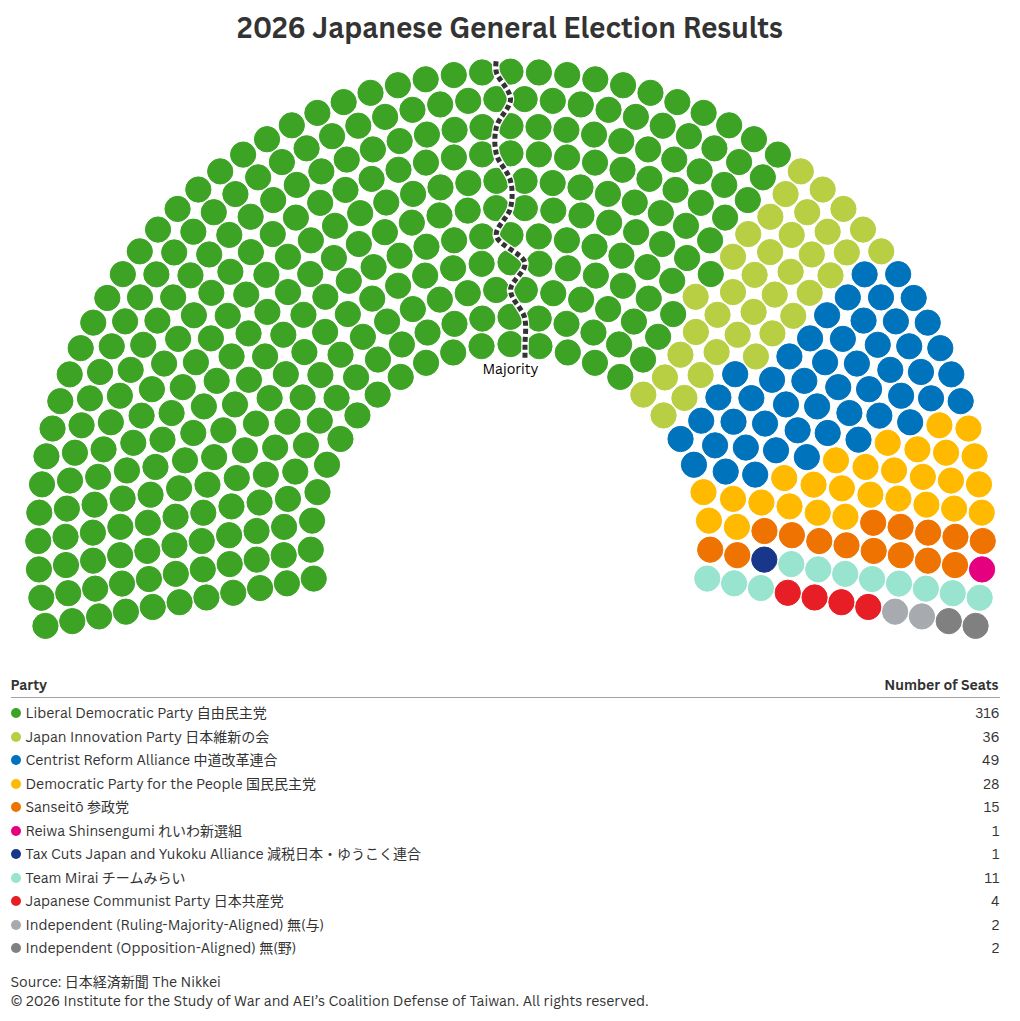
Japan’s ruling Liberal Democratic Party’s (LDP) won a landslide victory in the general election on February 8 that will give Prime Minister Sanae Takaichi a broader mandate to pursue her national security priorities in the face of PRC pressure. LDP’s victory illustrates the failure of the PRC’s pressure campaign against Takaichi, whom the PRC accuses of reviving Japanese militarism. LDP won 316 out of 465 seats in the House of Representatives snap election, 118 seats more than it won in the previous election in 2024.[41] LDP now has the two-thirds supermajority required to override decisions made by the House of Councillors, the upper house where LDP has a plurality but not a majority. It also holds enough seats to amend the constitution, which Takaichi declared that LDP will begin planning to do.[42] The Centrist Reform Alliance (CRA), the newly established opposition party formed by the merger of the Constitutional Democratic Party of Japan (CDP) and the Komeito Party in January, won only 49 seats, 118 fewer than the two former parties had collectively held before the election.[43] The CRA and its constituent parties are more PRC-friendly than the LDP and have criticized Takaichi for her comments on Taiwan in November 2025, when she suggested that Japan could militarily intervene if the PRC invades Taiwan.[44]
The PRC may have inadvertently contributed to the LDP’s victory through its multi-pronged coercive campaign against Japan, including increasing military presence and imposing import and export restrictions, to pressure Takaichi into retracting her November statement.[45] The PRC also largely suspended high-level exchanges with Japan since November 2025. LDP’s landslide victory reflects Prime Minister Sanae Takaichi’s high popularity and will allow Takaichi to pursue her national security priorities despite strong PRC opposition. PRC officials and media have accused Takaichi of trying to revive Japan’s World War II-era militarism. Takaichi has maintained a hardline position on the PRC and pledged to increase Japan’s defense budget, expand the JSDF’s capabilities, and strengthen the alliance with the United States.[46] Takaichi said she still welcomes dialogue with the PRC, however.[47]
Tensions between Japan and the PRC will likely continue as Takaichi strengthens her control over the Japanese government and LDP. PRC Foreign Affairs Ministry spokesperson Lin Jian on February 9 warned of “serious backlash” against Japan’s “far-right forces,” and threatened to combat “any form of provocation and reckless behavior” from anti-PRC forces.[48] Lin further rejected Takaichi’s invitation for dialogue with the PRC on February 10, accusing Takaichi of insincerity and “stoking confrontation” while calling for conversation.[49] Lin reiterated the PRC’s demand that Takaichi withdraw her November statement on Taiwan as a precondition to resume communications.[50]
Europe
Authorities in Greece and France separately charged spies attempting to pass sensitive NATO military information to the PRC last week. The PRC likely seeks information about NATO military capabilities both to develop countermeasures against them and to modernize its own military. French authorities charged two PRC nationals on February 5 for attempting to intercept Starlink satellite communications, including sensitive military information, and transmit it to the PRC.[51] The PRC nationals reportedly entered France on visas identifying them as engineers for a wireless telecom firm and allegedly set up satellite intercept equipment at an Airbnb rental property near France’s only Starlink ground station in Villenave d’Ornon.[52] The authorities said that two other suspects aided the operation by illegally importing the equipment into France.[53]
Greek military authorities also arrested a Greek Air Force colonel on February 5 for allegedly passing NATO military secrets to a PRC intelligence agent for money.[54] The colonel commanded a telecommunications and electronics training squadron from 2014 until his arrest.[55] The authorities alleged that the colonel’s PRC handler first contacted him through LinkedIn, presenting himself as a businessman named “Steven Wayne” and commissioning the colonel to write reports for Steven’s technology firm’s website for 500 to 600 Euros each.[56] The colonel allegedly later travelled to the PRC, after which his PRC handler began paying him 5000 Euros per month in cryptocurrency to send classified military information.[57]
PRC intelligence operations target NATO member states to acquire sensitive defense information on modern military forces and their capabilities, both to improve the PLA’s own capabilities and to develop countermeasures against its possible Western and Western-armed adversaries in the Western Pacific. A PRC spy ring in Germany passed information to PRC intelligence about shipments of military equipment and employees of Germany’s largest defense firm, Rheinmetall, from 2023 to 2024.[58] The PRC also views the Starlink low-earth orbit (LEO) satellite constellation, which Ukrainian forces have effectively used to maintain communications while fighting Russia’s invasion, as an important modern high-tech military capability.[59] Taiwan is seeking to develop a domestically-produced LEO satellite to provide it with similar communications capabilities.[60] The PRC is likely seeking to develop its ability to intercept Starlink communications, disrupt Taiwanese and US LEO satellite networks, and replicate such technology for its own use.[61]
Lithuanian Prime Minister Inga Ruginiene publicly called it a mistake to allow a “Taiwanese” representative office to open in Vilnius and signaled willingness to rename the office to “Taipei” representative office to avoid the implication that Taiwan is a country. Ruginiene stated in an interview on February 5 that naming the de-facto embassy the Taiwanese representative office “was probably a huge mistake” and that “the world did not appreciate it.”[62] Lithuania allowed Taiwan to open the “Taiwanese Representative Office” in 2021, an unprecedented name that implies Taiwanese statehood and sovereignty—other countries use “Taipei Representative Office” to avoid that implication. [63] Lithuania does not have formal relations with Taiwan.[64] PRC Foreign Ministry spokesperson Lin Jian responded on February 6 stating the PRC’s willingness to work to normalize relations should Lithuania uphold the one-China principle.[65] Ruginiene stated on February 11 her willingness to rename the Taiwanese representative office to a “Taipei Representative Office” and called the 2021 decision a “hasty step,” signaling that Lithuania seeks to renormalize relations with the PRC.[66] Ruginiene’s comments suggest that international support for Lithuania’s bolstered ties with Taiwan was insufficient to offset PRC retaliation.
The PRC retaliated to the 2021 decision by downgrading diplomatic relations and imposing informal economic punishments on Lithuania. The PRC blocked Lithuanian imports by removing Lithuania from its customs systems, halted freight rail links, and pressured companies such as car makers and tech firms to stop using Lithuanian components to avoid being banned from the PRC market.[67] The PRC also recalled its ambassador from Vilnius, and Lithuania recalled its ambassador and other diplomatic staff from the PRC. [68] This reflects a long-standing pattern by which the PRC leverages its economic dominance to coerce nations from taking any actions that could be viewed as support for Taiwanese independence. Lithuania’s policy shift may also be influenced by political change: the center-right government that opened the Taiwanese office in 2021 lost its majority to a center-left coalition in 2024, and Ruginiene became Prime Minister in September 2025.[69]
Latin America
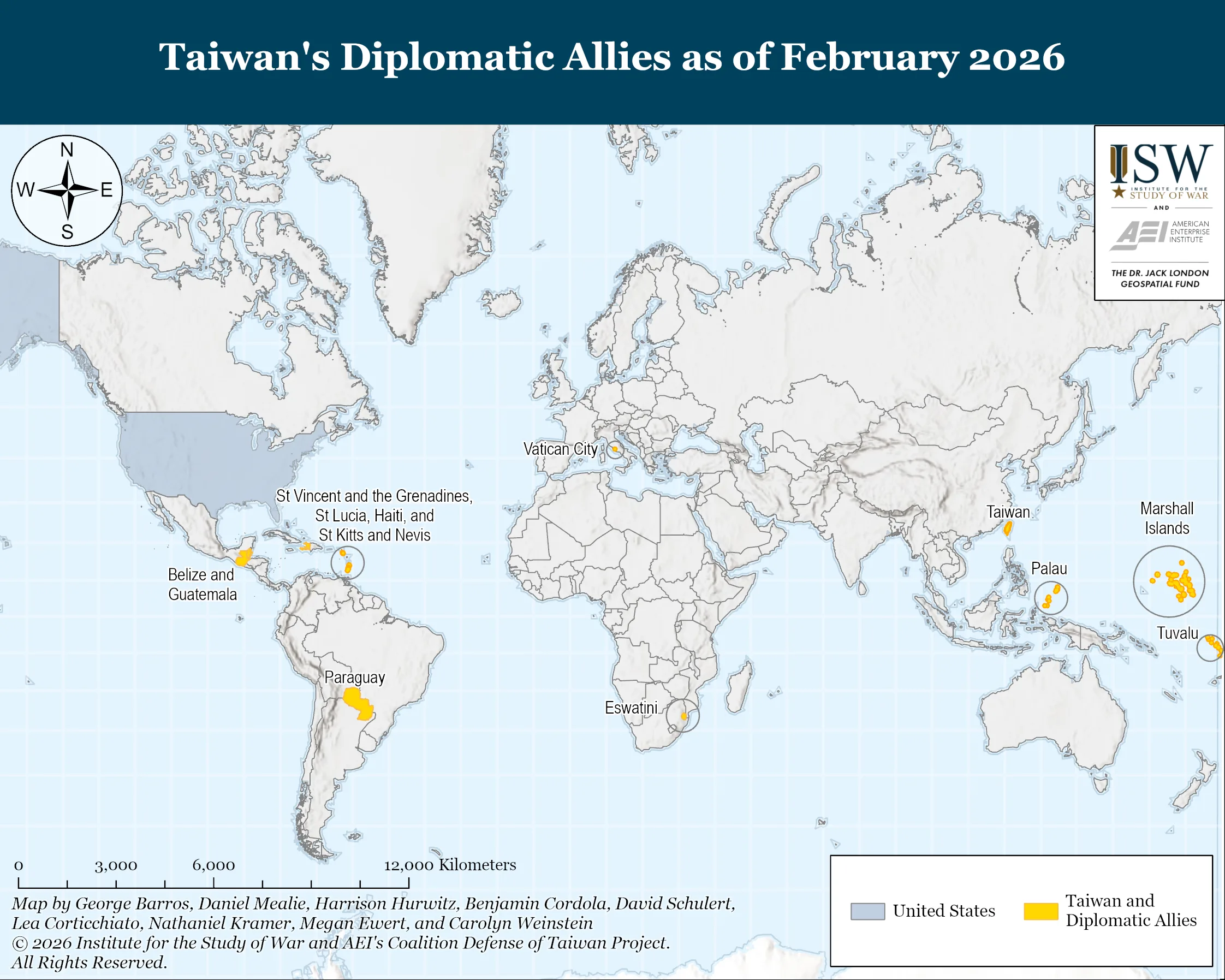
Honduran President Nasry Asfura said that he is considering switching Honduras’s diplomatic recognition from the PRC to Taiwan. The switch is part of a trend of the PRC losing diplomatic ground in Latin America over the past year, in line with US goals to reduce adversarial influence in the Western hemisphere. Asfura, who took office on January 27, made the statement after meeting with US President Donald Trump on February 7, repeating comments he made during his presidential run in 2025.[70] Honduras previously severed its diplomatic ties with Taiwan in 2023 under Asfura’s predecessor.[71] Honduran Vice President Maria Antonieta Mejia said that restoring relations with Taiwan would be a “gradual process,” which requires reviewing 16 agreements that the previous administration had signed with the PRC and assessing their economic impact, according to an article in Honduran media on February 9.[72] Honduras would rejoin Belize, Paraguay, and Guatemala as South and Central American countries that officially recognize Taiwan.[73]
Honduras’s shift toward Taiwan is part of a growing trend indicating the PRC may be losing ground in Latin America, in line with US foreign policy goals. The United States’ most recent National Security Strategy referenced “Non-Hemispheric competitors” as a threat to US interests in Latin America and emphasized that the United States would take steps to curb such competitors’ influence in the hemisphere.[74] The Panamanian Supreme Court cancelled a subsidiary of Hong Kong-based CK Hutchison’s contracts over two ports on the Panama Canal on January 29. Panama also declined to renew its involvement with the PRC’s Belt and Road Initiative (BRI) in 2025, despite being the BRI’s first signatory in Latin America.[75] Mexico imposed high tariffs on the PRC at the beginning of 2026.[76] The US removal of Venezuelan President Nicolas Maduro and energy blockade of Cuba in early 2026 have also weakened the PRC’s two staunchest ideological allies in Latin America.
The PRC has used economic inducements and coercion to poach Taiwanese allies and may intensify such efforts in Honduras to prevent Honduras from restoring ties with Taiwan.[77] Honduran sentiments toward the PRC quickly soured after the two established relations due to a widespread perception that the PRC did not deliver on the economic promises it made to entice Honduras. The shift in diplomatic resulted in a drastic drop in Honduran shrimp exports, which the PRC failed to purchase.[78] Both top Honduran presidential candidates expressed anti-PRC views in the 2025 election; Asfura’s chief opponent, Salvador Nasralla, said that Honduras had seen “absolutely no benefit” from its ties with the PRC.[79]