
Meanwhile: Afghan-Based Terrorists Stirring New India-Pakistan Tensions
A worsening militancy in Southwest Asia is again ramping up the risk of a major conflict between nuclear-armed adversaries India and Pakistan..
Pakistan has twice bombed territory deep inside Afghanistan, the latest raid coming overnight Saturday after a series of deadly attacks which Pakistan blamed on India-backed militants hiding in the country. The Taliban government has threatened to reply at a time and place of its choosing.
In the last three weeks suicide bombers have attacked a Shia mosque in Pakistan’s capital Islamabad, killing 31 worshippers; a military outpost, killing 11 security personnel; and a police station, killing two.
Although the Taliban’s options for retaliation are limited, its recent alignment with Pakistan’s arch enemy India escalates the situation.
Islamabad claims that India provides financial backing and training to anti-Pakistan organizations such as Tehreek-e-Taliban Pakistan (TTP), which have found refuge in Afghanistan. Recently, New Delhi has deepened its ties with Afghanistan’s Taliban government. In October last year, the Taliban’s foreign minister visited New Delhi, following which India upgraded its embassy in Kabul. However, India has yet to officially recognize the Afghan government diplomatically. So far, Russia remains the only nation to have granted formal recognition.
War is a constant risk in Southwest Asia, where longstanding enemies India and Pakistan both possess nuclear weapons.
Elevated Tensions
In May last year the two neighbors fought a brief war that ended after four days with Pakistan claiming victory after downing five Indian fighter jets, a claim Washington later corroborated.
The latest round of escalating attacks by Afghan-based militants and the Taliban government’s closer ties with India has further elevated tensions in a region, where a multitude of militant groups operate with seeming impunity.
Growing instability has expanded the areas where governmental authority in Pakistan and Afghanistan is minimal or nonexistent. This situation has benefited numerous militant organizations, who are now intensifying their recruitment efforts, coordinating more sophisticated attacks, and securing increased financial resources and backing.
A look at the region’s complex militant landscape shows a pattern of escalating violence and constant change.
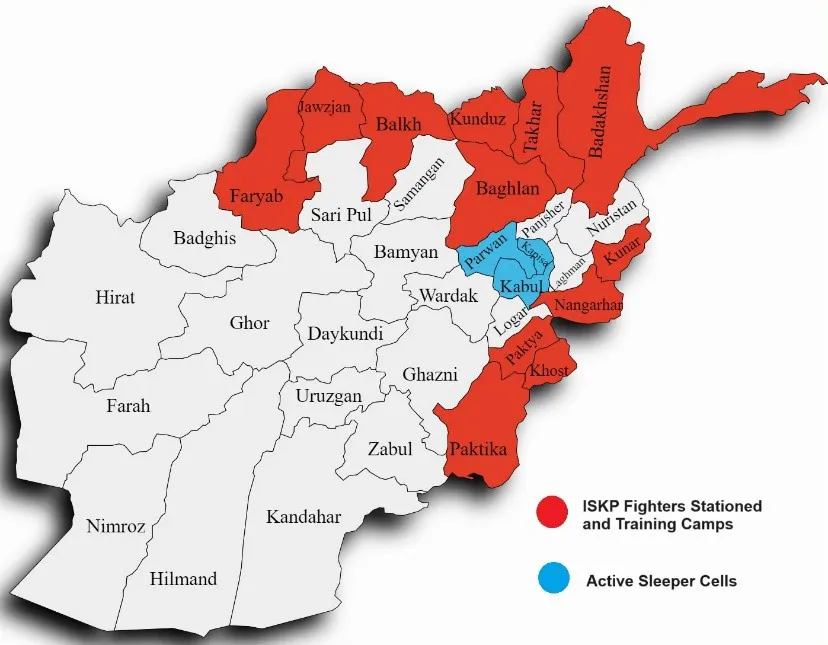
There are credible reports of disgruntled Islamic State militants from Syria finding safe spaces with their brethren militants in Afghanistan’s northern provinces, where the Islamic State in Khorasan Province (ISKP) has small camps. From these camps ISKP is actively recruiting from Afghanistan’s ethnic Uzbek community as well as neighboring Uzbekistan.
The number of fighters from Syria is difficult to gauge, says Mohammad Amir Rana, executive director of the Pakistan Institute of Peace Studies (PIPS). The numbers fluctuate wildly ranging from dozens of Syrian malcontents to thousands.
In Pakistan’s troubled Baluchistan province, a new semi-autonomous branch of the ISKP has emerged, known as the Islamic State Pakistan Province (ISPP). Its numbers are small, yet its attacks, though few in number, are most often among the deadliest, says Rana, whose organization tracks militant activity in Pakistan.
A gruesome video released last year by the ISPP was the first evidence of its presence in Pakistan. It showed the militants in the largely ungovernable area of Mustung in Baluchistan province, in the country’s southwest bordering Afghanistan and Iran. Disturbingly it showed fleeting alliances with other militant groups, alliances that later collapsed, deteriorating into ferocious battles, further destabilizing the region.
In widely circulated pamphlets, the ISPP labelled secessionist and nationalist militants operating in Baluchistan province as ‘infidels” declaring war on them.
Currently the largest of the militant groups operating in Baluchistan and from safe havens in Afghanistan is the Baluchistan Liberation Army (BLA) whose numbers are growing. It attracts disgruntled young Baluch who are frustrated by the relentless poverty in the province, despite its abundance of oil, gas and minerals, including coal, , as well as the seemingly endless military operations.
From their redoubts, located mostly in the southern regions of Afghanistan, the BLA has plotted and carried out attacks against Pakistan’s security agencies and often against Chinese workers, who are in the thousands in Pakistan building Beijing’s Belt and Road project that is to link south and central Asia to China.
The BLA’s presence in southern Afghanistan, however, predates the Taliban’s return in 2021.
In 2018, Aslam Baluch, a BLA leader who took responsibility for an attack on the Chinese consulate in Pakistan’s southern city of Karachi, was blown up while trying to wire a car with explosive material in a suburb on the outskirts of Afghanistan’s southern Kandahar city.
The reality of this region is that Afghanistan and the so-called tribal regions of Pakistan that border it have served for decades as a hub for militants from various backgrounds. During the 1980s, these groups were mobilized by the United States and its allies to oppose the former Soviet Red Army in Afghanistan.
Proxy Wars
Another deadly reality of the region is the use of militants as proxies by all the neighbors, with Pakistan deploying militants against India, India using militants against Pakistan, and Afghan factions utilizing them in their internal conflicts.
But they are expanding and evolving into increasingly dangerous and sophisticated entities operating in areas with little or no government control, where access to weapons and explosives is readily available. The tragic events of 9/11 demonstrated that what militants require most is space to organize, strategize, and carry out their operations, as well as a pool of prepared recruits.
While advanced weaponry may eventually hold some value—especially drones that have been used inside Pakistan—it’s the militants’ comprehensive training and skilled trainers who are essential to their success and easily available. ISIS-K’s 2024 attack on Russia’s Crokus City Hall music venue made the point.
When 9/11 occurred, the United States and much of the western world had isolated the Taliban during their first rule between 1996 and 2001. It created a dangerous intelligence vacuum, which Al Qaeda used to its advantage.
The price America paid for ignoring Afghanistan during the Taliban’s first rule was a missed opportunity to perhaps prevent 9/11 or acquire warning information. In about 1999 a senior Taliban member approached the CIA seeking its help to limit the foreign fighters—mostly the so-called “Arab Afghans” and militants from Pakistan—coming by the hundreds into Afghanistan. One of the CIA officials involved confirmed the meeting but said they didn’t follow up because they couldn’t be sure of the veracity of the Taliban rep with whom they were speaking. That Taliban, Mullah Mohammad Khaksar, was a member of the Taliban leadership council, its former intelligence chief in southern Kandahar and a deputy minister of border affairs at the time of the meeting.
Washington has evidently washed its hands of Afghanistan, where it fought a long and ultimately losing war that ended in 2021’s mass emergency airport evacuation. The present approach of again isolating the Taliban has been ineffective, and after five years since their return, they have not responded to pressure to change their extreme Islamic practices, rejected by most every Islamic nations, many of whom have sought to convince the Taliban to relent on their many edicts. In fact, the Taliban have intensified their restrictive and regressive policies, especially those targeting women and girls.
Even as the Taliban government has acted against and sought to eliminate ISKP in Afghanistan,it has also failed to address the growing problem of militancy, which now poses a potential threat to Europe and quite possibly the U.S., not to mention nuclear-armed Pakistan and India.
While agents of the U.S. and other intelligence agencies visit Afghanistan regularly, their absence on the ground has made them reliant on Afghans, many of whom are linked to the previous government and whose misuse of intelligence led the U.S. and coalition forces down countless wrong paths during the initial years of the 2001 invasion of Afghanistan.
The price America paid for ignoring Afghanistan during the Taliban’s first rule was a missed opportunity to perhaps prevent 9/11 or acquire warning information.
In his book, The Afghanistan Papers: A Secret War, published in 2021, Washington Post reporter Craig Whitlock revealed in detail how as early as 2002 the U.S. was repeatedly used by its Afghan allies to settle scores. “Michael Metrinko, a legendary Foreign Service officer,” Whitlock wrote, “said . . . Afghans learned that if they wanted to eliminate a personal rival in a power struggle, land grab or commercial dispute, all they had to do was tell the Americans that their foe belonged to the Taliban.”
During the Taliban’s initial period of governance between 1996 and 2001, al Qaeda expanded its influence as a result of limited international engagement and the Western policy of isolating Afghanistan. This environment contributed to the conditions that eventually culminated in the events of September 11, 2001. While it is impossible to know exactly how much information western intelligence is missing today because of ongoing isolation, the risk of discovering threats too late would seem to rise with each year and every new cycle of regional conflict. ###