
SOUTH ASIA INTELLIGENCE REVIEW
Andhra Pradesh: Impending Maoist Collapse
On March 30, 2026, Andhra Pradesh Director General of Police (DGP) Harish Kumar Gupta declared that the state was free of the Communist Party of India-Maoist (CPI-Maoist), a day before the Centre’s deadline, March 31, 2026. Addressing reporters at the Vijayawada Police Command and Control Centre, the DGP observed,
Over the past 18 months, a total of 18 Maoists were killed in exchange-of-fire incidents across Andhra Pradesh. These include Central Committee members Madvi Hidma, Gajarla Ravi (alias Uday) and Metturi Jogarao (alias ‘Tech Shankar’) as well as AOB Special Zonal Committee members Venkata Ravi Chaitanya (alias ‘Aruna’), Kakuri Pandanna (alias ‘Jagan’) and Madakam Raje. We have also arrested 81 others, while another 106 individuals have surrendered. We have recovered a total of 120 weapons, and are continuing our efforts to locate additional weapon dumps. The SIB [Special Intelligence Branch], Greyhounds, Intelligence Department, and district police personnel have performed commendably in efforts to eradicate Left-Wing Extremism. Cash rewards will be provided to surrendered Maoists as per established norms. We will also ensure that they benefit from various government welfare schemes.
According to partial data collated by the South Asia Terrorism Portal (SATP), 2025 recorded a total of 18 Left Wing Extremism (LWE)-linked incidents, as against 12 in 2024. Such incidents had been on a declining trend since 2018, falling from 37 in that year to 30 in 2019, 19 in 2020, 15 in 2021, 14 in 2022, and 12 each in 2023 and 2024. The increase in 2025 was linked to intensified Security Force (SF) operations in the run-up to the March 31, 2026, deadline for the eradication of Maoism in the state and across the country.
Similarly, incidents of killing have also been falling since 2020. There were seven incidents of killing in 2019, down to four in 2020, two in 2021 and one each in 2022, 2023 and 2024. Marking an increase in 2025, four incidents of killing have been recorded in the State. Overall fatalities have also been declining since 2020, with an exception in 2021. There were 14 fatalities in 2019, which dropped to five in 2020, increased to seven in 2021, and again down to one each in 2022, 2023 and 2024. 18 fatalities were recorded in 2025. A maximum of 204 incidents of killing and 317 fatalities were recorded in 2005.
Moreover, civilian fatalities dropped from five in 2019 to four in 2020 and have since remained at one each in the subsequent four years (2021-2024). No civilian fatality was recorded in 2025.
The last Security Force (SF) fatality in the state was reported on May 5, 2017, when a Home Guard, Sheikh Valli, was killed in a landmine blast triggered by CPI-Maoist cadres on the Lothugedda Junction-Balapam stretch, while returning from the Central Reserve Police Force (CRPF) outpost at Rallagedda in Visakhapatnam District. By contrast, Maoist fatalities rose to 18 in 2025. One of the last major incidents (involving three or more fatalities) involving Maoist casualties occurred on June 16, 2016, when six Maoists were killed in an exchange of fire with Greyhounds of the Andhra Pradesh Police in the Theegalametta Forest area of Koyyuru Mandal (administrative sub-division), under Mampa Police Station limits in Visakhapatnam District.
Meanwhile, at least 58 Maoists (LWE cadres) were arrested in 2025, as against none in 2024, while five arrests each were recorded in 2022 and 2021. Under mounting SF pressure, at least 38 Maoists surrendered in 2025, in addition to 45 such surrenders in 2024. At least 17 Maoists have already surrendered in the current year (data till April 12, 2026), according to the SATP database.
Other indicators of violence also suggest a near-complete halt in Maoist activity in the state. The Maoists have not carried out any major attacks against civilians or SFs in recent years. The last major incident in the civilian category was recorded on February 19, 2023, when three tribals were killed by CPI-Maoist cadres in the Lakkavaram Forest area of G.K. Veedhi Mandal in Visakhapatnam District. In the SF category, the last such major incident dates back to December 25, 2005, when four Railway Protection Force (RPF) personnel escorting a cash box on a Raigarh (Odisha)-bound passenger train were killed and five were injured in a Maoist attack at the Koneru Railway Station in Vizianagaram District.
The State has not recorded any incident of explosion since 2021. The last incident of explosion was recorded on August 3, 2020, in which two civilians were killed. The Maoists have not issued any bandh (shut down strike) call since 2022; there was one such call in 2021. On April 26, 2021, the Maoists had given a call for Bharat Bandh in protest against alleged harassment and torture of innocent people, especially tribals, social activists and civil rights activists, by SFs.
Since the beginning of 2026, Andhra Pradesh has not recorded any fatalities across any category, as of April 12, 2026. Maoists have not carried out any incidents of explosion or arson in the State. No exchange of fire between SFs and Maoists has been reported, nor have Maoists have not issued any bandh (shutdown strike) call in the State. No arrests of Maoists have been recorded. However, at least 17 Maoists have surrendered before the Police (data till April 12, 2026).
It is useful to note that, since March 6, 2000, when SATP began compiling data on LWE, a high of 507 LWE-linked incidents was recorded in Andhra Pradesh in 2005, the year in which the highest civilian fatalities, at 132, were also reported. The highest number of SF fatalities was recorded in 2001, at 41, while Naxalite fatalities peaked in 2003, at 165.
An analysis of overground and underground Maoist activities in Andhra Pradesh confirms their declining impact in the state. According to the SATP database, Maoist activity was reported from only one district in 2025 (out of a total of 26 districts in the state), with Alluri Sitarama Raju District in the ‘moderately affected’ category. In 2024, Maoist activity was reported from four districts. Of these, only Kurnool District fell in the ‘moderately affected’ category, while the remaining three – Alluri Sitarama Raju, Parvathipuram Manyam, and Visakhapatnam – were classified as ‘marginally affected’.
Significantly, on November 19, 2025, Special Intelligence Branch (SIB) Chief and Additional Director General of Police (ADGP) Mahesh Chandra Laddha stated that the Andhra Pradesh Police was working intensively to make the state free of CPI-Maoist and other extremist elements by March 2026. His statement followed two major exchange-of-fire incidents on November 18 and 19 in Alluri Sitarama Raju District, in which 13 Maoists, including senior cadres, were killed. Addressing the media, Laddha noted that around 50 Maoists of various ranks from Chhattisgarh and Telangana had recently entered Andhra Pradesh seeking shelter. In response, coordinated intelligence-led operations led to the arrest of more than 50 Maoists across Krishna, Eluru, NTR, Konaseema, Alluri Sitarama Raju, and Kakinada districts. He further disclosed that six Maoists, including Central Committee Member (CCM) Madvi Hidma alias Santosh, were killed in an encounter near Uttaluru in Maredumilli Mandal, and a substantial cache of weapons, ammunition, and other materials was recovered during post-encounter searches. Terming the operations as among the most comprehensive in recent years, Laddha emphasized their intelligence-driven character.
Early 2026, including the period after the March 31, 2026 deadline, has remained largely incident-free, reflecting sustained SF dominance.
Notwithstanding the Maoists’ impending downfall in the state, the Andhra Pradesh Police continue to face critical shortages in capacity and deployment. According to the latest Bureau of Police Research and Development (BPR&D) data, as of January 1, 2024, the Andhra Pradesh Police had a strength of 88,514 personnel, against a sanctioned strength of 110,186, resulting in a deficit of 19.66 per cent. The police-area ratio (number of policemen per 100 square kilometres) in Andhra Pradesh was just 54.33, compared to the national average of 65.78. Both the state and national averages for the police-area ratio were well below sanctioned levels, at 67.63 and 83.81, respectively. The police-population ratio (police personnel per 100,000 population) in the state was 166.18, as against a sanctioned level of 206.87. Moreover, the sanctioned strength of Indian Police Service (IPS) officers in the state was 144, but only 131 officers were in position, reflecting a deficit of 9.02 per cent, weakening executive supervision of the force.
Andhra Pradesh stands at a critical juncture in its counter-insurgency trajectory, with the near-eradication of Maoist influence marking the culmination of decades of coordinated security and developmental efforts.The decisive unravelling of Maoism in 2025 – reflected in surrenders eclipsing violence and SFs re-establishing control over core forested strongholds – set the stage for the March 31, 2026, Maoist-free deadline articulated by DGP Harish Kumar Gupta. With the deadline now past, this trajectory of decline has been sustained, though residual risks persist. The pre-emption of a spillover from neighbouring theatres and the resolution of enduring socio-economic deficits remain critical to consolidating these gains. The sustained reintegration of surrendered cadres, alongside accelerated development in tribal regions, will be central to securing durable and irreversible peace.
Tripura: Consolidating Peace
Tripura sustained its status as a “zero-insurgency” State through 2025 and into 2026, with no reported insurgency-related fatalities and no active militant violence. The gains achieved through the September 4, 2024, Memorandum of Settlement (MoS) with the National Liberation Front of Tripura (NLFT) and the All Tripura Tiger Force (ATTF) ‘ remained intact, reinforcing a broader trajectory of conflict de-escalation that has been underway for over a decade. However, beneath this apparent stability, emerging concerns relating to rehabilitation deficits, cross-border vulnerabilities, residual militant networks, and new radicalisation linkages, indicate that the State’s security landscape remains fragile and requires sustained policy attention.
The most significant indicator of enduring peace has been the absence of insurgency-linked killings since January 4, 2023, which marked the last recorded fatality in the State. Long-term data further underscores this decline: between 2010 and early 2026, only 17 fatalities were recorded across 13 incidents, and several years within this period reported zero fatalities. The MoS of September 2024 accelerated this trend by facilitating mass surrenders and formal disengagement from armed struggle. The agreement was followed by the laying down of arms ceremony on September 24, 2024, and a total of 902 cadres had joined the mainstream by December 2024. This trajectory continued into 2026, with official disclosures indicating that 1,245 militants surrendered between April 1, 2023, and March 17, 2026. These included cadres from multiple factions of the NLFT and the ATTF, collectively surrendering 147 weapons, including AK-series rifles and grenades.
Despite the quantitative success of surrender and demobilisation, the qualitative dimensions of reintegration remain deeply problematic. Discontent among surrendered militants has emerged as one of the most persistent internal security concerns. Throughout 2025 and early 2026, multiple protests were organised by former insurgents demanding the fulfilment of rehabilitation commitments. On February 25, 2025, the Tripura United Indigenous Revolutionary Peoples’ Council (TUIRPC) staged a blockade of the Assam-Agartala National Highway, reiterating long-standing grievances relating to housing, land allotment, withdrawal of legal cases, and access to basic infrastructure. These protests continued into 2026. On January 7, organisations representing surrendered militants accused the State Government of failing to honour financial commitments under earlier rehabilitation packages, including the non-release of INR 230 million from a sanctioned INR 450 million package. They also highlighted delays in promised benefits such as fencing support under livelihood schemes and the withdrawal of pending cases.
The persistence of such grievances raises concerns about the sustainability of the peace process. While the rehabilitation policy promises a fixed deposit of INR 400,000 and a monthly stipend of INR 6,000 for three years, implementation gaps risk eroding trust between former militants and the State. Incomplete reintegration can lead to recidivism or the emergence of splinter groups, and although no large-scale return to militancy has been observed in Tripura, isolated developments suggest such risks persist. The arrest of two suspected members of the newly formed Tripura United National Front (TUNF) in August 2025, along with the recovery of explosives, indicates that residual militant tendencies have not been entirely extinguished. Intelligence inputs suggesting plans to target police installations further underline the need for vigilance.
Another area of concern is the shifting pattern of arrests in the State. Since 2024, there have been no significant arrests linked directly to established insurgent outfits. Instead, law enforcement actions have increasingly focused on illegal arms possession. Several such arrests were recorded in 2025, including the seizure of pistols and ammunition in West Tripura, Sepahijala, and North Tripura Districts. This trend suggests that, while organised insurgent structures have weakened, the circulation of small arms persists, potentially sustaining a latent capacity for violence. The continued availability of weapons, even in the absence of active insurgent groups, constitutes a critical vulnerability in the State’s security framework.
Tripura’s 856-kilometre-long international border with Bangladesh remains a major structural challenge. Significant portions of the border remain unfenced due to terrain and local disputes and this porous boundary facilitates illegal migration, smuggling, and cross-border militant movement. While bilateral cooperation between Indian and Bangladeshi border forces has improved, the security environment in Bangladesh continues to have spillover effects. In 2025, the Border Security Force (BSF) reported significant enforcement activity along the Tripura frontier, including the detention of illegal immigrants – part of a broader trend in which at least 3,518 illegal migrants were apprehended in the State between 2022 and August 2025. According to data presented by Chief Minister Manik Saha in the State Assembly on September 23, 2025, this included 982 migrants in 2022 (965 Bangladeshis and 17 Rohingyas), 1,072 in 2023 (1,014 Bangladeshis and 58 Rohingyas), 1,007 in 2024 (947 Bangladeshis and 60 Rohingyas), and 406 up to August 2025 (390 Bangladeshis and 16 Rohingyas). In addition, a small number of other foreign nationals, including individuals from Nigeria and France, were also detained for illegal entry. Of the total apprehended, 2,739 were subsequently pushed back to their respective countries.
Developments during 2025 and 2026 further illustrate the evolving nature of cross-border threats. On June 3, 2025, Tripura Police arrested cadres of the Bangladesh-based Parbatya Chattagram Jana Samhati Samiti (PCJSS), who had crossed into Indian territory following clashes in the Chittagong Hill Tracts (CHT) of Bangladesh. Such incidents highlight the continued relevance of cross-border ethnic insurgencies and the potential for conflict spillover. Additionally, the recovery of drones near the India-Bangladesh border in April and August 2025 raised concerns about surveillance and possible reconnaissance activities. The use of unmanned aerial vehicles suggests a technological evolution in cross-border operations, which could be exploited for smuggling or intelligence gathering.
More troubling is the emergence of Islamist radicalisation networks with linkages to neighbouring States. On December 30, 2025, a suspected operative of the Imam Mahmuder Kafila (IMK), linked to the Jamaat-ul-Mujahideen Bangladesh (JMB), was arrested in West Tripura as part of a wider operation led by the Assam Police. Investigations revealed that the network was involved in online radicalisation, recruitment, and facilitation of cross-border movement for training. The use of encrypted platforms and digital propaganda indicates a shift from traditional insurgency to more diffuse, networked forms of extremism. Although such activities remain limited in scale within Tripura, their presence signals an emerging dimension of security risk that requires proactive counter-radicalisation strategies.
The State has also witnessed sporadic incidents involving foreign nationals and illegal transit networks. The arrest of a suspected Pakistani national at Sabroom Railway Station in October 2025, allegedly attempting to cross into Bangladesh using an agent network, underscores the complexities of transnational mobility in the region. While not directly linked to insurgency, such incidents highlight the vulnerabilities of border management systems and the potential for exploitation by criminal, extremist or subversive networks.
At the policy level, the Government has sought to consolidate peace through development-oriented initiatives. The approval of an INR 2.5 billion package in August 2025 for tribal development and rehabilitation reflects an attempt to address the socio-economic roots of insurgency. The focus on employment, education, healthcare, and infrastructure is consistent with broader counter-insurgency strategies that emphasise inclusive growth. However, the effectiveness of these initiatives will depend on timely implementation and equitable distribution. The persistent dissatisfaction among surrendered militants suggests that existing mechanisms are inadequate or poorly executed.
The political context also plays a significant role in shaping Tripura’s security environment. Ethnic and identity-based issues, particularly those relating to land rights, language, and cultural recognition, continue to influence local dynamics. Demands such as the adoption of the Roman script for the Kokborok language and the provision of land for rehabilitation reflect deeper concerns about identity and marginalisation. If left unaddressed, these issues could create fertile ground for future mobilisation, even in the absence of armed insurgency.
In assessing Tripura’s security situation in 2026, it is essential to distinguish between the absence of active insurgency and the presence of underlying vulnerabilities. The State has undoubtedly achieved a significant milestone in eliminating organised militant violence. The successful implementation of peace agreements and the large-scale surrender of cadres represent important achievements. However, the transition from conflict resolution to sustainable peacebuilding remains incomplete.
Three interrelated challenges are particularly salient. First, the rehabilitation and reintegration of former militants require urgent attention. Delays and deficiencies in this process risk undermining the credibility of the State and could potentially lead to renewed instability. Second, the porous international border continues to facilitate a range of security threats, including illegal migration, smuggling, and cross-border militancy. Strengthening border infrastructure and surveillance capabilities is critical. Third, the emergence of new forms of extremism, particularly Islamist radicalisation networks, necessitates a recalibration of security strategies to address non-traditional threats.
Tripura’s security landscape in 2026 is characterised by a paradox of stability and latent risk. The State has effectively transitioned out of an era of insurgency, but the foundations of lasting peace remain fragile. Addressing the grievances of surrendered militants, strengthening border management, and countering emerging extremist networks will be essential to consolidating the gains achieved thus far. Without sustained and coordinated efforts across these domains, the possibility of relapse, though currently remote, cannot be entirely discounted.
Weekly Fatalities: Major Conflicts in South Asia
April 6-12, 2026
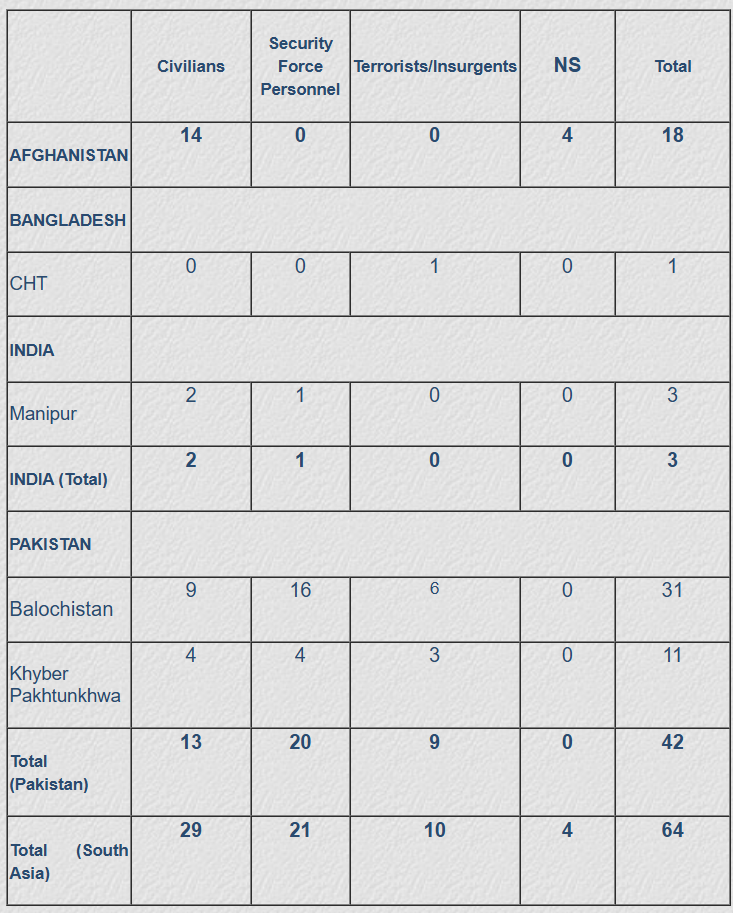
Provisional data compiled from English language media sources.