
China & Taiwan Update, May 1, 2026
Toplines
The PLA Navy (PLAN) conducted two major deployments in the South China Sea and the West Pacific, respectively, likely in response to the ongoing Balikatan 2026 exercises in the Philippines which include US and Japanese forces. The PRC likely aims to demonstrate that Indo-Pacific regional military cooperation invites increased PLA military activity. The PLA’s Southern Theater Command (STC) announced on April 24 that a surface task group consisting of one Type 055 guided missile destroyer, one Type 052D guided missile destroyer, one Type 054A guided missile frigate, and one Type 903A auxiliary oil replenishment vessel conducted exercises east of the Luzon Strait in response to the “current regional situation.”[1] The STC was likely referring to the combined Balikatan 2026 exercises between the Philippines, the United States, Japan, Australia, New Zealand, Canada, and France held from April 20 to May 8.[2] Balikatan 2026 marks Japan’s first active participation in the exercises.[3] The PLAN aircraft carrier Liaoning transited the Taiwan Strait heading south on April 20. Unverified satellite imagery has circulated on PRC social media purporting to show Liaoning operating in the South China Sea alongside three guided missile destroyers and six guided missile frigates.[4] The PLA STC announced on April 28 that it conducted exercises in the South China Sea in response to Philippine attempts to “stir trouble” in the region, but did not reveal what forces participated.[5] PRC state-owned tabloid Global Times reported on April 22 that the PLAN’s Type 076 landing helicopter dock departed Shanghai to conduct sea trials in the South China Sea, possibly supporting the PLAN’s response to Balikatan.[6] ISW-CDOT cannot confirm the location of Liaoning during these exercises, and official PRC media outlets have not reported on its location or that of its escorts.
The PRC likely seeks to show that it can surge a military presence around the Philippines when the Philippines engages in defense cooperation with the United States and Japan. The PRC conducted a similar deployment east of Luzon with the aircraft carrier Shandong during Balikatan 2025, but did not explicitly link this deployment to the exercises as it did this year.[7] The PRC’s deployment of major naval assets around the Philippines during Balikatan is likely an effort to frame Philippine cooperation with the US and other regional partners as escalatory and provocative, aligning with PRC coalition-breaking goals elsewhere in the region.
The PRC likely sees Philippine cooperation with the United States and Japan as a significant threat to its freedom of maneuver in the region. Balikatan 2026 has featured a significant amount of sea denial systems, including the US Navy-Marine Corps Expeditionary Ship Interdiction System (NMESIS) and Japan’s Type 88 anti-ship missile.[8] The current exercises in part have practiced the rapid deployment of these anti-ship systems to remote areas of the Philippines, including the Batanes Islands in the Luzon Strait, threatening the PLAN’s ability to break out of the first island chain via the Luzon Strait.[9] The PLAN’s commitment of significant surface assets to the waters around the Luzon Strait is likely an information operation designed to show the PLAN remains capable of breaking out of the first island chain, although conducting such a transit in peacetime is not indicative of PLAN wartime capabilities.
[A version of the following text appeared in the Korean Peninsula Update, April 28, 2026.]
US Forces Korea (USFK) may become central to US efforts to mobilize allied defense industrial bases (DIB) for US operational efficiency in the Indo-Pacific. The USFK proposed a plan that would clarify South Korea’s operational role in a potential Taiwan contingency. USFK Commander Xavier Brunson proposed establishing South Korea as a Regional Sustainment Hub (RSH) on April 22.[10] The concept builds on the US Department of Defense’s 2024 “Regional Sustainment Framework,” which aims to reduce time and cost by conducting maintenance, repair, and overhaul (MRO) in allied countries rather than returning assets to the United States.[11] South Korea already conducts maintenance of certain US aircraft. Establishing South Korea as an RSH would expand current maintenance efforts to include warships, missile systems, and drones.[12] The United States’ ability to conduct MRO in South Korea’s forward-deployed hubs may improve the response capabilities and logistical efficiency of US forces during a Taiwan contingency. The US 2026 National Defense Strategy (NDS) proposed enabling US allies to take primary responsibility for their own defense while prioritizing deterrence against the People’s Republic of China (PRC) in the Indo-Pacific.[13] US Under Secretary of Defense for Policy Elbridge Colby previously stated the need to reorient the USFK to better address broader regional threats, including the PRC.[14] The South Korean Lee Jae Myung administration proposed transferring wartime operational control (OPCON) from the United States to South Korea, increasing South Korea’s defense budget to 3.5 percent of GDP, and developing an indigenous nuclear-powered attack submarine (SSN) to showcase its commitments to its defense following the NDS’s release.[15]
The Lee administration has not responded to the USFK proposal yet. Lee has previously suggested a willingness for South Korea to assume a broader role in deterring the PRC, however. Lee has argued that South Korea’s diesel-electric submarine fleet lacks the endurance to track North Korean and PRC submarines, suggesting that South Korea would use SSNs to counter PRC submarine activities.[16] A completed OPCON transfer would also position South Korea to lead combined defense operations on the Korean Peninsula and thus enable USFK to focus on deterring high-priority threats beyond North Korea. The establishment of South Korea as an RSH would likely require the Lee administration to adopt a more assertive stance regarding South Korea’s operational role in a potential Taiwan contingency. Lee has emphasized the need to foster “stable” ties with the PRC as part of his pragmatic, balanced foreign policy approach.[17] South Korea has maintained strategic ambiguity regarding cross-Strait issues, likely due to the PRC’s significance to South Korea’s economy. The PRC imposed economic pressure on South Korea following South Korea’s 2017 deployment of the United States-provided Terminal High Altitude Area Defense (THAAD) System.[18] The PRC may again use economic pressure to deter South Korea from cooperating with the US plan.
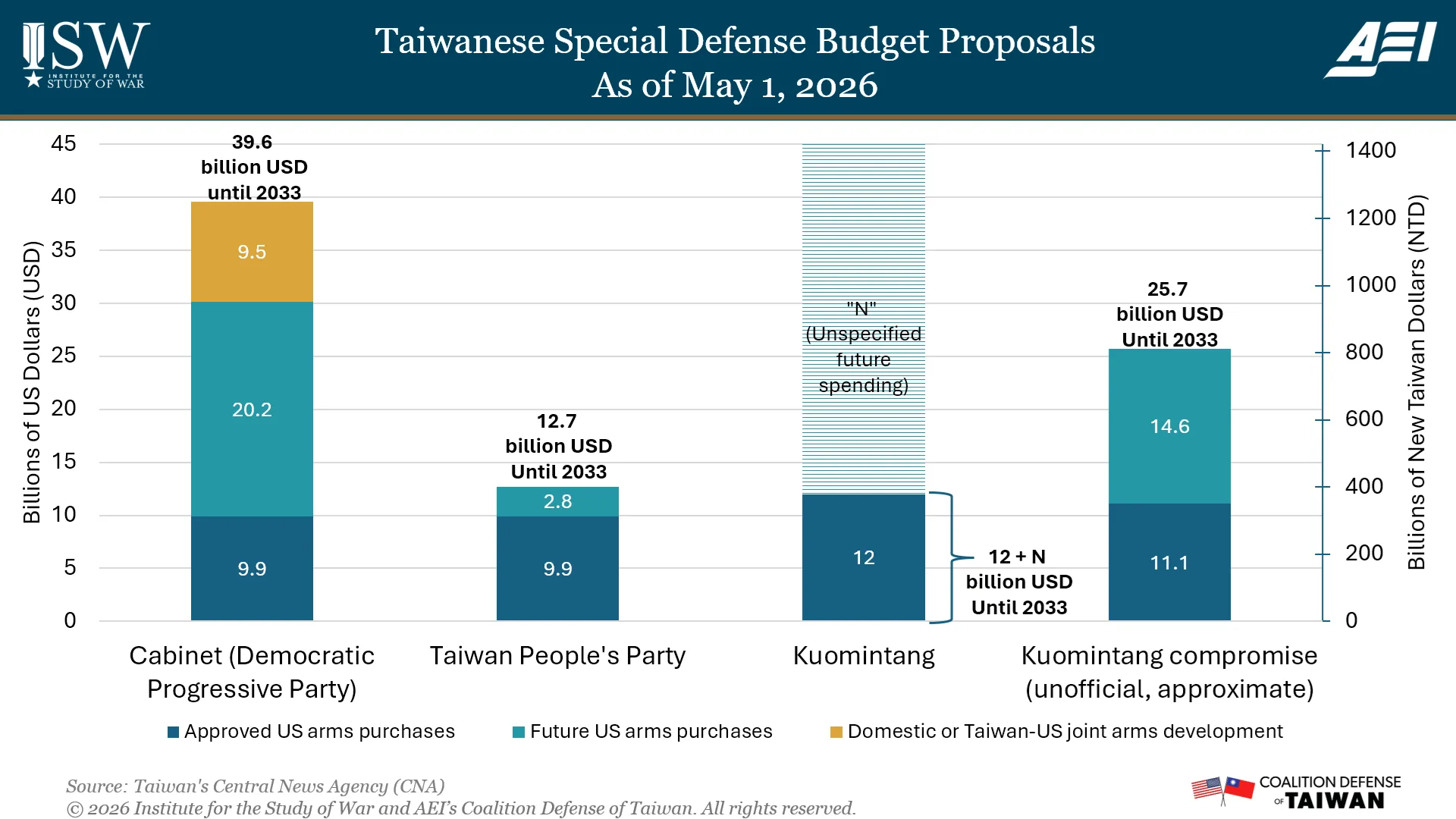
Taiwan’s special defense budget remains stalled due to partisan gridlock, despite growing US pressure to pass the budget. Taiwan’s Legislative Yuan (LY) has been gridlocked for months over competing versions of a special defense budget bill to fund asymmetric capabilities. Negotiations between the legislative caucuses of Taiwan’s ruling Democratic Progressive Party (DPP), the opposition Kuomintang (KMT), and the opposition Taiwan People’s Party (TPP) on April 23 and April 27 both ended without a consensus on the core procurement items and total funding amount.[19] The parties agreed on April 23 that the funding period should extend through 2033, however, in a small concession from the KMT. The KMT’s budget bill initially had a promulgation period through 2028.[20] The LY caucuses will reconvene for further negotiations on May 6.[21]
US officials have intensified efforts to lobby Taiwan to pass the asymmetric defense special budget. US Indo-Pacific Commander Admiral Samuel Paparo and American Institute in Taiwan (AIT) Director Raymond Greene both called for the LY to quickly pass the budget, including funding for the 11.1 billion US dollar (USD) arms package the United States approved in December 2025.[22] The LY deadlock has already delayed Taiwan’s payment for the High Mobility Artillery Rocket Systems (HIMARS), a key system in that arms package.[23] All special budget versions include funding for that arms package, but the special budget from the Cabinet and DPP also includes 20.2 billion USD for future US arms purchases and 9.5 billion USD for Taiwanese domestic arms manufacturing, totaling nearly 40 billion USD.[24] The KMT and TPP bills allocate around 12 billion USD. The KMT bill includes a “+ N” addition meant to represent an unspecified amount of funding for future purchases, however. A faction within the KMT, represented by legislator Hsu Chiao-hsin, is advocating for a special budget of around 25 billion USD, however.[25] KMT Deputy Chairman Chi Lin-lien harshly criticized LY Speaker Han Kuo-yu, a KMT member, for allegedly supporting Hsu’s proposal over the party caucus’s bill.[26] KMT Chairwoman Cheng Li-wun appeared to try to ease party tensions and said the LY would not approve funding for future US arms sales without formal letters of offer from the United States, regardless of the amount. Cheng also stated that passing the Cabinet’s 40 billion USD budget was “absolutely impossible.” [27] The KMT and TPP proposals do not cover Taiwanese domestic manufacturing of drones and air defense systems, which are likely to be critical to Taiwan’s defense.
KMT Chairwoman Cheng Li-wun is planning a visit to the United States at a critical moment in Taiwan’s special defense budget process. Cheng stated on April 27 that she plans to visit the United States for ten days in June to visit US universities and meet with US policy leaders.[28] Cheng said that she will use her visit to alter “Cold War” thinking and work to improve US views of the PRC.[29] Cheng said that the special defense budget debate will not impact her trip.[30]
Cheng’s visit to the United States closely follows President Lai’s thwarted attempt to visit Eswatini, a Taiwanese diplomatic ally, due to neighboring African states’ adherence to the “one China principle.”[31] Cheng blamed Lai personally for his failed visit. The PRC has sought to exclude Taiwan from international organizations and prevent its diplomatic engagement in an effort to undermine Taiwanese sovereignty.
Cheng’s framing reiterates CCP rhetoric portraying President Lai and the DPP as “provocative,” and Cheng may intend to elevate the KMT’s international standing and reputation relative to the DPP at a critical political juncture. Cheng’s visit will likely support PRC lines of effort to denigrate and delegitimize DPP leadership at a moment critical to Taiwan’s defense.
The PRC is attempting to frame its position on cross-strait issues as consistent with Taiwanese public opinion. The PRC aims to present the DPP as the main obstacle to productive dialogue. A spokesperson for the PRC’s Taiwan Affairs Office (TAO) highlighted a poll on April 22 conducted by the Taiwan Democracy and Education Foundation that showed over half of Taiwanese people polled agreed that Taiwan should proactively discuss the issue of cross-strait unification and that 70 percent of those polled supported strengthening cross-strait engagement to ensure regional stability.[32] The TAO spokesperson connected the polling data to KMT Chairwoman Cheng Li-wun’s April visit to the PRC, suggesting that mainstream public opinion in Taiwan supported KMT-led efforts to enhance cross-strait dialogue.[33] Former KMT Vice Chairman Kuan Chung founded the Taiwan Democracy and Education Foundation. The Foundation regularly participates in cross-strait exchanges organized by the TAO.[34] Kuan stated in an interview with Taiwanese media that the United States would not come to Taiwan’s aid during a conflict with the PRC.[35] ISW-CDOT cannot independently confirm the veracity of the foundation’s polling data.
The PRC aims to portray DPP efforts to bolster Taiwan’s self-defense as a major obstacle to cross-strait dialogue, in contrast with KMT policy. The same TAO spokesperson stated on April 22 that Taiwanese President William Lai Ching-te’s efforts to increase societal resilience and implement more realistic combat exercises constituted “seek[ing] independence through force,” the “root cause” of cross-strait instability.[36] The spokesperson similarly criticized the United States for pressing Taiwan to pass its special defense budget and stated that the DPP sought to turn Taiwan into an “ammunition depot” and “cash cow” for the United States.[37] The spokesperson further commented on more polling data from the Taiwan Democracy and Education Foundation that purported to show a majority of Taiwanese people did not believe that the United States would “unconditionally” send forces to protect Taiwan.[38]
ISW-CDOT previously assessed that the PRC is creating conditions for future engagement with the KMT following Cheng’s visit to the PRC.[39] The PRC TAO’s representation of Taiwanese polling data and DPP policy further indicates that the PRC is attempting to present PRC-KMT cross-strait dialogue as congruent with Taiwanese public opinion and contrast this engagement with DPP policy. The PRC may be attempting to set information conditions for the KMT to present itself as the party of peace and stability in Taiwan‘s 2026 local elections and 2028 national elections by claiming that the DPP’s defense policy and cooperation with the United States are the principal obstacles to official dialogue between Taiwan and the PRC.
Key Takeaways
PLAN Exercises: The PLAN STC conducted two major deployments in the South China Sea and West Pacific, likely in response to the ongoing Balikatan 2026 combined exercises. The PLA likely seeks to show that it can surge a military presence around the Philippines as a sign of its displeasure with Philippines military cooperation.
US-South Korean Relations: USFK Commander Xavier Brunson proposed establishing South Korea as a regional sustainment hub, which would improve US operational efficiency in the Indo-Pacific. This plan could serve to clarify South Korea’s role in a Taiwan contingency.
Taiwan’s Special Defense Budget: Taiwan’s special defense budget remains stalled due to partisan gridlock, despite increased US pressure to pass the budget. Divisions within the KMT could further complicate efforts to pass a version of the budget.
KMT-US Engagement: KMT Chairwoman Cheng Li-wun announced a planned visit in June to the United States to meet with US universities and US policy makers. Cheng stated that she hopes to use this trip to change US perceptions of the PRC.
PRC Cognitive Warfare: The PRC TAO highlighted a poll of Taiwanese people that showed over half of those polled agreed that Taiwan should discuss cross-strait unification and strengthen cross-strait engagement. The PRC aims to present the DPP as an obstacle to cross-strait dialogue and likely sees the KMT under Chairwoman Cheng Li-wun as a better option for influencing Taiwan.
Cross-Strait Relations
Taiwan
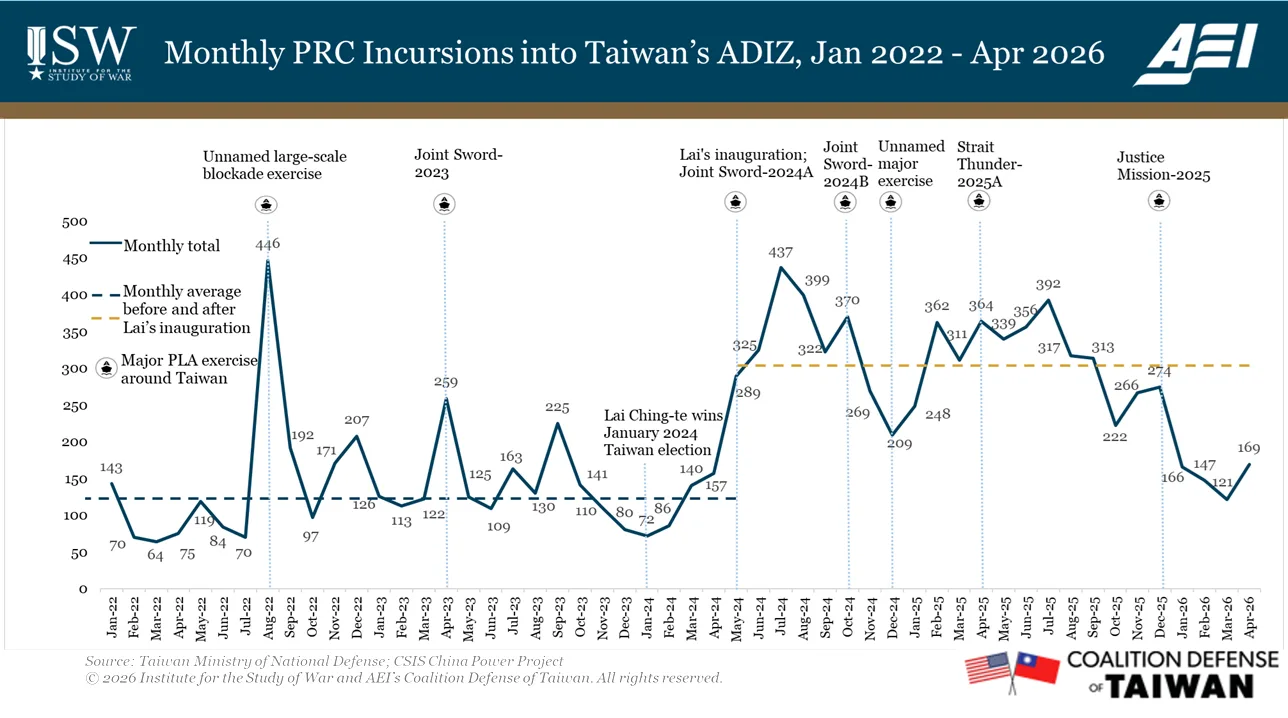
The PLA carried out a total of 169 aerial incursions into Taiwan’s Air Defense Identification Zone (ADIZ) in April. The PLA normalized an average of over 300 ADIZ incursions per month beginning in May 2024 when Taiwanese President William Lai Ching-te took office, but the monthly total fell below 200 in January and continued to decline through March.[40] The number of total incursions in April was higher than in March but remains significantly lower than the same period in 2025.[41] The PRC has not deployed any high-altitude balloons into Taiwan’s ADIZ since February, consistent with its usual practice of limiting balloon deployments to the winter months.[42]
The comparatively low number of ADIZ incursions in early 2026 may indicate that the PRC has adjusted its coercion strategy towards Taiwan. A high frequency of ADIZ incursions allowed the PLA to degrade Taiwan’s threat awareness by desensitizing it to near-daily aerial incursions, and the dramatic and sustained increase in monthly incursions beginning in May 2024 allowed the PRC to signal its displeasure with Lai’s election.[43] Reducing the number of monthly PLA sorties into Taiwan’s ADIZ may allow the PLA to refocus its resources on other training and modernization priorities, such as enhancing its joint combat operations capabilities, and may restore the utility of ADIZ incursions as a means of short-term political signaling. [44]
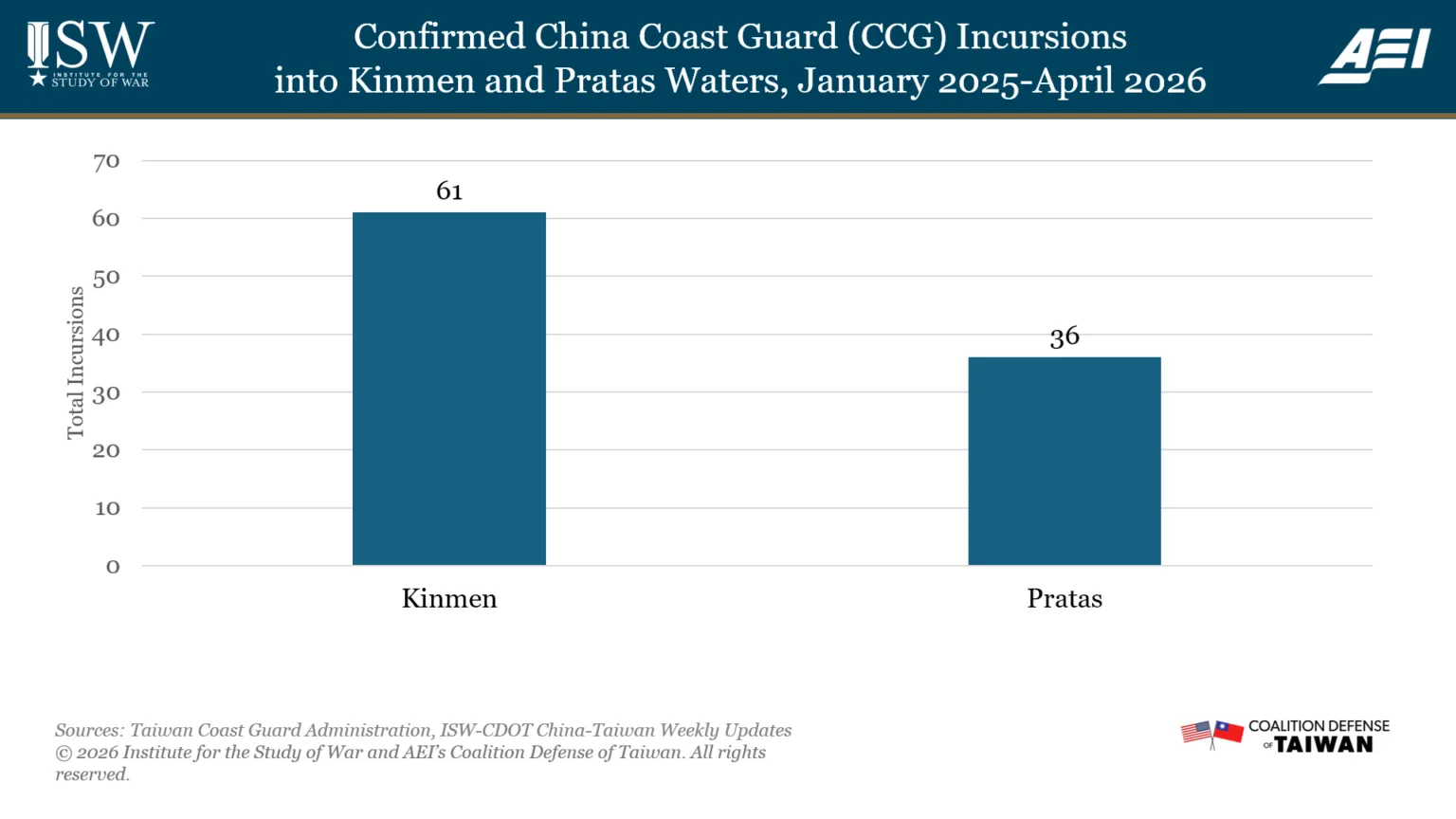
The China Coast Guard (CCG) made three incursions into Taiwan-administered waters near Taiwan’s Kinmen islands and one incursion near Taiwan’s Pratas Island in April. The PLA Navy (PLAN) also deployed two warships near Taiwan’s Penghu islands on April 27. Four CCG vessels intruded into restricted waters near Kinmen on April 21, 24, and 28, departing after around two hours each time.[45] A ship from the PRC’s China Maritime Safety Administration also intruded into restricted waters around Kinmen on April 21.[46] Taiwan’s Coast Guard Administration (CGA) boarded and detained an unregistered PRC fishing boat with no name, port of registry, or ship certificate, which the CGA refers to as a “three no’s” vessel, illegally operating inside Taiwan’s prohibited waters around Kinmen on April 10.[47] The CGA dispatched patrol vessels to respond to each intrusion around Kinmen.[48] Data from ship tracking software Starboard Maritime Intelligence shows that a CCG vessel also intruded into contiguous waters around Taiwan’s Pratas Island on April 22. The CCG ship turned off its Automatic Identification System (AIS) signal and patrolled around the island for around 15 hours before turning its AIS on again and departing on April 23.
Kinmen is a Taiwanese county made up of several islands located about two miles from the PRC.[49] Taiwan does not claim territorial waters or a contiguous zone around Kinmen due to its proximity to the PRC, but maintains “prohibited” and “restricted” waters that are functionally equivalent.[50] Pratas is a Taiwanese atoll north of the South China Sea with a CGA and Taiwanese marine garrison but no permanent population. The CCG began conducting regular patrols around Pratas in February 2025, usually sending a single ship to circle the island.[51] The CCG regularly intrudes into Taiwanese waters around Kinmen and Pratas to erode Taiwan’s territorial sovereignty and bolster PRC jurisdiction claims.[52] The Chinese Maritime Militia (CMM) and PRC “three-no’s” fishing boats also intrude into Taiwanese waters to support this line of effort.[53] These incursions also allow the PRC to probe the CGA’s monitoring and response capabilities and degrade Taiwan’s threat awareness by desensitizing it to repeated intrusions.[54] The PRC has normalized a frequency of around four CCG incursions near Kinmen per month since 2024.[55]
The PLAN also deployed a destroyer and a frigate to waters southwest of Taiwan’s Penghu islands on April 27.[56] Taiwan’s military deployed naval and air forces to monitor the PLAN vessels.[57] The Taiwanese military maintains naval and air bases on the Penghu islands, which are entirely inside Taiwanese territorial waters and would be strategically significant in a PRC invasion given their proximity to the main island of Taiwan.[58] The PRC has previously deployed CCG and PLAN ships near the Penghu islands and spread online disinformation seeking to normalize a PRC maritime presence in the area.[59]
China
The PRC may be developing a domestic version of SpaceX’s Starlink Low Earth Orbit (LEO) satellite constellation. Starlink has been used widely during the war in Ukraine to increase the range of drones and improve frontline communications. The PRC’s Ministry of Industry and Information Technology (MIIT) posted a report on April 26 on its official account detailing the PRC’s nascent LEO network.[60] The report claimed that the MIIT was pursuing a LEO constellation of over 10,000 satellites, a similar number to US-based Starlink’s LEO satellite count.[61] Hong Kong-based news outlet South China Morning Post published a report on April 25 analyzing a PRC journal article published in April that described LEO capabilities as a “strategic weapon” that would determine the future of information sovereignty.[62] The US-based RAND corporation has assessed that the PLA views LEO satellite capability as a key enabler of joint operations and a critical technology for improving communications resilience against jamming or kinetic attacks due to the large number of satellites in an effective LEO constellation.[63]
Starlink has seen widespread use in Ukraine and has been a crucial tool for expanding the range of drone operations well beyond the frontline and maintaining rapid communications with frontline units.[64] Russia’s loss of Starlink connectivity in February has likely impeded its ability to conduct long-range drone strikes.[65] A March 25 PLA Daily article warned against relying on foreign LEO satellites to conduct operations, pointing to Russia’s experience with Starlink as an example.[66] The PRC has likely observed the widespread use of Starlink in Ukraine and is using that experience to spur the development of its own LEO network.
A PRC-owned LEO satellite constellation that reaches similar capabilities as Starlink could markedly improve the PLA’s ability to communicate with frontline units in contested environments and extend the range of its drone operations during a conflict with Taiwan. The April 26 Global Times article also highlighted the potential for a PRC-owned LEO network to extend connectivity to remote areas, such as the far seas, possibly indicating the PLA could use a LEO constellation as a backup communications network to maintain contact with naval forces deploying amid communications and electromagnetic interference. These capabilities could improve the PLA’s ability to effectively coordinate a joint operation to isolate and seize Taiwan during a contingency.
The PRC is building its self-reliance in advanced computer chips, especially those used for artificial intelligence (AI) development, and taking steps to prevent PRC technology transfer to other countries. US Secretary of Commerce Howard Lutnick said on April 22 that Nvidia has yet to sell its H200 AI chips to PRC companies, even though the Trump administration approved the sale in January.[67] Lutnick said that the PRC has not allowed domestic firms to purchase H200 chips because it is investing in its domestic chip industry. Lutnick’s statement contradicts reporting in late January that the PRC would allow ByteDance, Tencent, and Alibaba to purchase a limited quantity of the chips.[68] ISW-CDOT previously assessed that the PRC may use limited imports of the H200, Nvidia’s second-most powerful AI chip, to improve its AI technology while prioritizing domestically-sourced chips.[69] PRC state-affiliated social media account Yuyuan Tantian wrote on April 26 that PRC AI firm Deep Seek delayed the release of its V4 model for months to optimize compatibility with Huawei’s Ascend AI chips rather than foreign-supplied chips.[70] Reuters reported that demand for Ascend AI chips surged among PRC tech firms following the Deep Seek V4 release.[71]
The PRC is also taking measures to prevent the transfer of its AI technologies to other countries. The PRC National Development and Reform Commission (NDRC) blocked Meta’s acquisition of PRC AI startup Manus on national security grounds on April 27 and demanded the rescission of the 2.5 billion USD deal.[72] The Washington Post reported on April 21 that PRC authorities were strengthening measures to prevent AI startups from leaving the country.[73] PRC authorities also reportedly warned AI firm MiroMind not to send research and talent out of the PRC.[74]
Beijing’s efforts to indigenize AI supply chains and prevent AI technology and talent transfer to other countries will help insulate it from the effects of future sanctions, economic warfare, and war-related disruptions. The PRC is investing heavily in artificial intelligence both to drive its economic growth and to modernize its military capabilities.[75] A war over Taiwan or a regional blockade will disrupt supply chains to most countries in the region, including the supply of Taiwanese, Japanese, and possibly South Korean chips to the PRC.
The PRC is implementing new regulations to prevent and punish foreign firms that try to decouple from the PRC or participate in foreign secondary sanctions. PRC Premier Li Qiang signed a law on industrial and supply chain security on April 7 that established a “security investigation mechanism” for industrial and supply chains, which will grant the government broad powers to investigate and punish foreign countries, regions, organizations, or individuals that “undermine China’s industrial and supply chain security.”[76] PRC laws previously allowed a more limited scope of regulation against foreign firms on grounds such as national security and antitrust violations.[77]
State-affiliated social media account Yuyuan Tantian said the new regulations were necessary considering the “spillover risks” caused by events such as US secondary sanctions against PRC entities purchasing Iranian oil and Panama’s cancellation of Hong Kong-based firm CK Hutchison’s port concessions on the Panama Canal.[78] The new law is part of a broader PRC effort to insulate itself from the effects of sanctions and supply shocks, while maintaining economically beneficial foreign investment. The law could strengthen the PRC’s economic resilience but may also deter foreign investors from opening new ventures in the PRC.
The US Cybersecurity and Infrastructure Security Agency (CISA), the US National Security Agency (NSA), and 19 international partner agencies on April 23 released a Joint Cybersecurity Advisory stating that since 2021, Advanced Persistent Threat (APT) actors linked to the PRC’s Ministry of State Security (MSS) have increasingly targeted consumer devices to access adversary military networks. The joint advisory revealed that these actors are specifically targeting telecommunications, government, transportation, residential, and military networks.[79] PRC hackers are increasingly targeting and infiltrating internet edge devices, which are devices connected to the internet that collect and transmit data from sensors. This includes smart home devices, wearable health-tracking devices, and other internet-connected consumer products.[80] The PRC leverages the less secure internet connections on these devices to laterally access larger target networks that host sensitive and classified data from US federal agencies.[81] The data stolen by these companies’ APT actors can enable the MSS to identify and track their targets’ communications and movements.[82]
PRC-linked hackers highlighted by the advisory are increasingly targeting internet-connected consumer devices and public networks to supplement the PRC’s cyber intelligence-gathering operations.[83] The PLA has stated that its cyber strategy aims to compromise adversary information systems while securing its own networks to preserve ongoing intelligence-gathering capabilities.[84] These APT actors are increasingly able to gain access to software that controls more complex systems, advancing their cyberwarfare capabilities to disrupt critical US infrastructure. [85] Access to critical infrastructure networks would enable the PRC to conduct disruptive and destructive attacks against adversaries.[86] ISW-CDOT has previously reported that the PRC government has developed a state-sponsored hacking industry with sophisticated cyberattacking capabilities.[87] The PRC likely aims to develop the capability to disrupt key network functions in the event of a conflict with the US by leveraging their access to information technology environments.[88]
Northeast Asia
Japan
Japan on April 27 convened a panel to review its defense policies amid an ongoing PRC pressure campaign. Japan is making efforts to bolster its defense cooperation, defense article exports, and military spending despite PRC coercion. The panel will convene fifteen political and military experts to review Japan’s defense budget and security policies.[89] The panel will work on revising three key strategy documents, including Japan’s National Security Strategy, and will meet approximately once per month to produce a proposal in fall 2026.[90]
Japan aims to raise its defense budget to 2 percent of its GDP through 2027. Japanese defense spending reached 1.4 percent of its GDP in 2025, marking the highest percentage since 1958.[91] Japan has similarly bolstered its defense cooperation with coalition partners. Australia signed a deal to acquire eleven frigates from Japan in April 2026.[92] Japan is also considering measures to fortify US bases in Japan, including against electromagnetic attacks.[93] These steps come amid broader efforts to loosen Japan’s restrictions on defense exports, including measures under consideration to export used defense articles for free or at a very low charge.[94]
The PRC has consistently framed Japan’s defense reforms as “militarism,” waging a rhetorical and economic pressure campaign against Japanese Prime Minister Sanae Takaichi since her November 2025 comments that a Taiwan contingency could implicate Japan.[95] An April 23 article in PRC state outlet People’s Daily called Japan’s constitutional revisions a “new type of militarism.”[96] PRC Ministry of Foreign Affairs (MFA) spokesperson Lin Jian linked Japanese defense reforms, including Takaichi’s panel, to past Japanese militarism in an April 28 press conference.[97] The PRC has accompanied this rhetoric with sanctions against Japanese policymakers and firms to signal its displeasure with Japan’s ties to Taiwan.[98] Takaichi’s defense reforms have resulted in some domestic pushback within Japan in addition to PRC criticisms, but it seems unlikely that current levels of domestic criticism will change Japanese policy.[99]
North Korea
[A version of the following text appeared in the Korean Peninsula Update, April 28, 2026.]
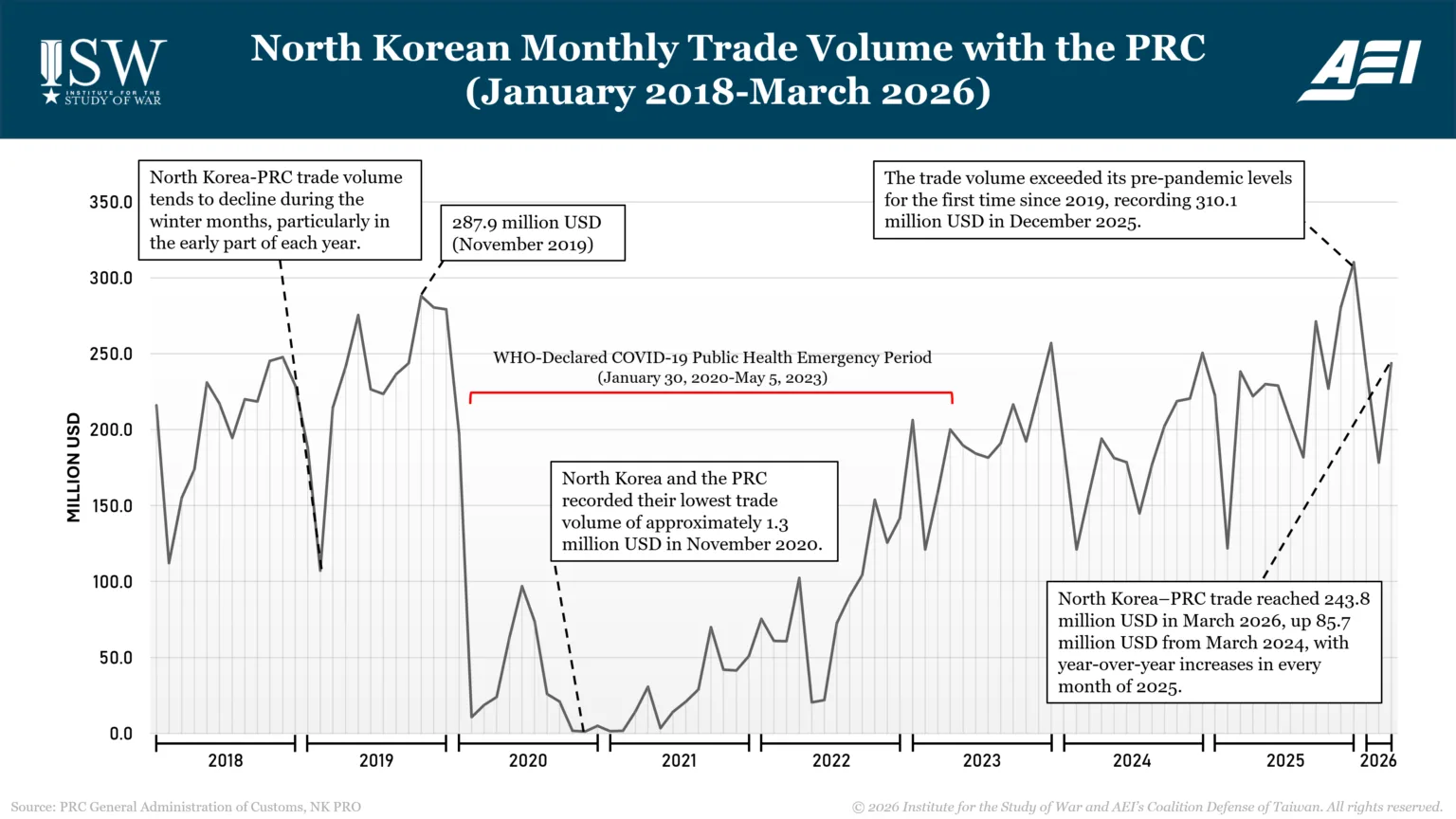
The PRC is likely expanding its people-to-people and economic exchanges with North Korea to pre-COVID-19 levels to gain leverage that could restore its former political relationship with Pyongyang. The PRC and North Korea conducted technical tests for trains at two bridges along the PRC-North Korea border on April 9. [100] These bridges handled passenger and cargo traffic between mid-sized border cities along the upper Yalu River and lower Tumen River before North Korea closed the border in 2020 due to the COVID-19 pandemic.[101] The PRC and North Korea resumed freight train operations along the route between Dandong, PRC and Sinuiju, North Korea in 2022, and also resumed Beijing-Pyongyang passenger service in March 2026.[102] PRC airline Air China also resumed flights to Pyongyang in March for the first time in six years.[103] PRC officials have visited North Korean tourism expos and a newly built resort area to expand civilian exchanges and to discuss bilateral cooperation.[104] The PRC General Administration of Customs reported that the PRC-North Korean trade volume has recovered to pre-pandemic levels, reaching 243.8 million USD in March.[105] The North Korean MFA invited PRC Foreign Minister Wang Yi on April 9 to reaffirm bilateral commitments to expanding exchanges and cooperation.[106] The PRC likely intends to restore its relationship with North Korea through civilian exchanges, while North Korea also appears to be gradually restoring bilateral relations with the PRC through expanded economic cooperation. North Korea-PRC relations stagnated in 2024 despite the border reopening, but recent developments suggest reviving trade and exchanges.[107] Pyongyang appears to be positioning itself to maximize trade benefits and reduce its trade dependency on Beijing. North Korea relied on the PRC for approximately 98 percent of its total trade volume in 2024, according to South Korea’s Korea Trade-Investment Promotion Agency (KOTRA).[108] ISW-CDOT previously assessed that the PRC is likely to seek to re-establish some of its past influence over Pyongyang.[109] Beijing may seek to limit Pyongyang’s economic diversification strategy and reassert its influence by increasing Pyongyang’s economic dependency on Beijing through the restoration of civil trade and exchange.
Europe
The PRC Ministry of Commerce (MOFCOM) placed seven European firms on its export control list on April 24 over their alleged involvement in arms sales to Taiwan. The PRC is attempting to disrupt EU-Taiwan engagement to isolate Taiwan from its diplomatic and defense partners and erode Taiwanese sovereignty. A MOFCOM spokesperson stated at an April 24 press conference that the targeted EU-based firms had participated in arms sales or “colluded with Taiwan.”[110] MOFCOM’s official announcement cited national security and nonproliferation as the reasons for the listing.[111] The PRC prohibits the export or transfer of PRC-origin dual-use goods to firms on its export control list.[112] This is the first time that MOFCOM has placed EU firms on the export control list.[113] MOFCOM has previously sanctioned US, Taiwanese, and Japanese firms by placing them on the list.[114]
The PRC sanctions are unlikely to significantly impact the firms’ supply chains.[115] The listings are likely intended to signal the PRC’s displeasure with international arms sales to Taiwan and to frame them as illegal and illegitimate, bolstering the PRC’s claims of jurisdiction over Taiwan.
The PRC is exerting political pressure on EU member states to treat Taiwan as a part of the PRC’s territory, denying its sovereignty. PRC diplomats in the EU have threatened that holding diplomatic exchanges with Taiwanese officials would damage relations between the PRC and their host nations.[116] The PRC reportedly pressured Germany to deny Taiwanese President William Lai Ching-te’s transit through Germany on the way to Lai’s planned Eswatini state visit on April 21 after several African nations cancelled overflight permissions for the Taiwanese delegation.[117] The PRC MSS also recently attempted to gather material to blackmail European politicians with ties to Taiwan.[118]
PRC espionage operations also target European militaries and defense industrial firms to acquire sensitive defense information about NATO and EU capabilities and strategy toward Taiwan. The military intelligence agency of the Netherlands stated in its annual report released on April 21 that PRC hacking and cyberespionage operations are systematically targeting NATO, the EU, and Western defense firms to identify adversary vulnerabilities and support the PLA’s technological modernization.
Iran
The US Department of the Treasury sanctioned the PRC’s second-largest independent refinery for buying Iranian oil. The PRC is well-insulated against the effects of Iran-related sanctions and oil supply shocks. Iran’s closure of the Strait of Hormuz very likely does more damage to the PRC than the US blockade of Iranian ports does, however. The US Treasury announced on April 24 that the United States is placing economic sanctions on PRC oil refinery Hengli Petrochemical, along with roughly 40 shipping companies and tankers involved in transporting Iranian oil.[119] At least eight of the 19 sanctioned tankers were owned by companies based in the PRC (primarily Hong Kong), and at least eight were transporting sanctioned oil to the PRC, according to the Treasury announcement. The sanctions will cut off the companies from the US financial system and penalize those who do business with them. The US Treasury said that Hengli received Iranian crude oil shipments since at least 2023 from the Sepehr Energy Jahan Nama Pars Company, the oil sales arm of Iran’s Armed Forces General Staff, and has generated hundreds of billions of dollars in revenue for the Iranian military.[120] The PRC purchased between 80 and 90 percent of Iran’s oil prior to the war, making it Iran’s largest economic backer.[121] A PRC MFA spokesperson said that Beijing opposes “illegal unilateral sanctions” and urged the United States to stop its “abuse” of sanctions.[122]
US sanctions on Hengli and PRC-owned “shadow fleet” vessels alone are unlikely to significantly reduce PRC support for Iran or reduce its oil purchases. The cumulative impacts of the sanctions, the US blockade of Iranian ports, and Iran’s closure of the Strait of Hormuz may cause moderate disruptions to the PRC energy supply as the war continues, however. The PRC buys most sanctioned oil through independent (rather than state-owned) “teapot” refineries, which account for about a quarter of the PRC’s refinery capacity. These refineries operate on thin margins and rely on large discounts from sanctioned oil to stay in business. “Teapot” refineries have limited exposure to the US financial system, however.[123] Other PRC refiners that the Trump administration has sanctioned have found workarounds to avoid sanctions.[124]
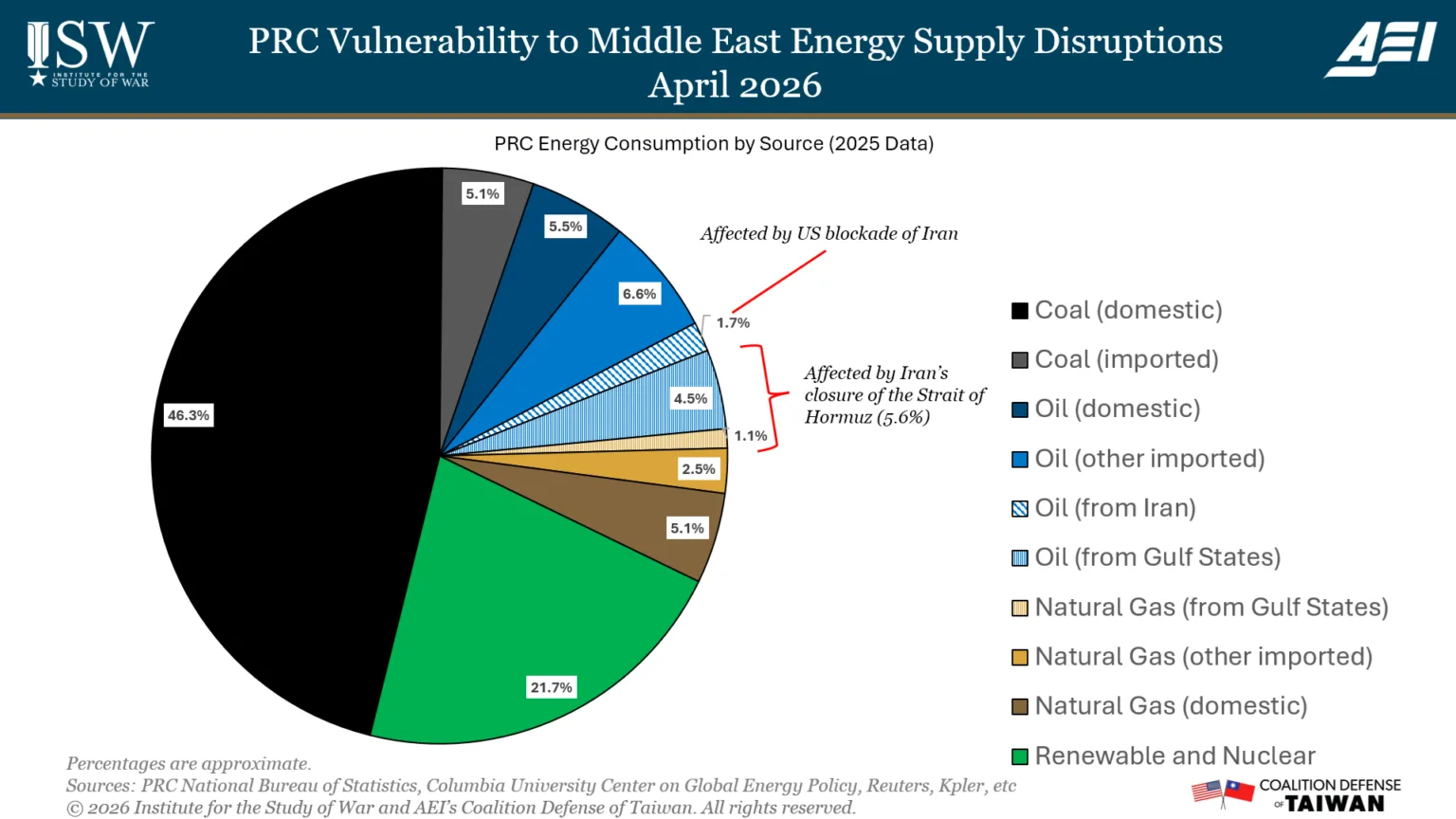
The PRC has diversified its energy supplies and had nearly 1.4 billion barrels stockpiled in December 2025, making it well-insulated from sanctions and oil supply shocks.[125] Only 18.2 percent of the PRC’s energy consumption came from oil in 2025, according the PRC’s National Bureau of Statistics.[126] Seventy percent of this oil was imported, and only 38 percent was imported from the Middle East. Under seven percent of the PRC’s overall energy consumption is from Middle Eastern oil. The PRC is around 80 percent energy self-reliant because it produces most of its energy from domestic coal, nuclear power, and renewable sources. The CCP Politburo pledged at an economic policy meeting on April 28 to “address external shocks” and enhance energy security, though it did not prescribe specific measures.[127]
Iran’s closure of the Strait of Hormuz very likely has a stronger negative economic impact on the PRC than the US blockade and sanctions. The US blockade only affects Iranian exports — not counting oil on tankers that are already at sea. Iran accounted for around 12 percent of the PRC’s oil imports in 2025, relabeled as originating from Malaysia or other countries.[128] The other Gulf States supplied around 42 percent of the PRC’s oil imports in 2025 and roughly a third of its Liquid Natural Gas (LNG).[129] The vast majority of these oil and LNG imports pass through the Strait of Hormuz and are thus blocked by Iran’s closure of the strait.
Latin America
Bloomberg reported that the PRC is seeking economic recourse for its port losses in Panama by joining a consortium to purchase CK Hutchison holdings. The China Merchants Group is reportedly attempting to join the consortium to help China Cosco Shipping, a PRC-owned shipping firm, finance the port deal.[130] The consortium reportedly aims to purchase dozens of CK Hutchison’s ports.[131] This revelation follows the PRC’s economic escalations against Panama after the Panamanian government seized two ports formerly held by Hutchison.[132] US firm BlackRock initially signed a deal to purchase ninety percent of the Panama Ports Company, a subsidiary of Hong Kong-based Hutchison, in March 2025.[133]The PRC has consistently sought to block Hutchison’s sale of two ports at either end of the Panama Canal, indicating that the PRC likely assigns significant economic and strategic value to the canal. The PRC launched an economic pressure campaign in retaliation for Panama’s seizure of the ports, including seizing Panama-flagged vessels.[134] The PRC likely interprets CK Hutchison’s sale of its global ports as a loss of face and will likely continue to block or recoup the sale. US policymakers have expressed concern regarding PRC influence and access to the canal, a significant lifeline of US commerce that critics have argued the PRC could blockade during a conflict.[135]