
South Asia Intelligence
Mizoram: Reinforcing Peace
The developments of April 2026 mark a decisive turning point in Mizoram’s internal security landscape, with the surrender of 43 cadres of the Hmar People’s Convention-Democratic (HPC-D) on April 30, 2026, and the signing of the Memorandum of Settlement (MoS) on April 14, 2026, representing the formal conclusion of the last active insurgent movement in the State. The agreement, signed at Sakawrdai – headquarters of the Sinlung Hills Council (SHC) – between the Mizoram Government and HPC-D leader Lalhmingthanga Sanate, and followed by the ceremonial laying down of arms at Sesawng near Aizawl, underscores both the culmination of a long-drawn peace process and the consolidation of Mizoram’s position as one of the most peaceful States in India’s Northeast. Chief Minister Lalduhoma’s characterization of the development as a “landmark” reflects the broader significance of the event, not merely as a symbolic closure of insurgency, but as a substantive achievement of sustained political negotiation, administrative accommodation, and security stabilization.
The HPC-D, which emerged from factional divisions within the original Hmar People’s Convention (HPC), had sustained a low-intensity insurgency since the mid-1990s, primarily centred on demands for greater autonomy, including the creation of an Autonomous District Council under the Sixth Schedule. Earlier agreements, notably those in 1994 and 2018, had partially addressed these demands but failed to fully integrate all factions, leaving residual elements active. The Lalhmingthanga Sanate-led faction represented the last remaining organized expression of Hmar militancy in the State. The April 2026 MoS, therefore, represents the terminal phase of a three-decade-long conflict cycle. As reflected in the earlier analyses, the agreement is the outcome of a calibrated and sustained engagement process, including multiple rounds of negotiations between September 2024 and March 2026, during which the operational and strategic space available to the insurgent group progressively narrowed, making a negotiated settlement the only viable option.
The surrender of 43 cadres confirms the limited residual strength of the insurgency and reinforces the broader assessment that militancy in Mizoram had already entered a terminal phase well before the formal agreement. The structured “homecoming” ceremony, coupled with rehabilitation assurances by the State Government, highlights Mizoram’s established model of conflict resolution, which emphasizes dignified reintegration over coercive elimination. The inclusion of development provisions in the MoS – targeting infrastructure, connectivity, and administrative support in the SHC areas – addresses long-standing grievances that had historically underpinned the insurgency. Equally significant are the symbolic provisions, such as the recognition of the Sikpui Ruoi festival, which contribute to cultural affirmation and reconciliation. The decision to sign the agreement at Sakawrdai rather than in the State capital further reflects an effort to enhance local ownership and legitimacy of the peace process.
While the formal end of insurgency marks a major achievement, the broader security environment in Mizoram continues to be shaped by complex external and transnational dynamics, particularly linked to developments in neighboring Myanmar. The State’s long and porous border with Myanmar, combined with strong ethnic linkages between communities on both sides, has made it particularly vulnerable to spillover effects from the ongoing conflict following the February 1, 2021, military coup in Myanmar. The recent airstrike by Myanmar’s military on April 30, 2026, at Khawpuichhip village in the Chin State of Myanmar, which killed at least seven civilians and triggered a fresh influx of refugees into Mizoram, underscores the persistent volatility along the border. The arrival of additional refugees into Zokhawthar in Champhai District adds to the estimated 30,000 Myanmar nationals already sheltered in the State, placing considerable humanitarian and administrative pressure on local authorities.
This influx is not an isolated phenomenon but part of a broader pattern of cross-border instability. Earlier incidents, such as the July 2025 clashes between rival Chin armed groups near Khawmawi, had similarly resulted in large-scale displacement into Mizoram. The State’s response – balancing humanitarian considerations with security imperatives – has been relatively measured, with security forces sealing the border while allowing controlled entry for refugees. However, the continued presence of armed actors, the movement of injured cadres into Mizoram for treatment, and the proximity of conflict zones to Indian territory create latent risks of militarization and inadvertent spillover.
These risks are further compounded by the growing evidence of Mizoram being used as a transit corridor for illicit arms trafficking and transnational militant networks. Investigations by the National Investigation Agency (NIA) have repeatedly highlighted the State’s role in facilitating the movement of weapons and personnel between India, Myanmar, and Bangladesh. The March 18, 2026, disclosure by NIA regarding a network involving foreign nationals – including six Ukrainians and one American – using the “Mizoram corridor” to access Myanmar’s Chin State is particularly significant. The reported activities, including training in drone assembly, signal jamming, and weapons handling, indicate an evolving threat landscape characterized by the introduction of advanced warfare capabilities into the region. The potential linkages between these ethnic armed groups in Myanmar and insurgent outfits in Northeast India raise concerns about the diffusion of technological expertise and the possible reactivation of dormant militant networks.
The pattern of arms trafficking cases in 2025 further reinforces these concerns. The January 15, 2025, arrest of five persons, including a prominent ‘leader’ of the Chin National Front (CNF), an insurgent outfit in Myanmar’s Chin state, and the seizure of six AK-47 rifles and over 10,000 cartridges in the Mamit District of Mizoram, intended for trade between CNF and Bangladesh-based groups, highlights the cross-border dimensions of the illicit arms trade. Similarly, the July 2025 NIA chargesheet in connection with a major arms consignment intended for a Bangladeshi militant group underscores Mizoram’s role as a logistical hub in a wider regional network. Additional cases, including a May 2025 chargesheet against individuals involved in supplying arms to insurgent groups in Manipur, indicate the interconnected nature of militancy across the Northeast.
The frequency of arms recoveries in Mizoram has shown a notable increase in recent years, reflecting both heightened enforcement and the scale of trafficking activity. According to South Asia Terrorism Portal (SATP) data, 12 such incidents were recorded in 2025, compared to 16 in 2024, 11 in 2023, and 13 in 2022. No such incident has been recorded in 2026 (data till May 3, 2026). While the rise in recoveries can be partly attributed to improved vigilance by security forces, particularly after the Myanmar coup, it also points to sustained attempts by transnational networks to exploit the State’s geography. The recovery of significant quantities of weapons and war-like stores in October 2025 in Champhai District, including mortar tubes, anti-personnel mines, and assault rifles, demonstrates the scale and sophistication of these operations.
Arrest data further illustrates the persistence of these challenges. Mizoram recorded 22 arrests in 12 incidents in 2025, all related to arms trafficking, matching the number of arrests in 2024 in 13 incidents, while 28 arrests were made in 2023 in 13 incidents. Cumulatively, since 2000, the State has recorded 268 arrests in 117 such incidents. These figures suggest that, while insurgency within Mizoram has effectively ended, the State continues to function as a conduit for arms movement, with implications for security in neighboring regions, particularly Manipur and parts of Myanmar and Bangladesh.
Despite these challenges, Mizoram has maintained an exceptional record in terms of insurgency-related fatalities. No such fatalities were recorded between 2023 and 2025, following a single incident in 2022 in which three civilians were killed in an explosion in Aizawl. No fatalities have been reported in 2026 (till May 3, 2026). This absence of violence reflects both the success of the State’s peace processes and the limited presence of active militant groups within its territory. However, it also underscores a critical paradox: while internal insurgency has been effectively neutralized, external threats and transnational networks continue to pose significant risks.
The role of security forces, particularly the Assam Rifles, has been central in addressing these challenges. A series of operations in 2025, including arrests in Lawngtlai, Champhai, and Saiha districts, and the seizure of weapons ranging from M4A1 carbines to large quantities of ammunition and air rifles, demonstrates sustained operational vigilance. The interception of foreign nationals and the disruption of trafficking routes indicate an adaptive security response to evolving threats. Nevertheless, the persistence of such incidents suggests that enforcement alone may not be sufficient to fully dismantle these networks, which are deeply embedded in cross-border socio-economic dynamics.
In this context, the April 2026 MoS with HPC-D acquires additional significance. By eliminating the last remaining insurgent group within the State, it allows security agencies to redirect their focus from internal counterinsurgency to border management and transnational threats. The consolidation of internal peace enhances the State’s capacity to respond to external challenges, including refugee management, trafficking networks, and potential spillover from Myanmar. However, the long-term sustainability of this peace will depend on effective governance, particularly in the SHC areas, where development deficits have historically contributed to discontent.
The successful implementation of the development package outlined in the MoS will be crucial in preventing the re-emergence of grievances. Delays or inadequacies in delivery could undermine the credibility of the agreement and create space for renewed mobilization, even if not in the form of armed insurgency. Additionally, the State will need to manage evolving aspirations within the Hmar community, particularly in relation to autonomy and administrative arrangements, which remain sensitive issues.
At a broader level, Mizoram’s experience highlights the importance of a comprehensive approach to conflict resolution, combining political dialogue, development initiatives, and security measures. The end of Hmar militancy demonstrates the effectiveness of sustained engagement and the willingness of smaller insurgent groups to accept negotiated settlements when credible alternatives are available. At the same time, the State’s continued exposure to transnational threats underscores the limitations of purely internal solutions in a region characterized by porous borders and complex ethnic linkages.
In conclusion, the developments of April 2026 represent both an endpoint and a transition. The surrender of HPC-D cadres and the signing of the MoS mark the formal end of insurgency in Mizoram, completing a peace process that has unfolded over three decades. This achievement significantly strengthens the State’s internal security and reinforces its reputation as a stable and peaceful region. However, the persistence of cross-border challenges, including refugee influxes, arms trafficking, and the activities of transnational networks, indicates that the security environment remains dynamic and uncertain. The future trajectory of Mizoram’s stability will depend on its ability to consolidate internal peace while effectively addressing these external pressures, ensuring that the gains of the present moment are not undermined by the complexities of its geopolitical context.
Kerala: Maoist Eclipse
Kerala effectively consolidated its Maoist or Naxalite (Left-Wing Extremism, LWE)-free status in 2025, recording zero incidents and marking a decisive end to insurgent activity that had peaked during the third phase of the movement in the state following the formation of the Maoists’ Western Ghats Special Zone Committee (WGSZC) in 2011. This outcome builds on the minimal activity observed in 2024; the remaining cadres were either arrested or surrendered in 2025, leading to the state’s formal removal from India’s LWE-affected map.
On February 22, 2025, the Kerala Anti-Terrorist Squad (ATS), with assistance from the Tamil Nadu Q-Branch, arrested a prominent Maoist and People’s Liberation Guerrilla Army (PLGA) cadre, Santhosh aka Ravi aka Santosh Coimbatore aka Raja, at Hosur in Krishnagiri district, Tamil Nadu. According to the Police, his arrest – given his central role in PLGA activities in the Kerala-Karnataka-Tamil Nadu (KKT) tri-junction – could signify the effective end of the Maoist movement in the region. A member of the Naadukani and Kabani dalams (squads), Santhosh had been actively involved in armed insurgent activities since 2013 and was an accused in approximately 45 cases under the Unlawful Activities (Prevention) Act (UAPA) across multiple jurisdictions in Kerala and outside.
Earlier, on January 8, 2025, in a development marking a decisive turn in the LWE movement in the state, six cadres of the Communist Party of India-Maoist (CPI-Maoist) operating in the KKT tri-junction, surrendered before Karnataka Chief Minister Siddaramaiah at his official residence, Krishna, in Bengaluru. The group included Jisha from Wayanad, Kerala; Vasantha K from Vellore, Tamil Nadu; and Mundagaru Latha, Vanajakshi Balehole, Sundari Kutluru, and Mareppa Aroli from Karnataka. According to the Police, the cadres did not surrender their weapons, which were believed to have been disposed of in the forest.
With most CPI-Maoist leaders in the Western Ghats region eliminated or arrested, and the arrested cadres entangled in prolonged legal proceedings across multiple jurisdictions, the insurgency has been significantly weakened. In this context, on March 25, 2026, former CPI-Maoist leader and WGSZC in-charge, Roopesh aka Praveen, was released from Viyyur Central Prison in Thrissur, Kerala after spending 11 years in custody, following the suspension of his life sentence by the Madurai Bench of the Madras High Court, Tamil Nadu. He had been arrested on May 4, 2015, along with his wife Shyna and three other Maoist cadres at Karumathampatti in Coimbatore, Tamil Nadu. While the others were released earlier, Roopesh continues to face charges in 43 cases across various Police Stations in Kerala and beyond, including several under the (UAPA). According to prison authorities, he has been acquitted or discharged in 14 cases and is required to appear before courts in the remaining cases.
In another case, on April 21, 2026, the Kerala High Court granted bail to three CPI-Maoist cadres – Rajan Chittilappally (Thrissur, Kerala), R. Raghavendran (Vellore, Tamil Nadu), and Deepak (Chhattisgarh) – after more than five years in custody in connection with the 2016 Nilambur arms case, which involved alleged illegal arms training in a reserve forest in the Malappuram district of Kerala. The court considered the prolonged period of incarceration in granting relief. Rajan was arrested on December 18, 2020, while Raghavendran and Deepak were arrested in 2021.
Kerala recorded no fatalities in LWE-linked violence in 2025, continuing the pattern observed in 2024. According to partial data compiled by the South Asia Terrorism Portal (SATP), the state has registered a total of 10 fatalities (all Maoists) in seven separate incidents across four districts – Palakkad, Wayanad, Malappuram, and Kannur since 2000 (data till May 3, 2026). Of these, one fatality occurred in 2014, two in 2016, five in 2019, and one each in 2020 and 2023. Significantly, no fatalities among civilians or Security Forces (SFs) have been recorded in LWE-related violence in the state during this period.
Of the 10 Maoists killed in the state, nine were eliminated in Security Force (SF) operations, all during the tenure of the successive Left Democratic Front (LDF) governments led by Chief Minister Pinarayi Vijayan. The remaining fatality occurred in 2014, when a Maoist cadre was killed in an accidental blast in Wayanad. Unsurprisingly, the first volume of the WGSZC English-language journal Communist, published in May 2017, identified Chief Minister Pinarayi Vijayan as the prime enemy of the Maoists fighting in the KKT tri-junction, citing the intensified counter-insurgency measures initiated after he assumed office in 2016.
Apart from their inability to execute any violent incidents, the evolving pattern of Maoist sightings in Kerala underscores a marked decline in their operational capacity and influence in the KKT tri-junction. According to data from the Union Ministry of Home Affairs (UMHA), the state recorded 152 Maoist sightings and 47 related UAPA cases in 2015; 131 and 48 in 2016; 118 and seven in 2017; 136 and 38 in 2018; 123 and 50 in 2019; 64 and 16 in 2020; 37 and 14 in 2021; 19 and 18 in 2022; 43 and 31 in 2023; and just 10 sightings with four cases in 2024. Significantly, no such incidents or cases have been reported in 2025, or in 2026, thus far.
Leading up to the UMHA’s official communication sent to states on April 8, 2026, declaring that no district in India remains affected by (LWE), Kerala’s Wayanad and Kannur districts – previously identified as LWE-affected – had already been removed from the list in April 2025. This followed sustained security operations, including “Operation Safe Forest” in the KKT tri-junction, which indicated a halted insurgency, with no significant rebel movements reported.
As SFs intensify counter-Maoist operations in LWE-affected regions of central and eastern India as part of efforts to achieve a “Maoist-free India,” concerns have emerged regarding the potential southward movement of residual cadres. On April 17, 2026, Odisha Director General of Police (DGP) Yogesh Bahadur Khurania indicated that intelligence inputs suggested Maoists who had not surrendered by the Centre’s March 31, 2026, deadline were planning to relocate to Kerala and blend in as labourers.
This concern is reinforced by earlier developments. On October 13, 2025, the National Investigation Agency (NIA) units in Kochi and Ranchi, with the support of the Kerala Police, arrested a wanted CPI-Maoist leader, Sahan Tudi Dinabu, from the Munnar area of Idukki district, Kerala. A native of Jharkhand, Dinabu was the key accused in a Maoist-triggered bomb blast that killed three policemen in his home state. He had reportedly been living in concealment for over a year at the Gudarvilla estate in Munnar, posing as a migrant labourer, along with his wife.
However, no credible reports have emerged of any major relocation of northern cadres to the south. Instead, recent developments suggest that the remaining Maoist cadres are increasingly focused on personal survival rather than any organised or strategic relocation.
In another development, a youth from Ernakulam, Rejaz M. Sheeba Sydeek, suspected to be an “urban Naxal,” was arrested in Nagpur, Maharashtra, on May 8, 2025, on charges of ‘waging war against the state’ in connection with a controversial Instagram post related to Operation Sindoor. According to the Police, material recovered during initial searches was considered sufficient to classify him as a Maoist, leading to charges under the UAPA. Preliminary forensic analysis of his devices reportedly suggested links to ‘urban Naxal’ networks, including documents outlining plans for propaganda and the urban expansion of the banned CPI-Maoist. Investigators further alleged that he maintained contact with senior Maoist leader Kannan Murali aka Murali Kannampilly aka Ajith aka Konnath Muralidharan, a Central Committee (CC) member associated with propaganda and urban operations. Subsequent searches at his residence in Ernakulam, Kerala, led to the seizure of digital storage devices and documents, with the Police also claiming to have uncovered possible linkages to external handlers and other militant networks, including the Jammu and Kashmir Liberation Front (JKLF).
Kerala’s Maoist movement has evolved through three distinct phases: the first in the 1960s, the second in the 1990s, and the third in the late 2000s, marked by the creation of a separate guerrilla zone in the Western Ghats region. In recent years, however, both the state and the wider KKT tri-junction have witnessed the near-total collapse of armed Maoist activity, reflected in the absence of major attacks, systematic leadership decapitation, and a sustained erosion of organisational capacity.
This transformation can be attributed, in part, to a calibrated policy shift that combined intensified counter-insurgency operations with a rehabilitative approach for cadres willing to surrender. Unlike earlier phases of the movement – when sympathisers could often expect relative leniency under Left-led administrations in the state – the current approach is characterised by a more uncompromising, security-centric posture.
Kerala’s success can be attributed to several key factors. First, sustained intelligence-led operations and coordinated inter-state policing have denied Maoists the sanctuary and mobility essential for guerrilla warfare; the difficult terrain of the Western Ghats, once considered advantageous, has instead constrained expansion and logistics. Second, the failure to establish a durable support base among local populations – including tribals – has limited recruitment and cadre replenishment. Third, sustained leadership attrition – through arrests, encounters, and surrenders – has progressively weakened the organisational core.
As the country moves toward the goal of a ‘Maoist-free’ status, Kerala’s absence of fatal Maoist violence, the dismantling of operational cadre presence, and the continuation of legal proceedings indicate that the state is approaching a functionally ‘Maoist-free’ condition. Nonetheless, the persistence of dormant ideological networks and over-ground fronts necessitates sustained policy attention beyond purely kinetic measures – integrating vigilant law enforcement, targeted development in vulnerable regions, and civil society engagement to ensure that the state’s long-term resilience against Maoist insurgency is maintained well into the future.
Weekly Fatalities: Major Conflicts in South Asia
April 27 – May 3, 2026
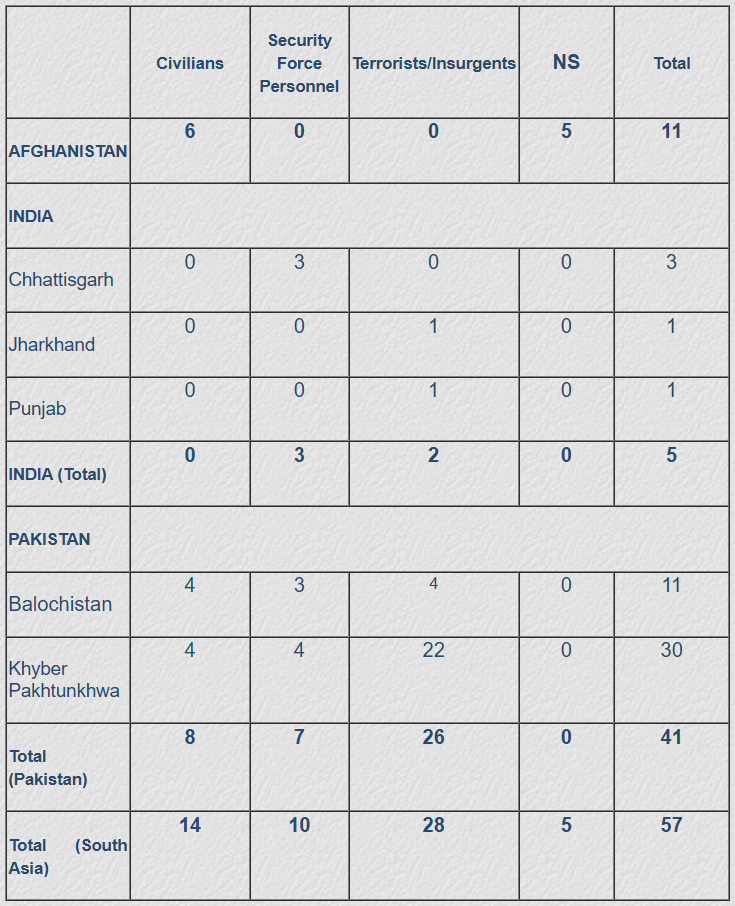
Provisional data compiled from English language media sources.