
China’s War Wolves: From Commercial Tech to Combat Power
Executive Summary
China is not just modernizing its military. It is reimagining how future wars will be fought. The People’s Liberation Army’s (PLA’s) embrace of “intelligentized warfare” (智能化战争) reflects a systematic effort to integrate artificial intelligence (AI), robotics, and unmanned systems into frontline operations. Robotic quadrupeds — often described in Chinese reporting as “robotic wolves” — sit at the center of this shift. These robots are not propaganda props. They offer a clear window into how China is converting commercial innovation into combat power.
The PLA’s robotics strategy matters because Taiwan is the most plausible test case for many of these cutting-edge systems. A cross-strait conflict would force the PLA to confront its hardest operational problems: contested littorals, dense urban terrain, degraded communications environments, and the threat of high casualties in the opening phase of combat. Semi-autonomous and autonomous platforms could shape whether the PLA sustains operational momentum or stalls when it matters most.
China’s robotic wolves demonstrate what this shift looks like in practice. Leveraging advances in commercial robotics, light detection and ranging (LiDAR) technology, and China’s military-civil fusion strategy, the PLA is testing quadrupeds that can scout ahead of infantry, breach obstacles, and transport supplies. Chinese reporting and training footage depict these wolves not as stand-alone units but as part of networked, attritable systems designed to share data and coordinate actions under fire.1 The payoff is scale and resilience: a networked wolf pack can cover more terrain, support multiple units simultaneously, and continue operating even when individual systems fail.
These advancements warrant a reassessment in Washington of how China could fight and how the United States may need to respond. If Beijing believes scalable robotic systems can absorb losses that would otherwise constrain operations, it may adopt a more aggressive risk calculus in a crisis. This shift is strategic, not just tactical. A force built to trade machines for time and momentum may press forward under fire, accepting levels of attrition and operational uncertainty that would be harder to sustain if the primary losses were human.
In response, U.S. policymakers must focus on three priorities. First, they should intensify efforts to constrain China’s military-civil fusion ecosystem and robotics development programs. Second, they should identify and exploit vulnerabilities in PLA robotic systems. Third, they should develop a dedicated counter-robotics strategy while strengthening the domestic industrial base needed to compete.
Together, these steps would complicate the PLA’s ability to field robotic systems at scale, make it easier to disrupt them in combat, and increase China’s costs of relying on autonomy as a battlefield advantage.
SECTION I: Intelligentized Warfare
“We will establish a strong system of strategic deterrence, increase the proportion of new-domain forces with new combat capabilities, speed up the development of unmanned, intelligent combat capabilities, and promote coordinated development and application of the network information system.” — Chinese Communist Party (CCP) Chairman Xi Jinping, Report to the CCP’s 20th Party Congress, 2022
The PLA’s pursuit of intelligentized warfare aims to secure decisive advantage at scale: to see first, decide first, and coordinate joint military effects faster than an adversary can disrupt them. A 2019 Chinese defense white paper set the trajectory for Beijing’s next phase of military modernization and called for accelerating the development of an “intelligent” military, linking advanced technologies and networked warfighting with improved operational effectiveness.2 In 2022, Xi Jinping sharpened that directive, ordering the PLA to “gain a good grasp of the characteristics of informatized and intelligent warfare and the laws that govern it” and to accelerate development of “unmanned, intelligent combat capabilities.”3
What is Intelligentized Warfare?
Intelligentized warfare is the PLA’s term for the most advanced stage of its military modernization beyond mechanization (fielding modern platforms and equipment) and informatization (networking those forces through data, information systems, and joint command and control). Xi’s 2017 report to the CCP’s 19th Party Congress set the PLA’s modernization timeline — basic mechanization by 2020, armed forces modernization by 2035, and the creation of a “world-class” fighting force by mid-century.4 PLA theorists frame Xi’s modernization milestones as a progression toward intelligentization — an end-state in which AI-enabled systems and data-centric operations define how the PLA fights and wins.
In PLA usage, intelligentized warfare specifically refers to integrating AI, robotics, automation, and big-data systems into military operations.5 This effort extends beyond frontline units into China’s defense-industrial base. Through its military-civil fusion strategy, Beijing has directed civilian companies, capital, and workforce talent to support the development of military capabilities. This strategy leverages commercial robotics, AI, and other technology firms to accelerate military modernization, including the development and fielding of autonomous combat and support systems. In practice, it allows the PLA to identify, acquire, adapt, and deploy commercial technologies faster than traditional defense procurement cycles. The result is a more continuous, software-centric, and scalable development pipeline that enables faster iteration and potentially more resilient combat systems.
China’s Ministry of National Defense is rapidly translating Xi’s guidance into force design. Beyond service-level reforms, the PLA has begun fielding the Integrated Command Platform — a digital command-and-control system that helps commanders share intelligence and better communicate between services to coordinate joint operations.6 In 2024, Xi also established the Information Support Force, a new branch of the PLA positioned directly under the Central Military Commission.7 It is tasked with building and sustaining network information systems for joint operations and strengthening integrated combat capabilities. Xi described the “brand-new strategic” unit as a key pillar of the “coordinated development and application of the network information system.”8
From Theory to Doctrine
While intelligentized warfare is often discussed in technological terms — drones, robots, sensors, and AI-enabled platforms — PLA writings frame it as a doctrinal shift in command and control. A core issue is autonomy: not independent machine control but delegated machine execution within human-set objectives, constraints, and escalation limits. As software and unmanned systems assume more battlefield functions, the central question is how the PLA allocates authority within its dual-command structure — military commanders alongside Party political commissars — while delegating more execution to machines. How the PLA manages these issues will shape how China’s military fights.
At least in current PLA writings, this approach is described as “human-set intent, machine-executed operations.”9 In this model, commanders set mission objectives and constraints, while autonomous systems effectively act as digital staff officers, executing assigned tasks, coordinating actions, re-tasking units in real time, and sustaining tempo under attrition.10 Fielded at scale, this approach would shift frontline execution from personnel to machines while preserving human control over objectives and escalation.
This evolving model offers at least two operational advantages for the PLA. One is risk redistribution: reducing personnel exposure by assigning the most dangerous battlefield tasks to expendable unmanned systems. Another is readiness generation at scale: Through AI-enabled training simulation, data-driven logistics, predictive maintenance, and automated production, the PLA could reduce platform downtime and accelerate replenishment of munitions and spare parts.
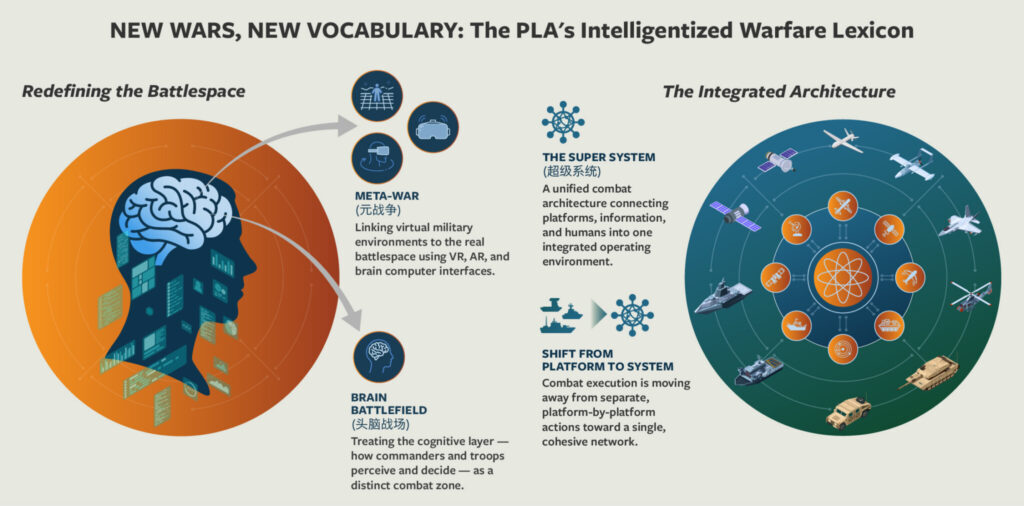
The PLA uses several new terms to describe the transition to intelligentized warfare as the next stage of contemporary conflict. Source: FDD.
PLA Daily (the PLA’s flagship newspaper) and China Military Online (the PLA’s official news portal) describe this model through terms such as “meta-war” (元战争), the “brain battlefield” (头脑战场), and a battlefield “super system” (超系统). This new terminology suggests military advantage could depend less on any single platform or weapons system and more on integrating physical operations, virtual simulation, and human cognition into one command environment.11 These models would enable commanders and units to model scenarios and subsequently synchronize actions faster under combat pressure.
Qiushi, the CCP’s flagship ideological journal, has similarly reinforced this type of doctrinal shift by highlighting the narrowing boundary between human decision-makers and weapons systems and calling for a pivot towards human-machine partnerships.12
PLA-affiliated media further operationalize this vision by depicting a future battlespace in which intelligent systems assume a larger share of the risk, allowing human forces to reduce their frontline exposure.13 These systems are described as being capable of limited autonomous decision-making, adaptive task execution, and dynamic coordination, reframing warfare away from direct human confrontation and decision-making and towards machine-managed operations.14 This depiction aligns with China’s broader “Digital China” strategy, which links digital and intelligent transformation to national power and positions autonomy-enabled warfare as central to securing long-term military advantage and “winning the future.”15
Why this matters is straightforward: Shifting sensing, coordination, and execution to machine-enabled systems could increase operational tempo, compress warning and decision time, and create new escalation risks, especially when automated functions shape targeting, tasking, or responses inside a conflict.
This model also sharpens unresolved ethical and operational questions about human control in the kill chain and accountability for machine-enabled errors. Moreover, AI-enabled decision support systems could help compensate for the PLA’s limited real-world combat experience by improving leaders’ ability to interpret data, anticipate adversary movements, and make faster, more informed operational decisions.16 This may strengthen cohesion among the Party, the military, and AI decision-making. Finally, a force designed to shift danger from humans to machines could also lower the perceived political costs of using force, potentially affecting Beijing’s risk calculus in a crisis, including over Taiwan.
SECTION II: China’s Robotic Wolves
China’s robotic wolves offer the clearest window into how the PLA is moving intelligentized warfare from theory into force design, procurement, and field testing. More than a novel platform, they show how Beijing is weaponizing military-civil fusion to convert commercial robotics into tactical capability at scale.
From Doctrine to Deployment
Quadruped robots (often referred to as robotic wolves by the PLA and Chinese media) are the clearest example of how China’s intelligentized warfare concept is moving from doctrine into procurement and real-world testing.17 China’s approach to fielding robotic wolves relies on commercial robotics innovation and production scale to meet PLA operational requirements.
For example, Chinese robotics firm Unitree markets commercial quadrupeds, such as the Go2. Rifle-equipped variants of the platform have since appeared in PLA exercises.18 Public tenders also indicate that Chinese military institutions and the People’s Armed Police (PAP) — a Chinese paramilitary force responsible for internal security, counter-terrorism, and riot control — have sought robot-dog support services through firms, including Unitree.19
Qiteng Robotics, Yunshenchu, Shenhao Technology, and other Chinese firms are also developing quadrupeds explicitly or implicitly for military tasks.20 These robots can move through explosive or hazardous areas without exposing personnel, operate in coordinated swarms to traverse terrain or approach objectives, and use onboard sensors to identify objects, relay information, and support logistics for forward units.
In parallel, Tencent Robotics X is advancing swarm-learning, pursuit-evasion, and autonomous decision-making in dynamic environments — capabilities directly applicable to PLA unmanned operations.21 Collectively, these firms give the PLA a civilian technology base for reconnaissance, targeting, and broader unmanned operations.
The PLA’s quadruped push is part of a broader effort to field autonomous and semi-autonomous systems at scale across the force. That effort depends, in large part, on enabling technologies such as LiDAR — a remote-sensing technology that uses laser pulses to generate high-resolution 3D maps for navigation, obstacle detection, and targeting in complex terrain. In 2018, the CCP identified LiDAR as a “chokepoint technology” and directed its integration into military systems through military-civil fusion.22
Beijing uses state-directed industrial policy to harness ostensibly commercial ecosystems for fielding autonomous and semi-autonomous systems, especially in dual-use technologies that can move quickly from civilian markets into PLA applications. This fusion strategy — in the form of subsidies, policy guidance, and preferential domestic demand — has helped Chinese firms build scale advantages across enabling sectors with direct military relevance, including drones, robotics, AI, batteries, and LiDAR. In LiDAR’s case, Chinese companies account for nearly 80 percent of global sales, giving the PLA a deep, price-competitive sensor base for integration across unmanned platforms, including quadrupeds.23
PLA budget documents do not typically disclose program-level spending on autonomous systems or their enabling components, but fielding patterns show what Beijing is prioritizing. Recent military exercises and high-visibility events, such as Beijing’s September 2025 Victory Day parade, increasingly feature LiDAR-equipped quadrupeds and other unmanned ground systems.24 This matters because it reflects a push to embed unmanned systems at tactical echelons and integrate them into routine unit training — steps that could improve PLA operations in dense littoral or urban terrain, such as during a Taiwan contingency, in which sensing, navigation, and attrition management become decisive.
A Closer Look at China’s Robotic Wolves
Chinese robotic wolf quadrupeds illustrate the ground-combat capabilities the PLA is seeking as it pushes intelligentized warfare down to the tactical level. Chinese reporting describes these platforms as integrating LiDAR arrays, electro-optical/infrared (EO/IR) cameras, and onboard AI computing to support autonomous navigation and target identification.25 These sources also claim the wolves use Huawei’s Ascend 310B processor to fuse 3D spatial data with visual and thermal inputs, enabling faster perception, route planning, and machine-assisted engagement decisions, including in degraded battlefield conditions.26
Beyond sensors and processing, Chinese reporting portrays the wolves as endurance platforms designed to operate alongside dismounted infantry. Reported performance includes nearly two hours of operation, a range of roughly 10 kilometers, and the ability to remain operational after submersion in water for up to 30 minutes.27 With an estimated payload of about 20 kilograms, the wolves can carry light weapons, demolition gear, or supplies, depending on mission requirements — a similar outload to ground robots currently fielded by the Ukrainian military. Mobility features in the base design include stair-climbing legs that enable use in built-up or urban areas.
These endurance and mobility traits translate into tactical utility once hostile contact occurs. According to a PLA Marine brigade leader, the wolves’ LiDAR-enabled 3D perception allows them to traverse minefields, debris-filled urban areas, and coastal obstacles.28 At the formation level, Chinese descriptions emphasize modularity and role flexibility within coordinated ground teams. Armed variants are portrayed as able to employ small arms or rockets to suppress positions or breach light defenses.29 Chinese reporting portrays these systems as capable of autonomous navigation even under fire, and able to provide suppressive fire to support infantry maneuvers.30
PLA commentary also cites a “three-three” assault configuration — two wolves advancing with one held in reserve — as a way of extending infantry reach, sustaining tempo, and reducing direct human risk exposure.31
Taken together, the robotic wolves show how the PLA is trying to turn intelligentized warfare into repeatable, unit-level capability. These systems combine sensing, mobility, and delegated machine execution to push reconnaissance, breaching, and suppressive support forward while reducing sustained exposure of infantry in the most dangerous terrain. Just as important, the wolves illustrate how military-civil fusion can convert commercial robotics, sensors, and processors into battlefield tools on short timelines — creating a scalable pathway for the PLA to proliferate autonomy across the ground force.
Forward Reconnaissance and Logistics
Drawing on lessons from Ukraine, the PLA is accelerating integration of unmanned systems for high-intensity operations, including in a potential Taiwan contingency. Chinese military writing emphasizes dense urban terrain, contested littorals, and information-degraded environments as necessitating investment in robotic platforms that can conduct reconnaissance and logistics support ahead of human forces.32
For instance, robotic wolf units appear designed for forward reconnaissance and real-time intelligence collection in combat environments, supporting force protection and perimeter defense ahead of infantry. In reported tests and field trials, wolves have operated in front of advancing PLA squads to map terrain and detect potential enemy positions using EO/IR cameras and LiDAR, transmitting sensor data back to command posts to build a more complete battlefield picture.33
State-affiliated reporting also claims the wolves can clear paths, breach light obstacles, and identify potential ambush points before troops arrive on foot. In this model, semi-autonomous wolves could conduct intelligence, surveillance, and reconnaissance (ISR) patrols under human supervision, extending coverage into areas that would otherwise require sustained manpower.34 That advantage is sharpest when terrain, obstacles, or electronic interference degrade visibility and communications.
Beyond reconnaissance, quadrupeds could support forward logistics, carrying ammunition, demolitions, or medical supplies through areas too dangerous or confined for vehicles.35
Close Infantry Support
Chinese reporting also claims these systems can support close-in combat functions. One account states that within roughly 150 meters of enemy positions, robot wolves can rapidly detect, track, and be ready to engage targets using EO/IR sensors and onboard AI processing.36 PLA-affiliated commentary also observes that these systems’ advanced processing could accelerate sensor-to-shooter integration, ensuring rapid target engagement. The same reporting highlights durability features relevant to littoral or amphibious assault operations, including brief seawater submersion tolerance that could matter during the initial phase of an amphibious landing and follow-on movement inland.37
Building on reconnaissance and support roles, Chinese sources also depict robot wolves operating in coordinated formations alongside troops and manned vehicles in dense urban environments. Recent exercises show rifle-equipped robot wolves patrolling through mock towns alongside infantry while drones provide aerial overwatch, moving ahead of infantry to detect and help neutralize ambushes.38 People’s Daily has explicitly tied these experiments to lessons from Ukraine, emphasizing the difficulty and attrition risks of dense urban combat.39 In that framing, the prospect of future urban operations — perhaps on the streets of a Taiwanese city — helps explain PLA investment in ground robots to address these capability gaps in city-fighting capacity.40
Cross-Domain Integration
PLA writings have also begun extending this concept beyond urban tactics to a broader unmanned force architecture spanning land, air, and maritime systems.41 In this framing, robotic wolves function not only as ground scouts or shooters but as networked nodes that share sensing, targeting, and situational-awareness data with other unmanned and manned platforms.42 That connectivity can cue aerial drones and extend command-and-control reach when terrain, urban density, or electronic interference degrades traditional communications.43
Chinese assessments of the Ukraine war — especially operations in the Black Sea — emphasize coordinated employment and layered functionality for unmanned platforms across domains. PLA commentary cites Ukrainian use of networked unmanned surface vessels to show how maritime drones can combine reconnaissance, electronic disruption, and strike to probe or penetrate defended waters.44
Chinese demonstrations of armed unmanned surface vessels suggest interest in these types of maritime, formation-level operations, with platforms assigned complementary roles such as scouting, decoying, jamming, and attack.45 PLA writings also pair these surface systems with unmanned underwater vehicles tasked with reconnaissance, target tracking, and follow-on attack — creating a diverse set of maritime capabilities.46
Beyond wolves and maritime assets, China North Industries Group spokesperson, Cheng Ziheng, has described a layered unmanned aerial vehicle (UAV) deployment model in which expendable drones trigger or expose enemy air defenses, anti-radiation drones target those emitters, and follow-on strike drones exploit the resulting gaps to neutralize air defense positions.47 Larger UAV platforms such as the Jiutian drone are also cited as enabling coordination across air, maritime, and littoral spaces by acting as airborne hubs for unmanned deployment and data fusion.48 Overall, the model reflects an emphasis on sequencing complementary unmanned roles rather than relying on any single platform.
Across these land, sea, and air domains, PLA writings are converging on a new joint wartime paradigm: aerial swarms, ground “wolf packs,” and maritime “shark packs.”49 Aerial swarms focus on mass and saturation to overwhelm air defenses and are supported by airborne launch platforms.50 Ground‑based “wolf packs” emphasize coordinated movement and attacks in complex terrain through team‑level autonomy. Meanwhile, maritime “shark packs” prioritize synchronized, multi‑directional attacks intended to saturate naval defensive systems.51 Despite operating in different environments, all three formations rely on decentralized control, redundancy, and the ability to continue functioning under attrition.52
Taken together, PLA sources describe unmanned systems — air, ground, and maritime — as a single, coordinated toolkit meant to extend sensing, speed decision-making, and sustain operations despite disruptions. The writing focuses on what these systems can do: scout ahead of troops, share targeting data, and sequence suppression and strike across multiple platforms. What appears less developed in open PLA discourse is the control problem: how Beijing maintains reliable human oversight when autonomous systems operate at speed, in degraded communications, and with limited supervision. That gap matters because it creates operational and escalation risk — especially in a fast-moving crisis.
Ground Zero: Taiwan
War over Taiwan is the most plausible proving ground for many of these systems because it compresses the PLA’s hardest problems into one fight: contested littorals, dense urban terrain, and degraded communications under fire. Xi has set a 2027 Taiwan milestone tied to the PLA’s 100th anniversary — an internal benchmark for accelerating China’s military modernization and improving readiness. U.S. officials and assessments have explicitly linked that milestone to building the capabilities the PLA would need for a Taiwan contingency, albeit without implying a decision to invade on a fixed date. Nevertheless, any invasion decision will hinge, in large part, on whether the PLA can field the platforms required to execute an invasion, including robotic wolves designed to operate in the most attrition-intensive phases of the fight.
As the PLA moves from concept to experimentation, training footage, simulations, and exercises offer a window into how robotic wolves are being tested, integrated, and refined for a potential Taiwan contingency. PLA concepts generally assign unmanned ground, air, and maritime systems sequenced roles in the opening phase of conflict — when their own assault forces would be exposed, dispersed, and most vulnerable.53
Chinese training materials and state media frequently show robotic wolves pushed to the front of that phase, moving ahead of infantry to scout, breach obstacles, and initiate suppressive fires.54 In this framing, wolves are not niche assets; they are designed for repeatable use during the most attrition-intensive window of an amphibious assault, preserving infantry combat power for exploiting breaches and conducting follow-on operations inland.
This employment pattern is visible across a range of PLA training scenarios designed to simulate Taiwan-like conditions. In China Central Television (CCTV)-released simulations of beachhead assaults, where coastal defenses are expected to impose high initial losses, these systems are shown absorbing the initial brunt of coastal defenses, helping the landing force get ashore.55 In these exercises, robotic wolves repeatedly appear as first-wave assets intended to absorb risk in the most attrition-intensive phase of an operation. Explosive-laden variants are shown clearing trenches, barriers, and tank traps, while gun-armed robots operate alongside airborne or maneuver elements to suppress positions and disrupt reinforcements.56 Other quadrupeds deliver ammunition and supplies to squads under fire, shifting high-risk tasks forward and preserving infantry combat power and momentum.57 Even if individual robots are destroyed during this intense initial phase of an invasion, PLA concepts assume the formation can continue moving, using machines as expendable forward elements while preserving infantry for the subsequent fight inland.
Beyond reconnaissance and force protection, PLA training materials also suggest robotic wolves could serve as a ground-based analogue to one-way attack drones. In this framing, they could deliver explosive payloads against defended or hard-to-reach targets, such as tactical command posts, communications relays, radar or air-defense nodes, ammunition and fuel points, and critical infrastructure chokepoints such as power substations and transformers. Those targets matter because disabling them can degrade a defender’s ability to coordinate and sustain resistance.
Vulnerabilities and Countermeasures
While the PLA has invested heavily in robotic systems, these platforms face clear vulnerabilities.58 They rely on wireless links and satellite navigation for control and movement, which makes them vulnerable to jamming, spoofing, or cyber intrusion.59 The wolves’ sensor suite also has limits: smoke, fog, reflective obscurants, and laser dazzlers can degrade LiDAR and cameras, while visual disruptors and directed-energy effects can impair EO/IR optics.60 Robots have thermal signatures, making them easier to detect with infrared sensors.61 PLA-linked reporting has acknowledged another constraint: unmanned ground vehicles remain vulnerable to direct fire and fragmentation, meaning even light weapons can disable them.62
Moreover, PLA training has highlighted gaps in control, survivability, and logistics for wolf deployments.63 Current policy appears to keep these systems in semi-autonomous, “man-in-the-loop” configurations, limiting them to bounded tasks such as breaching obstacles and conducting resupply runs rather than independently executing lethal operations.64 PLA Marine Brigade commander Wang Rui has publicly underscored that human approval remains required for the use of deadly force and warned that overreliance on automation can create new risks when robotic systems encounter conditions beyond their design limits.65
Lastly, sustainment challenges also limit operational scalability. Each system requires regular battery replacement or recharging, which creates a logistics burden: forward personnel, transport, and mobile power infrastructure. If units lose communications or support, disabled robots can become obstacles rather than assets.66
These dependencies create exploitable single points of failure. A destroyed charging vehicle or disrupted power supply could sideline an entire pack. Chinese developers reportedly are experimenting with counter-electronic warfare features and more autonomous modes, but performance under severe jamming and cyber pressure remains unclear in open reporting.67 Chinese sources also provide limited detail on battery endurance or recharging timelines, including whether they rely on fixed docking or charging stations like some Russian drone models.
Section III — Policy Priorities and Recommendations
To counter the threat posed by robotic wolves and other unmanned systems, U.S. policy should increase the cost of producing, sustaining, and deploying the commercial ecosystems that make them possible. This response should begin with three priorities. First, the U.S. and its allies should constrain the firms, components, and financial channels supporting China’s autonomous and semi-autonomous systems. Second, they should identify and exploit the operational vulnerabilities of those systems — including their dependence on power, communications, and human-in-the-loop control. Third, policymakers should develop a dedicated Defense Department counter-robotics strategy while strengthening its own robotics industrial base to ensure U.S. forces can counter, match, and out-innovate the PLA.
Policy Priority One — Constrain China’s Military-Civil Fusion Ecosystem:
Policymakers should prioritize closing the enforcement gap around military-civil fusion firms that remain outside current U.S. sanctions and export-control regimes despite contributing to the PLA’s autonomous warfare capabilities. Firms such as Unitree, Qiteng Robotics, Yunshenchu, Shenhao Technology, and Tencent Robotics X remain undesignated despite producing platforms and research with direct PLA relevance — preserving their access to U.S. capital and components, as well as other foreign partnerships.
olicy recommendations include:
Restricting unsanctioned military-civil fusion firms: Expand sanctions, export controls, and investment restrictions to cover Chinese robotics, AI, and sensing firms that materially support PLA autonomous and unmanned capabilities.
Targeting enabling inputs, not just end products: Prioritize controls on processors, sensors, batteries, communications modules, and other dual-use components that support autonomous and semi-autonomous platforms.
Coordinating with allies and partners: Align sanctions, export controls, and screening measures with allies to reduce opportunities for rerouting, substitution, and regulatory arbitrage.
Tightening capital-market exposure: Limit identified firms’ access to foreign capital, joint ventures, research partnerships, and other channels that help scale dual-use innovation for PLA capabilities.
Launching a national security investigation into robotic imports from foreign adversaries: Initiate a Section 232 investigation into the national security risks posed by foreign robotics manufacturers and consider imposing tariffs on Chinese robotics to prevent domestic market capture and cut off funding.
Policy Priority Two — Exploit Operational Vulnerabilities:
The utility of PLA robotics systems depends on wireless connectivity, geographic positioning systems, battery power, recharge cycles, and human oversight. U.S. planning should, therefore, focus on intelligence collection, vulnerability mapping, and counter-sustainment measures that can degrade these systems before they generate meaningful battlefield effects. Policy recommendations include:
Mapping the support architecture: Prioritize intelligence collection on where PLA robotic units are stationed, how they recharge, what companies and logistics nodes sustain them, and which military units control them.
Targeting power-system dependencies: Identify and restrict the materials, manufacturers, and supply chains that support batteries, charging systems, and mobile power infrastructure for robotic ground systems.
Training for robotic contact and expanding non-kinetic countermeasures:S. and partner forces should train to detect, jam, spoof, disable, and bypass small robotic ground systems in urban, littoral, breaching, and tunnel-clearing scenarios. Investments should be made in testing and tools that exploit vulnerabilities in sensors, communications, and navigation.
Incorporating robotic systems into wargaming and major exercises:S. planners should account for how PLA robotic and other unmanned systems could shape the battlefield, rather than treating future conflict as a contest defined only by missiles, ships, and aircraft. U.S. and partner forces should train to respond to robotic systems across all probable theaters.
Policy Priority Three — Promote and Protect:
Slowing China’s robotic buildup is necessary but insufficient. Policymakers must also build institutional capacity inside the Department of Defense (DOD), train forces to detect and defeat these systems in combat, help Taiwan prepare for the unmanned threats it will face in the opening phase of a cross-strait assault, and work with the U.S. defense-technology base to develop countermeasures faster than the PLA can field new variants. Policy recommendations include:
Developing a dedicated DOD counter-robotics strategy: The Department of Defense should treat Chinese robotic and semi-autonomous systems as a distinct operational challenge and build a strategy that integrates doctrine, procurement, training, and countermeasure development, folding in lessons learned from Ukraine’s experience operating with and against drones.
Support Taiwan’s counter-robotics preparedness:S. security assistance to Taiwan should include training, tools, and tactics for identifying, disrupting, and destroying PLA robotic and semi-autonomous systems during the opening stages of an amphibious assault.
Prioritize low-cost countermeasures for Taiwan: Taiwan should be equipped with scalable counters such as jammers, spoofers, obscurants, directed-energy tools or other platforms where feasible, and lightweight kinetic options suited for urban and littoral defense.
Partner with defense-technology firms on counter-robotics tools: The United States should work more closely with private-sector defense innovators to develop sensors, software, electronic warfare tools, and other countermeasures tailored to robotic ground systems and mixed unmanned assaults.
Screen Chinese robotics vendors and components from U.S. procurement: Federal, state, and local agencies should prohibit procurement of Chinese-made robotic ground systems and key autonomy-enabling components — including LiDAR, onboard processors, and cellular modules — for defense, public safety, critical infrastructure, and other sensitive operational environments.
Conclusion
Robotic wolves are only the first wave of a much larger Chinese effort to integrate autonomy into combat operations. The United States and its allies should act now to constrain the ecosystems behind these capabilities, exploit their vulnerabilities, and prepare for a fight in which autonomy could increasingly shape tempo, attrition, and military advantage.