China & Taiwan Update, May 15, 2026
Toplines
CCP General Secretary Xi Jinping met with US President Donald Trump from May 13 to 15. The two discussed global flashpoints, including Taiwan and the Middle East, but did not reach major agreements on these issues. PRC readouts downplayed the issue of Iran, consistent with previous ISW-CDOT analysis. Other top US officials, including Secretary of Defense Pete Hegseth, Secretary of State Marco Rubio, and Treasury Secretary Scott Bessent, attended. US tech and business leaders, including Elon Musk and Jensen Huang, also traveled to the PRC for the summit.[1] The PRC delegation similarly included CEOs from top firms such as Xiaomi, Bank of China, and Fuyao Glass.[2] PRC framing leading up to the meeting emphasized “win-win cooperation” and “peaceful coexistence” between the PRC and the United States. The PRC Embassy in the United States posted a video to X (formerly Twitter) that stated that the Pacific Ocean is vast enough for the United States and the PRC to “prosper in their own ways.”[3] Xi expressed his desire that the United States and PRC become “partners rather than rivals” and avoid the “Thucydides Trap” – a term referencing the phenomenon of military confrontation between an established and rising power.[4]
Trump and Xi’s discussions also addressed the conflict in Iran. Trump stated before the meeting that PRC intervention was not necessary to end the war in Iran.[5] Trump later stated that Xi agreed not to supply weapons to Iran and that the PRC “would like to be of help” in ending the conflict and reopening the Strait of Hormuz, however.[6] This is consistent with previous PRC statements on the issue.[7] The White House readout from the meeting stated that the United States and PRC “agreed that Iran can never have a nuclear weapon.”[8] Bessent commented that the PRC will work “behind the scenes” to reopen the Strait of Hormuz, as reopening the strait is “in their interest.”[9]
PRC readouts and statements on the summit downplayed discussions on Iran, however. The PRC Ministry of Foreign Affairs (MFA) daily press conference reiterated standard rhetoric on the issue, with MFA spokesperson Guo Jiakun stating that the PRC’s position on the Strait of Hormuz remains “consistent and clear.”[10] The MFA’s readout on Xi and Trump’s meeting used similarly vague language, stating that Xi and Trump “exchanged views” on the Middle East, Ukraine, and the Korean Peninsula without specifying concrete outcomes.[11] ISW-CDOT previously assessed that the PRC likely seeks to downplay its support for Iran, preferring instead to balance its relationship with Iran against other Middle Eastern nations.
Xi and Trump’s discussions centered on trade and economic relations; few concrete deals emerged from the meeting, however. Trump announced on May 14 that the PRC would purchase 200 Boeing jets.[12] The United States cleared approximately ten PRC firms to receive H200 chips, which have not yet been delivered.[13] US Trade Representative Jamieson Greer said that the United States and PRC did not discuss export controls on chips during the meeting.[14] Trump confirmed that the PRC would purchase US oil, and Greer confirmed the United States and PRC would establish a “Board of Trade” to cut tariffs on goods.[15]
Taiwan featured prominently in PRC rhetoric during the summit but was not featured in US readouts. PRC and US rhetoric on Taiwan were consistent with their established policy stances. Xi told Trump that the Taiwan issue is the most important topic in US-PRC relations.[16] Xi stated that the cross-strait situation could lead to a clash between the PRC and the United States if “handled poorly.”[17] The PRC maintained its longstanding stance against US arms sales to Taiwan.[18]
Neither the White House readout on the summit nor the US Embassy in China readout mentioned Taiwan or the US arms sales.[19] US Secretary of State Marco Rubio highlighted on May 14 that the US’s policy on Taiwan remains unchanged, however.[20] Rubio told the media that Taiwan “did not feature prominently” in Xi and Trump’s discussion but that the PRC had previously been “very upset” about a 2025 US decision to sell Taiwan 11 billion US dollars’ worth of weapons.[21]
Taiwan’s military plans to deploy its High Mobility Artillery Rocket Systems (HIMARS) to its outlying islands. This deployment would allow Taiwan to strike PLA infrastructure in the PRC, which could significantly complicate PLA efforts to concentrate sufficient forces for an amphibious invasion of Taiwan. Taiwanese media reported on May 10 that an unnamed military source stated that Taiwan plans to deploy HIMARS to the outlying islands of Penghu and Dongyin.[22] Taiwan’s HIMARS inventory includes 111 systems, including those purchased but not yet delivered.[23] Taiwan currently fields or has purchased a total of 504 Army Tactical Missile System (ATACMS), which have a range of 300 kilometers, to be launched by Taiwan’s HIMARS.[24] The unnamed Taiwanese military source also claimed that Taiwan was planning to procure a US-made precision strike missile with a range of around 500 kilometers.[25]
The unnamed military source stated that Taiwan aims to create a “dead zone” within the PRC that would prevent the PLA from executing an invasion of Taiwan.[26] The range of Taiwan’s HIMARS-launched munitions would allow Taiwan to strike likely points of concentration in the PRC for an amphibious invasion of Taiwan, such as Xiamen, Quanzhou, and Zhangzhou.[27] Taiwan could strike targets as far as PLA Navy (PLAN) bases at Wenzhou and Ningbo and a PLA Air Force (PLAAF) base in northeast Guangzhou, if Taiwan purchased and deployed the 500 km precision strike missile. The United States has used HIMARS to target stationary Iranian naval vessels during the conflict in the Middle East, despite the HIMARS lacking a dedicated anti-ship munition.[28] Taiwan could similarly use the HIMARS’ long range to target stationary PLA amphibious vessels during an embarkation of ground forces or refueling. Forward-deployed HIMARS, as a result, could complicate PLA efforts to concentrate the necessary ground and naval forces required for an amphibious invasion of Taiwan without risking significant degradation at the outset of a conflict.
Key Takeaways
US-PRC Diplomatic Engagement: US President Donald Trump met with CCP General Secretary Xi Jinping from May 13 to 15. Their discussions focused primarily on economic and trade-related issues; neither side strayed from established policy and rhetoric when speaking on geopolitical topics.
Taiwanese Military Developments: Taiwan’s military plans to deploy its HIMARS to the outlying islands of Penghu and Dongyin. Unnamed sources within the Taiwanese military stated that these deployments would help deter a PLA invasion of Taiwan.
Cross-Strait Relations
Taiwan
The US House of Representatives introduced new sanctions legislation aimed at deterring PRC aggression against Taiwan. US Congresswoman Young Kim introduced the bill on May 7 that would establish a China Sanctions Task Force led by the US State Department and US Department of the Treasury. The task force would identify PRC entities and individuals to sanction if the PRC invades Taiwan. The task force would also “align [U.S.] sanctions planning and economic countermeasures with U.S. allies and partners.”[29] Kim introduced the bill referencing the 2027 “Davidson Window,” for a PRC invasion of Taiwan. US Admiral Phil Davidson first mentioned the concept during a 2021 Congressional hearing, referencing the year by which CCP General Secretary Xi Jinping instructed the PLA to “be ready” to invade Taiwan.[30] The intelligence community assessed in 2026 that the PRC lacks a solid deadline for invasion and will likely not invade Taiwan in 2027, however.[31]
US Senator Dan Sullivan previously introduced a similar sanctions bill, the STAND with Taiwan Act, in 2023. This bill would empower the US president and Securities and Exchange Commission (SEC) to target entities to sanction if the PRC or one of its proxies invades Taiwan.[32]
The US House and Senate have introduced other bills to counter PRC aggression against Taiwan, including the Critical Undersea Infrastructure Resilience Initiative Act, aimed at safeguarding Taiwan’s undersea internet cables.[33] Bills such as these could act as deterrents for PRC coercion and signal US support for Taiwan if passed. Bills must clear the House and Senate before receiving a signature from the president and becoming law, however.[34]
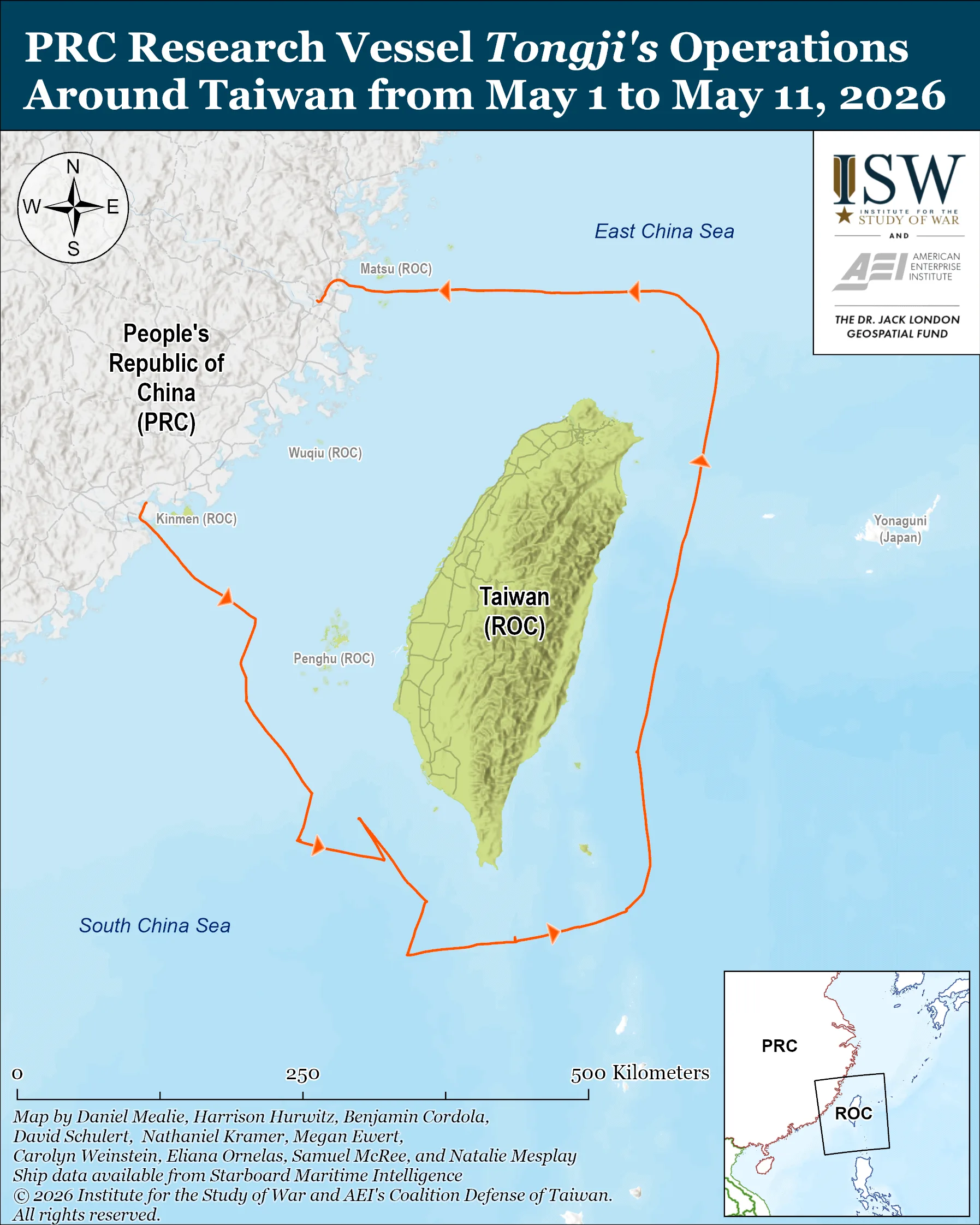
The Taiwanese Coast Guard Administration (CGA) expelled the PRC research vessel Tongji for conducting unauthorized hydrological surveys near Taiwan’s restricted waters. The PRC is increasingly using research vessels to study the waters surrounding Taiwan, which could enhance the PLA’s ability to conduct submarine warfare and launch an amphibious invasion of Taiwan. The CGA spotted Tongji on May 7 five nautical miles outside of Taiwan’s restricted waters and issued warnings and radio-wave disruptions to the vessel until it returned to the PRC on May 11.[35]
The PRC has increasingly used research vessels to study the waters around Taiwan since 2023. [36] The CGA expelled the PRC research vessels Yanping No. 2, Xiangyanghong 1, and Dongfanghong 3 in 2025 for conducting seabed mapping in crucial sea lanes, including those on Taiwan’s East Coast.[37] Tongji is the first reported PRC vessel to conduct undersea research around Taiwan in 2026.
The PRC’s undersea research of Taiwan’s waters could help facilitate submarine operations or an amphibious invasion of Taiwan. PRC state media reports that the Tongji can conduct scientific surveys of marine geology, geophysics, and physical oceanography.[38] Tongji is also capable of carrying unmanned systems and performing offshore engineering operations, including fault detection, repair, and pipeline laying.[39] Other PRC research vessels observed operating around Taiwan have been equipped with advanced sonar equipment, deep-sea sampling technology, and unmanned submarines.[40] Oceanographic data from these vessels could enhance the PRC’s understanding of undersea currents and thermal layers, providing tactical advantages in submarine detection, concealment, and navigation.
The PRC may be aiming to discourage support for Taiwan’s ruling Democratic Progressive Party (DPP) among Taiwanese nationals with business interests in the PRC. The PRC’s Taiwan Affairs Office (TAO) announced on May 6 that the nephew of Taiwanese Minister of the Interior Liu Shyh-fang was removed from his position at the PRC branch of Taiwanese firm Long Time Technology.[41] The TAO announced in February that it was investigating Liu’s nephew, Yen Wen-chun, for allegations that Yen made political donations to Liu.[42] The TAO designated Liu as a “Taiwan independence diehard” on January 7.[43] The PRC has designated a total of fourteen Taiwanese individuals, including members of Taiwan’s legislature and cabinet, as “diehard separatists” to justify targeted coercion under the guise of legitimate law enforcement efforts.[44] A TAO spokesperson stated that the PRC will not allow “Taiwan independence diehards” to profit off the PRC while supporting “separatism.”[45] Taiwan’s Mainland Affairs Council (MAC) condemned Long Time Technology’s PRC branch for firing Yen and stated that such actions are detrimental to cross-strait relations and impede normal cross-strait investments.[46]
The PRC’s investigation of Yen and his subsequent ouster from a PRC branch of a Taiwanese company suggests the PRC may be aiming to deter Taiwanese businesses from associating with people designated as “diehard separatists” or otherwise associated with “separatists.” The PRC previously sanctioned a company owned by DPP legislator Puma Shen’s father in Jun 2025.[47] The PRC also considers Shen a “diehard separatist.”[48] The PRC may be aiming to set the precedent that PRC authorities will investigate and possibly target those with business connections to designated “diehard separatists.” The PRC could be attempting to strengthen the opposition Kuomintang’s (KMT) efforts to present itself as a more positive force for cross-strait relations than the DPP, including cross-strait economic opportunities.
China
A suspected PRC intelligence agent attempted to recruit a US House Select Committee on the CCP aide for espionage. The PRC is likely seeking to acquire insider information on US economic decision-making to better exploit its leverage over rare earths exports and other critical supply chains. A likely PRC intelligence agent posing as a business consultant at a fictitious Hong Kong-based firm, “Nimbus Hub Consulting,” contacted the aide online and offered to pay 10,000 US dollars for information about the Committee’s work and US foreign policy toward the PRC.[49] The PRC agent framed the arrangement as “consulting” work and repeatedly promised cash up front and future payments for information.[50] The PRC agent specifically requested information on US responses to PRC rare earths export controls and US plans for the Venezuelan oil industry and oil supply chains after Maduro’s capture.[51] The aide reported the contact to the Committee and did not accept payment from the PRC agent.[52]
PRC intelligence agents often pose as consultants online to recruit staffers with access to national security and defense information in the United States, NATO member countries, and US partners in the Western Pacific.[53] PRC Ministry of State Security (MSS) hackers also sent emails impersonating Select Committee on the CCP Chairman Representative John Moolenaar to US government officials, business group leaders, think tank researchers, and others ahead of US-PRC trade negotiations in Stockholm in July 2025.[54] The emails requested feedback on fictitious draft legislation and attempted to install malware onto the devices of the recipients, likely to acquire information about US trade strategy ahead of the talks.[55]
The PRC has leveraged its control of rare earth supplies and other critical supply chains to exert pressure on the United States during trade negotiations, and ISW-CDOT has assessed that the United States will remain vulnerable to PRC economic coercion as long as it relies on the PRC for critical supplies.[56] The PRC is likely seeking to increase the effectiveness of its economic coercion by gaining insider information on US and EU trade policy and responses to PRC economic leverage.
Arcadia, California, Mayor Eileen Wang agreed on May 11 to plead guilty to illegally acting as a foreign agent of the PRC. The PRC aims to co-opt US politicians to promote PRC propaganda narratives and exert influence on ethnic Chinese communities abroad. Wang operated a news site targeting Arcadia’s Chinese-American community and admitted to republishing pro-PRC propaganda content at the direction of PRC government officials from 2020 to 2022.[57] Wang received pre-written articles from PRC officials for publication, including an essay denying allegations of genocide and forced labor in the PRC’s Xinjiang province as a smear campaign against the PRC.[58] Wang worked with Jun “John” Chen and Yaoning “Mike” Sun, who the United States charged with acting as agents of the PRC in November 2024 and February 2026, respectively, to publish the propaganda.[59] Sun also served as Wang’s campaign manager in 2022.[60]
The PRC claims to hold authority over all ethnically Chinese people regardless of citizenship and carries out transnational repression and political influence campaigns against Chinese-American communities.[61] The PRC often uses its United Front, a whole-of-government and society effort by the CCP to target and co-opt political, academic, business, civil society, and cultural figures and groups, to carry out these overseas operations.[62] PRC influence and repression operations aim to promote the PRC’s propaganda narratives overseas, coerce dissidents abroad into silencing their criticism of the PRC, and ensure the election of the PRC’s preferred candidates to local, state, and national-level political offices in the United States.[63]
Northeast Asia
Japan
Japan is maintaining its efforts to strengthen ties with the Philippines despite PRC pressure. Japan’s efforts reflect an increased focus on coalition-building to deter PRC aggression. Japanese Defense Minister Shinjiro Koizumi met with Philippine Defense Secretary Gilberto Teodoro Jr. on May 5 and agreed to strengthen Japan-Philippines defense ties.[64] Japan plans to transfer destroyer escorts and other defense equipment to the Philippines, in addition to joint training and information sharing efforts.[65] Japan’s coalition-building efforts with the Philippines echo similar Japanese military diplomacy with Australia. Japan pledged in April 2026 to sell warships to Australia following the relaxation of Japanese defense export restrictions.[66]
Japan’s actions illustrate a concerted effort to rearm and coalition-build despite PRC pressure. The PRC has maintained a pressure campaign against Japan following Japanese Prime Minister Sanae Takaichi’s 2025 comments that a PRC attack on Taiwan could implicate Tokyo. The PRC routinely blames Takaichi’s comments, which she has refused to retract, as being the source of current PRC-Japan tensions.[67] A PRC Ministry of Foreign Affairs (MFA) spokesperson reiterated this rhetoric in a May 12 press conference, referencing the “gray rhino” of Japanese militarism.[68] The PRC will likely continue to levy both rhetorical criticisms and economic sanctions against Japan amid Takaichi’s rearmament, military modernization, and coalition-building efforts.
Europe
Norwegian authorities arrested a PRC citizen on May 7 on suspicion of attempting to steal sensitive satellite data. The PRC is likely targeting NATO member states’ satellite networks to acquire defense secrets and support PLA military modernization. Norwegian police arrested one woman, charged two other suspects who had already left Norway, and seized a 22-ton satellite ground receiver in a shipping container at the port of Oslo during the investigation.[69] Norway’s Police Security Service (PST) alleged the three people attempted to set up the ground receiver near Norway’s Andøya spaceport to illegally download data from satellites in polar orbit for the PRC.[70] The PST stated that the alleged espionage operation sought state secrets that could harm Norway’s national interests if passed to a foreign state.[71]
PRC espionage operations are likely seeking to intercept NATO members’ satellite data to improve PLA capabilities, understand and anticipate NATO’s strategy toward the PRC, and identify vulnerabilities in NATO and NATO-armed militaries that the PRC could exploit during a potential conflict in the Western Pacific.[72] Two PRC agents illegally imported and set up equipment near a French Starlink ground station in January to spy on satellite communications, including sensitive military information, and transmit them back to the PRC.[73] PRC espionage operations have also recently targeted NATO member militaries, national security institutions, and defense manufacturers to acquire military secrets.[74]
Iran
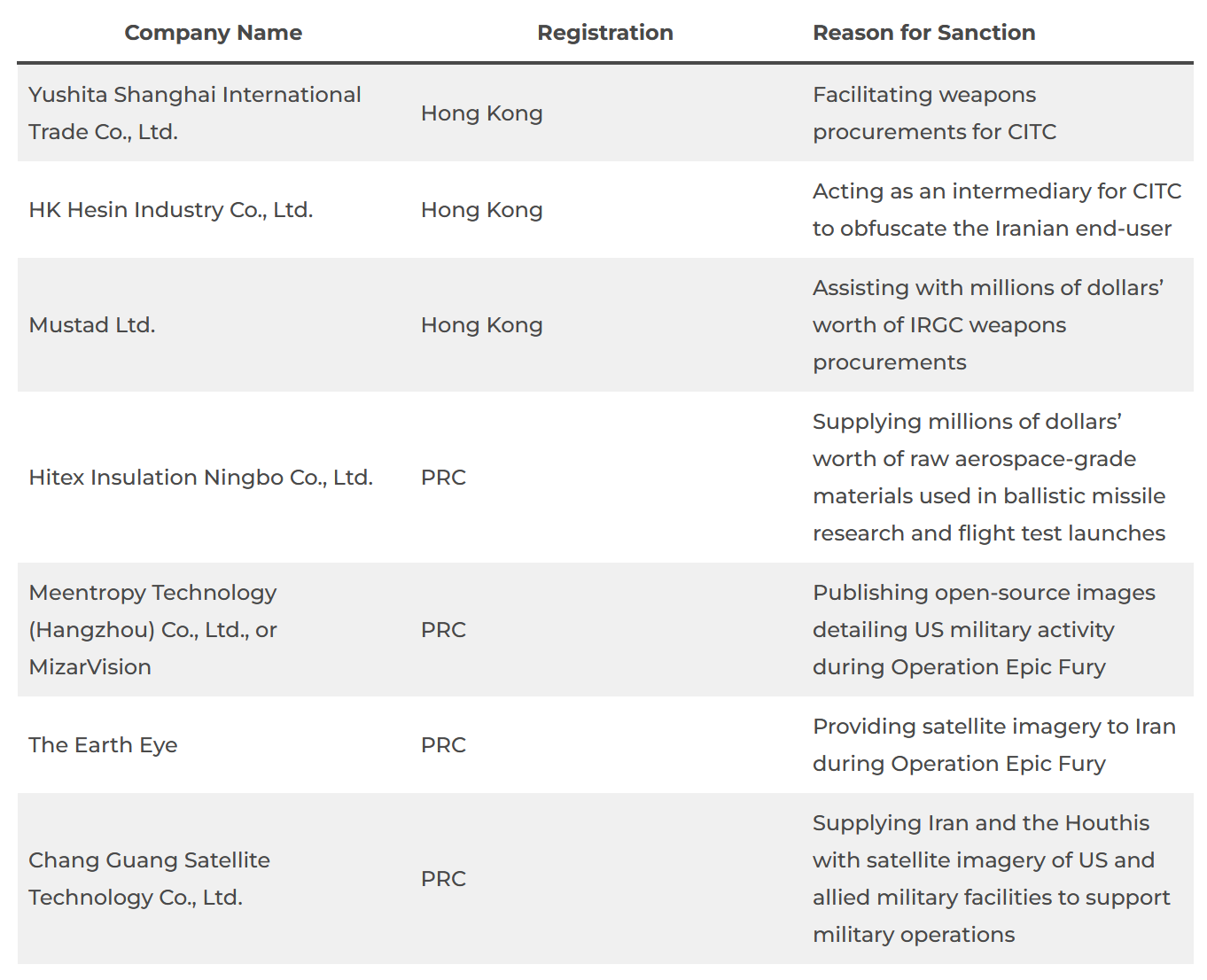
The US Treasury Department sanctioned multiple PRC firms on May 8 for assisting with Iranian military procurements and supplying drone components to Tehran. The US State Department concurrently sanctioned multiple PRC firms for providing the Iranian military with satellite imagery support. The US Treasury Department sanctioned ten individuals and entities from the PRC (most being Hong Kong-based), the United Arab Emirates, Belarus, and Iran.[75] The US State Department sanctioned four satellite imagery providers from the PRC and Iran.[76] These sanctions came one week before US President Donald Trump’s meeting with CCP General Secretary Xi Jinping in Beijing.[77]
An Iranian government entity, the Center for Innovation and Technology Cooperation (CITC), was previously sanctioned by the United States in June 2012. CNN reported in April 2026 that US intelligence assessed that CITC sought to purchase PRC weapons such as man-portable air-defensive systems (MANPADS).[78] The US Treasury sanctioned four PRC firms for cooperating with CITC. One firm, HK Hesin, acted as an intermediary company for CITC to hide that the goods were destined for Iran. [79] The US Treasury sanctioned PRC firm Mustad for assisting the Islamic Revolutionary Guard Corps’ (IRGC) weapons procurements worth millions of dollars. PRC firm Hitex allegedly supplied raw aerospace-grade materials to the Iranian-based Pishgam Electronic Safeh Company (PESC), which was likewise sanctioned in April 2026 for supplying the IRGC Aerospace Force Self Sufficiency Jihad Organization (IRGC ASF SSJO) with unmanned aerial vehicle (UAV) components.[80] The US Treasury sanctioned Hitex and its legal representative, Li Genping, for supporting PESC.
The US State Department’s sanctions announcement targets three PRC firms and Iran’s Ministry of Defense Exports (MINDEX), the exporting arm of the Iranian Ministry of Defense Armed Forces Logistics Department.[81] The US Office of Foreign Assets Control added or updated entries to the Specially Designated Nationals (SDN) for all targeted entities.[82]
PRC Firms Sanctioned by the United States on May 8, 2026