
South Asia Intelligence Review
Manipur: Deepening Ethnic Entanglements
The ethnic conflict that erupted in Manipur in May 2023 was initially characterised as a confrontation between the Meitei community, concentrated in the Imphal Valley, and the Kuki-Zo tribes inhabiting the surrounding hill districts. More than three years later, while the Meitei-Kuki conflict remains unresolved, a parallel and increasingly violent confrontation has emerged between the Naga and Kuki communities in the hill districts of the State. The latest incidents indicate that Manipur’s security crisis is no longer confined to the valley-hill divide but has evolved into a multi-layered ethnic conflict involving competing territorial, political and historical claims among several communities.
The latest incident occurred on June 5, 2026, when three Kuki civilians were killed and seven houses set ablaze at Loibol Khullen village in Kangpokpi District. Kuki Inpi Manipur (KIM) alleged that cadres of the National Socialist Council of Nagalim-Isak Muivah (NSCN-IM) and its alleged proxy, the Zeliangrong United Front-Kamson (ZUF-K), carried out the attack.
Just days earlier, on May 31, 2026, a resident of Konsakhul Naga village in Kangpokpi District was seriously injured in a suspected attack by militants belonging to the Kuki National Front-Presidential (KNF-P). The incident reportedly stemmed from a dispute involving a village water supply pipeline and highlighted how local grievances are increasingly becoming catalysts for wider ethnic confrontation.
The conflict entered a more dangerous phase on May 13, 2026, when unidentified armed militants ambushed two vehicles carrying members of the Thadou Baptist Association of India (TBAI) and the United Baptist Council (UBC) near Kotlen and Kotzim villages along the Kangpokpi-Churachandpur Road in Kangpokpi District, killing three church leaders – Reverend Vumthang Sitlhou, Reverend Kaigoulun Lhouvum and Pastor Paogoulen Sitlhou – and injuring four others. The victims had reportedly been involved in church-led efforts to promote dialogue and reconciliation. On the same day, a Naga civilian, Wilson Thanga, was killed and his wife injured in a suspected militant ambush near Joujangtek and Nungsai villages in Noney District while returning from Imphal.
The violence has been particularly pronounced in Ukhrul, Kamjong and Kangpokpi Districts.
On April 24, 2026, a Naga Village Guard (NVG), Horshokmi Jamang, was killed in an ambush attributed to suspected Kuki militants in Ukhrul District. On the same day, two Kuki village volunteers Paominlun Haolai (22) and Letlal Sitlhou (41) were killed and several civilians, including women and children, were injured in suspected militant attacks at Mullam and Shongphal villages in Ukhrul District.
Earlier, on April 22, 2026, another Naga village volunteer, Chihanngam Rungsung, sustained gunshot injuries in suspected sniper fire by Kuki militants at Sinakeithei village in Ukhrul District.
The confrontation acquired a more organised character on April 10, 2026, when a Border Security Force (BSF) Constable, Mithun Mandal, was killed by a stray bullet during an exchange of fire between suspected Kuki-Zo and Tangkhul Naga village volunteers in Ukhrul District.
On April 13, 2026, four cadres of the Kuki National Army-Burma (KNA-B) were reportedly killed in a clash with NSCN-IM cadres along the Indo-Myanmar border in Kamjong District. Subsequently, on April 24, 2026, the NSCN/GPRN-Aleng faction claimed to have killed five KNA-B cadres in a retaliatory operation. The growing involvement of organised armed groups indicates that the confrontation has moved beyond sporadic communal tensions and increasingly resembles a structured insurgent-linked conflict.
On March 11, 2026, two Kuki civilians, Thenkhogin Baite (45) and Thangboimang Lunkim (35), were allegedly abducted and later killed by cadres of NSCN-IM in Ukhrul District, while another civilian, Letginthang Haokip (29) sustained injuries. On the same day, at least 20 Naga civilians, including women and children, were reportedly abducted by suspected Kuki militants near Shangkai village before being released following pressure from Naga civil society organisations and the intervention of authorities.
Subsequently, on March 19, 2026, suspected Kuki militants reportedly attempted to enter the Tangkhul Naga-inhabited village of Sirarakhong in Ukhrul District, triggering exchanges of fire with local Naga village volunteers.
According to partial data compiled by South Asia Terrorism Portal (SATP), at least 20 persons have been killed in the Kuki-Naga confrontation in Manipur since March 2026, including 10 civilians (eight Kukis and two Nagas), one Security Force (SF) trooper and nine militants, across eight separate incidents. (Data till June 6,2026).
The most consequential development, however, has been the hostage crisis that followed the killing of three church leaders on May 13, 2026. According to available reports, more than 48 civilians from both communities were abducted during the ensuing violence. Although 28 hostages, including 12 Nagas and 16 Kukis, have subsequently been released, the crisis remains unresolved. As of June 5, 2026, six Naga civilians reportedly remain missing, while Kuki organisations maintain that 14 Kuki civilians continue to be held by Naga groups. The continued captivity of 20 civilians has become the central issue driving mobilisation and resentment on both sides.
The hostage issue has generated unprecedented public mobilisation. Hundreds of Nagas marched in Imphal on May 25, 2026, demanding the release of six Naga civilians allegedly abducted by Kuki militants. On June 4, 2026, the All Naga Students’ Association, Manipur (ANSAM), announced intensified agitation programmes, while a Public Interest Litigation (PIL) was filed before the Manipur High Court seeking urgent intervention to trace the missing civilians. Amnesty International, in a statement issued on June 4, 2026, called for the immediate and unconditional release of all hostages and warned that the continued detention of civilians reflected a worsening human rights and security crisis in the State.
While the initial phase of Manipur’s ethnic violence from May 2023 was primarily defined by Kuki- Meitei hostilities, developments since early 2026 indicate the re-emergence of a distinct Kuki-Naga conflict. The killing of church leaders in Kangpokpi on May 13, subsequent retaliatory abductions, and escalating clashes across Ukhrul, Kamjong and Kangpokpi suggest that historical Kuki-Naga fault lines are once again becoming a major driver of instability in the State.
The emergence of Kuki-Naga hostilities marks a significant departure from the dominant pattern of violence witnessed since May 2023. The original conflict primarily pitted the Meitei community of the Imphal Valley against Kuki-Zo groups inhabiting the surrounding hill districts. However, as the Kuki- Meitei conflict settled into a protracted stalemate, older inter-tribal disputes that had remained dormant for decades began resurfacing. The current phase of violence demonstrates that Manipur’s crisis cannot be viewed exclusively through the prism of Kuki- Meitei antagonism. Instead, it reflects the interaction of multiple unresolved ethnic and territorial disputes, each possessing its own historical roots and political dynamics.
Indeed, Kuki-Naga tensions in Manipur are neither new nor incidental. The two communities have a long history of contestation over territory, traditional authority and political representation. The most violent manifestation of these tensions occurred during the 1990s, particularly between 1992 and 1997, when clashes between NSCN-IM cadres and various Kuki militant organisations resulted in hundreds of fatalities and the displacement of thousands of civilians.
At the heart of that conflict were competing territorial aspirations. Naga insurgent groups sought the integration of Naga-inhabited areas into a proposed Greater Nagalim, encompassing territories across Nagaland, Manipur, Assam, Arunachal Pradesh and Myanmar. Kuki organisations, meanwhile, increasingly articulated demands for a separate Kuki homeland. Since both projects overlapped geographically in large parts of Manipur’s hill districts, disputes over villages, customary land ownership and administrative boundaries frequently escalated into violence.
Although the intensity of the conflict declined after the late 1990s, no comprehensive political settlement addressed the underlying issues. Territorial claims remained contested, competing historical narratives persisted and mutual distrust continued to shape relations between the two communities. Consequently, the conditions that had produced violence in the 1990s never entirely disappeared.
The present resurgence of conflict appears to be driven by several interconnected factors. First, unresolved territorial disputes continue to generate friction, particularly in mixed-population areas of Kangpokpi, Senapati, Ukhrul and Kamjong Districts. Second, the proliferation of armed actors has complicated local security dynamics. Besides established insurgent organisations such as NSCN-IM, numerous Kuki armed groups, village defence forces and splinter factions remain active in the region. Third, the prolonged instability created by the Kuki-Meiti conflict weakened administrative structures and created opportunities for local disputes to escalate into ethnic confrontations.
The increasing involvement of armed organisations is particularly concerning. Recent clashes have involved NSCN-IM, NSCN/GPRN-Aleng, KNA-B and KNF-P, suggesting that the conflict is becoming intertwined with existing insurgent networks operating along the Indo-Myanmar border. Several incidents have occurred close to the international boundary, raising concerns about cross-border movement of militants, weapons and logistical support.
The hostage crisis has also demonstrated the growing use of civilians as instruments of coercion. Unlike previous clashes, where violence was largely directed at armed opponents, recent incidents have increasingly targeted non-combatants. Such tactics risk deepening ethnic polarisation and making future reconciliation efforts considerably more difficult.
Political and civil society responses have so far failed to halt the deterioration. While Chief Minister Yumnam Khemchand Singh has assured that investigations are underway and security agencies are working to secure the release of missing civilians, confidence among affected communities remains low. The National Investigation Agency’s (NIA’s) involvement in selected cases may improve accountability, but it is unlikely to address the broader structural drivers of the conflict.
The current confrontation serves as a reminder that Manipur’s instability is rooted in multiple overlapping ethnic disputes rather than a single binary conflict. While national attention has largely remained focused on Kuki-Meiti violence, the resurgence of Kuki-Naga hostilities underscores the fragility of inter-community relations across the hill districts. Unless meaningful political dialogue is initiated and long-standing territorial grievances are addressed, the present violence risks evolving into a sustained cycle of retaliation reminiscent of the devastating Kuki-Naga conflict of the 1990s. The continued captivity of 20 civilians and the persistence of armed confrontations indicate that the State may be entering a new and potentially more complex phase of ethnic conflict.
Criminals unleashed
As reported on June 4, 2026, the Taliban security command in Herat Province announced that two-armed robbers were killed following a clash with members of the group in the Injil District.
On May 30,2026, armed robbers killed a 60-year-old man, Mohammad Asif Naseri, inside his grocery shop in the Chahar Qala area of Kabul city’s District 6.
On May 25, 2026, a former military officer, who had also served under the Taliban, Nurullah, was killed by armed robbers in the Arzanqimat area of Kabul. Nurullah had served in the Taliban’s Mansouri Corps, stationed in the Khost and Paktia provinces.
As reported on May 22, 2026, armed robbers stormed into Khwaja Mohammad Tali Commercial Center in Herat city, looting significant amounts of cash and goods. The armed group initially tied up the security guard and completely destroyed all surveillance cameras.
On May 20, 2026, Hashmatullah Rahmani, Spokesperson for the Taliban Police Command in Samangan Province, discloed that a 27-year-old man’s body was discovered by local residents inside a garden in Aybak city, the provincial capital. The motive behind the killing remains unclear.
On May 19, 2026, unidentified gunmen killed a tribal elder of Kalamtar village in the Dand District of Kandahar Province. The motive behind the killing remains unclear.
On May 5, 2026, Sahibullah Nazar, a well-known figure, was killed in the Surkh Rod District of Nangarhar Province. Gunmen targeted him near his home, who then fled the scene. The motive behind the attack was not clear.
On April 24, 2026, a young man was killed by armed robbers in the Bolan area of 10th District of Lashkargah city in Helmand Province. Sources indicated that the young man had sold his car and was on his home with the money, when the robbers shot him dead on the road and decamped with the money.
Afghanistan is witnessing a discernible surge in criminal incidents, including homicides, armed robberies, thefts, and physical assaults. Though the country is grappling with severe media restrictions, scattered media reports indicate that these crimes are happening across the length and breadth of Afghanistan, especially in the Helmand, Badakhshan, Herat, Kabul, Balkh, Parwan, Faryab and Jawzjan provinces, among others.
According to a World Bank report, Afghanistan Economic Monitor, published in December 2025, the Taliban administration spent about 96.9 billion Afghanis (USD1.4 billion), on security in the first nine months of the 2025 fiscal year.
Yet, as reported on January 28, 2026, figures published in November 2025 by the Taliban Interior Ministry showed criminal cases, particularly murder and theft, rising sharply. Total criminal cases reached 17,320 in the solar hijri year 1403 (March 2024-March 2025), up from 10,834 in 1400 (March 2021-March 2022). The figure rose to 12,688 in 1401 and 16,186 in 1402, reflecting an overall increase of about 60 per cent since the Taliban’s return. Between March 2024 and March 2025, 1,734 murders were recorded, compared with 1,502 between March 2021 and 2022, an increase of more than 15 percent. The statistics authority reported 6,225 thefts between March 2024 and March 2025, compared with 3,102 between March 2021 and March 2022, a 100 percent increase.
The transition to the current Taliban-led judiciary has fractured institutional continuity with the previous government. Trained judges, legal personnel, and public prosecutors have been replaced by Taliban members who largely lack formal legal credentials. Consequently, modern legal procedures have given way to swift, summary adjudications. On the contrary, the Taliban, is trying to portray itself as a “regime based on justice and punishment for the criminals.” According to United Nations Assistance Mission in Afghanistan (UNAMA’s) Update on the human rights situation in Afghanistan: January to March, 2026:
On 1 January, the Deputy Spokesperson [Hamdullah Fitrat] for the de facto authorities announced that in 2025 de facto courts adjudicated approximately 241,799 criminal and civil cases, resolved about 54,956 cases through reconciliation [mediation], applied Qisas (retributive punishment) to six people in four provinces (Farah, Nimroz, Badghis, and Khost), and applied discretionary punishment to 1,118 criminals and accused… During the reporting period, the de facto Supreme Court issued 29 announcements highlighting the de facto courts’ role in mediating 33 cases of killings in 17 provinces, including cases of murder potentially involving Qisas, and unintentional killings.”
In reality, the rise of crime in Afghanistan has several recognizable causes. First, when the Taliban took power, prison doors were thrown open and large numbers of inmates were freed. In the month of August, 2021, the Taliban released thousands of prisoners from the Pul-e-Charki prison on the outskirts of Kabul city, which held around 5,000 prisoners. Many of those released later joined the Taliban ranks, playing a role in consolidating power and looting public assets, before contributing to the spread of violent crime. Regrettably, The Taliban has continued with this policy through periodic amnesties, especially during Eid festivals. In a statement issued on March 18, 2026, the Supreme Court of Taliban announced that, in addition to the 4,596 released prisoners, the sentences of 4,407 other inmates were also reduced, ahead of Eid al-Fitr.
Further, the proliferation of small arms has accelerated criminal activities across Afghanistan. According to the Small Arms Survey’s March 2025 Briefing Paper, Open Markets: Documenting Arms Availability in Afghanistan under the Taliban, based on extensive field investigations from 2022 to early 2025, M4 and M16 rifles, along with other US-supplied weapons. continued to be widely available in informal markets across Afghanistan and in the Afghanistan-Pakistan border regions. Significantly, more than 300,000 of the total of 427,300 weapons the US gave to Afghan forces remained in Afghanistan at the time of the US military withdrawal. Less than 1,537,000 of the “specialty munitions” and “common small arms ammunition,” valued at a total of USD 48 million, are still in the country.
Extortion racketeering is also causing surge in the criminal activities. According to the Global Organized Crime Index 2025 – Crime at a crossroads, extortion and protection racketeering is widespread in Afghanistan and this illicit market is a significant revenue source for criminal groups. Since 2021, these practices have been formalized and incorporated into both existing and newly established ‘taxation’ systems. Nonetheless, businesses, legal trade sectors and individuals remain vulnerable to extortion by former warlords and other powerful actors seeking financial gain. For instance, as reported on April 21, 2026, armed robbers were stopping vehicles along the Herat-Ghor highway and stealing money and belongings from passengers and civilians. Ismatullah Raihan, Police Chief of Karukh District in Herat Province, stated: “These thieves had been operating as a major criminal gang for about three to four months, carrying out robberies.” Earlier, as reported on February 12, 2026, in Qarabagh District of Kabul, local gangs operating under the cover of Taliban authority have been demanding daily or weekly “protection money” from street vendors and small shopkeepers, with non-payment resulting in harassment and physical violence.
The drug trade is fueling organized crime, including arms trafficking and human smuggling in Afghanistan. The illegal drug and weapons trades are closely linked. As stated by United Nations Office on Drugs and Crime (UNODC) in November, 2025, “As agricultural-based opiate production declines, synthetic drugs appear to have become the new business model for organized crime groups due to the relative ease of production, the greater difficulty in detection and relative resilience to climate changes…” According to another UNODC report of June 25, 2025, “people openly gather to use drugs in locations such as graveyards, under bridges, parks, abandoned buildings and farmlands. More than 100 of these sites were located in Kabul and Kandahar alone. A third of those who used drugs admitted to engaging in criminal activity to fund their addiction.”
The criminal acts are making the life of a common Afghan more and more dreadful. The surge in street crime presents an acute challenge to Afghanistan’s internal security framework. There is no doubt that the Taliban regime has failed to neutralize the underlying triggers fueling these acts amidst severe lawlessness.
Weekly Fatalities: Major Conflicts in South Asia
June 1-7, 2026
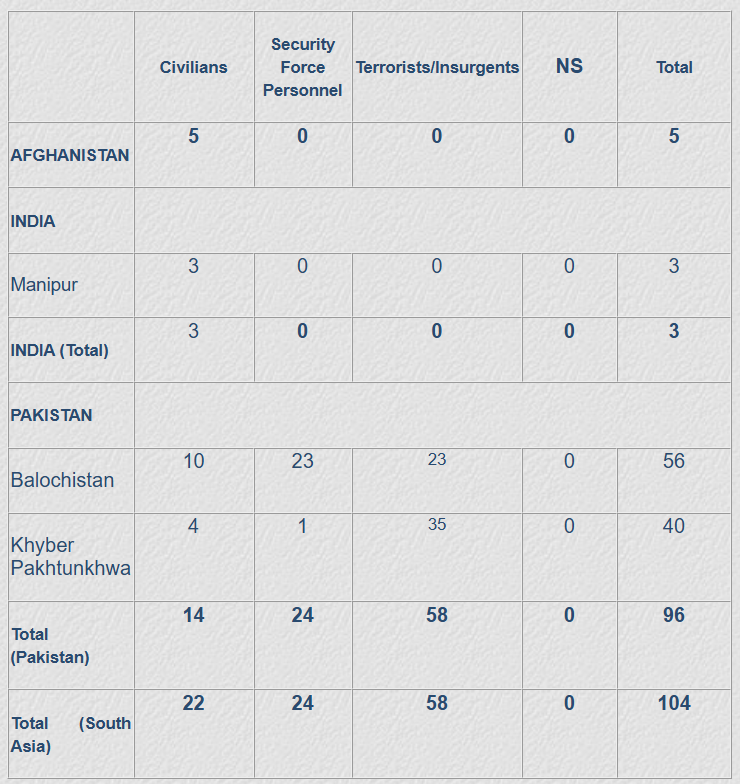
Provisional data compiled from English language media sources.