
South Asia Intelligence Review
Punjab: Insidious Wave
Punjab is experiencing an escalation in low-intensity terrorist activities orchestrated by Khalistani extremist networks, often in tandem with foreign-based gangsters and Pakistan-backed handlers. According to partial data compiled by the Institute for Conflict Management (ICM), since the start of 2026, the state has recorded at least eight low-intensity blasts, targeting critical infrastructure such as railway tracks, police stations, political offices, military-linked sites and, most recently, escalating to medical infrastructure.
On June 22, 2026, two unidentified youths hurled a petrol bomb at a clinic owned by Dr. Tarsem Garg on Mela Ram Road in Bathinda District. The clinic is situated directly opposite a recently inaugurated Rashtriya Swayamsevak Sangh (RSS) office. No injuries were reported in the attack. Dr Garg’s family had recently shifted political allegiance from the Aam Aadmi Party (AAP) to the Bharatiya Janata Party (BJP). His wife, Dr. Rajni Jindal, had contested the recent municipal council elections as a BJP candidate. CCTV footage from the scene showed two persons arriving at the clinic, one with his face covered, before the petrol bomb was thrown into the premises. Nearly two hours after the attack, Dr. Rajni Jindal received a WhatsApp call from a foreign number. The caller allegedly identified himself as Pakistan-based terrorist Shahzad Bhatti and later sent two messages, including one bearing his name and a casual “Hi”. In this case, In this case, as of June 28, 2026, Police have arrested three accused identified as Nikhil Kumar, Gurwinder Singh, and Sandeep Singh. According to Police, the trio had been promised INR 3,000 each to carry out the attack. Preliminary investigations indicated that Sandeep Singh was in contact with a criminal network. Police have also booked Pakistan-based terrorist Shahzad Bhatti. Tehreek-e-Taliban Hindustan (TTH), a proxy network backed by Pakistan’s ISI, claimed responsibility for the attack, which is being verified.
The first incident of June occurred on June 2, 2026, when a low-intensity grenade was hurled at Multani Hospital, a private healthcare facility near the bus stand in Kalanaur town, Gurdaspur District. The explosion damaged property, shattering window panes and the glass door of the emergency ward, but caused no casualties. Following the attack, Police arrested Dharmendra alias Dharminder alias Tindy, who is linked to foreign-based gangster Jaswinder Singh alias Manu Agwan alias Baghi. Agwan, a Greece-based operative of Babbar Khalsa International (BKI) and a key figure in ISI-backed networks, later claimed responsibility for the attack through social media.
These two attacks signal a possible shift toward softer civilian targets, including the healthcare infrastructure; earlier blasts focused on security and strategic assets. Key prior incidents include:
May 5, 2026: low-intensity Improvised Explosive Device (IED) blasts near the Border Security Force (BSF) Punjab Frontier Headquarters in Jalandhar District. One BSF trooper suffered splinter injuries. A delivery person (Gurpreet) was also reported injured in some accounts, though there were no fatalities. The Khalistan Liberation Army (KLA) claimed responsibility for the attack, while the Punjab Police arrested at least two suspects, Umar Deen and Anil. Investigations point to possible ISI-linked networks.
May 5, 2026, a low-intensity explosion near the Army cantonment boundary wall (suspected IED or thrown device) was reported in Amritsar District. No casualties were reported.
April 27, 2026: A powerful explosion occurred on the Dedicated Freight Corridor (DFC) railway track near Bothonia village, between Shambhu and Rajpura in Patiala District, killing the suspected bomber, Jagroop Singh, while he was attempting to plant an Improvised Explosive Device (IED). The incident marked the second attack on the DFC in the first four months of 2026. In the immediate aftermath, Punjab Police arrested four highly radicalised operatives – Pardeep Singh Khalsa, Kulwinder Singh alias Bagga, Satnam Singh alias Satta, and Gurpreet Singh alias Gopi – linked to a Pakistan-based, ISI-backed pro-Khalistan terrorist module. Security forces recovered pistols, hand grenades, Royal Demolition Explosive (RDX), IED components, a Rocket-Propelled Grenade (RPG) launcher, communication devices, and other incriminating materials. Investigations revealed that the module maintained operational links with handlers based in Pakistan, Malaysia, and the United States. The investigation expanded through a series of subsequent arrests that significantly disrupted Khalistan Zindabad Force (KZF)-linked networks. On June 17, 2026, the National Investigation Agency (NIA) arrested Gurjinder Singh alias Baba Beant in connection with the April 27 blast. Two days later, on June 19, Punjab Police secured the deportation of Gurwinder Singh and Manjeet Singh from Malaysia, both accused of involvement in the January 23 and April 27 IED attempts targeting the DFC. According to NIA, a total of seven accused has been arrested so far in the broader case (RC-21/2025/NIA/DLI), highlighting the role of cross-border terrorism financing, logistics, and operational support from foreign-based handlers.
April 1, 2026, a low-intensity explosion occurred outside the Punjab BJP headquarters (HQ) in Chandigarh. The banned BKI claimed responsibility for the attack. Five people were arrested in this case.
March 30, 2026, A low-intensity blast occurred at around 1:30 am outside Bhindi Saidan Police Station in Amritsar District. KLA claimed responsibility for the attack. No fatality was reported and six accused were subsequently arrested.
January 23, 2026, DFC blast near Sirhind in Fatehgarh Sahib. One locomotive pilot was injured, though no fatality was reported. Investigations determined that KZF was involved in this case.
Khalistani outfits such as BKI, KZF, KLA and TTH, the last reportedly linked to Pakistan-based Shahzad Bhatti, are increasingly driving terrorist activities in Punjab, often acting as proxy groups with support from Pakistan’s ISI. These groups recruit local youth to carry out attacks and destabilise the security situation. While BKI and KZF have long been designated as proscribed organisations with a well-established history of terrorism in Punjab, KLA is often described as a separatist group associated with the Khalistan movement that was active during the 1980s and 1990s in Punjab. It is a faction group of the Khalistan Liberation Force (KLF). In recent reports, Indian security agencies have identified KLA as one of the most organised, well-trained and heavily armed proxy groups to emerge in recent years, under the broader Khalistani terrorist umbrella. At present, it remains uncertain whether KLA has been formally reactivated or whether the name is being used by loosely connected or unrelated individuals/groups.
TTH represents a new trend in Punjab’s evolving terrorism landscape. The group has claimed several violent incidents in 2026, including the killing of Punjab Police Assistant Sub-Inspector (ASI) Joga Singh in the Majitha area of Amritsar District on May 24, 2026; and the February 22, , killing of two Punjab Police personnel – ASI Gurnam Singh and Home Guard Ashok Kumar – at the Adhian Police Outpost near the India-Pakistan border in Gurdaspur District.
Security assessments indicate that Khalistani networks, backed by Pakistan-based handlers and transnational terrorist elements, have cultivated such proxy formations to sustain and expand terrorist operations in India.
The shift to softer targets, alongside symbolic ones (RSS office, BJP HQ, security forces) suggests a strategy of “persistent low-level pressure” to normalise disruption and force diversion of resources. Limited casualties reduce scrutiny while building operational confidence and propaganda value.
Meanwhile, in a significant joint operation on June 5, 2026, the Uttar Pradesh Anti-Terrorism Squad (ATS), along with the Punjab Special Task Force (STF), arrested Mohammad Mohtsim alias Mohtasim from Bachiti village in the Deoband area of the Saharanpur District of Uttar Pradesh. The arrest is linked to the 2021 Mohali RPG attack on the Punjab Police Intelligence Headquarters in Sahibzada Ajit Singh Nagar (Mohali). According to officials, Mohtsim is a suspected associate of the Pakistan-backed terrorist organization, Jaish-e-Mohammed (JeM). He was under investigation for allegedly facilitating communication between local operatives and Pakistan-based handlers via WhatsApp, sharing OTPs and other technical details. Security agencies recovered electronic devices and suspicious materials from the accused, which are being examined. The case highlights the hybrid terror strategy involving sporadic attacks combined with efforts to radicalise and mobilise local support networks.
These networks recruit disaffected or financially vulnerable local youth (including minors) for execution of local operations, while foreign handlers provide direction and funding, and make claims of responsibility via social media. Convergence with organised crime is critical: narcotics smuggling, hawala financing, and arms trafficking sustain operations. A defining feature of the current threat in Punjab is the deep convergence between Khalistani terrorist modules, foreign-based gangsters, and organised criminal rackets. These hybrid networks rely heavily on social media for recruitment, arms procurement, coordination, and claims of responsibility, with hawala channels funnelling proceeds from drug trafficking to finance terrorist activities. Moreover, according to a report in early June, 54 minors had been arrested in the preceding 14 months across Punjab’s border districts (Amritsar, Tarn Taran, Ferozepur, and Fazilka), with 32 linked to drug trafficking and 22 to Arms Act violations, highlighting the increasing involvement of juveniles in cross-border smuggling.
The Punjab Police and central agencies have shown proactive intensity. In a series of swift actions, authorities dismantled multiple cross-border networks. On June 25, 2026, seven persons, including an Afghan national and a juvenile, were arrested in Amritsar for their role in a cross-border arms, narcotics, and hawala network, with recoveries of 10 sophisticated weapons [including two Submachine Guns (SMGs)], 5.048 kilograms of heroin, and INR 3.038 million in hawala money. On June 8, four persons including an Afghan national were arrested along with eight sophisticated pistols and seven cartridges. On June 5, 2026, four accused including Afghan national Baz Mohammad and two juveniles were nabbed with 1.035 kilograms of heroin, five pistols (including Glocks), and INR 500,000 in drug money. In June 2026, Punjab Police carried out a three-day statewide crackdown targeting hawala operators. According to the Director General of Police (DGP) Gaurav Yadav, the operation led to the arrest of 73 persons involved in hawala networks and the recovery of approximately INR 100 million in illicit funds. The action marks a broader expansion of the state’s anti-drug and anti-financial crime campaign, with hawala networks identified as a key focus area.
Punjab is locked in a protracted shadow war where transnational Khalistani networks and Pakistan-linked handlers have fused into a dangerous hybrid terrorist-criminal ecosystem. The ongoing low-intensity campaign deliberately limits casualties while intentionally expanding targets and enhancing operational sustainability. Sustained domestic crackdowns, coupled with decisive international cooperation will be critical to dismantling these networks, severing their funding channels, and averting a dangerous escalation that could destabilise the region.
Punjab’s stability is not merely a state-level concern but a litmus test for India’s capacity to counter hybrid transnational terrorism in the digital age. Vigilance, resilience, and coordinated action across multiple fronts remain essential to ensure this low-intensity shadow war does not cast a longer and darker shadow over the state.
ULFA-I: Progressive Attrition
On June 26, 2026, Assam Police, assisted by central agencies, arrested two suspected United Liberation Front of Asom-Independent (ULFA-I) cadres, identified as ‘second lieutenants’ Humenjyoti Baruah alias Siyor Asom and Papu Moran alias Manoj Asom, during an intelligence-based operation at Jagun under the Lekhapani Police Station in Tinsukia District. The two had reportedly infiltrated into Assam from Myanmar through Arunachal Pradesh and were intercepted before they could execute an alleged plan to carry out indiscriminate attacks on civilians in Tinsukia District. Security Forces (SFs) recovered two AK-56 rifles, 172 rounds of ammunition, two hand grenades and other war-like stores from their possession. Police said the two were allegedly involved in the ambush on an Army camp at Kakopather on December 17, 2025; the attack on an Assam Police commando camp on March 21, 2026; and the kidnapping of an employee from a crusher unit at Jagun on October 23, 2024. The incident once again underscored the continuing efforts of ULFA-I to retain an operational footprint in Assam despite mounting military, logistical and organisational pressures.
The investigation into the June 26, arrests subsequently led to the apprehension of two suspected over-ground workers (OGWs) of the outfit from Tinsukia. On June 28, 2026, Assam Police arrested Bitu Bora and Kalpa Bora for allegedly providing logistical support to the two ULFA-I cadres in Tinsukia District. Police alleged that Bitu Bora arranged the vehicle used to transport the cadres, while Kalpa Bora provided logistical assistance. During interrogation, the accused reportedly disclosed that the vehicle had been arranged on the instructions of senior ULFA-I leader Aiseng Asom, providing investigators with fresh leads into the outfit’s support network.
The latest arrests came amid an intensified crackdown on the outfit’s recruitment, extortion and support networks across Assam and beyond. On May 30, 2026, Assam Police arrested two suspected ULFA-I linkmen, Dulav Moran and Rongat Moran, in Tinsukia District, for allegedly maintaining communication channels between the group and its local contacts.
A day earlier, on May 29, 2026, three youths were apprehended while allegedly attempting to join ULFA-I through the Tinsukia-Arunachal Pradesh corridor leading to the outfit’s camps in Myanmar. Investigations suggested that ULFA-I’s Over Ground Workers (OGWs) were targeting economically vulnerable youths and facilitating their movement across the border.
On May 28, 2026, Assam Police uncovered a nationwide funding and extortion network linked to the outfit, arresting two operatives from Uttar Pradesh for allegedly channelling funds to ULFA-I.
Earlier, on May 25, 2026, two extortionists linked to the outfit were injured in an exchange of fire with the Police in the Sivasagar District of Assam while allegedly attempting to extract money from local businessmen. These incidents highlighted ULFA-I’s continued dependence on extortion and local support structures to sustain its insurgent activities.
Further pressure was exerted through targeted operations against the outfit’s active cadres. On May 15, 2026, the National Investigation Agency (NIA), assisted by Assam Police, carried out coordinated operations in Tinsukia District as part of an ongoing investigation into ULFA-I activities.
On May 6, 2026, an active ULFA-I cadre, Biren Chetia aka Rontu Asom, described as a Myanmar-trained militant, was arrested in Sivasagar District with a substantial cache of arms, grenades and ammunition. These operations the security agencies’ sustained effort to dismantle the group’s residual networks in Assam.
Available data illustrates the shrinking operational space available to the outfit. According to partial data compiled by the South Asia Terrorism Portal (SATP), 35 ULFA-I cadres have been arrested in 11 separate incidents in 2026 (data till June 28, 2026), adding to 38 arrested in 17 incidents through 2025. In 2024, 69 cadres were arrested in 32 incidents, while 32 cadres were arrested in 23 incidents in 2023. Since 2010, a cumulative 675 ULFA-I cadres have been arrested in 369 incidents. The persistence of arrests over an extended period demonstrates both the durability of the insurgent network as well as the effectiveness of sustained counter-insurgency operations in preventing its resurgence.
The mounting counterinsurgency pressure has also been reflected in a steady stream of surrenders. On May 5, 2026, two active cadres deserted the outfit’s headquarters at Ranu in Myanmar and surrendered before SFs at Pangsu Pass in Arunachal Pradesh.
Earlier, Jintu Gogoi aka Arun Asom surrendered on April 3, 2026, while ‘second lieutenant’ Bitul Baruah surrendered on March 3, 2026. Such incidents indicate growing disillusionment within ULFA-I ranks and suggest declining morale among cadres stationed in Myanmar-based camps.
The SATP database has recorded six surrenders in five incidents in 2026, while 17 ULFA-I cadres surrendered in 11 separate incidents in 2025. In 2024, only two cadres surrendered in two incidents. Since 2010, a total of 125 ULFA-I cadres have surrendered in 71 separate incidents (data till June 28, 2026).
Despite these setbacks, ULFA-I has attempted to demonstrate its continuing relevance through sporadic acts of violence. On March 22, 2026, suspected ULFA-I militants attacked an Assam Police Commando camp at Jagun in Tinsukia District with grenades and gunfire, injuring four Police personnel. The attack, which triggered a gun battle lasting nearly thirty minutes, highlighted the group’s continuing ability to launch limited offensive actions in areas proximate to the Arunachal Pradesh border. Nevertheless, such incidents have become increasingly infrequent, compared to the outfit’s earlier operational tempo.
ULFA-I’s current predicament is closely linked to developments that unfolded during 2025. One of the most significant events was on July 13, 2025, when ULFA-I ‘chief’ Paresh Baruah claimed that the outfit’s eastern headquarters in Myanmar’s Sagaing Region had been targeted in a large-scale drone strike. According to the group’s own disclosures, the attack killed 19 cadres and injured another 19. Among those reportedly killed were senior leaders Nayan Medhi aka Nayan Asom, Ganesh Asom and Pradip Asom. ULFA-I further alleged that cadres belonging to Manipuri insurgent organisations were also among the casualties. While the Indian Army categorically denied carrying out any such strike, the episode generated considerable speculation regarding the changing nature of counter-insurgency operations in the India-Myanmar border region.
Subsequently, on July 28, 2025, ULFA-I and Manipur’s People’s Liberation Army (PLA) issued a joint statement reiterating allegations that sophisticated combat drones had been employed against their camps in Myanmar. Regardless of the veracity of these claims, the aftermath appears to have had a significant impact on insurgent morale and infrastructure. Later reports suggested that several camps and logistical facilities had either been abandoned or relocated, while allied insurgent organisations like NSCN-IM became increasingly reluctant to provide sanctuary to ULFA-I cadres.
The strategic consequences became more visible in the months that followed. On October 16, 2025, suspected ULFA-I militants attacked an Indian Army camp at Kakopathar in Tinsukia District, injuring three soldiers. On the same day, ULFA-I militants operating alongside the National Socialist Council of Nagaland-Khaplang-Yung Aung (NSCN-K-YA) faction allegedly attacked an Assam Rifles camp in Arunachal Pradesh, injuring at least four personnel. These incidents indicated that, despite operational constraints, the outfit continued to maintain tactical cooperation with other insurgent organisations active along the India-Myanmar frontier.
However, ULFA-I’s internal challenges deepened considerably towards the end of 2025. On November 23, 2025, Assam Chief Minister Himanta Biswa Sarma reiterated that meaningful peace talks could progress only if ULFA-I ‘chief’ Paresh Baruah personally agreed to participate in negotiations. The statement followed the surrender of Arunoday Dohotia, regarded as one of Baruah’s closest associates, which was viewed as a significant symbolic setback for the organisation.
Shortly thereafter, reports emerged that Naga insurgent groups in Myanmar had become increasingly reluctant to host ULFA-I cadres due to fears of precision strikes and heightened surveillance. ULFA-I had traditionally relied upon a network of camps controlled by NSCN-K factions for transit, shelter and logistics. The erosion of this support structure reportedly forced the group to scout for alternative locations while simultaneously grappling with supply disruptions and declining manpower. Available assessments suggested that ULFA-I’s effective strength had fallen below 200 cadres.
Significantly, the Union Ministry of Home Affairs (UMHA) reinforced pressure on the organisation when it extended the ban on ULFA-I for another five years with effect from November 27, 2024. The Ministry cited the group’s continuing commitment to Assam’s secession, involvement in extortion and intimidation, and links with other insurgent groups as grounds for the extension.
In an apparent attempt to adapt to evolving circumstances, ULFA-I announced a major organisational restructuring on December 26, 2025, dissolving its existing councils and created a new 24-member Central Committee headed by Paresh Baruah as ‘president’. The restructuring appeared aimed at consolidating authority and revitalising the organisation amid persistent speculation regarding possible peace talks and growing operational difficulties. However, ULFA-I simultaneously reiterated that Assam’s sovereignty remained a non-negotiable objective, thereby maintaining the ideological position that has long prevented formal negotiations with the Government of India (GoI).
Additional insights into the organisation’s deteriorating condition emerged from statements made by surrendered leader Arunoday Dohotia. He disclosed that Paresh Baruah had not visited ULFA-I camps in Myanmar for more than a decade and was reportedly based in China. Dohotia further revealed that morale within the camps had fallen sharply following recent developments, that ideological training had largely ceased, and that many cadres wished to surrender but remained trapped in remote Myanmar bases. Such disclosures reinforced assessments that the organisation was increasingly disconnected from its original ideological foundations and struggling to retain cohesion among its remaining members.
Concerns regarding the regional dimensions of the insurgency have also persisted. In January 2026, Chief Minister Himanta Biswa Sarma warned that intelligence inputs indicated the presence of senior ULFA-I leaders in Bangladesh. He noted that changes in the political environment in Bangladesh could potentially create opportunities for militant groups to regroup and re-establish networks. Given Assam’s extensive international border with Bangladesh, such developments continue to be closely monitored by security agencies.
Taken together, these developments indicate that ULFA-I remains active but increasingly confined. While the outfit retains a limited capacity for recruitment, extortion and sporadic acts of violence, sustained counter-insurgency operations, progressive cadre attrition, financial disruptions and the erosion of external support networks, have significantly degraded its operational capabilities. Continued reliance on Myanmar-based sanctuaries, coupled with mounting logistical challenges and declining morale, further limit the group’s ability to sustain a prolonged insurgent campaign. Although ULFA-I continues to adhere to its objective of Assam’s sovereignty, prevailing trends suggest that the organisation is struggling to reverse its long-term decline and re-establish itself as a significant insurgent force in the region.
Weekly Fatalities: Major Conflicts in South Asia
June 22-28, 2026
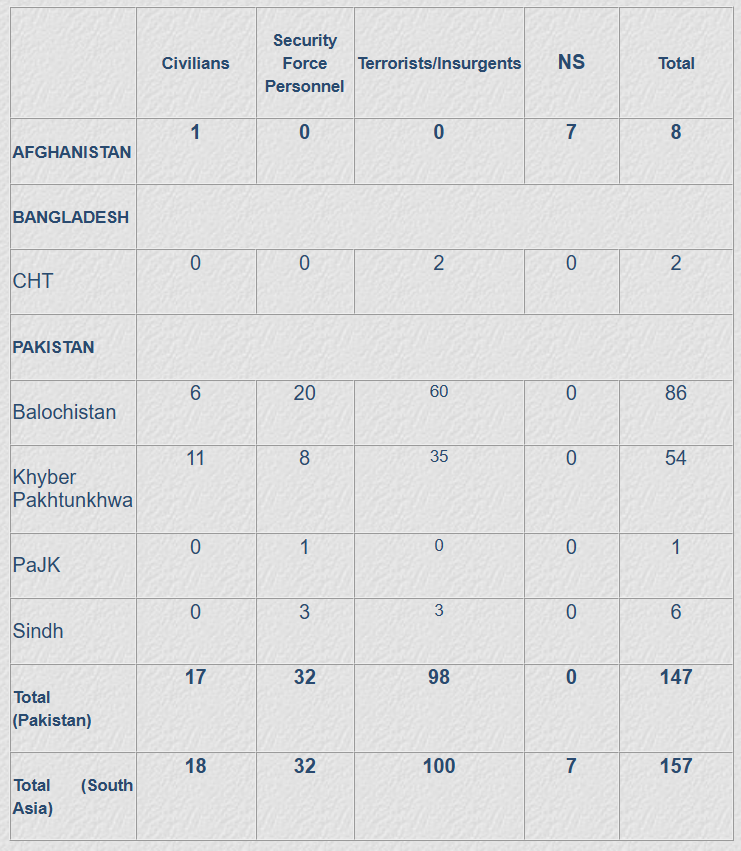
Provisional data compiled from English language media sources.