
China & Taiwan Update, July 17, 2026
Japan is developing its own central intelligence agency for the first time since World War II. These efforts underscore the failure of the PRC’s pressure campaign to divide Japan and its security partners and dissuade Japan from modernizing its security architecture. The New York Times reported on July 13 that Japan has consulted Germany, the United States, and Australia for “advice on technology, staffing, and priorities” pertaining to the creation of an intelligence agency.[1] Japan previously managed intelligence across multiple bureaus, including its Foreign Ministry.[2] US officials reportedly advised Japan on cyber defense, counterintelligence against industrial espionage, and foreign investment screening.[3] These developments dovetail with Japan’s ongoing efforts to create an investment-screening body modeled after the Committee on Foreign Investment in the United States (CFIUS), aimed at preventing investments with potential national security risks.[4]
Japanese officials acknowledged a growing need to counter foreign intelligence activities amid recent reporting that Japan had become a “spy paradise” for adversaries including Russia.[5] The New York Times published a report on July 12 highlighting the presence of Russian spies in Japan, as well as the presence of Japanese components in Russian drones and missiles.[6] The New York Times cited a Ukrainian statistic that 90 percent of Russian missiles and drones contained Japanese components, despite Japan banning the export of such components to Russia. Third countries, such as Vietnam, can import Japanese dual-use technologies and then ship them to Russia to evade restrictions.[7] PRC espionage presents a similar concern; Japanese Prime Minister Sanae Takaichi warned in a 2024 book that the PRC’s national intelligence legislation can compel PRC nationals to act as intelligence collectors.[8] A unified intelligence collection system could streamline Japan’s efforts to suppress internal espionage threats.
A unified intelligence body would support Japan’s efforts to harden its military and economy against threats from the PRC. The PRC has waged an economic and informational pressure campaign against Japan since November 2025 in retaliation for Japan’s military modernization and Takaichi’s comment that Japan may intervene in a Taiwan military contingency. PRC coercion has failed to pressure Takaichi to retract the statement or curtail Japan’s military development, however. Cooperation between Japan and its allies indicates a similar failure by the PRC to coalition-break Japan from its security partners, most notably Five Eyes countries such as the United States and Australia.
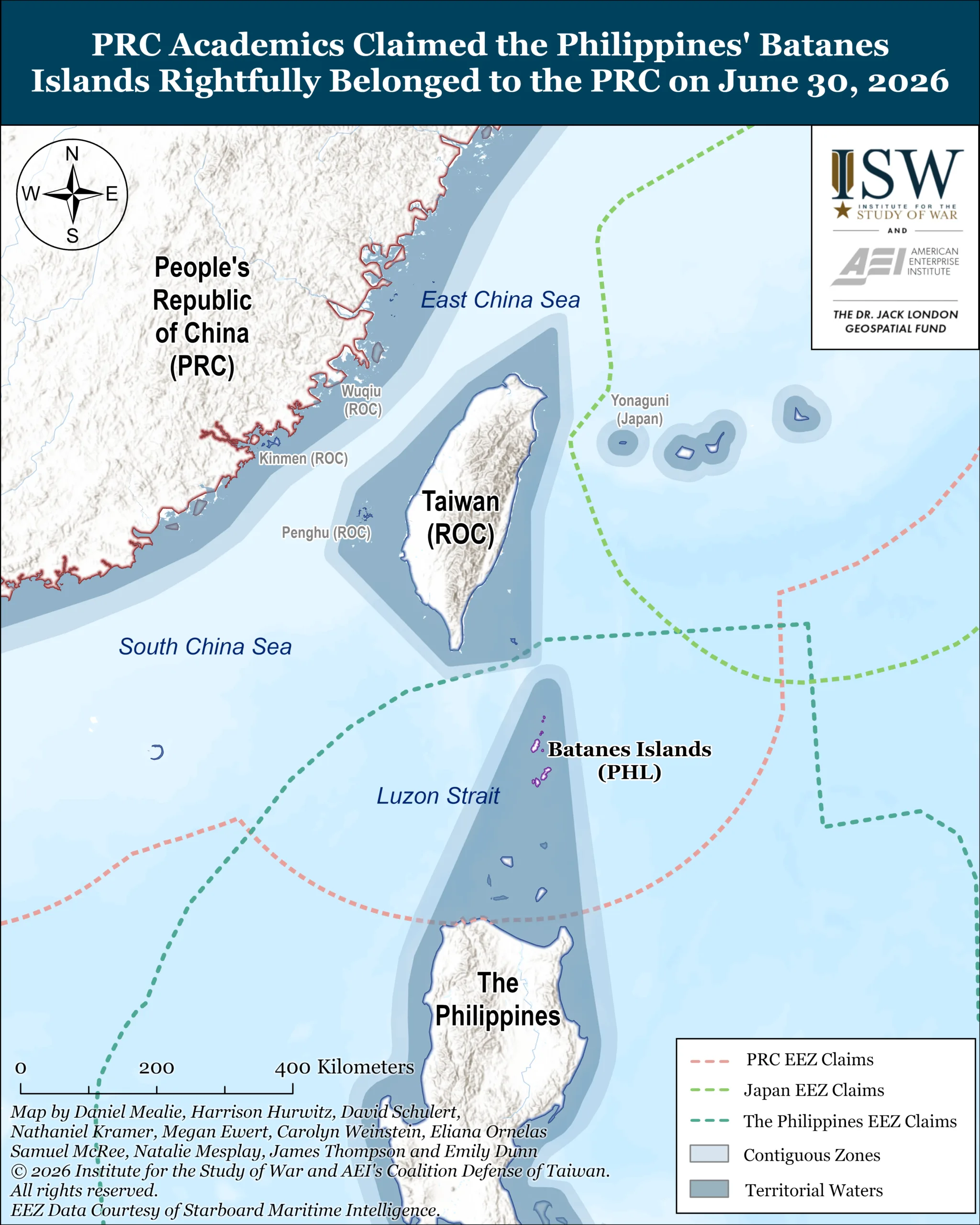
The PRC may be setting information conditions to contest Philippine sovereignty over the Batanes Islands in the Luzon Strait. The PRC could use this information effort to expand its presence around the Batanes Islands under the guise of “law enforcement.” The PRC’s Jinan University held a symposium in Guangzhou on June 30 during which several PRC academics claimed that the Batanes in the Northern Philippines are historically “affiliated” with Taiwan, and thus rightfully belong to the PRC.[9] PRC state-owned tabloid Global Times amplified the scholars’ arguments as if they were factual.[10] The scholars also claimed that Philippine sovereignty over the islands had no basis, because the 1898 Treaty of Paris that transferred the Philippines from Spain to the United States did not include them in its definition of Philippine territory.[11] The 1900 Treaty of Washington later rectified the omission, but the PRC scholars did not mention this fact.[12] The university convened the symposium in response to the Philippines’ and Japan’s announcement that they would work toward delimiting their overlapping exclusive economic zone (EEZ) claims in the Pacific on May 28.[13] The Batanes are the landmass that allows the Philippines to claim an EEZ east of Taiwan that overlaps with the PRC, Taiwan, and Japan’s EEZ claims.[14] The PRC has not officially contested the Philippines’ sovereignty over the Batanes, but the PRC’s embassy in Manila has repeatedly refused to comment on the academics’ claims to the islands.[15] Jinan University deleted the text of the symposium’s findings from its website following international backlash, but it remains online on several other sites, including Global Times.[16]
The PRC may be tacitly encouraging academic discussions of PRC claims to sovereignty over the Batanes to set information conditions for future activity around the islands. Global Times previously promoted academic narratives that questioned Japanese sovereignty over the Ryukyu Islands, an archipelago northeast of Taiwan that was once an independent kingdom.[17] The PRC has also used its claim to the Japan-administered Senkaku Islands to justify maintaining a consistent coast guard presence around the islands.[18] The PRC could be setting informational conditions to justify similar actions around the Batanes.
The PRC may be targeting the Batanes due to their strategic location astride the Luzon Strait, a critical waterway for PLAN efforts to break through the first island chain.[19] US and Philippine forces have practiced deploying area denial assets to the Batanes Islands to demonstrate and practice their ability to close the strait during wartime.[20] The PLA has expressed significant concern at the prospect of its surface fleet being contained within the first island chain during a conflict.[21] The PRC could seek to normalize a maritime presence around the Batanes Islands to erode Philippine control over the Luzon Strait and facilitate its efforts to break through the first island chain.
Taiwan’s Mainland Affairs Council (MAC) announced on July 9 that 72 Taiwanese nationals have gone missing or been detained in the PRC since late March. PRC authorities are likely detaining and questioning Taiwanese travelers to advance the PRC’s United Front efforts against Taiwan and intimidate pro-Taiwanese voices. MAC data showed that 385 Taiwanese nationals have been reported missing, been detained, or had their movement restricted in the PRC since January 2024, with 72 new cases occurring between March 27 and July 9.[22] MAC Deputy Minister Liang Wen-chieh stated that PRC public security authorities questioned a Taiwanese judge travelling in the PRC in April, asking him about his work and views on the PRC.[23] The PRC authorities also discussed cross-strait exchanges with the judge and attempted to pressure him to connect with them on the PRC social media application WeChat.[24] Liang stated that PRC authorities have questioned 14 Taiwanese public servants travelling in the PRC since June 2024.[25] Taiwan’s ruling Democratic Progressive Party (DPP) stated on July 12 that these incidents suggest that the PRC is gathering intelligence on visiting Taiwanese nationals in advance, assessing their political views, and establishing continuing contact with them.[26]
PRC authorities are likely targeting and contacting Taiwanese nationals, especially civil servants, to identify potential recruits for PRC influence and espionage operations targeting Taiwan. PRC United Front agents and intelligence officers have previously approached Taiwanese nationals visiting the PRC and recruited them to carry out espionage and political infiltration after returning to Taiwan.[27] The United Front is a whole-of-government and -society effort to co-opt non-government segments of society in the PRC and abroad to support CCP aims, including covert political influence operations targeting Taiwan.[28]
PRC authorities may also be seeking to identify pro-Taiwan individuals for prosecution under PRC anti-separatism laws. PRC authorities secretly arrested Taiwanese citizen Yang Chih-yuan in August 2022 and longtime Taiwan resident Li Yanhe in March 2023, holding them incommunicado for months before handing them prison sentences for “separatism” in closed-door trials.[29] The PRC uses “separatism” prosecutions and imprisonment to intimidate pro-Taiwan voices into silencing their opposition to PRC annexation.[30] It is not clear if the Taiwanese nationals currently detained or missing in the PRC have been arrested on “separatism” or other criminal charges, however.
Key Takeaways
Japan’s security modernization: Japan is developing a centralized intelligence agency for the first time since the Second World War, with advice from its allies and partners. The agency will help counter PRC and Russian espionage in Japan and enhance Japan’s contributions to a US-aligned coalition in the Indo-Pacific.
PRC-Philippine territorial dispute: PRC academics and state media promulgated a narrative that the Philippines’ northern Batanes Islands belong to the PRC. The PRC may be setting information conditions to expand coercive patrols around the Batanes to strengthen PRC access and control in the Luzon Strait.
PRC arrests of Taiwanese nationals: PRC authorities are likely detaining and questioning Taiwanese nationals who travel to the PRC to recruit collaborators and intimidate pro-independence voices.
Cross-Strait Relations
Taiwan
Taiwanese authorities charged two Taipei business executives on July 7 for aiding a PRC cyberespionage campaign targeting Taiwanese politicians and academics. The PRC uses cyberespionage targeting Taiwan, the United States, and other democratic nations to acquire sensitive information and target critics of the CCP abroad. Taiwan’s Ministry of Justice Investigation Bureau stated that the current and former heads of Taipei-based firm Abigail rented out Taiwan-registered accounts on the messaging and social media app LINE to hackers at a PRC technology firm operating under the direction of the CCP.[31] The PRC hackers used the accounts to impersonate journalists from the International Consortium of Investigative Journalists and Taiwan’s CommonWealth Magazine to contact Taiwanese politicians, government officials, and academics.[32] The hackers also targeted Uyghur, Tibetan, Hong Kong, and Taiwanese expatriates and journalists reporting on Tibet and Xinjiang overseas in Asia, Europe, and the United States.[33]
The CCP-linked hackers asked their targets to write “articles” divulging sensitive information as part of a fake journalistic interview process and sent data-stealing malware to their targets.[34] PRC cyberespionage operations have used similar tactics to target government staffers, military personnel, academics, and think tank staff in the United States and allied and partner nations.[35]
The PRC also co-opts private technology and media firms to support its international cyberespionage and political interference campaigns, likely to obscure the operations’ links to the CCP and to take advantage of existing private technological expertise and infrastructure. The PRC has employed the PRC digital marketing firm “Boundless Group” to carry out long-running election interference campaigns targeting Taiwan since at least 2024.[36]
Taiwan passed draft legislation laying the groundwork for Starlink to provide communications services in Taiwan. Starlink could enhance Taiwan’s telecommunications resilience amid possible PRC efforts to disrupt Taiwan’s communications infrastructure. The Taiwan Legislative Yuan Transportation Committee passed proposed amendments on July 13 that would allow foreign investment in Taiwan’s telecommunications sector.[37] The new amendments would allow authorities to approve foreign telecommunications companies such as Starlink to provide services in Taiwan on national security grounds.[38] Starlink is a division of SpaceX that uses thousands of low-earth orbit (LEO) satellites to provide internet connectivity.[39]
Starlink could provide Taiwan with additional satellite-based internet and communications services, giving Taiwan a valuable backup communications system if the PRC attacks Taiwan’s internet connectivity. ISW-CDOT has previously assessed that the PRC could significantly disrupt Taiwan’s internet access by cutting its undersea cables, which Taiwan – and especially its vulnerable outlying islands – relies on for connectivity.[40] Starlink has already proven invaluable in Ukraine, where it is used to pilot drones remotely.[41]
Taiwan’s government reported that a physical assault on a Japanese-Taiwanese journalist may be an instance of transnational repression related to the PRC’s new ethnic unity law. A Hong Kong national allegedly assaulted CEO of the Indo-Pacific Strategy Think Tank Akio Yaita in Taichung, Taiwan on July 6.[42] Taiwanese authorities arrested the Hong Kong national, reportedly named Liao Gangfa, at Taichung Airport.[43] The Indo-Pacific Strategy Think Tank focuses on cross-strait relations and has criticized the PRC’s military activity around Taiwan.[44] MAC Deputy Minister Liang Wen-chieh stated on July 9 that the MAC strongly suspects that the assault was a deliberate act of transnational repression to silence Yaita and intimidate like-minded individuals.[45] The MAC did not explain the basis for its claim, however. A spokesperson of the PRC’s Taiwan Affairs Office (TAO) on July 8 denied any government involvement in the attack but stated that Yaita’s assailant acted out of “righteous indignation,” a statement which could tacitly encourage similar activity from other individuals in the PRC.[46] The spokesperson also stated that Taiwan’s ruling DPP aimed to fabricate excuses to “betray the nation” and that any efforts to split the country would be punished according to the ethnic unity law.[47]
The PRC’s ethnic unity law went into effect on July 1 and aims to intimidate individuals and organizations that undermine the PRC’s definition of ethnic and national unity, including those based in Taiwan and overseas.[48] ISW-CDOT has assessed that this law could supplement existing PRC legal measures used to intimidate Taiwanese people that espouse anti-PRC views but is unlikely to significantly expand PRC lawfare efforts against Taiwan.[49] The PRC already possesses legal frameworks, including a 2005 anti-secession law, that it uses to intimidate Taiwanese figures it views as separatists.[50] It is unclear whether the ethnic unity law was a motivating force behind the attack on Yaita. Future attacks on critics of the PRC in the Taiwanese information space would signal a new line of effort aimed at using cross-national violence and intimidation to shape Taiwanese perceptions of the PRC, however.
The Taiwanese military conducted drills testing capabilities relevant to a possible PRC invasion, including decentralized command and control. Taiwan staged these drills in the weeks leading up to Han Kuang, its largest annual military exercise. The Joint Defense Exercise ran from July 13 through July 17 and focused on urban defense around Taipei, Taiwan.[51] Marine units traveled from southern Taiwan into districts in Taipei, where they drilled acting as rapidly mobilizable units.[52] The exercises broadly focused on mobility and rapid responses. They incorporated asymmetric systems and traditional systems such as Black Hawk helicopters (which conducted rapid refueling drills) and M60A3 tanks.[53] TaiwanPlus News reported that the exercises would involve Taiwan’s newly established coastal defense command, also known as the Littoral Combat Command.[54] The inauguration of this command reflects Taiwan’s increasing responsiveness to PRC maritime threats.[55]
The Taiwanese military drilled the defense of key urban sites under conditions of decentralized command and control, such as after a PLA decapitation strike against Taiwanese leadership.[56] The PRC has very likely drilled decapitation strikes on training grounds resembling government buildings in Taipei.[57] The Taiwanese military also drilled for infrastructure denial and island defense, incorporating Taiwan’s outlying Green Island and Orchid Island – particularly vulnerable to PRC incursions – into the exercises.[58]
The Taiwanese military conducted the drills prior to the upcoming Han Kuang exercises in August, Taiwan’s most comprehensive annual military drills. Taiwan has sought to improve the realism of the Han Kuang exercises in recent years, drilling for new capabilities and supplementing the military exercises with whole-of-society defense resilience drills.[59] The Joint Defense Exercise illustrates Taiwan’s ongoing commitment to augmenting the realism of its military exercises, and integrating the use of traditional and asymmetric weapons systems.
Taiwan’s Coast Guard Administration (CGA) took Inter-Parliamentary Alliance on China (IPAC) delegates on a patrol near Kinmen to teach them about PRC maritime coercion of Taiwan. IPAC is an international organization of lawmakers working to counter PRC coercion against democracies. Taiwan hosted an IPAC summit for the first time in 2024 and participated as a full member in 2025.[60] The delegation aboard the CGA ship included lawmakers from the United Kingdom, New Zealand, Ukraine, and the Czech Republic, along with Taiwanese lawmakers of the DPP and opposition Taiwan People’s Party (TPP).[61] CGA briefed the delegates on PRC short-of-war coercion during the tour and showed them the PRC’s land reclamation work for a new airport on Xiamen’s Dadeng Island, less than two miles from Kinmen. China Coast Guard (CCG) vessels have made periodic incursions into Taiwan-administered waters around Kinmen since February 2024.[62] PRC state media coined the term “Kinmen model” to refer to the PRC campaign to erode Taiwan’s territorial control and degrade its threat responsiveness.[63] The IPAC tour is part of Taiwan’s effort to safeguard against and raise international awareness of PRC maritime coercion.[64]
The PRC’s consistent incursions into Taiwanese waters have increased Taiwan’s willingness to involve international partners, including the United States, in counter coercion efforts. PRC maritime coercion will likely continue to motivate Taiwan’s international outreach efforts as the CCG maintains its patrols near Kinmen and East of Taiwan.
The Taiwan High Court sentenced former DPP staffer Huang Chu-jung to 10 years in prison for developing a spy network on the PRC’s behalf, which targeted information related to then-Vice President William Lai Ching-te and his 2024 presidential campaign. Prosecutors said PRC intelligence agents recruited Huang, who later recruited then-DPP staffer Chiu Shih-yuan in 2017 and attempted to recruit former advisers to then-Foreign Minister Joseph Wu and Lai.[65] Prosecutors said that the CCP paid Huang and Chiu to approach officials and collect classified information, including confidential details on Lai’s visits to Taiwan’s diplomatic allies and his presidential campaign.[66] The adviser continued to serve alongside Lai after Lai was elected president in 2024, and was only dismissed as a result of the investigation.[67] The Taipei District Prosecutors Office separately indicted Huang for leaking and delivering classified state secrets to the PRC as well as money laundering. Huang faces a reduced sentence of 6 years related to that indictment, following an appeal.[68]
Huang is one of several DPP members whom the PRC has co-opted in espionage operations, including former Taipei City Councilor DPP primary winner Chu Cheng-chi in 2022.[69] Taiwanese media in recent years have criticized Taiwan’s comparatively light sentencing in espionage cases, compared to other countries.[70] Light sentencing for spy cases may not effectively deter participation in PRC espionage operations.[71] Huang may have received a comparatively harsher sentence than other convicted spies due to his espionage network’s proximity to Lai.
China
The PLA Navy (PLAN) is likely preparing to conduct flight testing from its newest amphibious assault vessel Sichuan. The PLAN may seek to commission Sichuan before the end of 2026 to bolster its far-seas naval capability. PLA official newspaper PLA Daily released footage of the PLAN’s Type 076 landing helicopter dock (LHD) Sichuan that showed the ship’s electromagnetic catapult and arresting gear had been installed and that it had received complete deck markings for flight operations.[72] The PLAN launched Sichuan in December 2024 and has undergone several navigational tests since November 2025.[73] The additions to Sichuan’s deck indicate that it is preparing to conduct flight testing with its catapult system soon.
Sichuan’s advance toward testing of its catapult system may indicate that the PLAN is preparing to commission Sichuan before the end of 2026. Flight testing is likely the final phase of Sichuan’s testing schedule before it can commission with the PLAN. The PLAN’s only other catapult-equipped vessel, the aircraft carrier Fujian, commissioned two months after achieving “initial full-deck operational capability,” following several months of catapult launch and aircraft recovery testing.[74] The PLAN could accelerate Sichuan’s flight-testing schedule because the ship only operates a single catapult, compared to Fujian’s three.[75]
The PLAN may seek to commission Sichuan as soon as possible to bolster its far-seas naval deployments, particularly for its two short take-off but arrested recovery (STOBAR) carriers. Sichuan is the only amphibious assault ship in the world to operate an electromagnetic catapult and has been described in PRC sources as a “drone carrier.”[76] ISW-CDOT has assessed that the vessel is likely designed to support long-range naval deployments with the GJ-21 stealth drone, which can perform surveillance and strike missions.[77] Sichuan’s catapult launch capability addresses a significant shortcoming of the PRC’s STOBAR carriers Liaoning and Shandong, which cannot launch larger aircraft needed for fleet situational awareness.[78] Commissioning Sichuan could allow the PLAN to supplement either Liaoning or Shandong’s carrier strike group with an organic airborne early warning capability that is critical to fleet survivability, thereby increasing the range and efficacy of its STOBAR carrier operations.[79]
The CCP expelled Politburo member Ma Xingrui from the party and his post for corruption. Ma is the third Politburo member to be removed and the second to be expelled from the party in the current Politburo term. The CCP Central Committee announced the decision on July 14 and referred Ma for criminal prosecution after reviewing a report by the Central Commission for Discipline Inspection (CCDI).[80] The report publicized new details on Ma’s alleged wrongdoing that the CCDI had not disclosed when it began its investigation in April.[81] The report said that Ma had improperly accepted gifts and “huge amounts of money and property” himself or through his relatives and associates, engaged in “power-for-sex” and “money-for-sex” transactions, arranged jobs and business contracts for relatives and others, helped relatives purchase houses at discounted prices, generally engaged in “large-scale family corruption,” and failed to supervise serious violations by his staff. [82] Ma left his post as CCP Secretary of the Xinjiang Autonomous Region in July 2025 and last appeared in public in October 2025.[83]
Ma is the third Politburo member to be removed from the Politburo since the current term began in 2022, following Central Military Commission Vice Chairmen He Weidong and Zhang Youxia.[84] He is the second to be expelled from the party, after He.[85] Most of the PRC’s top-level purges since 2022 have targeted military officers. CCP General Secretary Xi Jinping has strictly cracked down on perceived ideological heterodoxy and disloyalty in the PLA ahead of major modernization milestones.[86] Ma began his career as an aerospace expert and executive, serving as general manager of the China Aerospace Science and Technology Corporation (CASC) and deputy commander of the PRC’s manned space program from 2007-2013.[87] Ma has not been in the defense sector for over 13 years, however, and instead has served in civilian government roles for nearly the entirety of Xi’s tenure as general secretary of the CCP. The announcement of Ma’s removal said that he “did not restrain himself” after the 18th Party Congress in 2012, meaning that he continued his misconduct after being elected to the CCP Central Committee.[88]
The specificity and nature of the allegations could suggest that Ma was removed due to genuine egregious corruption, rather than perceived ideological or political disloyalty. The CCP’s accusations against Zhang, He, and other recently purged top military officials included undermining the military’s ideological cohesion and Xi’s leadership, in addition to abuse of power.[89] The CCDI’s public allegations against Ma lacked any mention of ideology or loyalty to Xi and instead focused almost entirely on personal and family corruption.
Northeast Asia
North Korea
Note: A version of the following text appeared in the Korean Peninsula Update on July 14, 2026.
North Korean Premier Pak Thae Song met with CCP General Secretary Xi Jinping in Beijing on June 10 ahead of the 65th anniversary of the PRC-North Korea friendship treaty. CCP Politburo member Wang Huning subsequently visited North Korea and met with Workers’ Party of Korea (WPK) General Secretary Kim Jong Un, indicating a significant improvement in PRC-North Korea relations over the past year. Xi stated that his summit with Kim in early June had provided “strategic guidance” for developing bilateral ties.[90] Xi called for the two countries to advance strategic coordination and “create a favorable external environment for both countries to follow a socialist path suited to their own national conditions.”[91] Pak praised the bilateral relationship and claimed that North Korea and the PRC have worked together to safeguard regional and global peace.[92] Pak also said Xi’s meeting with Kim on June 8 and 9 marked a “new milestone” in North Korea-PRC relations. A PRC readout after the meeting reported that Pak said that North Korea would support the PRC’s “core interests on issues such as Taiwan,” promote PRC-North Korea unity, and advance the socialist cause.[93] Pak also met with PRC National People’s Congress Chairman Zhao Leji on July 10 and PRC Premier Li Qiang on July 11.[94] This is the first visit by a North Korean Premier to the PRC since 2018.[95]
Chairman of the National Committee of the Chinese People’s Political Consultative Conference (CPPCC) Wang Huning, the PRC’s fourth-ranking official and top ideologue, made a “goodwill visit” to North Korea from July 15 to 17.[96] Wang met with Kim Jong Un on July 16 and exchanged rhetoric similar to the Xi-Pak meeting.[97] Wang also met on July 15 with Jo Yong Won, member of the Presidium of the Political Bureau and secretary of the WPK Central Committee, one of Kim Jong Un’s closest aides.[98] Wang and Jo discussed strengthening party-to-party exchanges and cooperation in the economy, culture and other fields, according to North Korean state media.[99] Wang also spoke at a commemoration of the bilateral treaty and visited a cemetery for PRC soldiers who died in the Korean War.[100]
Pak’s visit to the PRC and Wang’s visit to North Korea are the second and third major PRC-North Korea state visits in 2026, after the Xi-Kim summit on June 8 and 9.[101] Xi and Kim also met at the PRC military parade in September 2025, along with Russian President Vladimir Putin and other world leaders.[102] The meetings indicate a significant improvement in PRC-North Korean relations following a tense period in 2024, when they held just one high-level meeting, despite the year being designated a “China-North Korea friendship year.”[103] The relationship declined in 2024, likely in part due to a PRC trilateral joint statement with Japan and South Korea in May 2024 that discussed the denuclearization of the Korean Peninsula, an issue that Pyongyang considers to be non-negotiable.[104] The PRC may also have been displeased with North Korea signing a defense treaty with Russia in June 2024 and its subsequent deployment of troops to aid Russia’s war in Ukraine, which reduced Beijing’s leverage over Pyongyang. PRC-North Korea exchanges also dropped to nearly zero during the COVID-19 pandemic, but have since mostly recovered.[105] The PRC has also tactically shifted its opposition to North Korea’s nuclear program by not publicly mentioning the issue since May 2024, despite stating when asked that its position remains unchanged.[106] The PRC is North Korea’s main economic lifeline and appears to be taking a more tolerant, if not outright cooperative, approach to enable North Korea’s military modernization and diplomatic ambitions.
Southeast Asia
Philippines
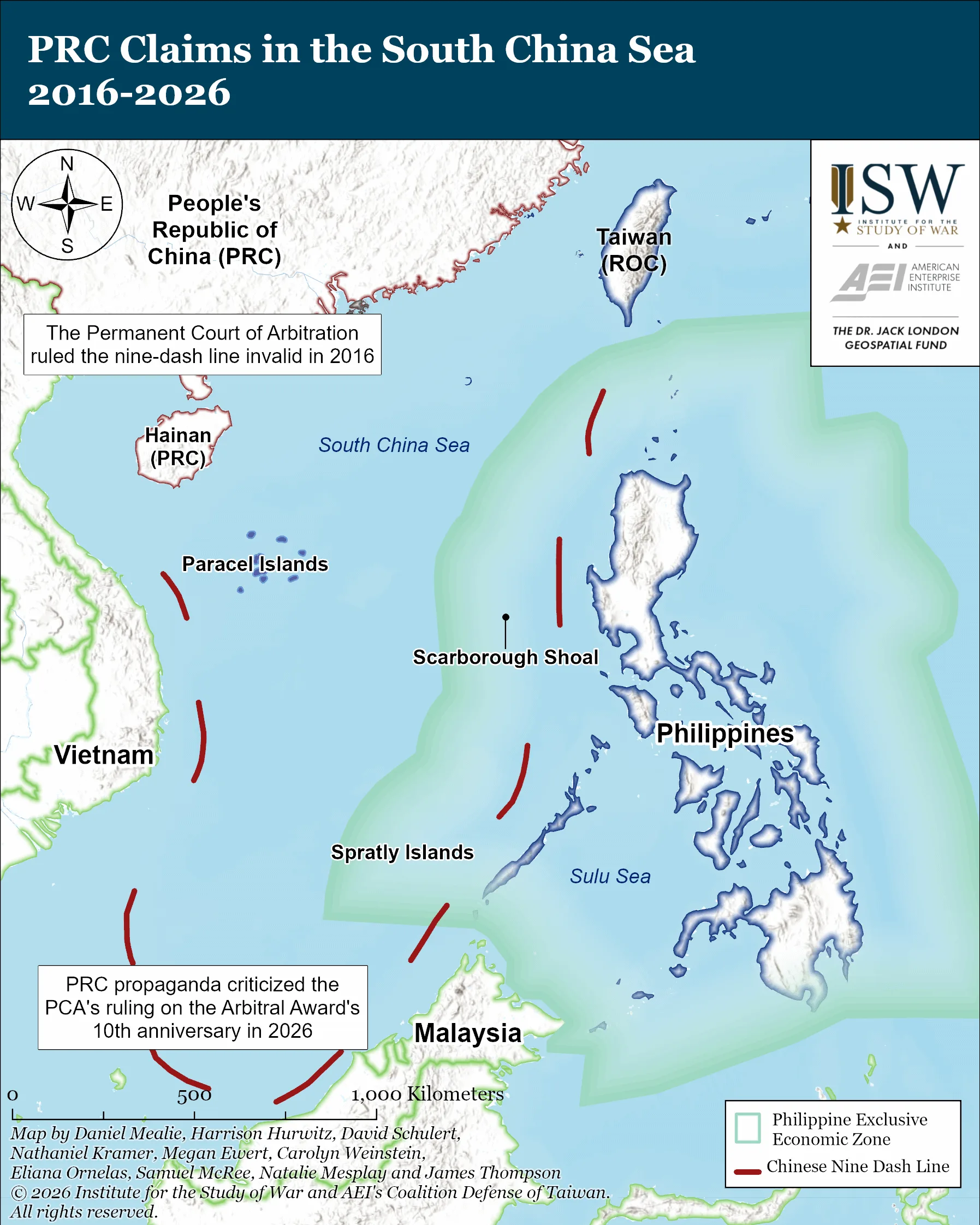
The PRC strongly criticized the 2016 South China Sea Arbitral Award on its 10th anniversary. The PRC disputes the ruling, despite asserting itself as an upholder of international law, because the ruling invalidated the basis for the PRC claim to most of the South China Sea. The Philippines filed the suit with the Permanent Court of Arbitration (PCA) in 2013 to contest the PRC’s nine-dash line claim to nearly the entire South China Sea, clarify the legal status of the islands in the South China Sea, and challenge PRC violations of the Philippines’ rights in its EEZ. [107] The PRC did not participate in the arbitration, which the PRC argued fell outside the jurisdiction of the United Nations Convention on the Law of the Sea (UNCLOS). The PCA ruled in favor of most Philippine claims in 2016, invalidating the PRC’s nine-dash line claims and stating that the PRC interfered with Philippine maritime rights in the South China Sea, though it did not determine which country had sovereignty over which maritime features.[108] The PRC has consistently disputed and ignored the ruling.[109]
PRC officials and state media used the 10th anniversary of the ruling to advance standard propaganda narratives about PRC claims over the South China Sea. Several officials and media outlets claimed on July 10 that the Arbitral Award created obstacles to Sino-Philippine relations and became a “source of chaos.” [110] The “Zong Haiping” byline in the CCP newspaper People’s Daily, which the newspaper uses for authoritative commentary on maritime issues, listed out 10 “fallacies” that it claimed make the Arbitral Award illegal.[111] Global Times called the Arbitral Award “nothing more than an illegal, null and void piece of paper with no binding force” and “a piece of waste paper.”[112] The PRC routinely makes statements characterizing itself as an upholder of international law but has continually claimed that the Arbitral Award is not legally binding. The PRC has accordingly continued its activities in the South China Sea, including land reclamation, militarization, coercive “law enforcement” in disputed waters, and Chinese Coast Guard (CCG) patrols around its claimed islands. These lines of effort have sparked confrontations between PRC and Philippine coast guard, naval, and government vessels, particularly around Scarborough Shoal and the Spratly Islands.[113]
Europe
The European Parliament (EP) advocated for Taiwan’s inclusion in international organizations in a new report. The report may reflect the European Union (EU)’s changing stance toward Taiwan. The report, entitled The changing geopolitical situation in East Asia, mentioned Taiwan 44 times and called for establishing a dedicated, structured, and comprehensive EU–Taiwan cooperation framework and expressed support for Taiwan’s participation in international bodies.[114] Taiwan’s Ministry of Foreign Affairs (MOFA) praised the report as a sign of the European Parliament’s “high regard for Taiwan,” also citing a 2024 resolution on the PRC’s military aggression against Taiwan.[115]
The PRC uses economic coercion to dissuade countries in Europe and elsewhere from recognizing or engaging with Taiwan. The only European country that recognizes Taiwan diplomatically is the Holy See.[116] European support for Taiwan nevertheless offers opportunities to strengthen Taiwan’s supply chain resilience and contribute to its international diplomatic and economic participation, however.[117]