
China & Taiwan Update, April 24, 2026
Toplines
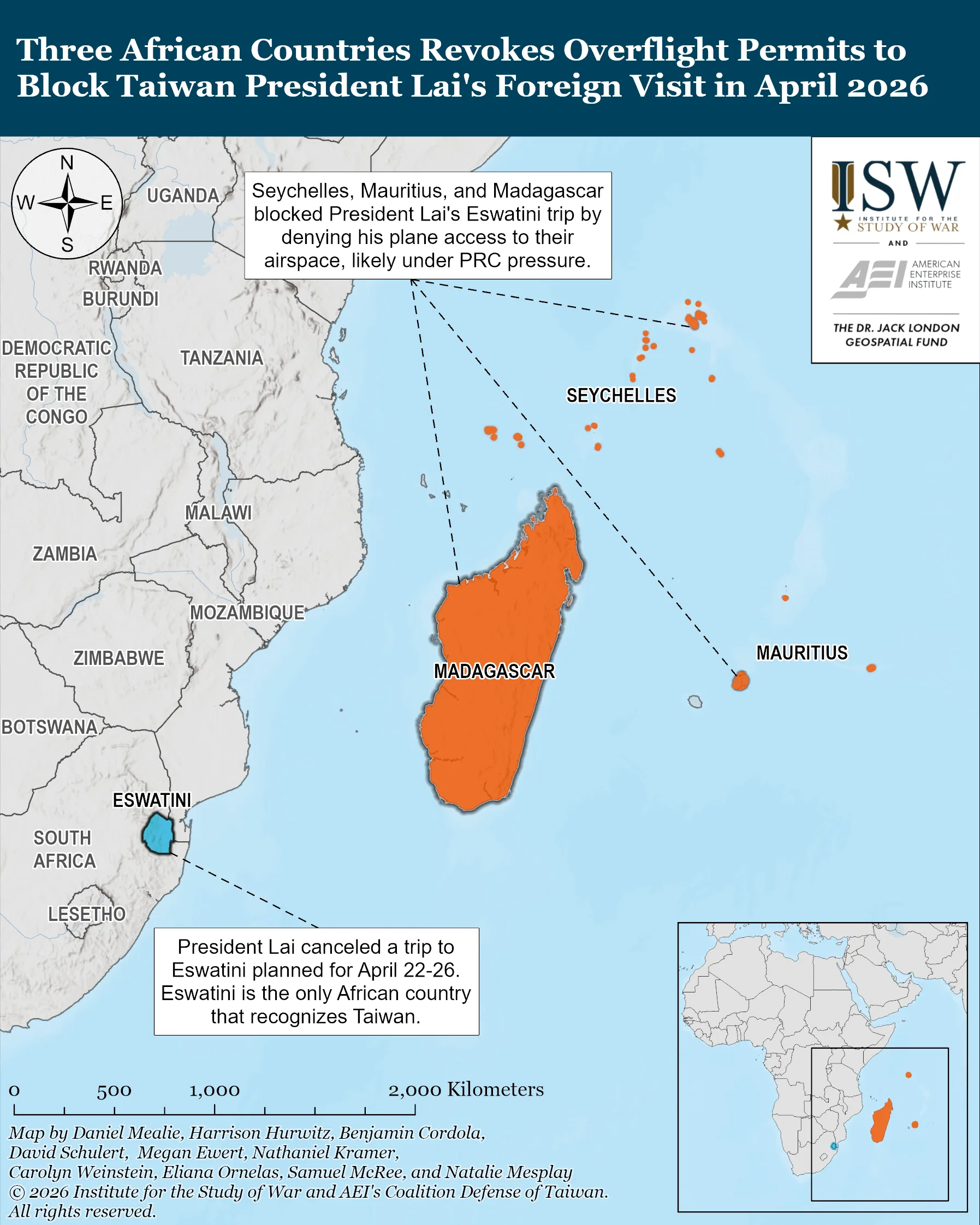
Taiwanese President William Lai Ching-te cancelled a planned visit to Taiwanese diplomatic ally Eswatini on April 21 after nearby Mauritius, Madagascar, and Seychelles revoked overflight permissions for his aircraft. The PRC very likely took unprecedented measures in pressuring third countries to help it disrupt Taiwan’s diplomatic engagements and erode Taiwanese sovereignty. The Seychelles Ministry of Foreign Affairs stated that the revocation was in line with Seychelles’ policy of refusing to recognize Taiwan diplomatically.[1] An official from Madagascar’s foreign ministry confirmed the revocation and stated that Madagascar “recognizes only one China.”[2] Most countries have a “one China policy” and do not recognize Taiwan as an independent state. This appears to be the first time a country has invoked the “one China policy” to block Taiwanese officials from flying through its airspace.
President Lai stated on X (formerly Twitter) that the PRC pressured the three countries to cancel overflight permissions for the Taiwanese delegation.[3] A senior Taiwanese security official stated that PRC pressure on the countries included threats to revoke debt relief.[4] PRC Ministry of Foreign Affairs (MFA) spokesperson Guo Jiakun commended the countries for adhering to the PRC’s “One China” principle and called the Taiwanese presidency a “false title,” asserting in a press conference on April 22 that “it’s very clear that there’s no longer a so-called ‘ROC president’ in the world anymore.”[5]
Taiwan’s opposition Kuomintang (KMT) and Taiwan People’s Party (TPP) joined the ruling Democratic Progressive Party (DPP) on April 22 to pass a resolution condemning the PRC’s coercion of the three countries in a rare instance of partisan solidarity.[6] Eswatini is the only African nation among the 12 countries that diplomatically recognize Taiwan. The government of Eswatini expressed regret that Lai would not be able to visit and stated that the incident will not change Taiwan-Eswatini relations.[7]
The PRC’s pressure campaign on the three African countries to block Lai’s trip to a different country is an unprecedented tactic to disrupt Taiwan’s diplomatic engagement. The PRC aims to erode Taiwan’s sovereignty by pressuring countries not to engage with the Taiwanese government or recognize Taiwan as a sovereign state. The PRC has previously pressured foreign governments to deny visas to visiting Taiwanese officials, denied the validity of Taiwanese passports and government offices, and threatened that hosting Taiwanese officials would disrupt relations between the PRC and their host nations.[8] All known previous incidents involved would-be host countries that do not recognize Taiwan blocking visits by Taiwanese officials, rather than unrelated third countries intervening to block Taiwanese officials from visiting Taiwanese diplomatic allies.
PRC espionage operations are exploiting financial instability among Taiwanese military personnel to acquire military secrets and weaken Taiwan’s confidence in its military. Taiwanese authorities charged or sentenced at least 17 Taiwanese military personnel in at least four separate cases over the past week for spying for the PRC.[9]Taiwanese prosecutors stated that PRC intelligence agents recruited a Taiwanese man surnamed Chen through social media in September 2024 to offer bribes and loans to financially insecure Taiwanese military officers in all branches of the military.[10] Chen pressured these officers to film themselves proclaiming their loyalty to the PRC, photograph and transmit sensitive military documents, and secretly film military operations.[11] Taiwanese prosecutors said that a PRC national working for the PRC’s Central Military Commission Political Work Department bribed Taiwanese officers to pass on sensitive military information and not resist during a PLA invasion.[12]
ISW-CDOT has previously assessed that PRC espionage operations are targeting financially insecure Taiwanese military personnel, offering these soldiers bribes and loans to transmit sensitive information, recruit more soldiers into spy rings, and film themselves pledging to surrender to the PLA in an invasion or proclaiming their loyalty to the PRC.[13] These operations threaten Taiwan’s ability to defend itself and damage Taiwan’s confidence in its military.[14] The PRC seeks to convince Taiwan’s leaders and citizens that Taiwan’s military is unable or unwilling to defend them against invasion.[15]
The PLA may be prioritizing metrics of loyalty and ideological orthodoxy over material improvements in its internal understanding of its own modernization. Emphasizing political and ideological standards instead of operational competence could impede the PLA’s military modernization and lead to miscalculation. CCP General Secretary Xi Jinping gave a speech on April 8 at an inaugural training program for all senior PLA officers that stressed the importance of loyalty to the CCP, Marxist study, and political rectification.[16] Xi urged the PLA to greet its 100-year anniversary in 2027 with a “brand-new political outlook.”[17] This is the first time that Xi has attended a senior officer training program in person since he became General Secretary in 2012.[18] PRC state media, including PLA official newspaper PLA Daily and PRC state broadcasting service CCTV, later released commentaries that elevated the importance of political loyalty and the “new political outlook” goal for 2027.[19] The US intelligence community has previously assessed that Xi has directed the PLA to be ready for a Taiwan contingency by 2027, though that is a deadline for preparedness and not for military action.[20]
Xi may be empowering party committees throughout the PLA to measure and enforce political readiness standards and link them to military modernization goals. CCTV published a report on April 12 highlighting the role of party committees at all levels of the PLA in implementing the tenets of Xi’s April 8 speech.[21] An April 19 CCTV commentary similarly stressed the PLA Navy’s (PLAN) efforts to enhance “party construction” through strengthening party committees, which CCTV claimed helped improve training exercises and combat readiness.[22] An April 13 PLA Daily report on a training exercise detailed how the party committee of an air defense brigade concluded that the brigade’s lackluster training performance, despite technological improvements, resulted from political “deviation.”[23] These publications suggest that the PLA views political loyalty as directly effecting combat performance and as a key metric of military preparedness.
Xi’s renewed emphasis on ideological loyalty in the PLA may skew the PLA’s modernization efforts and its self-perception of its own combat readiness. ISW-CDOT previously assessed that Xi’s widespread purge campaign throughout the PLA may create a sycophantic climate that impedes honest reflection of PLA capabilities.[24] The introduction of political and ideological standards as metrics for PLA martial quality will likely further accentuate this problem. The same emphasis on ideological “rectification” in the military could also raise the risk of miscalculation by creating a senior officer corps that is unwilling to contradict Xi’s beliefs and goals even on factual and practical grounds.
Key Takeaways
Taiwanese Diplomatic Relations: The PRC very likely pressured three African countries to close their airspace to Taiwanese President William Lai Ching-te to prevent his planned visit to Eswatini, one of Taiwan’s 12 remaining diplomatic allies. This is an escalation of PRC efforts to disrupt Taiwan’s international engagement and erode its sovereignty.
PRC Espionage Tactics: PRC espionage operations are exploiting financial instability among Taiwanese military personnel to acquire military secrets and weaken Taiwan’s confidence in its military.
PLA Modernization: The PLA may be prioritizing metrics of loyalty and ideological orthodoxy over material improvements in its military modernization, amid expansive military purges. Emphasizing political and ideological standards instead of operational competence could impede the PLA’s military readiness and lead to miscalculation.
Cross-Strait Relations
Taiwan
Taiwan’s Legislative Yuan (LY) agreed to advance the general government budget to committee review after a six-month delay. Taiwan’s ruling DPP and the opposition KMT and TPP caucuses advanced the budget to the LY Finance Committee on April 21.[25] The party caucuses agreed as part of the deal that the Cabinet should propose bills within six months to raise pay for military personnel and pensions for retired police and firefighters, major KMT and TPP demands that prevented the budget from advancing.[26] Raising pay for military personnel may help counter the PRC’s ability to exploit financially insecure soldiers for espionage and cognitive warfare.
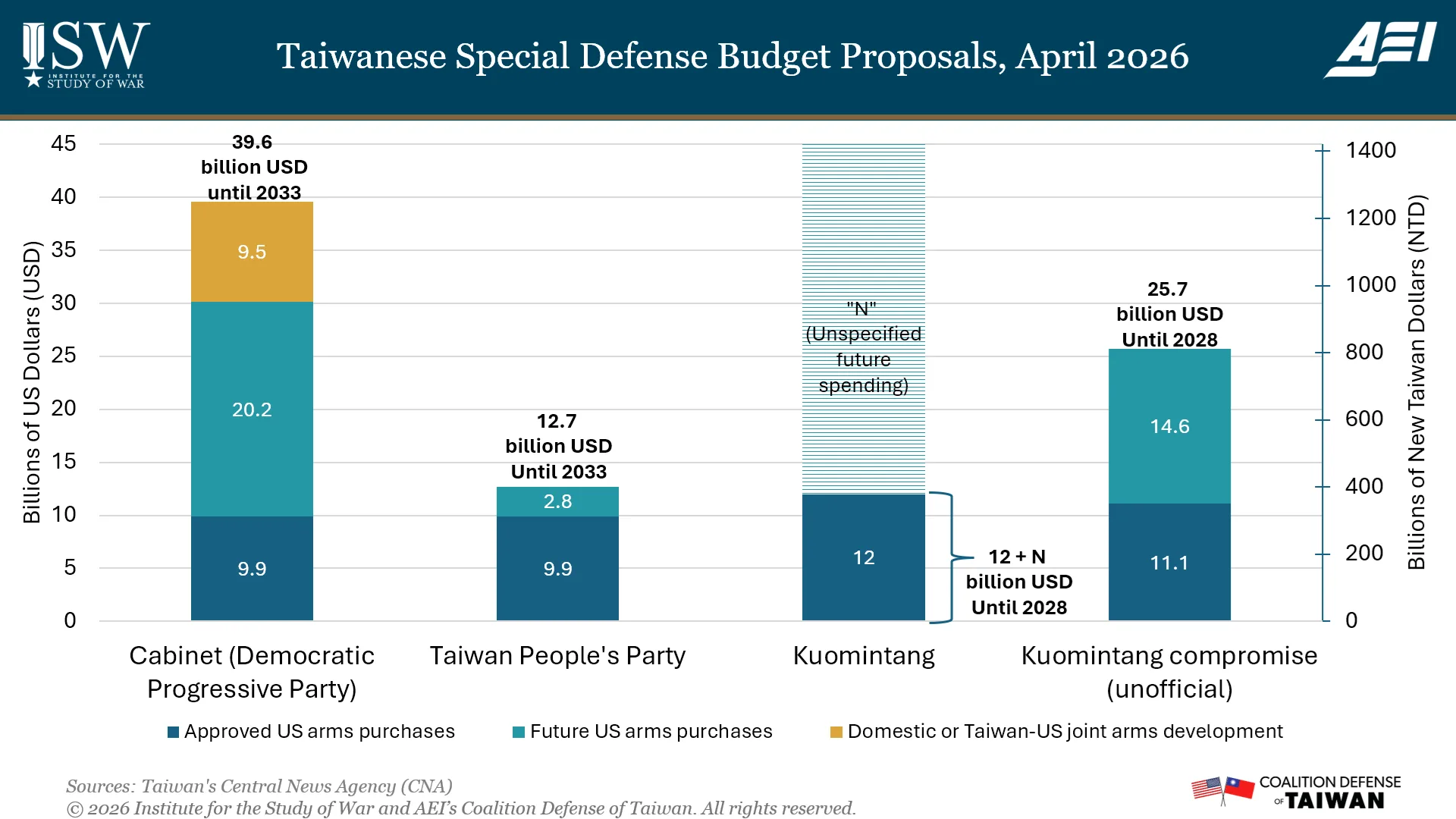
Taiwan’s party caucuses again failed to agree on a special budget bill for asymmetric defense despite a growing number of KMT legislators seeking compromise with the Lai administration. The compromise proposals are nominally more than double the KMT caucus’s baseline budget but still lack funding for key asymmetric systems and for domestic arms manufacturing. The LY’s three party caucuses held cross-party negotiations on April 23 over their competing special budget bills, but failed to reach consensus on key items, continuing a monthslong deadlock.[27] The Lai administration, backed by the DPP caucus, is pushing a 1.25 trillion New Taiwan Dollars (NTD) (approximately 40 billion US Dollars) (USD) budget to cover existing and future US arms sales to Taiwan as well as funding for domestic military systems production. The KMT and TPP bills amount to “380 billion + N” and around 400 billion NTD (approximately 12.05 and 12.69 billion USD), respectively. These bills would only pay for military equipment that the United States has already approved for sale. The KMT bill’s “+N” allows for funding increases to pay for future US arms sales, but only after the United States approves them. The KMT has expressed concerns about authorizing a “blank check” to buy US equipment that the United States has not yet approved for sale and which may face delays in delivery to Taiwan.[28]
Former KMT vice presidential candidate Jaw Shaw-kong on April 19 proposed a “compromise” special budget of 810 billion NTD (approximately 25.69 billion USD) to help resolve the deadlock.[29] A DPP lawmaker called the proposal a “first step of goodwill.”[30] Jaw’s proposal includes 350 billion NTD for systems that the United States has already agreed to sell to Taiwan. An additional 460 billion NTD would be frozen until the United States approves further arms sales. The proposal resembles the existing KMT bill but replaces the “+ N” component with a concrete number, which Jaw argued would make the budget easier to explain to US officials. Other KMT figures, including legislator Hsu Chiao-hsin, former legislator Jason Hsu, and Taichung mayor Lu Shiow-yen, have backed special budgets of between 800 billion NTD (approximately 25 billion USD) and 1 trillion NTD (approximately 32 billion USD).[31] TPP Chairman Huang Kuo-chang appeared to endorse a plan similar to Jaw’s during an interview on April 22, which may indicate that the two parties are converging on a compromise with the DPP.[32]
The 800 billion NTD proposals still lack funding for domestic drone and munitions manufacturing, however, which is a major feature of the administration’s bill. Taiwanese defense minister Wellington Koo lauded the government’s special budget bill on April 20 as the most comprehensive plan based on overall combat requirements, including funding to purchase 200,000 unmanned systems and develop a Taiwanese integrated air and missile defense (IAMD) network.[33] Taiwan’s Ministry of National Defense (MND) said that about 24 percent of the 1.25 trillion NTD bill would fund direct commercial sales or commissioned manufacturing – mainly for the drones and IAMD systems – while the remaining 76 percent would fund purchases of US weapons systems.[34] The wars in the Middle East and Ukraine illustrate that widespread use of unmanned systems has reshaped modern warfare through the ability of low-cost systems to create battlefield transparency and a pervasive threat of precision strikes.[35] The proliferation of long-range strike drones paired with precision missile strikes likewise necessitates an IAMD network capable of addressing such threats.[36] A special budget that omits funding for significant numbers of unmanned systems and a Taiwanese IAMD network will leave Taiwan inadequately equipped for the realities of modern warfare. It will also limit Taiwan’s ability to build its domestic drone industry, which is critical to reduce dependence on imported systems.
KMT caucus whip Fu Kun-chi ordered KMT legislators to mobilize for a largely symbolic impeachment vote against Taiwanese President William Lai Ching-te in May. The KMT and TPP initially voted on December 26, 2025, to begin impeachment proceedings against Lai, with the impeachment vote set for May 19.[37] The parties argued that Lai undermined Taiwan’s constitutional order when he refused to promulgate a budget reallocation law that the LY passed. Fu gave the order to mobilize the vote on April 13, over a month before the vote was set to take place.[38] The KMT and TPP collectively do not have the two-thirds majority needed to pass an impeachment vote in the legislature, so the vote is largely symbolic. DPP legislators criticized Fu for organizing the impeachment vote days after US President Donald Trump’s visit with CCP General Secretary Xi Jinping on May 14-15.
Taiwan is likely learning from the war in the Middle East to decrease its vulnerability to a PRC blockade. Taiwanese Deputy Interior Minister Ma Shih-yuan told Bloomberg on April 14 that the Interior Ministry will conduct its first-ever exercise alongside other government ministries to practice escorting vessels carrying natural gas and oil to Taiwan during a blockade of the island.[39] Taiwan’s energy sector is heavily dependent on imports and thus highly vulnerable to a blockade. The US-based Center for Strategic and International Studies estimated that Taiwan’s liquid natural gas (LNG) reserves would run out in about two weeks during a total blockade.[40] The Strait of Hormuz crisis has highlighted how the threat of interdiction can curb international shipping for several months. This situation revealed the potential risks if the PRC conducted a similar blockade operation against Taiwan.[41] Ma stated that Taiwan will aim to maintain corridors to the Philippines, Japan, and the United States during a blockade and that Taiwan expects that other nations will aid in escorting vessels through these corridors.[42]
ISW-CDOT has previously assessed that Taiwan’s limited energy reserves are a critical vulnerability that the PRC may target to extract concessions from Taiwan without an invasion.[43] The PRC has rehearsed a blockade of Taiwan on several occasions, most recently in December 2025 during its “Justice Mission” military exercise.[44] Taiwan’s ability to withstand a blockade may rest on its capacity to escort critical supplies to Taiwan and assuage the fears of the shipping industry that led to the halt of seaborne transit through the Strait of Hormuz.[45] The operating environment around Taiwan is more conducive to blockade-breaking than the narrow Strait of Hormuz, and the corridors that Taiwan intends to maintain during a blockade traverse the open ocean rather than maritime chokepoints.[46] Practicing and maintaining critical corridors during a blockade and escorting vessels carrying energy supplies will likely improve Taiwan’s ability to withstand a PRC blockade.
Taiwan is likely improving its ability to detect small watercraft that attempt to approach the island from the PRC. Improving this capability will allow Taiwan to curb PRC efforts to clandestinely insert espionage operatives or special forces into Taiwan. Taiwan’s Ocean Affairs Council stated on April 16 that it was developing an integrated ocean radar observation network to enhance Taiwan’s surface monitoring capabilities.[47] The project aims to integrate 57 radar stations from different agencies into a single network and add eight radar stations by 2028 to enhance detection around key areas, such as the Luzon Strait and Pengjia Islet, where PRC vessels often operate.[48] Taiwanese media reported that the radar network would use artificial intelligence (AI) to enhance detection capabilities, particularly of smaller surface vessels.[49] ISW-CDOT previously assessed that the PRC is likely practicing inserting special operating forces (SOF) or clandestine espionage personnel into Taiwan with small motorboats or unpowered vessels to avoid detection.[50] Taiwan has noted several incidents of PRC nationals in small boats successfully landing on Taiwan in recent years.[51] These insertions could allow the PRC to create favorable conditions for an amphibious landing or undermine Taiwan’s will to resist PRC coercion.[52] Taiwan’s effort to enhance its ocean radar observation network is a critical capability in safeguarding Taiwan’s national security from PRC efforts to infiltrate Taiwan undetected.
China
See Toplines.
Northeast Asia
Japan
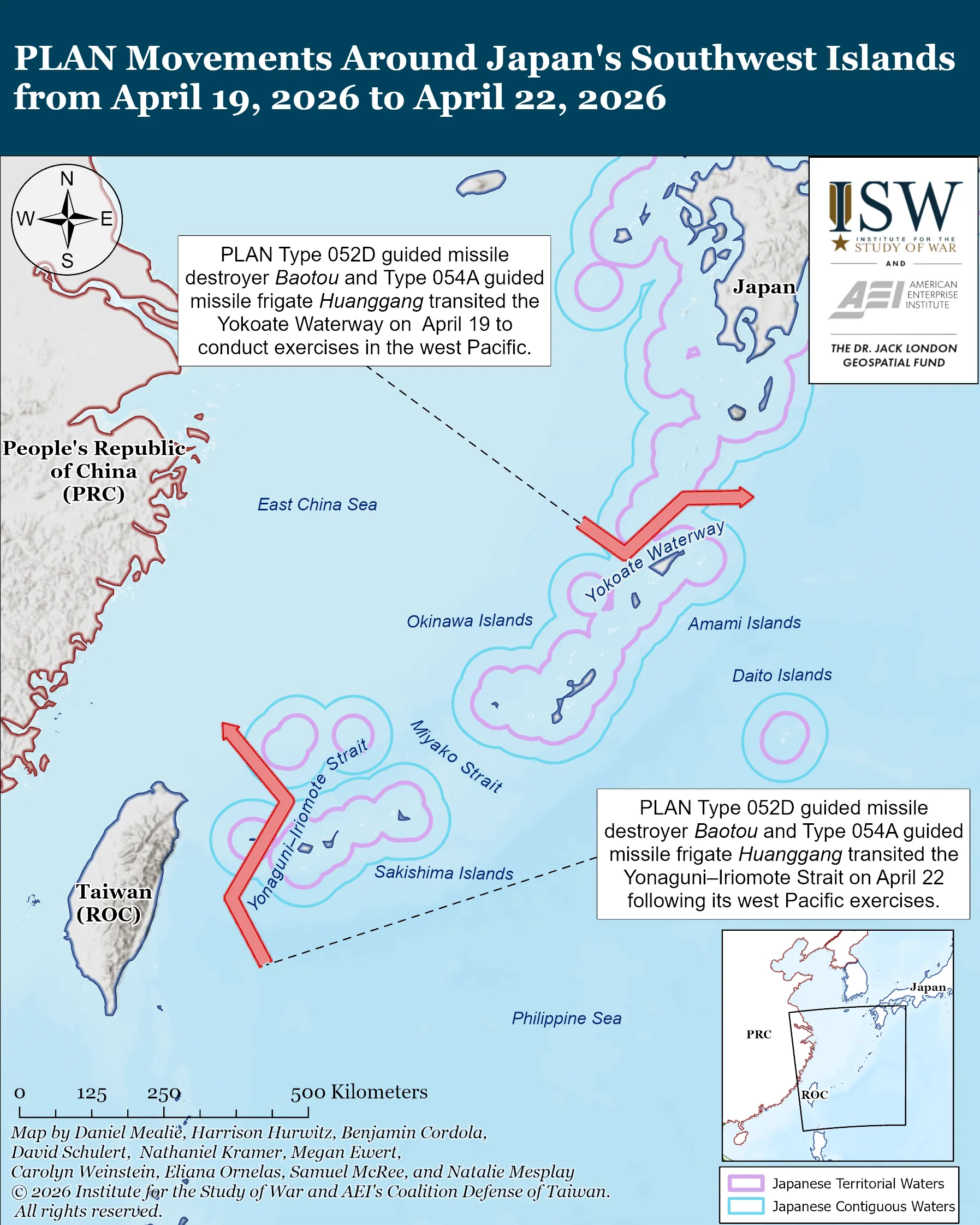
The PRC is likely attempting to impose costs on Japan for military cooperation with regional partners. The PRC likely views a resurgent Japanese military as a significant threat to PRC regional ambitions. The Japan Self-Defense Forces are participating in the Philippines-led Balikatan exercises from April 20 to May 8 for the first time, alongside the United States and Canada.[53] Japanese destroyer JS Ikazuchi transited the Taiwan Strait on April 17 on the way to the exercises, the first Japanese transit of the strait since June 2025.[54] A PRC MFA Spokesperson described the transit as a “deliberate provocation” and condemned Japan’s participation in the Balikatan exercises.[55] The PLA Eastern Theater Command (ETC) announced on April 19 that it would conduct naval exercises in the western Pacific Ocean with a Type 052D guided missile destroyer and a Type 054A guided missile frigate.[56] Both vessels transited Japan’s Yokoate Waterway on April 19, traveling toward the Western Pacific, and came back to the East China Sea through the Yonaguni–Iriomote Strait on April 22.[57] The Yokoate Waterway is much narrower and closer to Japan’s main island than the Miyako Strait, the normal passage for PLAN vessels deploying to the Western Pacific, indicating the PLA chose this route as a response to Japan’s Taiwan Strait transit.[58] China Military Bugle, the official press account of the PLA on social media, posted an image on Weibo depicting the JS Ikazuchi crewed by a figure representing Japanese World War II-era militarism being struck with a hammer decorated with the PRC flag, suggesting that the ETC exercise is intended as a response to Japanese military activity.[59]
Japan is continuing to bolster its military capabilities and its cooperation with regional partners to counter PRC aggression. ISW-CDOT previously reported that Japan is modernizing its naval force structure and is deploying advanced weapons systems to its southwest coast and southwest islands to deter PRC aggression.[60] The PRC has sought to impose costs on these Japanese efforts through military deployments to the Western Pacific, restricting PRC tourism to Japan, and limiting rare earth mineral exports.[61] The PRC also frequently criticizes Japanese military development in historical terms and amplifies “grassroots” criticisms of Japanese military development, particularly among opposition political parties in Japan and nations Japan aims to cooperate with.[62] The PRC may be setting information conditions for increasing its pressure campaign against Japan through military, political, and economic means. The PRC may also aim to dissuade other countries from pursuing military cooperation with Japan by showing that such cooperation invites PRC military deployments.
The PRC’s multi-domain coercion campaign targeting Japan indicates that the PRC sees such a buildup as a major threat to its regional ambitions. A resurgent Japanese military, particularly in the maritime domain, would likely force the PLA to allocate significant resources toward countering Japanese military deployments and dissuading Japan’s participation in a Taiwan contingency. Japan also revised its defense export restrictions on April 21 to allow it to export lethal military equipment.[63] This measure could improve defense capabilities throughout the region. Australia has already purchased three Japanese frigates, and the Philippines and Taiwan have expressed interest in similar purchases.[64]
Japan is expanding its economic statecraft in Asia through a 10 billion USD energy support framework, which may strengthen its regional partners’ ability to resist PRC coercion amid energy supply shocks from the Iran war. Japanese Prime Minister Sanae Takaichi announced the energy support framework on April 15, emphasizing the region’s vulnerability to external energy shocks.[65] The initiative will finance oil procurement and energy infrastructure across Asia, including support for alternative sourcing, helping partners diversify their energy supply and build reserves that reduce their vulnerability to supply disruptions and external pressure.[66]
Japan’s economic statecraft may complicate the PRC’s ability to exploit regional energy vulnerabilities as leverage over regional states. The Philippines renewed discussions with the PRC in late March to pursue joint oil exploration in the South China Sea due to the impact of the closure of the Strait of Hormuz.[67] The Philippines imports 98 percent of its oil from the Persian Gulf.[68]
The People’s Daily released on April 22 a “Zhong Sheng” commentary–a Chinese homophone for “Voice of China” and a pseudonym that is used to voice official Beijing positions on global affairs–on the prospective Philippines-PRC deal.[69]
The commentary stated that the Philippines could not simultaneously pursue economic cooperation with the PRC while “escalating tensions” over territorial disputes and collaborating with “external powers” – Japan and the United States – in the annual Balikatan military exercise.[70] Japan can reduce regional reliance on the PRC by providing alternative financing and supply options to the Philippines and other Southeast Asian nations and reduce Beijing’s ability to exploit such dependencies for geostrategic gain. Japan’s initiative, alongside growing Japan–South Korea coordination on energy and supply chains, reflects a broader effort by US allies to reduce these vulnerabilities.[71]
North Korea
Nothing Significant To Report.
South Korea
Nothing Significant To Report.
Southeast Asia
Vietnam
The PRC and Vietnam may pursue bilateral engagement to resolve South China Sea disputes rather than use Association of Southeast Asian Nations (ASEAN)-wide mechanisms. This could hinder the negotiations of the ASEAN South China Sea Code of Conduct and prevent ASEAN states from agreeing on measures to prevent the PRC from enforcing its territorial claims. Vietnamese Communist Party General Secretary To Lam visited the PRC from April 14 to 17 in his first state visit since being elected President of Vietnam on April 7.[72] CCP General Secretary Xi Jinping and To Lam released a joint communique on April 17 that promised significant cooperation and coordination under the PRC-Vietnam Comprehensive Strategic Cooperative Partnership.[73] PRC and Vietnamese officials also signed 32 joint agreements reached during To Lam’s visit, including cooperation on cross-border infrastructure, education, media, and supply chains.[74] This visit came amid the PRC’s expansion of its presence on Antelope Reef in the Paracel Islands, which both the PRC and Vietnam claim as their sovereign territory. Satellite imagery shows that the PRC may be attempting to build its largest South China Sea military base in Antelope Reef.[75] Vietnam’s foreign ministry called the Antelope Reef expansion “completely illegal and invalid” in March.[76]
The PRC-Vietnam agreements could hinder ASEAN’s pursuit of a South China Sea Code of Conduct before 2027. The PRC has consistently advocated for resolving maritime disputes in the South China Sea bilaterally, as opposed to negotiating with ASEAN.[77] The PRC’s claims over the Paracel and Spratly Islands overlap with the claims of several other countries, including Vietnam and the Philippines. The PRC likely favors bilateral engagement with these rival claimants to prevent the claimants from coalescing against the PRC’s position in the region. Vietnam’s willingness to engage bilaterally with the PRC and possibly overlook expanded PRC military infrastructure likely strengthens Beijing’s position against ASEAN-wide negotiations that could provide a more forceful challenge to PRC regional expansion.
Russia
CCP General Secretary Xi Jinping and other top PRC officials met with Russian Foreign Minister Sergey Lavrov in Beijing on April 14 to 15. PRC state media did not mention Russia’s offer to help with PRC energy shortfalls caused by the Iran War. Lavrov met with PRC foreign minister Wang Yi on April 14 to discuss preparations for an upcoming meeting between Xi and Russian President Vladimir Putin later in the year, as well as a variety of issues, including the Iran and Ukraine wars.[78] Lavrov also met with Xi Jinping on April 15.[79] Xi and Wang called for the PRC and Russia to strengthen cooperation to safeguard their “legitimate interests,” maintain unity among the “global South,” and enhance multilateralism through organizations such as the Shanghai Cooperation Organization (SCO) and BRICS, according to PRC readouts.[80] Lavrov called for alignment between Xi’s series of “global initiatives” and Putin’s visions for Eurasian regional architecture. Lavrov reportedly offered Russia’s help to “fill the resource gap that has arisen in China and other countries” due to the Iran War, according to Russian state media.[81] PRC readouts did not mention this, however, likely because Beijing wants to maintain a diverse range of energy suppliers and is hesitant to increase dependence on Russian energy. The PRC’s energy supply was likely impacted less by the war in Iran than other East Asian states, because the PRC diversified its energy sources and vastly increased its oil stockpile before the Iran war began.[82] PRC has the world’s largest oil reserve by far, with nearly 1.4 billion barrels stockpiled in December 2025.[83]
Iran
The PRC’s diplomacy during the US-Iran ceasefire is likely intended to de-escalate the conflict, open the Strait of Hormuz, and preserve Iran’s regime stability. The PRC is unlikely to be a decisive diplomatic player in ending the war because it has conflicting interests and low risk tolerance, however. CCP General Secretary Xi Jinping spoke with Saudi Crown Prince Mohammad bin Salman on April 20.[84] Xi said that the PRC supports an “immediate and comprehensive ceasefire” and maintains “normal passage” through the Strait of Hormuz.[85] PRC foreign minister Wang Yi told Iranian foreign minister Abbas Araghchi on April 15 that freedom of navigation in the “international waterway” should be guaranteed, though he also expressed support for Iran’s sovereignty and rights as a littoral state along the Strait of Hormuz.[86] The PRC Mission to the United Nations (UN) published a statement on April 17 explaining its veto of an April 7 Bahrain-proposed UN Security Council resolution, backed by most Gulf States, that would have authorized coordinated action to reopen the strait.[87] The statement argued that the resolution would have exacerbated tensions and was not conducive to a lasting ceasefire.
The PRC reportedly indicated that it would be willing to take possession of or downgrade Iran’s highly-enriched uranium (HEU) if that would help end the war, according to an unnamed diplomat.[88] US officials have insisted that Iran give up its estimated 970 pounds of HEU, but Iran has refused.[89] This proposal by the PRC would be Beijing’s most concrete contribution to US-Iran negotiations to date and could significantly boost Beijing’s diplomatic reputation as a peacemaker, if accepted. The PRC and Pakistan put forth a five-point “peace plan” on March 31 to end the war, and Xi himself presented four principles for peace in the Middle East on April 14.[90] Neither proposal included actionable measures to resolve the conflict, however.
The PRC has conflicting interests in the Iran war that complicate its ability to play a mediating role, however. Beijing was Iran’s top economic backer before the war, purchasing over 90 percent of Iranian oil exports and securing a sizable discount due to the international sanctions on Iran.[91] The PRC has shipped missile fuel precursor chemicals to Iran and reportedly sold Iran a satellite in 2024 that Iran used to target US bases during the war.[92] Unconfirmed reports state that the PRC is considering sending man-portable air defense systems (MANPADS), advanced radar, and other military systems to Iran, though the PRC has denied this.[93] The PRC likely wants to keep a friendly regime in power in Tehran that will protect PRC economic interests and keep US military attention and resources tied up away from the Indo-Pacific. The PRC, therefore, very likely does not want Iran to lose the war. Beijing likely wants Iran to perceive it as a reliable partner without getting directly involved in the war. The PRC also likely wants to maintain good relations with the Gulf States, which are important trading partners and oil suppliers for the PRC, and avoid overly aggravating relations with the United States, especially ahead of the Xi-Trump summit in mid-May. The PRC also likely wants to ensure freedom of navigation in the Strait of Hormuz, which is at odds with the core of Iran’s asymmetric strategy against the United States. Roughly half of the PRC’s crude oil imports and about 30 percent of its liquid natural gas came through the Strait of Hormuz before the war. The vast majority of PRC energy comes from other sources, however.[94] These conflicting goals and relationships, along with Beijing’s general aversion to risky entanglements in other regions, make it unlikely that the PRC will play a decisive role in shaping the outcome of the war.