
China & Taiwan Update, May 8, 2026
Toplines
Readouts from preparatory phone calls ahead of US President Donald Trump and CCP General Secretary Xi Jinping’s meeting next week indicate that trade, US arms sales to Taiwan, and the Iran War may be the top issues of discussion between Trump and Xi. Trump is scheduled to meet with Xi in Beijing on May 14 and 15.[1] PRC Foreign Minister Wang Yi spoke with US Secretary of State Marco Rubio on April 30. PRC Vice Premier He Lifeng called US Secretary of the Treasury Scott Bessent and US Trade Representative Jamieson Greer on the same day to discuss a range of diplomatic, security, and trade issues in preparation for the summit.[2] Both countries have recently placed trade and investment restrictions on each other despite a one-year trade war “truce” since October 2025.[3] The PRC implemented a new law on April 7 that establishes its ability to punish foreign firms that “undermine China’s industrial and supply chain security,” including by complying with sanctions placed on the PRC or attempting to decouple from PRC supply chains.[4] The United States has implemented trade restrictions to de-risk supply chains and prevent advanced technology transfer to the PRC.[5] The United States is also pursuing investigations on PRC goods that could lead to new tariffs by the end of 2026, following the US Supreme Court’s cancellation of Trump’s “reciprocal” tariffs under the International Emergency Economic Powers Act (IEEPA) in February.[6]
Xi will likely urge Trump to decrease or stop arms sales to Taiwan. The Trump administration approved an arms package to Taiwan worth 11 billion US dollars (USD) in December 2025 and is reportedly considering an even larger arms package worth 14 billion USD that it has yet to publicly disclose.[7] Wang Yi warned Rubio that the Taiwan issue is the “biggest risk factor” in US-PRC relations. Xi previously warned Trump in a February 4 call against selling more arms to Taiwan, implying that it may jeopardize the upcoming Trump-Xi summit or other aspects of bilateral relations.[8] Xi will likely have less leverage to push Trump on arms sales now that Taiwan’s legislature has approved a 25 billion US dollar (USD) special defense budget to fund both the December 2025 sale and future sales.
Xi may also push Trump to lift Iran-related sanctions on the PRC and work to resume the flow of trade through the Persian Gulf. The US blockade of Iranian ports and Iran’s intermittent closure of the Strait of Hormuz harm PRC energy security. The PRC is more resilient to economic shocks from the Iran War than most of its neighbors, however, and reaps some geopolitical benefits from the war and blockade continuing, so Xi is unlikely to strongly prioritize pressuring Trump to end the war at this time.
Iranian Foreign Minister Abbas Araghchi visited the PRC for the first time since the Iran War began and met with PRC Foreign Minister Wang Yi, possibly to coordinate positions before the Trump-Xi meeting. Wang and Araghchi met on May 6 in Beijing to discuss the war.[9] The PRC’s stated positions are:
The PRC believes that a “complete cessation of hostilities” is imperative and that restarting the conflict is unacceptable;
The PRC supports Iran safeguarding its sovereignty and security;
The PRC hopes that all parties will “respond promptly to the strong calls from the international community” to restore normal and safe passage through the Strait of Hormuz;
The PRC “appreciates Iran’s commitment not to develop nuclear weapons,” while recognizing Iran’s right to develop peaceful nuclear energy;
The PRC advocates for the Gulf countries, including Iran, to “take their destiny into their own hands” and build a regional security architecture.[10]
Araghchi claimed that the “political crisis cannot be resolved through military means” and that the issue of opening the Strait of Hormuz “can be resolved as soon as possible.”[11] Araghchi commended the PRC’s peace efforts and likewise expressed support for a postwar regional security architecture.[12]
Wang’s rhetoric signaled that Beijing wants active hostilities to end, likely to avoid further erosion of Iranian regime stability, protect energy infrastructure throughout the region, and prevent conflict escalation that harms PRC interests.
Wang’s comments on the Strait of Hormuz were less direct, however, calling for a “prompt response” to the “international community’s” desire to restore normal passage through the Strait, rather than clearly stating that Beijing wants Iran to reopen the Strait. Wang may have used indirect language to avoid offending his Iranian interlocutor. Other PRC officials have more explicitly called for Iran to reopen the Strait of Hormuz and stop attacking the Gulf States, while still blaming the United States and Israel for initiating the war.[13] The PRC likely wants the Strait reopened eventually but can weather the economic shock longer than most East Asian states, given PRC oil reserves and diversified energy supply.[14] The PRC benefits from the war depleting US military stockpiles, weakening US alliances, and creating energy vulnerabilities for US allies that the PRC can exploit, however.[15] Beijing’s conflicting interests with regard to the war likely limit the extent of its peacemaking efforts.
Wang’s comments on the Iranian nuclear program and on Gulf countries taking security “into their own hands” likely indicate that the PRC does not intend to get heavily involved in resolving either issue directly. The PRC likely does not support Iran getting nuclear weapons and may be gently reminding Iran to honor commitments it made under the late Ayatollah Ali Khamenei to not build them. The PRC is advocating for Middle Eastern regional security architecture to reduce US influence in the Middle East while allowing the PRC to balance relations with Iran and the Gulf States without getting entangled in their conflicts.
The PRC confirmed on May 7 that a PRC-owned oil tanker came under attack in the Strait of Hormuz for the first time on May 4, shortly before the Wang-Araghchi meeting.[16] The ship was off the coast of the United Arab Emirates when it was hit. The vessel’s chief engineer said it was “still unclear” who fired on the ship or what kind of munition was used.[17] A PRC Ministry of Foreign Affairs (MFA) spokesperson said on May 8 that there were no reported crew casualties and reiterated the importance of restoring safe passage through the Strait.[18]
The PRC National Financial Regulatory Administration (NFRA) verbally instructed banks on May 1 to suspend new loans to independent oil refineries, also known as teapot refineries, under US sanctions.[19] The PRC Ministry of Commerce (MOFCOM) activated an anti-sanctions law for the first time on May 2, however.[20] This may indicate PRC efforts to mitigate financial sector risks from US sanctions without projecting weakness ahead of negotiations. US Treasury Secretary Scott Bessent announced new sanctions on May 1 against PRC-based oil terminal operator Qingdao Haiye Oil Terminal Co, Qingdao Haiye’s president Li Xinchun, and a Hong Kong-based vessel management company for importing sanctioned Iranian crude oil.[21] The United States sanctioned independent oil refinery Hengli Petrochemical on April 24.[22] The NFRA privately and verbally instructed large banks to temporarily suspend new loans to the five US-designated teapot refineries, review business dealings with those refineries, and not extend new yuan-denominated credit nor call in existing loans.[23]
MOFCOM issued an injunction on May 2 that banned the “recognition, enforcement, and compliance” with US sanctions against designated teapot refineries, contradicting the NFRA directive.[24] A MOFCOM spokesperson stated that the sanctions violate international law and that the basis for the injunction is the 2021 Measures for Blocking the Improper Extraterritorial Application of Foreign Laws and Measures, also known as the “Blocking Rules.” The law gives the PRC legal authority to determine when foreign restrictions do not apply to PRC entities and allows affected parties harmed by foreign sanctions compliance to sue sanctions-complying entities for compensation.[25] The Blocking Rules may deter compliance with sanctions, and thus reduce the effectiveness of those sanctions in cutting off funds to Iran. PRC entities can apply to MOFCOM for exemptions to the Blocking Rules, however.
NFRA and MOFCOM appear to have issued contradicting guidance, with the former directing banks to abide by US sanctions and the latter signaling that the PRC believes it has the strength to defy US sanctions. This may be the PRC’s attempt to avoid publicly showing that US sanctions have any effect on the PRC economy, as the NFRA’s guidance was privately and verbally issued, lest they face a weakened negotiating position ahead of US President Donald Trump’s meeting with General Secretary Xi Jinping on May 14 and 15.[26]
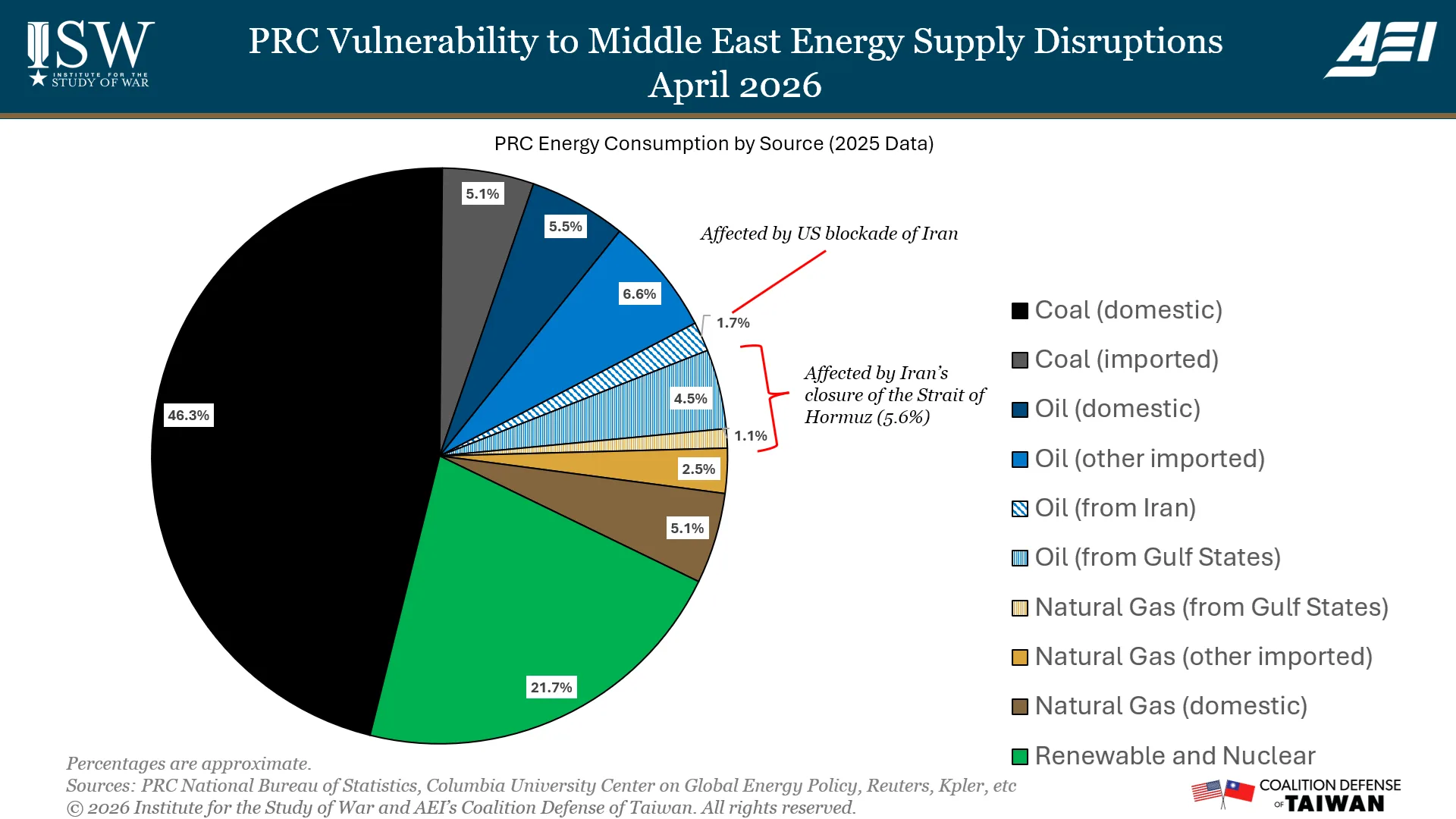
The PRC is the largest buyer of Iranian oil, purchasing over 80 percent of Iranian crude oil before the war.[27] Less than seven percent of the PRC’s overall energy consumption is from Middle Eastern oil, however.[28] The PRC also has insulated itself from supply shocks by diversifying its energy supplies and stockpiling nearly 1.4 billion barrels of oil in December 2025.[29] The PRC has continued to purchase Iranian oil throughout the war by accepting imports from tankers that were already in transit or were storing oil at sea when the war began, despite the blockage of the Strait of Hormuz.[30] The PRC’s invocation of the anti-sanctions law, together with new April 7 and April 13 regulations on industrial and supply chain security, expands the PRC legal framework to counter foreign sanctions and other related measures and prosecute foreign companies perceived to be acting against PRC interests.[31]
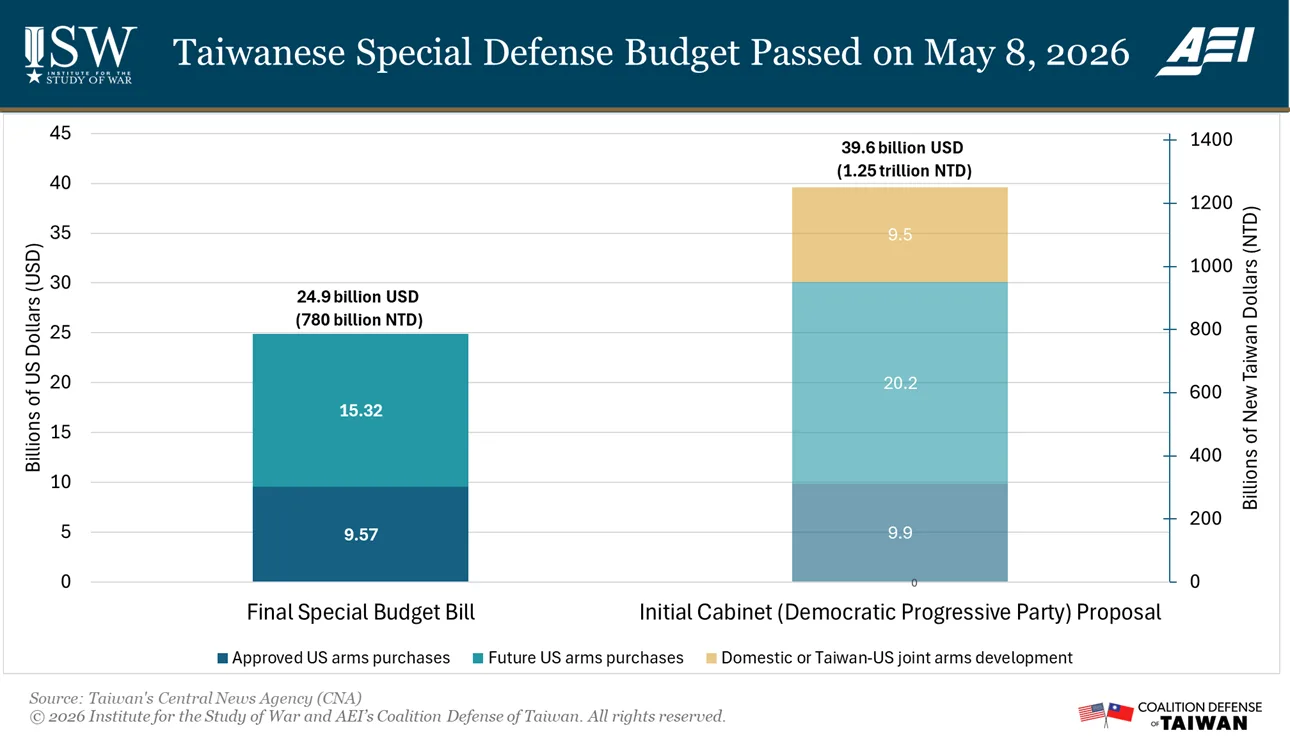
The Taiwanese Legislative Yuan (LY) passed a special defense budget totaling 780 billion New Taiwan Dollars (NTD) (roughly 25 billion USD) on May 8. The budget lacks funding for key efforts to modernize Taiwan’s defense industry and military capabilities. The budget will be split to fund two rounds of arms purchases. The first round allocates 300 billion NTD for High Mobility Artillery Rocket Systems (HIMARS), M109A7 self-propelled howitzers, anti-armor drone missile systems, and Javelin and TOW anti-tank guided missiles. The second round will allocate 480 billion NTD for anti-ballistic missile systems, low and medium altitude air defense systems, counter-drone systems, and the replenishment of anti-tank guided missiles.[32] The budget lacks the funding for domestic weapons development, the ‘T-Dome’ missile defense network, and joint US-Taiwan manufacturing found in the Executive Yuan’s (EY) version.[33] The opposition Kuomintang (KMT) and Taiwan People’s Party (TPP) voted to pass the budget. The ruling Democratic Progressive Party (DPP) continued to support the EY’s 1.25 trillion NTD (roughly 40 billion USD) budget.[34]
KMT Chairwomen Cheng Li-wun met Taichung Mayor Lu Shiow-yen and Legislative Speaker Han Kuo-yu on May 7. Lu and Han favored the 25 billion USD budget over the KMT’s original proposed budget of “380 billion + N” NTD (roughly 12 billion US dollars plus an unspecified amount ‘N’ for future arms purchases) favored by Cheng.[35] The KMT and TPP likely accepted a larger budget than their original proposals due to pressure from the United States and a desire to align with mainstream public opinion prior to the November local elections.[36] Cheng’s inability to convince the KMT to pass the smaller budget may suggest that moderate KMT politicians and public opinion will impact her ability to further her legislative objectives in the near future. This smaller defense budget will limit Taiwan’s ability to invest in its domestic defense industries and key military system research.
Key Takeaways
US-PRC Diplomacy: Diplomatic engagements between the United States and the PRC preceding next week’s summit between US President Donald Trump and CCP General Secretary Xi Jinping indicate that US-PRC trade, US arms sales to Taiwan, and the Iran war will be major topics of discussion.
PRC-Iran Relations: Iranian Foreign Minister Abbas Araghchi visited the PRC for the first time since the Iran War began, possibly to coordinate with the PRC prior to the Xi-Trump meeting. The PRC’s stated positions suggest that it seeks an end to active hostilities and eventual reopening of the Strait of Hormuz, but is unlikely to increase its involvement in the conflict.
PRC Economic Policy: The PRC presented seemingly contradicting guidance regarding whether PRC entities should abide by US sanctions. The PRC may be attempting to mitigate risks posed by US sanctions without projecting weakness ahead of the Trump-Xi meeting.
Taiwanese Special Defense Budget: The Taiwanese LY passed a special defense budget totaling 780 billion NTD on May 8, despite efforts by KMT Chairwoman Cheng Li-wun to pass a smaller version of the budget plan. The 780 billion NTD budget lacks the funding for Taiwanese domestic weapons development, the ‘T-Dome’ missile defense network, and joint US-Taiwan manufacturing, however.
Cross-Strait Relations
Taiwan
The PRC amplified remarks from a retired Taiwanese military officer at a PLA anniversary event, likely to advance its narrative of Taiwanese support for cross-strait relations on the PRC’s terms. PRC state media broadcast former Taiwanese Naval Lieutenant Commander Lu Li-shih’s statement where he said that “people on both sides of the Taiwan Strait are one family” and that “a strong motherland means Taiwan is safe” while visiting the PRC on April 23 for the 77th anniversary of the PLA Navy (PLAN).[37] The PRC often highlights the historical, cultural, and ethnic unity between Taiwan and the PRC to argue for unification.[38] The PRC has likewise attempted to depict its increased military activity around Taiwan as protecting Taiwan from “separatists” and external powers.[39] Lu has attended other PLA events, such as the September 2025 military parade, and praised the PLA for its strength.[40] Taiwan’s Mainland Affairs Council (MAC) announced on April 30 that it would investigate Lu’s remarks for potential “cooperative activity” with the PRC.[41]
ISW-CDOT has previously assessed that the PRC seeks to amplify the perception that most of Taiwan’s population supports greater cross-strait engagement and depict the DPP’s cross-strait policy as alienated from the will of the Taiwanese people.[42] A PRC Ministry of National Defense spokesperson stated on April 30 that the MAC’s investigation into Lu was a product of the DPP’s unwillingness to accept closer relations between the PRC and Taiwan.[43] The PRC uses Taiwanese efforts to counter PRC information operations as evidence for PRC narratives that Taiwan’s government is out of touch with the wishes of its people for cross-strait unity.[44] Recent polling data suggests that only around 10 percent of Taiwanese people support unification with the PRC, which includes those who support unification under a Republic of China government but would not support CCP rule over Taiwan.[45]
Taiwanese President William Lai Ching-te circumvented PRC efforts to limit Taiwanese diplomatic engagement by successfully visiting Eswatini, Taiwan’s only diplomatic ally in Africa. Lai made a surprise visit to Eswatini on May 2 after canceling a trip originally scheduled for April 22 to 26 due to PRC interference.[46] The PRC reportedly pressured Seychelles, Mauritius, and Madagascar to revoke overflight permissions for Lai’s original flight to Eswatini.[47] The DPP stated that the countries’ flight authorities initially approved overflight permissions weeks in advance, only to revoke them with 12 hours’ notice.[48] Taiwanese Presidential Office Secretary-General Pan Meng-an claimed the sudden overflight ban was due to intense PRC pressure, which included economic coercion.[49] Taiwanese officials attempted to secure alternative flight routes in the following 48 hours by requesting transit authorization in European countries, but Germany and the Czech Republic reportedly denied the requests.[50] Bloomberg reported that Beijing immediately pressured Berlin after learning that Germany was considering the request.[51] Lai ultimately traveled in an Eswatini-chartered private plane owned by Eswatini’s King Mswati III and did not announce the visit until he arrived to avoid travel complications.[52]
The PRC’s unprecedented pressure campaign against third party countries demonstrates the extent of the PRC’s ability to restrict Taiwanese diplomatic engagements. The PRC has also used economic incentives to prevent countries from allying with Taiwan and notably excluded only Eswatini from its zero-tariff policy for Africa.[53] The PRC does not have diplomatic relations with Eswatini due to Eswatini’s continued diplomatic relations with Taiwan. Lai’s visit to Eswatini also highlights Taiwanese efforts to maintain diplomatic relations despite PRC opposition.[54] The PRC Taiwan Affairs Office (TAO) referred to Lai’s unannounced trip as being “like a rat scurrying across the street,” to which the Taiwanese Ministry of Foreign Affairs (MOFA) replied that announcing visits after a head of state’s arrival has international precedent.[55] The PRC MFA called the deliberate concealment of Lai’s travels “an extremely dangerous, scandalous and outrageous violation of these countries’ sovereignty and territorial airspace.”[56]
PRC diplomats pressured Zambia’s government to cancel an upcoming international human rights summit because of planned Taiwanese participation. The PRC is leveraging African nations’ debts to coerce them into excluding Taiwan from international gatherings and regular diplomatic exchanges. The RightsCon 2026 summit was planned to take place in Zambia’s capital, Lusaka, on May 5 and include several representatives from Taiwanese civil society.[57] Access Now, the nonprofit that organizes the annual summit, said in a public statement on May 1 that PRC diplomats pressured the Zambian government to block RightsCon from taking place unless summit organizers agreed to completely exclude the Taiwanese delegation.[58] Access Now subsequently cancelled the summit, calling the Zambian government’s request to exclude Taiwanese representatives at the behest of the PRC “unacceptable.”[59]
The PRC likely leveraged Zambian debt to coerce it into blocking Taiwanese participation in the conference. Zambia owes the PRC government and PRC firms around 6.6 billion US dollars and is seeking debt relief for these loans.[60] The PRC also co-chairs the Official Creditor’s Committee responsible for negotiating Zambia’s debt restructuring.[61]
Access Now’s executive co-director stated that this was the first time the PRC had attempted to pressure it to change RightsCon.[62] The PRC is attempting to disrupt Taiwan’s diplomatic and international engagements to erode Taiwanese sovereignty and bolster its claim that Taiwan is a part of the PRC.[63]
Taiwan’s Ministry of National Defense (MND) reported that its emergency loan program for Taiwanese military personnel has disbursed around 6.7 million US dollars since January 1. The program could hinder PRC efforts to recruit spies by exploiting financial insecurity among Taiwanese soldiers. The MND began offering low-interest loans to Taiwanese military personnel for emergency expenses such as medical treatment, childcare, and funerals on January 1.[64] The MND stated that the program is intended to help military personnel cope with major expenses without needing to borrow from underground lenders and accumulate large debts. PRC intelligence agencies have recently targeted indebted Taiwanese military personnel for espionage recruitment, enticing them with bribes or loans.[65]
The MND’s maximum loan amount per service member significantly exceeds the amounts that PRC intelligence agents promised to pay some Taiwanese soldiers in recent espionage cases, indicating that the loan program may reduce Taiwanese soldiers’ vulnerability to espionage recruitment schemes.[66] It is unclear whether Taiwanese service members can use the loans to help repay existing debts, however.
China
See toplines.
Southeast Asia
Philippines
The 2026 Balikatan exercises focused on enhancing interoperability among US allies in the Indo-Pacific and developing a denial-based defense concept within the first island chain that integrates lessons from the war in Ukraine. Enhanced cooperation between the United States and its regional partners in the Indo-Pacific will likely present a major obstacle to PRC regional ambitions. Warships from the United States, the Philippines, Japan, Australia, and Canada conducted combined exercises focusing on anti-submarine operations, fleet air defense, and replenishment at sea in the West Philippine Sea from April 20 to May 1.[67] This is the first time that Japan has joined Balikatan as an active participant.[68] US, Philippine, and Japanese forces also practiced defending against an amphibious invasion using the United States’ High Mobility Artillery Rocket System (HIMARS) to strike surface targets at a distance.[69] US forces also practiced deploying unmanned surface vessels (USV) similar to the Ukrainian Magura USV from an island in the middle of the Luzon Strait, a critical waterway that the PLAN uses to operate beyond the first island chain and around Taiwan.[70] The exercises also practiced deploying and using the US Navy-Marine Corps Expeditionary Ship Interdiction System (NMESIS), Typhon missile system, and Japan’s Type 88 anti-ship missile, all of which could be used to deny use of the Luzon Strait to the PLAN.[71] A denial-based defense of the first island chain would likely significantly limit the PLAN’s ability to operate safely beyond the PRC’s immediate waters, preventing the PLAN from completely isolating Taiwan during wartime.
The PRC typically couples US and allied cooperation with increased PLA military activity and capitalizes on internal alliance tension to dissuade future cooperation. A PRC Ministry of National Defense (MOD) spokesperson stated on April 30 that the Philippines was acting as a “pawn” of the United States.[72] The same spokesperson also elevated Philippine objections to a US military plan to build a fuel depot in Davao City and Philippine criticisms of Japanese participation in Balikatan, which the spokesperson linked to Japanese aggression during World War Two.[73] The PLA Southern Theater Command (STC) shadowed the Balikatan maritime exercises with four surface vessels and deployed two H-6 bombers armed with anti-ship missiles near Scarborough Shoal during the exercises armed with anti-ship missiles.[74] The STC conducted two major deployments to the South China Sea and West Pacific in late April in response to Balikatan.[75] The PRC’s rhetoric and military activity are likely designed to frame increased military cooperation among its neighbors as escalatory and provocative.
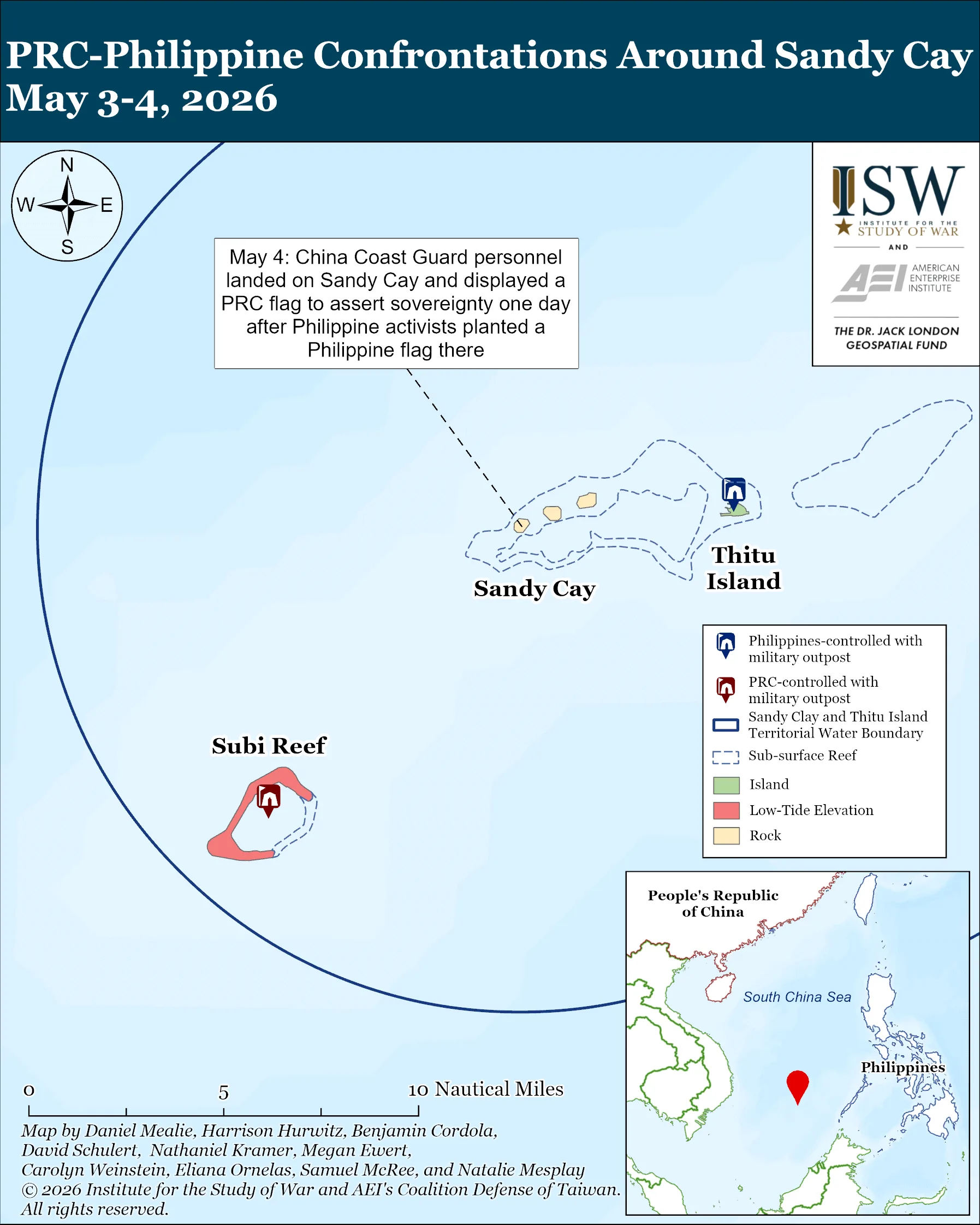
The PRC is using alleged ecological damage by Philippine personnel to portray itself as the more responsible custodian of disputed South China Sea territories. Five Philippine activists of the Atin Ito Coalition landed on Sandy Cay on May 3. They planted a Philippine flag, which a Philippine Armed Forces spokesperson called “a powerful assertion of our sovereign rights.”[76] Atin Ito is a non-governmental organization that asserts Philippine territorial claims in the South China Sea and resupplies Filipino inhabitants and fishermen in the region. The China Coast Guard (CCG) called the landing “illegal” and sent its own personnel to the island on May 4.[77] The CCG recorded its officers cleaning up trash allegedly left by the Filipinos, which state media described as “video evidence of the Philippines’ illegal activities and ecological damage to the reef.”[78] Sandy Cay is a barren sandbar between the Philippine-controlled Thitu Reef, the administrative center for Philippine holdings in the South China Sea, and the large PLA naval base on Subi Reef. Sandy Cay has been the site of low-level clashes between Chinese Maritime Militia, Philippine civilians, and military and coast guard personnel from both countries since at least 2017.[79] Sandy Cay’s territorial waters grant its owner legal jurisdiction over Subi Reef, which is likely why the PRC is placing a particular emphasis on controlling this feature.
The PRC is likely accusing the Philippines of causing ecological damage to Sandy Cay to support its territorial claims and possibly as a response to similar Philippine accusations against the PRC. The Philippine National Security Council accused the PRC on April 13 of using cyanide fishing to kill the fish population in Second Thomas Shoal, removing a source of food for Philippine personnel stationed in the area.[80] The CCG, MOD, and PRC state media lodged counter-accusations that Philippine personnel on the BRP Sierra Madre were damaging the ecosystem by burning garbage and dumping it in the water.[81] The Sierra Madre is a grounded warship that the Philippine military uses as an outpost at Second Thomas Shoal. The PRC has also used the pretext of environmental protection to justify its control over Scarborough Shoal, which it seized from the Philippines in 2012. The PRC established a “nature reserve” on Scarborough Shoal in September 2025 to justify strengthened “law enforcement” against Philippine vessels trying to enter the area.[82]
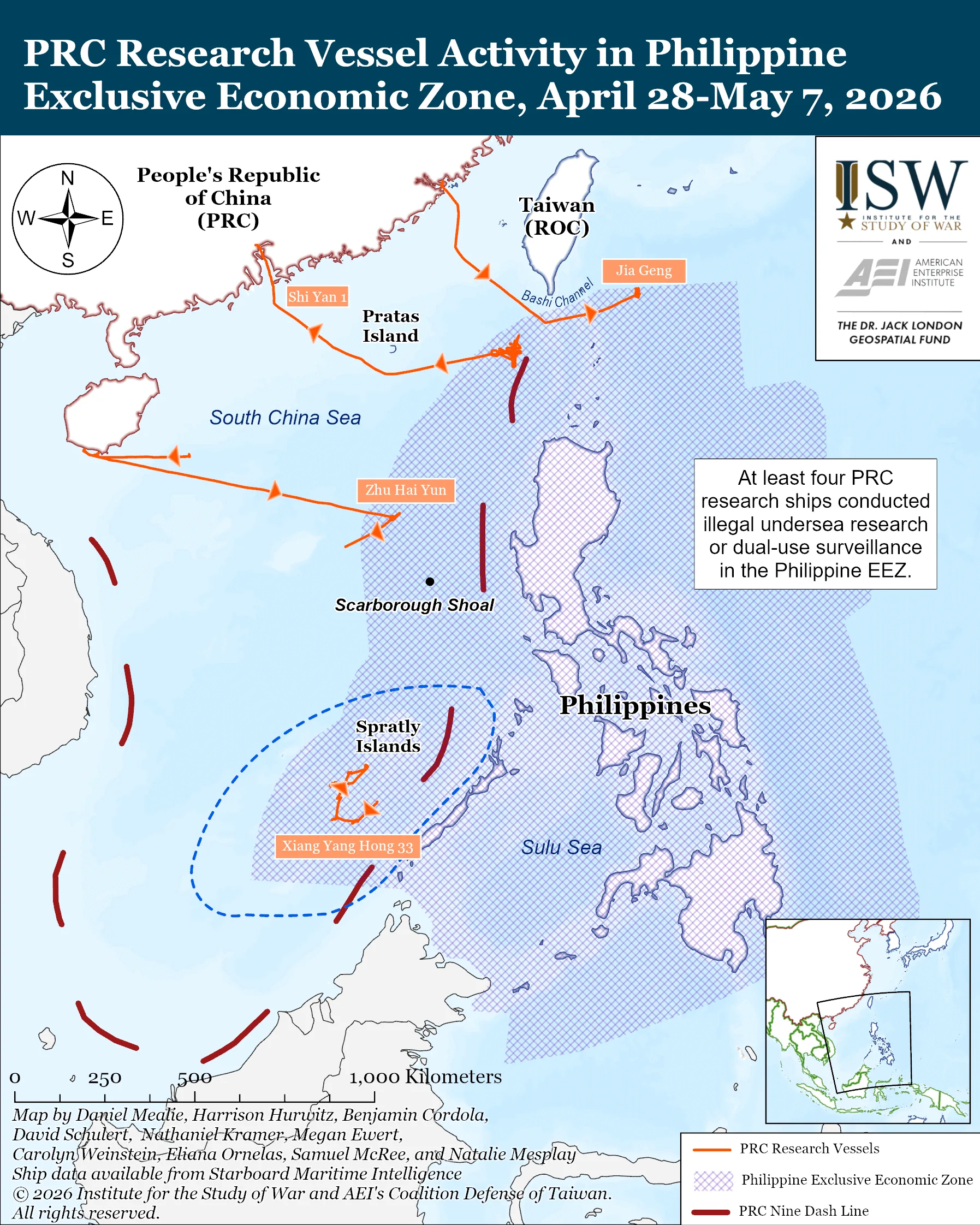
The Philippine Coast Guard (PCG) said it would drive away four PRC research vessels illegally surveying the Philippine Exclusive Economic Zone (EEZ). PCG spokesperson for the West Philippine Sea Jay Tarriela announced on May 2 that the PCG detected four PRC research vessels conducting “illegal marine scientific research” in the Philippine EEZ.[83] The vessels included the advanced oceanographic survey ship Xiang Yang Hong 33, a research ship specializing in marine research and hydro-acoustics called Shi Yan 1, the deep-sea research ship Jia Geng, and the intelligent drone mothership Zhu Hai Yun, which all operated in different areas. Tarriela said that the PCG would send ships and aircraft to drive the research vessels away from Philippine waters.[84] The PRC’s embassy in Manila claimed that the ships’ activities were within waters under PRC jurisdiction and “beyond reproach.”[85] The UN Convention on the Law of the Sea (UNCLOS) does not permit unauthorized economic or scientific activities in other countries’ EEZs. The PRC disputes Philippines territorial claims in the South China Sea and claims its own territorial or economic rights over the majority of the sea, however.
The PRC very likely uses research vessels to improve its undersea surveillance and submarine navigation capabilities. The Jia Geng sailed through Bashi Channel between Taiwan and the Philippines and is currently surveying a seamount southeast of Taiwan that overlaps with the Philippine EEZ, according to ship-tracking data from Starboard Maritime Intelligence. The Bashi Channel is a key maritime chokepoint that the PRC will very likely seek to control during a blockade or invasion of Taiwan. The Xiang Yang Hong 33 operated from April 20 to May 5 very close to Sabina Shoal, Second Thomas Shoal, and Iroquois Reef. All three are disputed features that the PRC seeks to seize from Philippine control through a variety of coercive means. Several of the research vessels can deploy Unmanned Underwater Vehicles (UUVs) and frequently operate in the South China Sea and around Taiwan, according to Starboard data. The PRC’s “Transparent Ocean” initiative aims to build a multilayered web of sensors to enhance PLA undersea navigation and detection capabilities.[86] The PRC very likely uses ostensibly civilian research vessels to map underwater terrain, deploy undersea sensors and surveillance drones, and place navigational beacons for submarines in preparation for future conflict.
Oceania
Australian officials carried out diplomacy with the PRC, Japan, and other Indo-Pacific countries to secure Australia’s fuel and fertilizer supplies amid the Iran War. Australian Foreign Minister Penny Wong met with Japanese Foreign Minister Toshimitsu Motegi on April 28, PRC Foreign Minister Wang Yi on April 29, and South Korean Foreign Minister Cho Hyun on April 30.[87] The discussion centered on the provision of jet fuel, diesel, gasoline, and fertilizer to Australia, which Wong said was necessary for Australia to continue shipping them food, coal, and liquified natural gas (LNG).[88] Japan, the PRC, and South Korea do not have substantial natural oil resources but are major exporters of refined oil products, which they produce from imported crude oil. Wong said the PRC agreed to cooperate with Australian businesses on jet fuel shipments.[89] The PRC accounted for about one third of Australia’s jet fuel imports before the Iran war, but significantly curtailed its exports of jet fuel and other fuels in March and April to secure the PRC’s domestic supply.[90] Australia similarly announced a policy on May 7 to reserve a portion of LNG equivalent to 20 percent of its exports for domestic consumption. This will not affect existing contracts but will reduce its future exports.[91] Australia is a major supplier of LNG, iron ore, and other raw materials to the PRC.[92] Australian Prime Minister Anthony Albanese and Japanese Prime Minister Sanae Takaichi met in Canberra on May 4 and signed a joint pledge to deepen cooperation on energy security, critical minerals, and defense.[93] Australia supplies nearly half of Japan’s LNG, while Japan is a top five supplier of gasoline and diesel to Australia.[94]
Indo-Pacific countries are working to shore up critical energy supplies disrupted by the Iran War while avoiding overdependence on the PRC, which has increasingly leveraged economic dependencies to secure political and security concessions from trading partners. The PRC recently reopened talks to pursue joint oil exploration cooperation with the Philippines to alleviate the Philippines’ energy crisis, but signaled that such cooperation was contingent on the Philippines accommodating PRC security interests in the region.[95]
South Asia
Pakistan
Pakistan commissioned the first of eight Hangor-class attack submarines derived from a PRC design, indicating Pakistan’s reliance on PRC military technology. The PRC could use Pakistan’s reliance on its military relationship with the PRC to support power projection efforts in the Indian Ocean. Pakistan commissioned the first Hangor-class submarine on April 30 in Sanya, Hainan Province, with Pakistan President Asif Ali Zardari in attendance.[96] The Hangor-class is likely a copy of the PRC’s Type 039A diesel-electric attack submarine equipped with air-independent propulsion, increasing the amount of time the submarine may remain submerged.[97] The Hangor-class is the latest example of Pakistan’s extensive military reliance on PRC-designed and produced equipment. Pakistan also operates the PRC’s J-10C and likely used it to score multiple aerial victories during its May 2025 conflict with India.[98] The PRC could similarly use Pakistan as a testing ground for the performance of the Type 039A. Pakistan also operates surface vessels derived from the PRC’s Type 054A and Type 053H3 guided missile frigates.[99] Approximately 80 percent of Pakistan’s arms imports from 2021 to 2025 came from the PRC.[100]
The PRC could leverage Pakistan’s reliance on its arms industry to exact concessions from Pakistan to aid its regional posture in the Indian Ocean. A major limiting factor in PRC power projection is its lack of overseas bases to support long-range naval deployments.[101] Pakistan’s Gwadar Port is operated by a PRC state-owned enterprise and is large enough to host all PLAN major surface combatants.[102]
PRC military infrastructure in Pakistan could improve PRC power projection in the Indian Ocean and the Middle East. The PRC could use this newfound capability to secure critical sea lines of communication (SLOC) in the region that it relies on for some of its energy imports.[103] The PRC could also use enhanced power projection through Pakistan to support its ambitions in the Middle East where it has increasingly sought to represent itself as a force for peace and stability, including during the current war between the United States and Iran.[104]