
China & Taiwan Update, May 29, 2026
Toplines
The PRC has not blocked Taiwanese government officials, including Minister Without Portfolio Yang Jen-ni, from participating in Asia-Pacific Economic Cooperation (APEC) meetings in the PRC, despite its general policy against Taiwanese officials participating in international forums. Taiwan sent Yang, who is also the head of the Taiwan Office of Trade Negotiations, to Suzhou to attend an APEC ministerial meeting from May 22 to 23.[1] Yang is the most senior sitting Taiwanese official to visit the PRC on official business since the PRC cut off official exchanges with Taiwan in 2016 in response to the election of former Democratic Progressive Party (DPP) President Tsai Ing-wen.[2] The PRC insists that cross-strait relations must be based on the “1992 Consensus,” which Tsai, current President William Lai Ching-te, and the DPP do not recognize. The 1992 Consensus is an alleged verbal agreement between semi-official representatives of the CCP and the Kuomintang (KMT), Taiwan’s then-ruling party, that says that Taiwan is part of “China,” though the two sides did not agree on whether “China” is rightfully represented by the PRC or the Republic of China (ROC). Taiwan sent Director General of the Ministry of Foreign Affairs (MOFA) Department of International Organizations Jonathan Sun to APEC Senior Officials meetings earlier this year.[3] Taiwan has participated in APEC under the name “Chinese Taipei” since it joined the organization in 1991. APEC is an organization of “economies” and does not require participants to be sovereign states.[4]
The PRC’s acceptance of an actively serving ministerial-level Taiwanese official to come to the PRC to participate in APEC is an unusual exception to Beijing’s escalating campaign to constrain Taiwan’s international participation. The PRC has engaged in multiple diplomatic coercion efforts against Taiwan in 2026, including blocking Taiwan from participating in the World Health Assembly (as it has every year since 2016), reportedly pressuring countries to exclude or downgrade Taiwan’s participation in international organizations, and financially coercing three African countries to close their airspace to block President Lai’s state visit to Eswatini.[5] The PRC maintains that it is the official representative of Taiwan and insists that Taiwan can only participate in international bodies if Beijing allows it.
The PRC may still use its leverage as current host of APEC to control which Taiwanese officials represent Taiwan in the Economic Leaders’ Meeting in November, which is traditionally attended by heads of government. Taiwan is the only APEC member state that does not send its senior leadership to APEC summits. The PRC rejected Taiwan’s then- DPP president Chen Shui-bian’s bid to attend an APEC summit and his choice of envoy in 2001, leading Taiwan to boycott APEC for the year.[6] The PRC allowed former Taiwanese President Ma Ying-jeou to send former Taiwanese Vice President Vincent Siew when it hosted APEC again in 2014, however, likely in part because Ma was a KMT member with relatively Beijing-friendly policies.
A US decision to suspend an arms sale to Taiwan would likely undermine Taiwanese confidence in the United States’ commitment to Taiwan’s defense. US President Donald Trump stated that US arms sales to Taiwan were under consideration and suggested they could be used as a “negotiating chip” with the PRC.[7] Reuters reported on May 23 that an unnamed source in the White House stated that Trump would make a decision “soon” on the potential arms package.[8] The arms sale under consideration totals to 14 billion US dollars and includes Patriot surface-to-air missile systems, National Advanced Surface-to-Air Missile Systems (NASAMS), and interceptor munitions for these systems. These systems would aid Taiwan’s efforts to develop an integrated air and missile defense (IAMD) network known as the “T-dome,” which President Lai has outlined as a key priority of his administration.[9] A robust IAMD network is critical for Taiwan’s ability to withstand PRC precision strikes preceding a PLA amphibious invasion.[10]
The KMT-aligned media space in Taiwan has used the arms sale delay to cast doubt on US support for Taiwan and elevate the KMT’s model of conciliatory cross-strait relations. The KMT-aligned United Daily News (UDN) published several articles from May 22 to 26 that suggested Trump decided to suspend the arms sale as a result of pressure from the PRC.[11] KMT-aligned China Times also published an article on May 27 suggesting that Trump’s decision to suspend arms sales marked a reversal of the United States’ Taiwan policy that sought to prevent a violent confrontation with the PRC by decreasing material support for Taiwan.[12] The KMT has previously pointed to delays in arms deliveries from the United States to criticize DPP proposals to increase defense spending.[13]
President Trump has not determined the status of the arms sale at the time of writing. Reuters reported on May 22 that no preparations have been made for a phone call between Trump and Lai, despite Trump stating on May 20 that he would speak to Lai about the potential sale.[14] US and Taiwanese presidents have not publicly held exchanges since the United States severed diplomatic relations with Taiwan in 1979. Further delays or an outright cancellation of the arms sale would likely have significant deleterious effects on Taiwanese confidence in its defense partnership with the United States and would lend undue credence to the position of the CCP and voices within Taiwan that Taiwan’s defense buildup is the main antagonist to cross-strait stability.
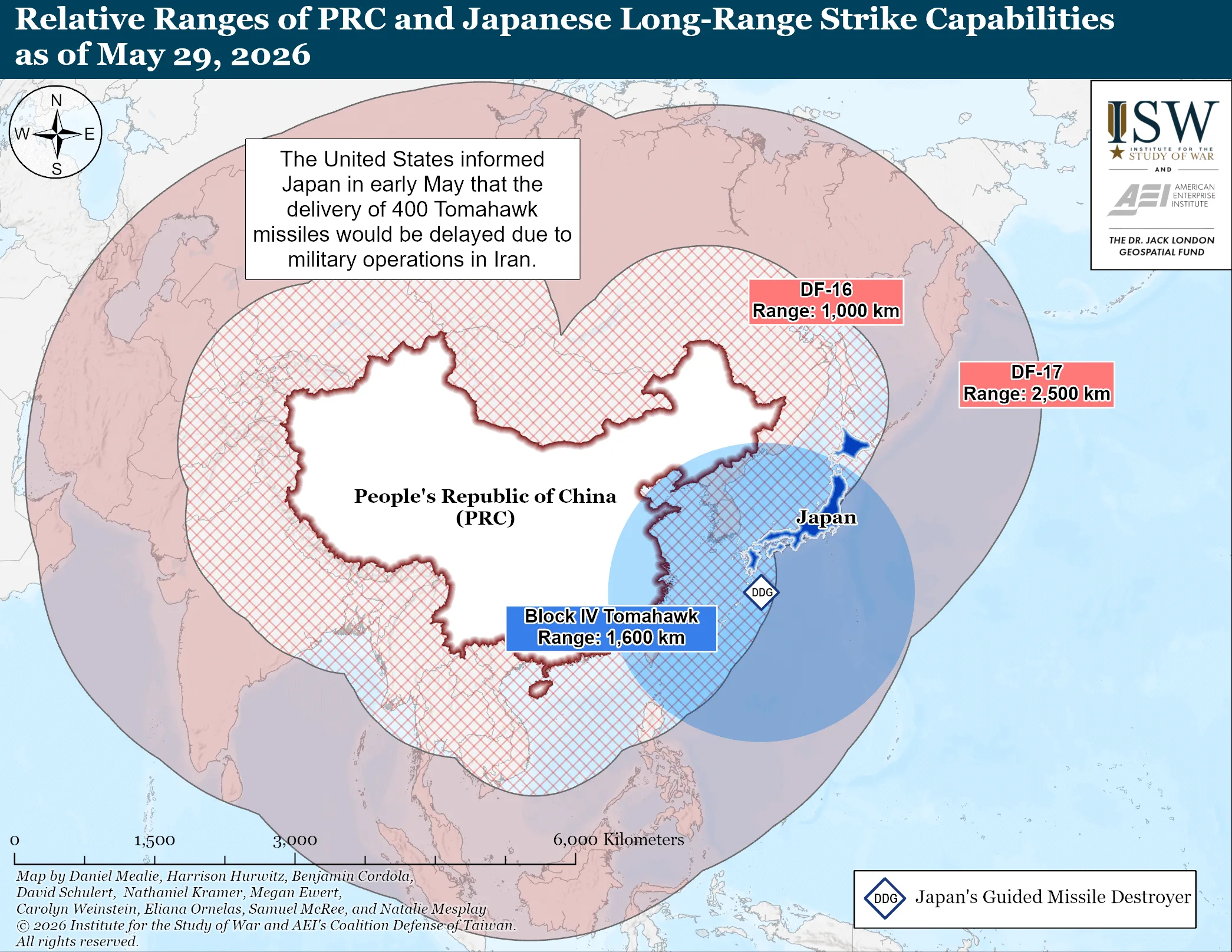
Delays in US Tomahawk missile shipments to Japan may pose a threat to Japan’s evolving defense concept. The PRC may weaponize arms delivery delays in information operations to undermine the US-Japan relationship, despite continued US support for Japan’s defense reforms. The United States warned Japan that it may delay a planned delivery of four hundred Tomahawk missiles due to the war in Iran.[15] Tomahawk deliveries were initially planned in two shipments to be completed by 2028, but the delay could reportedly push this timeline back by two years.[16]
The Tomahawk delivery delay risks undermining Japan’s military modernization efforts. Japanese defense expert Tatsumi Yuki told Taipei Times that Japan’s defense concept, currently under revision, assumed the delivery would take place on time.[17] Japan had already begun incorporating Tomahawks into its training and was preparing to place the Tomahawk missiles on its Aegis-equipped JS Chokai destroyer.[18] Tomahawks are long-range cruise missiles that place the Japan’s missile capabilities more closely on par with those of the PRC. The Tomahawks have a range of 1600 kilometers.[19] The presence of Tomahawks would illustrate a notable shift in Japan’s defense concept from territorial defense systems to more offensive systems that can strike back against an attacker.
PRC state media CCTV similarly cited a defense expert who said that the Tomahawks’ delay would affect Japan’s defense plans. PRC propaganda often frames the United States as an unreliable ally as an attempt to coalition-break between the United States and its Pacific partner states.[20]
Key Takeaways
Taiwan’s International Participation: The PRC did not block a Taiwanese minister-level official from participating in APEC in the PRC, in an exception to its usual obstruction of Taiwanese participation in international forums.
US Arms Sales to Taiwan: A US decision to suspend an arms sale to Taiwan would likely undermine Taiwanese confidence in the US commitment to Taiwan’s defense.
US Arms Sales to Japan: Delays in the planned delivery of Tomahawk missiles to Japan may hinder Japan’s military modernization plans and deterrence capability.
Cross-Strait Relations
Taiwan
A quarrel between former Taiwanese President Ma Ying-jeou and his former spokesperson, KMT Vice-Chair Hsiao Hsu-tsen, may be part of a deepening rift within the KMT since the election of KMT Chairwoman Cheng Li-wun. Ma removed Hsiao as the CEO of the Ma Ying-jeou Foundation on March 24 and launched an investigation into Hsiao’s alleged financial misconduct in the role, including business dealings in the PRC.[21] Hsiao, Cheng, KMT Caucus Secretary Lin Pei-hsiang, and other prominent KMT leaders discredited the investigation, citing Ma’s advanced age and family issues as complicating factors.[22] Other KMT figures, such as “deep Blue” (hardline KMT) media personality Jaw Shaw-kong and former National Security Council director-general King Pu-tsung, have defended Ma’s accusations.[23] Although the formal investigation yielded no substantial evidence, King revealed additional evidence on May 25 that Hsiao accepted unreported cash donations from Taiwanese businessmen and met with PRC Taiwan Affairs Office (TAO) director Song Tao in 2025 without informing Ma.[24] Hsiao met with Song shortly after Cheng appointed him as a KMT Vice Chair in October 2025, but before he formally assumed the vice chairmanship.[25] Hsiao was still CEO of the Ma Ying-jeou Foundation at the time of the meeting.
Hsiao’s spat with Ma may be the latest development in a series of internal spats within the KMT since Cheng’s election as KMT chairwoman in October 2025. Cheng’s campaign focus featured anti-establishment rhetoric, promoted Chinese identity on both sides of the Taiwan Strait, and reaffirmed her reverence for the 1992 Consensus. Cheng’s campaign brought her into early conflict with KMT elites such as Jaw who wish to reform the KMT’s image.[26] Jaw implied during the election that the CCP was interfering in the election in support of Cheng.[27] KMT internal divides also emerged over the recently passed Special Defense Budget, with Jaw and legislative speaker Han Kuo-yu joining moderate KMT lawmakers to back a larger budget than the Cheng-led party leadership faction.[28]
Ma is Taiwan’s last KMT President and remains an influential figure in the KMT even though he no longer holds a formal position in the party or government. Ma met with CCP General Secretary Xi Jinping in April 2024, and the CCP has referred to Ma’s presidency as a model for peaceful cross-strait relations.[29] Cheng’s ascension to KMT Chairwoman, her meeting with Xi in April 2026, and the KMT’s recent attempts to sideline Ma signal a shift to a younger faction of KMT hardliners that the CCP will likely pursue as its preferred Taiwanese interlocutors.[30] TAO Deputy Director Pan Xianzhang stated on May 22 that Cheng’s April meeting with Xi “pointed the way” to enhanced cross-strait relations and had “far-reaching implications” for unification and rejuvenation.[31] The CCP will likely prioritize engagement with Cheng’s faction due to Ma’s reduced influence in the KMT, the CCP’s dissatisfaction with past cooperation attempts, and the CCP’s likely preference for hardline KMT candidates that align with its views over moderates with broader appeal.
The PRC and KMT may be aiming to capitalize on US President Donald Trump’s statements cautioning against Taiwanese independence to undermine support for Taiwan’s ruling DPP. The PRC is aiming to elevate the cross-strait policy of the opposition KMT and paint the DPP as antagonistic to cross-strait peace. A PRC TAO spokesperson repeatedly stated during a May 20 press conference that Taiwanese President William Lai Ching-te supported Taiwanese independence and was an obstacle to cross-strait stability as a result.[32] A PRC Ministry of Foreign Affairs (MFA) spokesperson similarly described Lai as a “peace destroyer” and criticized Lai’s “pro-independence” stance.[33] US President Donald Trump cautioned Taiwan against seeking independence during a May 15 interview.[34] The PRC aims to present Lai and the DPP as “separatist” and therefore the main obstacle to cross-strait peace, in contrast to the KMT and PRC. Lai has said that Taiwan does not need to declare independence because it is already independent and not subordinate to the PRC.
The KMT has also elevated its anti-independence rhetoric following Trump’s comments and has criticized the DPP for allegedly seeking independence. Taichung Mayor and KMT politician Lu Shiow-yen called on the DPP to clarify its independence policy on May 20, stating that adhering to a pro-independence stance would cause international concern.[35] The KMT similarly put out a statement on May 20 that condemned Lai for committing to “two-state” rhetoric despite President Trump’s comments cautioning against independence.[36] The KMT has presented its cross-strait policy and opposition to independence as conducive to cross-strait dialogue and stability and depicted the DPP as the primary catalyst for regional tension.
The DPP began as a pro-independence party in the 1980s but has since emphasized maintaining the status quo in the Taiwan Strait and no longer includes declaring independence in its party platform.[37] The PRC is likely attempting to conduct an information operation that obfuscates the DPP’s position on Taiwanese sovereignty to undermine its domestic and international standing, particularly with the United States, and place the blame for the PRC’s own coercive behavior on the victim of that coercion. The PRC continues to take concrete steps to reshape the status quo in the Taiwan Strait, including maintaining a constant military presence around Taiwan and conducting major military exercises surrounding Taiwan.[38]
The PRC is detaining an increased number of Taiwanese individuals compared to previous years. The PRC’s detention of Taiwanese individuals without informing the Taiwanese government is another example of the PRC denying Taiwanese sovereignty. The Straits Exchange Foundation (SEF), a semi-official Taiwanese organization that handles relations with the PRC, reported that the PRC most recently detained three Yiguandao (also known as I-Kuan Tao) followers in two incidents in Fujian and Guangdong provinces in May 2026 without notifying Taiwan.[39] SEF Secretary-General Luo Wen-jia said that 19 Taiwanese nationals in 17 cases have been detained for religious reasons in the PRC since 2019, 14 of which are affiliated with Yiguandao.[40] Yiguandao is a Taoist sect that the CCP banned in 1949.[41] Yiguandao was also previously banned in Taiwan, but an estimated 2.2 percent of the Taiwanese population follows Yiguandao according to a 2021 survey.[42] The PRC only recognizes five religions—Buddhism, Taoism, Islam, Protestantism, and Catholicism—and bans those the CCP considers to be “cults.” The PRC persecutes followers of non-state-sanctioned religions, with punishments including detention, prison sentences, physical abuse, and movement restrictions even after release.[43] Taiwan’s Mainland Affairs Council (MAC) reported in late March that 313 Taiwanese people have gone missing or been detained, interrogated, or had their civil liberties restricted in the PRC since January 2024, a drastic spike compared to previous years.[44] An unnamed MAC official said that the number of new cases has been increasing every month. The increased detention and disappearance of Taiwanese people in the PRC may be due to a combination of a PRC crackdown on Taiwanese “separatists” and greater restrictions on civil liberties in the PRC in general.[45] The PRC considers Taiwanese people to be PRC nationals and has reduced its communication with Taiwanese authorities about such cases in recent years.[46]
China
The US House of Representatives Select Committee on China found that two US banks underwrote the stock offerings of a PRC military-linked company, helping it raise billions of dollars. The Committee released a report on May 21 that found that Bank of America and JPMorgan Chase underwrote the Initial Public Offering (IPO) of Contemporary Amperex Technology Co., Ltd. (CATL) on the Hong Kong Stock Exchange in May 2025, after the US government determined in January 2025 that the company had ties to the PLA.[47] The House committee found that the banks accepted CATL’s claims that the US Department of Defense (DOD) incorrectly designated it as a PLA-linked company, and the banks did not do due diligence to interrogate those claims. CATL is the world’s largest battery manufacturer.[48] Members of the US Congress warned in 2023 that CATL’s lithium-ion batteries may soon power PLA conventional submarines.[49] US Senators also found that CATL had supply chain links to the Xinjiang Production and Construction Corps (XPCC) and other entities that the United States has implicated for using forced labor.[50] The committee report also found that the investment bank Morgan Stanley similarly underwrote the Hong Kong IPO of Zijin Gold, Inc, another company the US government found had tied to forced labor. The committee said the banks acknowledged the US government’s national security and human rights concerns about the companies, but proceeded to sponsor the companies’ stock listings anyway, helping them raise billions of dollars. The report concluded that “key U.S. financial institutions prioritize deal completion over national security and human rights concerns” as long as they meet legal obligations.[51]
PRC Foreign Minister Wang Yi convened a United Nations Security Council (UNSC) debate and meeting to advocate for revitalizing the United Nations (UN) and present the PRC as a peacemaker and defender of international institutions. The PRC convened the debate in its capacity as the rotating president of the UNSC in May.[52] Wang gave a speech laying out the PRC’s vision for the UN, warning that “the dregs of a law of the jungle are resurfacing” — a term the PRC has used to refer to US “America First” policies and other actions the PRC considers “unilateralism.”[53] Wang called for a revitalization of the UN’s authority and role in diplomatically resolving conflicts and promoting economic development. Wang said the international community should “uphold sovereign equality and oppose interference in internal affairs,” and “uphold the peaceful settlement of disputes and oppose the use of force,” principles that the PRC has used to object to foreign support for Taiwan and to US military action in the Middle East, among other issues. Wang also called on the world to “oppose the glorification of the history of aggression” in the Second World War, a thinly veiled reference to common PRC criticisms of Japan.[54] Wang called for the UN to “unequivocally oppose protectionism and unilateral actions, oppose the over-securitization of trade and economic issues, and oppose technological blockades and decoupling,” echoing PRC criticisms of US, European, and other countries’ attempts to curtail PRC leverage over global supply chains and acquisition of sensitive technologies.
Wang also lauded the PRC’s contributions to “multilateralism,” including large financial contributions to the UN, promotion of peace talks for international conflicts, and state-backed initiatives for global development, global security, and global governance.[55] The PRC is the second largest financial contributor to the UN after the United States. The PRC contributed nearly 24 percent of the UN’s budget in 2025, and substantially increased its share of contributions since 2024.[56] The PRC portrays itself as a responsible great power, defender of the international order, and source of stability, in contrast to the United States. The PRC aims to shape international institutions to serve its own goals, however, including opposing US and allied attempts to counter PRC regional aggression and technological development without curtailing its own protectionism and aggression, or that of its allies.
The PLA is continuing to emphasize metrics of political and ideological loyalty, which could detract from its efforts to enhance its readiness. ISW-CDOT has assessed that emphasizing these metrics over operational performance could create conditions for CCP General Secretary Xi Jinping to miscalculate his military’s preparedness for a major operation to seize or coerce Taiwan. PRC state media Xinhua reported on May 27 that the Central Military Commission (CMC), the CCP’s top military decision-making body, recently promulgated the “Several Measures on Strengthening the Education, Management, and Supervision of Senior Cadres in the Military.”[57] The measures emphasized enhancing ideological consciousness and the leadership of PLA Party Committees.[58] The PLA’s official newspaper PLA Daily also published multiple commentaries between May 23 and 26 that discuss the central role of Party Committees within the PLA, with one commentary stating that “the quality of [Party Committee] construction directly affects the generation and enhancement of the troops’ combat effectiveness.”[59] Multiple other PLA Daily articles published in the same time frame discussed the central importance of political loyalty and ideological orthodoxy to the PLA’s combat capabilities.[60] ISW-CDOT has previously assessed that CCP General Secretary Xi Jinping’s widespread purges within the PLA has likely led the PLA to prioritize metrics of political and ideological conformity over operational competence.[61]
The PLA’s emphasis on ideology and political reliability could encourage a sycophantic climate within the PLA that skews the CCP’s perception of its combat readiness. ISW-CDOT has previously assessed that Xi’s purge campaign may lead to the promotion of yes-men within the PLA, thereby impeding honest reflection on PLA capabilities.[62] Conflating the ideological outlook of rank-and-file soldiers with their warfighting quality could also cause the PLA to mistake enhanced political reliability for improved combat readiness. ISW-CDOT does not assess that the PLA’s renewed emphasis on ideological conformity has rendered it combat ineffective, however.
Northeast Asia
Japan
Japan may export frigates to New Zealand as it relaxes restrictions on defense article exports. Japan’s military cooperation with friendly Indo-Pacific states strengthens US-aligned coalition-building efforts in the Pacific and may counter ongoing PRC information operations against Japanese “militarism.” Kyodo News on May 25 cited unnamed sources who said that Japan is initiating plans to export its Mogami-class frigate to New Zealand.[63] Japan signed a similar frigate deal with Australia in April 2026.[64] Japan, Australia, and New Zealand’s defense ministers will meet on the sidelines of the upcoming Shangri-La Dialogue beginning on May 29, in their first trilateral defense meeting. [65]
Japan’s sale of frigates to Australia and potentially to New Zealand are part of its efforts to deepen defense ties with partners in the Indo-Pacific region, which also include the Philippines, South Korea, and the United States. Japan is taking steps to revise its constitution and three key security documents – the Defense Buildup Program, the National Security Strategy, and the National Defense Strategy – to loosen restrictions on its military and play a more active role in addressing regional security challenges, including deterring aggression from the PRC.[66] Japan’s defense modernization efforts have continued despite pushback from the PRC, which has waged an informational and economic pressure campaign against Japanese “militarism” since November 2025.
Europe
German authorities arrested a German married couple on May 20 on suspicion of working for a PRC intelligence agency to illegally acquire information on dual-use technologies. PRC espionage operations target NATO militaries and defense-industrial firms to support the PLA’s modernization efforts. The couple allegedly contacted scientists working on aerospace engineering, computer science, and artificial intelligence (AI) at German universities and research institutions to acquire information on advanced technology with potential military applications.[67] German authorities stated that the couple sometimes posed as employees of an automotive parts manufacturing firm when contacting the scientists.[68] Intelligence agents from the PRC’s Ministry of State Security (MSS) routinely pose as employees of private firms to contact and solicit information from their targets.[69] The couple allegedly enticed some of the German scientists to travel to the PRC and give paid lectures to supposedly civilian audiences, which in reality included representatives of PRC state-owned defense firms.[70]
PRC intelligence agencies seek to covertly acquire advanced military and dual-use technology from Germany and other NATO member states to support PLA technological modernization. An MSS spy ring in Germany allegedly acquired information on naval, armored vehicle, and drone propulsion systems, aircraft protection systems, and sonar from German scientists and illegally purchased and exported an advanced laser to the PRC with MSS funding from 2017 to 2024.[71] A separate group of PRC intelligence operatives in Germany allegedly spied on shipments of military equipment and the movements of people linked to Rheinmetall, Germany’s largest defense firm, from 2023 to 2024.[72] MSS agents have also recently targeted staffers at defense and national security institutions across several NATO member states for espionage recruitment and attempted to illegally intercept sensitive satellite data in Norway and France.[73] The PRC is likely using NATO military secrets and dual-use technologies acquired through its espionage operations to improve PLA capabilities in specific high-tech areas, including satellite communications and militarized AI.
Russia
Note: A version of this text appeared in the Russia Offensive Campaign Assessment, May 19, 2026.
The PLA reportedly trained Russian military personnel in drone and mine-clearing operations in the PRC in 2025. The PRC is helping Russia’s war effort in Ukraine and may be interested in seeing Russia test PRC technology and tactics on the battlefield. Reuters reported on May 19, citing three European intelligence agencies and additional documents, that the PLA secretly trained about 200 Russian military personnel in PRC military facilities in late 2025, focusing on drone operations.[74] Reuters cited internal Russian military reports detailing four of the trainings, which included firing mortars with reconnaissance drone support, using drones and small arms to counter enemy drones, first-person view (FPV) drone operations, and engineering, mine, and mine-clearing operations. Two of the European intelligence agencies stated that many of the Russian military personnel who trained in the PRC had a high enough rank to be able to transmit lessons learned down the command chain. One of the European intelligence agencies reported that it has confirmed that at least a “handful” of Russian military personnel who trained in China and have since deployed to operations in occupied Crimea and Zaporizhia Oblast. Reuters reported that Russia and the PRC previously concluded an agreement wherein about 200 Russian military personnel would train in the PRC, and several hundred PLA personnel would train in Russia, and that both sides agreed not to inform other countries.[75]
The PRC presents itself as a neutral mediator in the war in Ukraine but has a vested interest in a Russian victory, or at least in forestalling a Russian defeat. PRC Foreign Minister Wang Yi reportedly told the European Union’s top diplomat in 2025 that the PRC does not wish to see Russia lose the war because it would draw US attention fully toward the PRC. The PRC also benefits from battle-tested Russian military personnel training with PLA personnel. Revelations emerged in 2025 that the PRC reportedly sent PLA officers behind the Russian frontline to learn lessons from the war and that the PLA sought Russian training and equipment to improve its airborne operations.[76] The PLA training Russian military personnel on drone and mine-clearing operations is unusual and noteworthy because Russia has significantly more experience with such operations than the PRC does. The PRC may be training Russian troops to use PRC-made technology including drones, or it may intend for Russia to use PLA tactics and lessons on the battlefield to gauge the effectiveness of these tactics, doctrine, and training.[77]