
South Asia Intelligence Review
Punjab’s Urban Verdict
The results of Punjab’s Municipal Corporation (MC), Municipal Council and Nagar Panchayat elections, declared on May 29, 2026, delivered a decisive victory to the ruling Aam Aadmi Party (AAP), reinforcing its dominance in urban Punjab ahead of the 2027 Assembly elections. The outcome is significant given the challenges facing the party, including the defection of seven Rajya Sabha members to the Bharatiya Janata Party (BJP), concerns over deteriorating law and order in the state, and opposition allegations that the government has politicised its anti-crime initiatives. Conducted across 102 urban local bodies using paper ballots, the elections extended AAP’s electoral momentum and built on its strong performance in the Panchayat, Panchayat Samiti and Zila Parishad (rural local governance bodies) polls held in December 2025.
According to the Punjab State Election Commission (SEC), AAP secured 958 of the 1,977 wards contested, accounting for nearly 48 per cent of the total and emerging as the clear electoral frontrunner. The Indian National Congress (INC) finished second with 397 wards, followed by Independents with 251. The Shiromani Akali Dal (SAD) won 191 wards, while the BJP secured 172, placing behind both Independents and SAD. The Bahujan Samaj Party (BSP) won seven wards. Polling was held on May 26, 2026, across Punjab’s urban local bodies, recording a voter turnout of 63.94 per cent, with more than 2.23 million votes cast.
Widely viewed as a political semi-final ahead of the 2027 Punjab Assembly elections, the urban civic polls have provided a significant boost to AAP. The outcome strengthens the party’s claim to continued electoral relevance and governance legitimacy in Punjab, one of only a few opposition-governed jurisdictions in northern India, alongside Himachal Pradesh and the Union Territory of Jammu and Kashmir. The results also build on AAP’s strong performance in the December 2025 rural local body elections, where it secured a commanding share of seats, winning 218 of 346 Zila Parishad zones and 1,529 of 2,834 Panchayat Samiti zones. Taken together, the party’s successive victories in both rural and urban local elections indicate that, despite criticism over governance, law and order, and security concerns, AAP retains a broad and resilient electoral base across the state.
Reacting to the results, Punjab Chief Minister Bhagwant Mann described the outcome as “historic” and said it signalled that AAP had entered the “finals” of the political contest ahead of the 2027 Assembly elections. Taking a swipe at the BJP, he remarked that the party’s poor showing – finishing fifth – demonstrated the absence of any serious challenge to AAP.
Opposition leaders, however, downplayed the significance of the outcome. Leader of Opposition Partap Singh Bajwa argued that the results were largely expected, noting that urban local body elections in Punjab have traditionally favoured the ruling party. Meanwhile, Punjab Congress president Amrinder Singh Raja Warring accused the government of misusing the administrative machinery to influence the polls, while asserting that AAP would “bite the dust” in the 2027 Assembly elections.
Amid persistent concerns over law and order, a central element of AAP’s campaign narrative has been its claim that it is tackling Punjab’s entrenched drug trade and organised criminal networks. The Bhagwant Mann government has projected its anti-crime initiatives as evidence of a level of political resolve absent under previous administrations.
Two flagship campaigns have been central to this strategy. The first, Yudh Nashian Virudh (War Against Drugs), launched on March 1, 2025, combines enforcement, interdiction, and rehabilitation measures. According to official figures, 65,824 alleged drug traffickers had been arrested during the first 455 days of the campaign, up to May 30, 2026. Authorities also reported significant seizures of narcotics and drug proceeds, alongside expanded de-addiction and rehabilitation efforts.
The second initiative, Gangstran Te Vaar (Attack on Gangsters), launched on January 20, 2026, under Operation Prahar, targets organised criminal networks and their support structures. By May 20, 2026, Punjab Police reported conducting 77,895 raids and arresting 30,721 gangsters across the state. Recoveries included firearms, ammunition, sharp-edged weapons, and hand grenades. Further, preventive action was taken against more than 13,000 persons and over 1,100 proclaimed offenders were arrested. The government has highlighted these operations as evidence of a sustained effort to dismantle criminal ecosystems that have expanded across Punjab over the past decade.
Despite AAP’s portrayal of these campaigns as decisive blows against organised crime, a fundamental contradiction persists in Punjab’s security environment. Even as anti-drug and anti-gangster operations continue, the state has seen an escalation of incidents of targeted killings, extortion, inter-gang rivalries, attacks on police personnel, grenade attacks on security-linked establishments, continued cross-border narcotics trafficking, and the growing influence of foreign-based gangsters. Opposition parties contend that the campaigns have been heavily publicised and aimed more at generating political dividends than at delivering lasting structural change.
Leader of Opposition Partap Singh Bajwa accused the AAP government of indirectly benefiting from gangster networks for political purposes and alleged that some extortion victims were discouraged from pursuing formal complaints and instead encouraged to “settle matters” with criminal elements. The BJP similarly argued that the anti-crime drives intensified in the run-up to both the rural and urban local body elections, suggesting an electoral motive. The demolition of around 60 properties allegedly acquired through drug proceeds has become a particularly contentious issue, with AAP presenting the action as evidence of accountability and the opposition portraying it as selective enforcement against political rivals.
The reality is more nuanced. In a state where bureaucratic and policing institutions have often been influenced by political considerations, distinguishing genuine law-enforcement efforts from politically motivated action is difficult. Punjab’s history of such entanglements lends some credibility both to the government’s claims of pursuing criminal networks and to the opposition’s allegations of selective enforcement.
Despite concerns over law and order, the electoral outcome suggests that security issues have not triggered a strong anti-incumbency wave against the AAP government. A key reason is the continued fragmentation of the opposition. The Congress retains pockets of influence and remains the principal challenger to AAP in several constituencies, but it continues to grapple with organisational weaknesses and leadership uncertainties. The BJP, despite an energetic campaign in urban Punjab and efforts to expand its footprint following the collapse of its alliance with SAD in 2020, failed to convert its visibility into significant electoral gains. Its performance fell short of expectations, undermining claims that it had emerged as a viable standalone force in the state. SAD, meanwhile, though retaining influence in a few pockets, remains far from regaining its former statewide dominance.
Panthic (Sikh religious identity) politics in Punjab has undergone significant transformation in recent years. The traditional SAD, once the principal Panthic force, has weakened due to leadership crises, the fallout of the farm laws agitation, internal divisions, and electoral setbacks. While radical and hardline Panthic groups have attracted periodic attention, their influence remained limited in the recent local body elections, with no significant electoral gains.
With issues of Sikh identity, diaspora radicalisation, and historical grievances continuing to provide a latent reservoir for political mobilisation, particularly amid evolving security challenges, AAP intensified its outreach to the Sikh community. Amid growing political competition over Panthic issues and criticism from religious groups and opposition parties – especially SAD – that it was employing religious symbolism for electoral gain, the AAP government enacted the Jaagat Jot Sri Guru Granth Sahib Satkar (Amendment) Act, 2026, introducing stringent penalties for sacrilege-related offences. Presented as a landmark initiative, the legislation was followed by Chief Minister Bhagwant Mann’s statewide Shukrana Yatra (thanksgiving tour), during which he paid obeisance at key Sikh religious institutions, including the Akal Takht, Takht Sri Kesgarh Sahib, and Takht Sri Damdama Sahib. Together, these measures reflected the government’s effort to strengthen its engagement with Sikh religious sentiments while consolidating political support among the community.
A notable feature of the municipal elections was the use of paper ballots instead of electronic voting machines (EVMs), with the SEC citing a shortage of machines. While opposition parties alleged administrative bias and electoral irregularities, the paper-ballot system blunted claims of EVM manipulation. AAP leaders highlighted this as strengthening the mandate’s credibility, though there is little empirical evidence that the voting method affected the outcome. Allegations of booth-level irregularities and political pressure nevertheless persisted, underscoring that electoral trust in Punjab depends as much on administrative conduct as on voting technology.
Overall, the results indicate that AAP continues to enjoy a strong organisational presence across Punjab’s urban centres. Political observers often regard municipal elections as an important indicator of booth-level mobilisation and grassroots strength ahead of Assembly elections. At the same time, critics interpreted AAP’s failure to cross the 1,000-wards mark, along with BJP and Congress victories in select municipal corporations, as early signs of emerging anti-incumbency sentiment.
Moreover, while urban local body elections are often viewed as a political semi-final ahead of Assembly polls, Punjab’s recent electoral history suggests that their predictive value is limited. In the 2021 municipal elections, the Congress secured a sweeping victory, winning 1,516 seats across Municipal Corporations, Municipal Councils, and Nagar Panchayats. Yet, within months, AAP swept the 2022 Assembly elections with 92 seats, while the Congress was reduced to 18. A similar pattern emerged earlier. In the 2015 municipal polls, the SAD-BJP alliance won 1,420 urban wards against the Congress’s 356, but the Congress went on to secure 77 of 117 Assembly seats in 2017, while the SAD-BJP alliance was reduced to 18.
The broader implication of the municipal elections is therefore not that AAP’s re-election is assured, but that the party has demonstrated political resilience despite operating within one of India’s most challenging security and governance environments. The results suggest that a significant section of the electorate has not yet held the government solely responsible for Punjab’s entrenched problems and may view its anti-drug and anti-gangster campaigns as credible, if still incomplete, efforts to address these longstanding issues.
Whether this perception survives until 2027 will depend less on campaign rhetoric than on measurable improvements in security, governance and economic conditions. Punjab’s political future will ultimately be shaped by the interaction between electoral calculations and the unresolved structural challenges posed by the state’s evolving drug-gangster-terror nexus.
Several factors could reshape Punjab’s political trajectory before the 2027 Assembly elections. A deterioration in law and order could erode AAP’s governance credentials and weaken its anti-drug/gangster narrative. Equally important will be whether opposition parties remain fragmented or succeed in forging a more cohesive challenge. The evolution of Panthic politics will also be a key variable. Although SAD has struggled to regain its traditional support base, Sikh religious and radical Panthic groups continue to influence voting patterns in some constituencies and could affect local electoral dynamics. Given Punjab’s complex mix of shifting Panthic alignments, security concerns, and AAP’s relatively broad support base, the 2027 Assembly election is shaping up to be one of the most consequential – and unpredictable – contests in the state’s recent political history.
While civic body elections are not always reliable predictors of Assembly outcomes, they offer important indicators of trends in organisational strength and voter sentiment. The current results point to a growing consolidation of Punjab’s politics around the principal contenders, particularly AAP and the Congress, with AAP enjoying a clear advantage in momentum and organisational reach. As the 2027 Assembly elections approach, issues such as governance, public safety, employment, and the continuing menace of drugs and organised crime are likely to shape voter preferences. AAP enters with momentum, yet the state’s structural vulnerabilities ensure no outcome is predetermined.
Balochistan: BLA Rampage
On May 24, 2026, at least 30 people were killed and 50 were injured after a blast caused by a vehicle-borne suicide bombing tore through a shuttle train near Chaman Phatak in Quetta, the provincial capital of Balochistan. The shuttle service was travelling from Quetta’s cantonment area to connect with the Jaffar Express long-distance train when the blast occurred, a Railways Ministry statement disclosed. Immediately after the blast, BLA spokesperson Jeeyand Baloch declared that the group accepted responsibility for what it called a “highly organized fidayeen attack” on a train carrying Pakistani military personnel.
On May 25, 2026, BLA released a detailed statement to the media, claiming the death of at least 82 military personnel and injuries to more than 121. According to the statement, the dead and wounded include junior commissioned officers (JCOs), non-commissioned officers (NCOs), soldiers, and newly recruited personnel. Spokesperson Jeeyand Baloch stated that this successful operation was a severe blow to the ‘enemy’ Army’s new and secret travel protocol, which was introduced after the March 11, 2025 Jaffar Express hijacking and the November 9, 2024, attack on Quetta Railway Station carried out by Majeed Brigade suicide bomber Rafiq Baloch.
On May 16, 2026, BLA cadres killed six SF personnel during a clash in the Bypass area of Dalbandin town in Chagai District. According to a statement issued by BLA ‘spokesperson’ Jeeyand Baloch, the SFs attempted to advance into the area after militants seized control of parts of Dalbandin town. Two military vehicles were disabled during the exchange of fire, forcing SF personnel to retreat from the area.
On May 16, 2026, BLA cadres killed three SF personnel in an ambush on a military convoy in the Abad area of Kanak in Mastung District. While claiming responsibility for the attack in a statement, BLA spokesperson Jeeyand Baloch asserted that several other SF personnel were injured and one military vehicle was disabled during the attack on the Quetta-Taftan Highway.
On May 15, 2026, BLA cadres killed two SF personnel during a clash in the Mal area of Nushki District. In a statement claiming responsibility for the attack, BLA spokesperson Jeeyand Baloch said that BLA cadres had blocked the Quetta-Taftan Highway and conducted snap checking for several hours, during which four persons associated with the Saindak Project were also detained for interrogation.
On May 13, 2026, five SFs personnel were killed when the BLA cadres launched a heavy ambush on a SF checkpoint in the Kardgah area of Mastung District. In a BLA statement, spokesperson Azad Baloch claimed responsibility for the attack.
On May 12, 2026, two SF personnel were killed while one sustained injuries when BLA cadres attacked a SF checkpoint in the Mangochar area of Kalat District. According to a statement issued by BLA spokesperson Azad Baloch, the attack was carried out at around 10:00 AM. The outfit further claimed that surveillance cameras installed at the SF camp were destroyed during the attack.
According to partial data compiled by the South Asia Terrorism Portal (SATP), at least 60 BLA-linked incidents have already been recorded in 2026, and at least 222 persons, including 48 civilians, 71 SF personnel and 103 militants, have been killed (data till May 31, 2026). During the corresponding period of 2025, 59 such incidents resulted in 245 fatalities, including 32 civilians, 159 SF personnel and 54 militants. The whole of 2025 recorded 134 incidents in which 454 persons were killed, including 54 civilians, 339 SF personnel and 61 militants.
Since the beginning of the Baloch insurgency, 2025 has recorded the highest levels of violence, driven largely by BLA, which carried out the majority of militant attacks. In the deadliest attack of 2025, BLA militants hijacked the Jaffar Express on March 11, after blowing up a section of the railway track near Dhadar in the Bolan District, disrupting the train’s journey from Quetta (Balochistan) to Peshawar (Khyber Pakhtunkhwa). More than 400 passengers were on board when the train was seized. In response, the Pakistan Army launched a rescue operation on March 12 and announced its conclusion on March 14, stating that all 33 militants involved had been killed. According to the Army, 26 hostages – including 18 SF personnel, three railway employees, and five civilians – were killed by the attackers before the retaliatory operation commenced. The military further reported that 354 hostages, including 37 injured passengers, were successfully rescued, while five Frontier Corps (FC) personnel lost their lives during the operation. BLA, however, disputed the official account, claiming that its fighters had inflicted a significant blow on the Pakistani military and had executed all 214 military personnel allegedly held hostage during the train siege.
While releasing its annual operations report for 2025, on January 7, 2026, BLA claimed at least 521 attacks across Balochistan, resulting in the deaths of more than 1,060 SF personnel. The report, titled Dhak, claimed that more than 556 personnel and informants were also injured in various attacks. BLA also claimed that it killed 75 people it labelled as informants, saying some were detained during raids and “sentenced to death” by a body it referred to as the “Baloch National Court.” The group said it carried out 15 “special operations” in 2025, four by the Majeed Brigade, six by the Fateh Squad and five by the Special Tactical Operations Squad (STOS). It added that its intelligence wing, the Zirab (Zypher Research and Analyses Bureau), played a key role in identifying targets and planning operations. The report claimed that BLA fighters conducted 212 explosions, including 112 improvised explosive device (IED) attacks, and destroyed 215 military vehicles and motorcycles, 35 quadcopters and surveillance drones, seven communication and surveillance towers, and three railway tracks. The group also said it seized 208 weapons from security forces and their collaborators, and further, that its members took control of 48 locations during the year, including what it described as military camps, Police and Levies stations, and the towns of Zehri, Mangochar, Surab, Mastung and Panjgur, and established more than 42 highway blockades across Balochistan. It claimed to have detained 366 people it referred to as “agents,” including some members of Pakistan’s armed forces.
Since August 1, 2004, when the first BLA-linked incident was recorded by SATP, at least 1,596 persons, including 353 civilians, 832 SF personnel, 391 militants, and 20 in the Not Specified category, have been killed (data till May 31, 2026). The first BLA-linked incident was recorded on August 1, 2004, when five soldiers and a civilian were killed in a targeted attack on SF vehicles in the Khuzdar District.
The persistence of enforced disappearances and extra-judicial killings by state agencies has contributed to the cycle of violence in Balochistan, fostering deep-seated grievances and fuelling retaliatory attacks by Baloch insurgent groups against SFs and state institutions. Civilians accused of collaborating with the State, including members of pro-government armed groups often referred to as “death squads,” have also been frequent targets of insurgent violence. The resulting security vacuum and instability have created conditions conducive to the growth of Islamist militant outfits, some of which have operated alongside or in parallel with Baloch insurgent groups. The principal insurgent groups active in the province include the BLA, Balochistan Liberation Front (BLF), Balochistan Liberation Tigers (BLT), Baloch Republican Guards (BRG), Baloch Republican Army (BRA), Baloch National Army (BNA) and United Baloch Army (UBA). Among these, BLA has emerged as the most active and lethal insurgent formation, accounting for a significant proportion of major attacks in recent years.
Composed predominantly of members of the Marri and Bugti tribes, BLA emerged amid growing resentment in Balochistan over the exploitation of the province’s natural resources by the Pakistani state and the persistent neglect of its socio-economic development. The group is estimated to maintain a strength of approximately 6,000 cadres operating across Balochistan and in adjoining border regions of Afghanistan. Among its ideological and political forebears was Sardar Akbar Khan Bugti, the former Chief Minister and Governor of Balochistan, who was killed during a military operation on August 26, 2006 – a defining moment in the evolution of the contemporary Baloch insurgency. Following Bugti’s death, the leadership of BLA passed to Balach Marri, who remained at its helm until his death in Afghanistan on November 21, 2007. Thereafter, his brother, Hyrbyair Marri, assumed the leadership of the organization from exile in London, where he has continued to serve as its principal political figure. The group’s military operations are reportedly directed by current ‘commander-in-chief’ Bashir Zeb Baloch, who assumed command in 2018, following the death of its earlier leader Aslam Baloch.
Among the various Baloch insurgent groups, BLA is distinctive for maintaining a dedicated suicide unit known as the Majeed Brigade. The brigade is named after Majeed Langove Senior and Majeed Langove Junior, who are revered within the organization for carrying out suicide missions in August 1974 and March 2010, respectively. Majeed Senior attempted to assassinate then Prime Minister Zulfiqar Ali Bhutto during an official visit to Quetta, reportedly in retaliation to the dismissal of the National Awami Party (NAP) Government in Balochistan. The attempt failed, and he was killed during the operation. Decades later, Majeed Junior died while resisting an SF raid on a militant hideout in Quetta’s Wahdat Colony, enabling his associates to escape. Following his death, senior BLA ‘commander’ Aslam Achu formalized the group’s suicide warfare capability through the creation of the Majeed Brigade, which is currently led by Hammal Rehan Baloch.
The brigade conducted its first vehicle-borne suicide attack on December 30, 2011, targeting tribal elder Shafiq Mengal, son of former acting Chief Minister and Federal Minister Naseer Mengal, on Arbab Karam Khan Road in Quetta. Shafiq Mengal had long been accused by Baloch nationalist circles of leading a pro-state militia “death squad,” involved in counter-insurgency activities against Baloch insurgents. While the intended target survived the attack unharmed, the bombing resulted in the deaths of 14 people, including women and children, and injured another 35, underscoring the significant civilian toll associated with the insurgency’s evolving tactics.
Beyond the Majeed Brigade, BLA also maintains a specialized operational wing known as STOS, reportedly under the command of Bashir Zeb Baloch. The unit is tasked with conducting intelligence-led operations against military personnel and the members of “death squads.” STOS primarily functions as the BLA’s intelligence and reconnaissance arm, focusing on surveillance, target identification, intelligence collection, and operational planning, to facilitate precision attacks against designated targets.
In May 2021, BLA established an elite combat unit known as the ‘Fateh Squad’, composed of highly trained and experienced cadres selected for their demonstrated battlefield proficiency and operational capabilities. The squad was named in honour of Fateh Qambrani, a prominent BLA militant who was killed during an assault on an Army camp in the Meshdari area of Shahrag tehsil in Harnai District in September 2018. According to the organization, Qambrani’s actions were instrumental in facilitating the capture of the military installation and he had previously played a significant role in several other insurgent operations. The Fateh Squad is reportedly tasked with spearheading high-risk assaults, with its cadres drawing on extensive combat experience to lead attacks on military and paramilitary installations. Acting as the vanguard of such operations, the unit is intended to breach defensive positions and create opportunities for follow-on forces to penetrate and secure targeted facilities.
On April 13, 2026, BLA announced the creation of a new maritime wing, the Hammal Maritime Defence Force (HMDF), and claimed responsibility for what it characterized as its first naval operation. The unit was named after Hammal Jiand Baloch, a historical figure associated with resistance against Portuguese incursions along the Makran coast during the sixteenth century, whom the organization portrays as a symbol of maritime resistance. In a statement issued to the media, BLA spokesperson Jeeyand Baloch asserted that HMDF had been established to safeguard what the group described as Baloch maritime interests, particularly in response to the alleged exploitation of coastal resources and the expanding security presence along the province’s coastline. The announcement followed an attack reportedly carried out on April 12, 2026, near the Jiwani area of Gwadar District, in which three personnel of the Pakistan Coast Guards (PCG) were killed after their patrol vessel came under fire at sea. The incident marked a notable development in the BLA’s operational evolution, suggesting an effort to expand its insurgent activities into the maritime domain.
Earlier, on February 12, 2026, BLA announced the operationalization of its dedicated aerial warfare and drone unit, QAHR (Qazi Aero Hive Rangers), marking a significant expansion of the organization’s technological and operational capabilities. In a statement issued to the media, BLA spokesperson Jeeyand Baloch stated that the unit had successfully completed its initial missions during the second phase of Operation Herof (Operation Dark Storm). According to the organization, the establishment of QAHR reflected an effort to adapt the Baloch insurgency to the evolving requirements of modern warfare through the integration of unmanned aerial systems and advanced operational technologies. The unit was named after senior BLA commander Abdul Basit Zehri, also known as Qazi, who was credited with promoting technological innovation, research, and institutional development within the movement and is regarded as a key figure in the unit’s creation. The spokesperson further claimed that QAHR’s inaugural operational deployments were conducted during Operation Herof II, with coordinated drone strikes targeting Gwadar Port highlighted as the most significant of these actions. The announcement underscored BLA’s growing emphasis on technological adaptation and the diversification of its insurgent capabilities beyond conventional guerrilla tactics.
BLA’s increasing strength and sophistication are reflected in the execution of Operation Herof, a two-phase coordinated campaign carried out in August 2024 and subsequently in February 2026. The first was conducted on August 25-26, 2024, with coordinated and simultaneous attacks across seven Districts. This was the largest act of retribution by any Baloch insurgent group. In the early morning of August 26, 2024, BLA cadres offloaded passengers from trucks and buses in the Rarasham area of Musakhail District and shot them after checking their identities. At least 23 Punjabi travellers were killed. The armed men also set fire to 10 vehicles. As the day progressed, Balochistan recorded multiple attacks across the province, which left at least 38 people dead, including the 23 in Musakhail. In response, SFs neutralised 21 terrorists and injured several others. BLA cadres then targeted Levies Forces and Police Stations in Mastung, Kalat, Pasni, and Suntsar, resulting in numerous casualties. Explosions and grenade attacks were reported in Sibi, Panjgur, Mastung, Turbat, Bela, and Quetta, with militants blowing up a railway track near Mastung. The ISPR issued a statement later in the day, claiming that 21 terrorists had been killed, while 14 SF personnel, including four from law enforcement agencies, were killed during ‘clearance operations’.
However, in a statement released on its official media, Hakkal, BLA announced the successful completion of its fidayeen Operation Hereof, claiming to have killed 130 military personnel during a series of coordinated attacks across Balochistan. BLA spokesperson Jeeyand Baloch claimed that the group’s elite fidayeen unit, the Majeed Brigade, had maintained control over the Bela Army Camp for 20 hours, during which 68 military personnel were killed and dozens more injured. After achieving the objectives of Operation Herof, the roadblocks on all highways were lifted.
The second part of Operation Hereof was launched on January 31, 2026, when BLA cadres launched coordinated attacks at 48 locations across 14 cities in Balochistan, killing 84 personnel of the Army, Police, intelligence agencies and CTD. BLA spokesperson Jeeyand Baloch stated that BLA had “taken control of multiple enemy posts, including central military headquarters,” and that movement of Pakistani forces had been “severely restricted.” According to the group, several units, including the Fateh Squad, the Majeed Brigade, the intelligence wing ZIRAB and STOS, were operating jointly across different Districts. On February 6, BLA said that the second phase of its campaign had successfully concluded. Jeeyand Baloch added that the operation began at 5 a.m. on January 31 and ended at 4 p.m. on February 6 after, according to the group, its “predefined objectives” were achieved, and the campaign had targeted 14 cities across Balochistan – termed the group’s “largest, most intense and most organised military operation.” He said 93 Baloch fighters were killed, including 50 from the Majeed Brigade, 26 from the Fateh Squad and 17 from STOS, while more than 362 Pakistani security personnel from the Army, Frontier Corps, Police and state-backed armed groups were killed.
Horrified by the continuous and escalating BLA attacks, security personnel have started hesitating to serve in Balochistan. After the first phase of Operation Hereof (August 25-26, 2024), while chairing the Provincial Apex Committee in Quetta on August 30, Prime Minister (PM) Shehbaz Sharif emphasized the need for the deployment of capable and talented officers in Balochistan, acknowledging that, due to security concerns, some officers hesitate to serve in the province. Announcing the policy, PM Sharif said half officers of the 48th Common Group of both Police and Civil side would be posted to Balochistan immediately for one year. The remaining half of the officers of the 48th Common Group would be posted after six months from their initial deployment, and would also serve for one year. Similarly, he said after one year, the first half of the officers from the 49th common group would be posted to Balochistan for one year. After one and a half years, the remaining half of the officers from the 49th group would be posted to Balochistan for one year. PM Sharif also announced that special incentives would be provided to officers deployed in Balochistan, including four air tickets for their families every three months. There is no readily available public evidence confirming implementation of these announced incentives.
With rising BLA attacks and roadblocks on all highways, security personnel and state functionaries no longer feel safe on Balochistan’s roads. Former Chief Minister and ex-speaker Jan Muhammad Jamali noted, on September 28, 2025, that Government ministers and party leaders could no longer travel safely by road, as armed groups expand their dominance over the region’s highways. On May 15, 2026, Pakistan People’s Party (PPP) parliamentary leader Sadiq Umrani emphasised that the security situation in Balochistan had deteriorated to the point where Ministers were unable to travel to their own areas by road. On May 22, 2026, Deputy Director and Commanding Officer of the Airport Security Force (ASF), Waseem Ahmed, was detained by BLA cadres during a snap-checking operation in Kalat District. In a brief statement issued to the media, BLA spokesperson Jeeyand Baloch confirmed that Waseem Ahmed was in the group’s custody.
Notwithstanding the Balochistan Government’s enforcement of Section 144 across the province on May 17, 2026, BLA demonstrated its operational capability by carrying out a large-scale attack in Quetta. BLA’s trajectory demonstrates a significant transformation from a conventional insurgent outfit into a highly adaptive and increasingly sophisticated militant outfit. Through the expansion of specialized units such as the Majeed Brigade, STOS, Fateh Squad, HMDF, and QAHR, the group has diversified its operational capabilities across land, maritime, and aerial domains. Its ability to conduct coordinated, large-scale attacks, impose highway blockades, target critical infrastructure, and challenge state authority across vast areas of Balochistan underscores a deteriorating security environment across and beyond the province.
Weekly Fatalities: Major Conflicts in South Asia
May 25-31, 2026
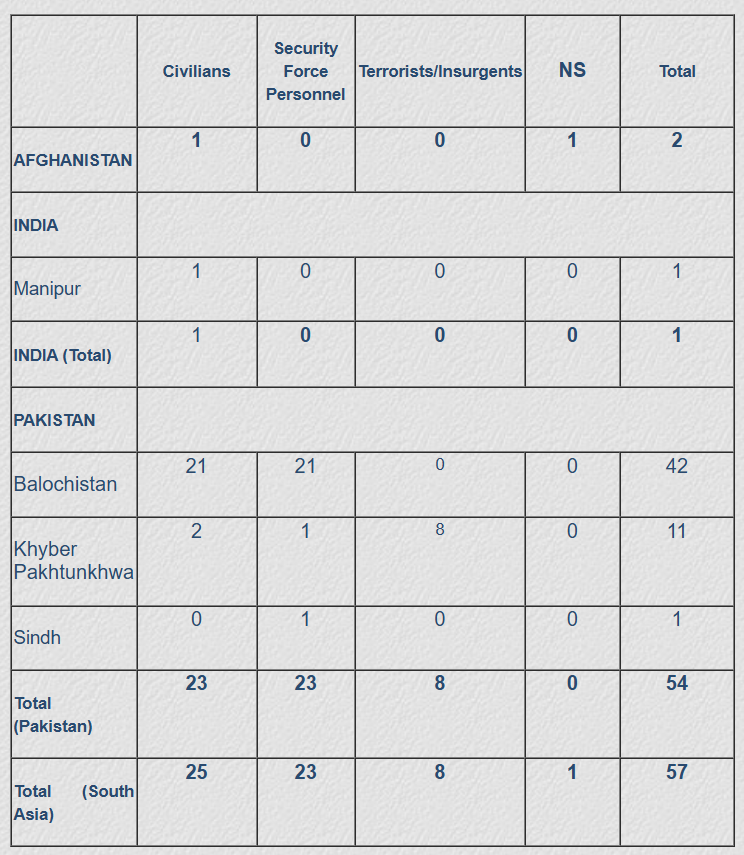
Provisional data compiled from English language media sources.