
Korean Peninsula Update, June 16, 2026
Toplines
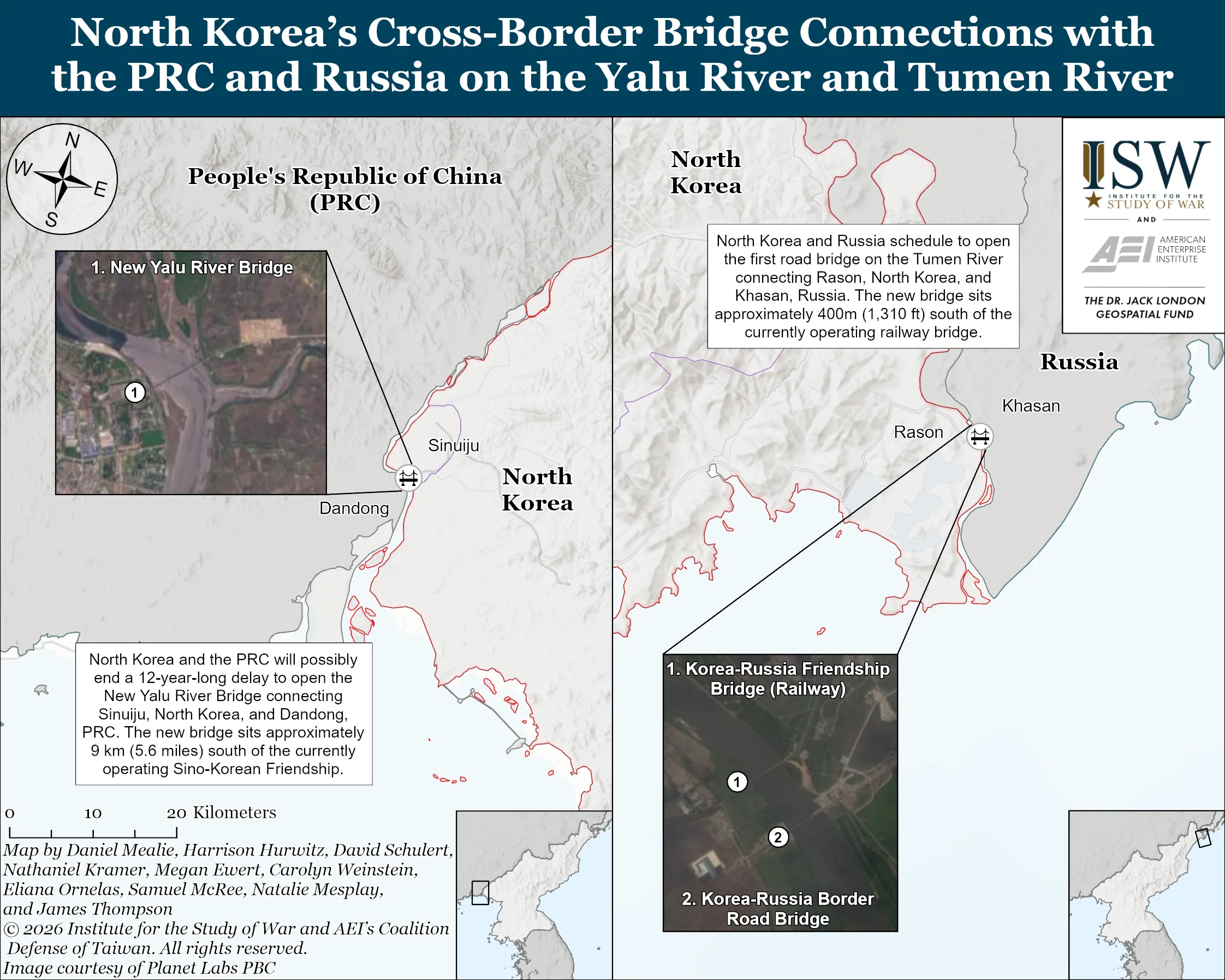
North Korea is increasing its revenue generation through trade with both the People’s Republic of China (PRC) and Russia by leveraging its heightened geopolitical importance for the two major powers. South Korea-based satellite imagery analysis firm AI Analytics (SIA) reported on June 11 that North Korea increased the number of construction vehicles and equipment stationed at the customs and immigration facilities at the New Yalu River Bridge from 40 in mid-May to 160 at the end of May.[1] SIA also noted an increase in sedans at the construction site, which could signal visits from high-ranking officials.[2] The New Yalu River Bridge spans 3km (1.88 miles) to connect Sinuiju, North Korea, with Dandong, PRC, located approximately 9km (5.6 miles) south of the currently operating Sino-Korean Friendship Bridge.[3] The two countries completed the bridge in 2014 but delayed its opening due to international sanctions on North Korea and concerns about the financial burden the bridge construction could present.[4] Chinese Communist Party (CCP) General Secretary Xi Jinping visited North Korea on June 8 and agreed to enhance bilateral “people-to-people exchanges and visits” alongside cooperation across sectors.[5] The total trade volume between the two countries reached $325.8 million in April 2026, the highest monthly figure in eight years.[6] Bilateral trade began increasing to pre-pandemic levels in late 2025, and surpassed pre-COVID levels in December 2025.[7]
Workers’ Party of Korea (WPK) General Secretary Kim Jong Un sent a congratulatory letter to Russian President Vladimir Putin on June 12 to mark Russia Day.[8] Kim emphasized that Pyongyang fully supports “Moscow’s policies and maintains an unyielding alliance with Russia.”[9] The first road bridge connecting North Korea and Russia will open on June 19.[10] The two countries appear to have deliberately designated June 19 as the opening date to celebrate the second anniversary of the Treaty on Comprehensive Strategic Partnership and display their bilateral alignment.[11] The new bridge, approximately 400m (1,310 ft) south of the existing bilateral railway bridge on the Tumen River, will provide a vital logistical cross-border connection.[12] Vladivostok-based tourism agency Vostok Intur began promoting a new tourism package travelling through the PRC, North Korea, and Russia.[13] This effort supports Russian efforts to increase tourism to North Korea. The Russian Border Service reported that 9,985 Russian nationals visited North Korea in 2025, the highest annual volume since 2010.[14]
North Korea appears intent on expanding civil and economic exchanges in addition to diplomatic and military engagement with the PRC and Russia. The new bridges over the Tumen and Yalu Rivers will enhance previously restricted cross-border logistics capabilities. The four-lane New Yalu River Bridge, in particular, will increase transport capacity significantly compared to the existing single-track and single-lane road structures.[15] Kim is likely exploiting North Korea’s increased geopolitical value for the two major powers to maximize benefits for North Korea. North Korea increased its strategic importance for Russia by exporting military equipment and deploying approximately 14,000 troops to support Russian war efforts.[16] South Korean government-affiliated think tank the Institute for National Security Strategy estimated the total value of North Korean arms supplied to Russia through 2025 at between $7 million and $13.8 million.[17] The rapid consolidation of the North Korea-Russia alliance conversely diluted the PRC’s influence over North Korea, prompting the PRC to attempt restore its leverage by resuming high-level exchanges with Pyongyang. The PRC has largely avoided sensitive topics, including denuclearization, during conversations with high-level North Korean officials, while focusing heavily on the traditional bilateral friendship.[18]
The United States, South Korea, and Japan held their first trilateral working-level meeting since the Xi-Kim summit on June 12 and held separate bilateral consultations with the United States on June 11 to counter North Korean efforts to claim its “irreversible” nuclear status. The United States, South Korea, and Japan expressed “serious concern” over North Korea’s nuclear and missile development programs and reaffirmed their commitment to the complete denuclearization of North Korea.[19] The United States and South Korea on June 11 separately reaffirmed their shared goal of North Korean denuclearization during the 6th Nuclear Consultative Group (NCG) in Seoul.[20] The United States also reiterated its commitment to provide the “full range of US capabilities, including nuclear capabilities,” to deter North Korea.[21] The joint NCG statement adopted in December 2025 did not mention North Korean denuclearization.[22] The United States and Japan on June 11 rejected Russia’s claim that North Korea’s pursuit of nuclear weapons is a “settled issue” during their Extended Deterrence Dialogue (EDD) in Tokyo and called for the complete denuclearization of North Korea.[23] North Korea on June 14 stated that “the meaningful anti-[Democratic People’s Republic of Korea] denunciations and coordinated nuclear threats by the United States and its followers” cannot impact North Korea’s “irreversible” status as a nuclear weapons state.[24]
The United States-South Korea-Japan meeting marked the first trilateral commentary on North Korea since CCP General Secretary Xi Jinping met with WPK General Secretary Kim Jong Un from June 8 to 9. The three countries likely aimed to rebuff North Korea’s efforts to consolidate its nuclear status amid increasing Russian and PRC support. The NCG and EDD also served to reassure US commitments to extended deterrence against North Korean nuclear threats. South Korea’s participation in these dialogues and joint statements is noteworthy given Lee Jae Myung’s reticence to act in ways that could incite protest from North Korea. South Korean President Lee Jae Myung and Japanese Prime Minister Sanae Takaichi also paid each other reciprocal visits in 2026.[25] The Lee administration’s management of its relations with Japan may reflect a view that near-term inter-Korean engagement remains unlikely. The United States-South Korea-Japan trilateral coordination may strengthen in response to Russian and PRC recognition of North Korea’s nuclear program.
Key Takeaways
North Korea-Russia-PRC Relations: North Korea is continuing to exploit its relationship with Russia and the PRC to continue its economic growth. North Korean infrastructure projects connecting North Korea, Russia, and the PRC could facilitate additional trade and logistics cooperation between the three states.
Trilateral Counter-North Korea Cooperation:  The United States, Japan, and South Korea issued a joint statement calling for North Korean denuclearization during their trilateral meeting on June 12. South Korea’s inclusion in the joint statement may reflect assessments that inter-Korean dialogue remains unlikely at present, thus making trilateral cooperation and united policy statements essential.
North Korean Domestic Politics
Nothing significant to report.
North Korean Military Developments
Nothing significant to report.
North Korean Foreign Relations
High-level Russian-North Korean cooperation is continuing. A North Korean economic delegation led by North Korea Minister of External Economic Relations Yun Jong Ho attended the St. Petersburg International Economic Forum (SPIEF) in Russia and attended the international exhibition “Belagro-2026” in Minsk, Belarus, between May 29 and June 8.[26] This does not appear to be the first time North Korean officials have attended the SPIEF, but North Korea’s attendance appears to be a relatively new phenomenon, with a previous delegation sent in 2024 and North Korea’s ambassador to Russia Sin Hong Chol attending in 2022.[27] PRC Vice President Han Zheng was also in attendance at the SPIEF and is reported to have met with Russian President Vladimir Putin, who is reported to have said that Russia-PRC relations were at an “unprecedentedly high level.” There were no publicly scheduled meetings between the PRC, North Korea, and Russian representatives at the SPIEF, but it is possible there could have been some level of non-public coordination or meetings while they were all in attendance.
Chairman of the Russian Duma Vyacheslav Volodin stated that the Duma demanded that international sanctions against North Korea, Cuba, and Iran, be lifted during a Duma plenary session to remove obstacles to state development.[28] Volodin further expressed Russian opposition to new obstacles to the PRC’s development that have been introduced, without detailing the “obstacles” or those responsible.[29] Russian state media additionally published several articles about WPK General Secretary Kim Jong Un’s annual telegram to Russian President Vladimir Putin, congratulating him on Russia Day.[30] The telegram emphasized that North Korea and Russia are “opening a new page of history,” with Kim saying that his “unwavering will and position” is to “consistently support the domestic and foreign policy of Moscow, and to always stand together with Russia.”[31]
These latest events conclude a period of significant, high-level bilateral meetings among Russia, North Korea, and the PRC, including direct, bilateral meetings between the leaders of all three countries. The SPIEF is known as a conduit for Russia to strengthen political and economic ties with participating countries, particularly amidst sanctions enacted after the 2022 invasion of Ukraine.[32] North Korea has experienced significant economic growth since 2022, largely due to its partnerships with Russia and the PRC.[33] Continued high-level engagement could sustain this growth.
North Korea is importing and exporting raw materials and military goods in violation of international sanctions. Bilateral trade with Russia and the PRC has surged in recent years.[34] United Nations (UN) Security Council resolution 2371 entirely prohibits member countries from procuring coal from North Korea.[35] South Korea’s opposition People Power Party (PPP) Representative Yu Yong-weon issued a statement declaring that North Korea illegally exported approximately 1.5 million tons of coal in 2025, using foreign-flagged ships and falsely labeling its exports as being of Russian origin.[36] Yu stated that North Korea is importing refined oil at over seven times the UN sanctions cap of 500,000 barrels per year. Yu stated that North Korea is also in violation of UN regulations by exporting other minerals, such as iron ore, and exchanging military equipment with Russia.[37]
The United States, Japan, South Korea, and seven other countries issued a joint statement on May 30 to “examine information regarding violations” and take action against vessels involved in North Korean sanctions evasions, specifically citing illegal exports of coal and iron ore.[38] The PRC and Russia are North Korea’s largest trading partners, and both countries oppose sanctions on North Korea. The PRC and Russia issued a joint statement in May 2026 that explicitly expressed opposition to sanctions or military pressure on North Korea.[39] The international sanctions are intended to prevent North Korea from generating foreign revenue to fund its nuclear weapons and ballistic missile programs.[40] North Korea is legally allowed to export some raw materials, however, and the PRC General Administration of Customs figures show that PRC imports of North Korean tungsten from January to April 2026 increased over 13-fold compared to the same period in 2025.[41] North Korea exported $75.17 million worth of tungsten to the PRC from January to April 2026, overtaking hair-related products as the country’s most valuable export.
North Korean Cognitive Warfare
Nothing significant to report.
Inter-Korean Relations
The South Korean Ministry of Unification (MOU) may be pursuing alternate strategies encouraging inter-Korean exchange amid continued North Korean rejections of South Korean diplomatic outreach. The South Korean Jeju provincial government sent $105,000 worth of medical supplies, pest control equipment, and Jeju tangerine seedlings to North Korea via Dalian, PRC in March.[42] Jeju’s actions marked the resumption of the Jeju North Korean aid project since the Moon Jae-in administration.[43] Jeju provided aid to North Korea from 1999 to 2010, with additional aid packages being delivered in 2018 and 2021.[44] This instance represents the first inter-Korean exchange since WPK General Secretary Kim Jong Un proclaimed his “hostile two-state relations” policy in 2023.[45] Director-General of Jeju Tourism and Cultural Exchange Kim Yang-bo stated on June 8 that Jeju and North Korea agreed to cooperate in the medical sector and expand their tourism connections.[46] Jeju officials estimated that cargo arrived in North Korea on May 4, although Pyongyang did not acknowledge the shipment or issue an official response.[47] This humanitarian project began in November 2025 when Jeju Governor Oh Young-hoon requested the MOU’s cooperation and the PRC’s support.[48] Japanese media outlet Kyodo News claimed that Oh and a Jeju delegation met with North Korean operative Ri Ho-nam in Beijing in February.[49] Ri oversaw an informal inter-Korean communication channel since the 1990s and was previously involved in past inter-Korean summit negotiations and in South Korean corporate remittance scandals.[50] Jeju officials declined to confirm whether Oh met with Ri.[51] MOU Spokesperson Yoon Min-ho denied that this aid is part of a Lee administration official policy on June 8, despite MOU approval of the project.[52] Yoon added that local governments constitute separate legal entities from the central administration.[53]
Jeju’s aid, delivered with MOU approval, may align with the MOU’s broader strategy to expand indirect inter-Korean exchanges, in line with its “peaceful coexistence” policy. The MOU also likely views unofficial communication channels with North Korean figures as a functional alternative while the official bilateral lines remain severed. Jeju may also intend to expand general exchanges with Pyongyang in line with its cooperative agreements with North Korea. North Korean national and UN Educational, Scientific, and Cultural Organization (UNESCO) Chief of Section of Education Policy Gwang Chol Chang will attend the annual Jeju Forum, which is co-hosted by South Korean Foreign Ministry and Jeju Province.[54] The South Korean central government and Jeju government clarified that Chang would attend strictly as a UNESCO official, irrespective of his North Korean nationality.[55] Jeju likely hopes to use this opportunity to maintain an indirect dialogue channel, although Chang will likely treat South Korea as a foreign state in accordance with Pyongyang’s “hostile two-state relations” policy. North Korea will likely exploit Seoul’s diplomatic overtures to enforce its demands and secure the immediate material it needs, while continuously refusing to engage in high-level dialogue.
South Korean Domestic Politics
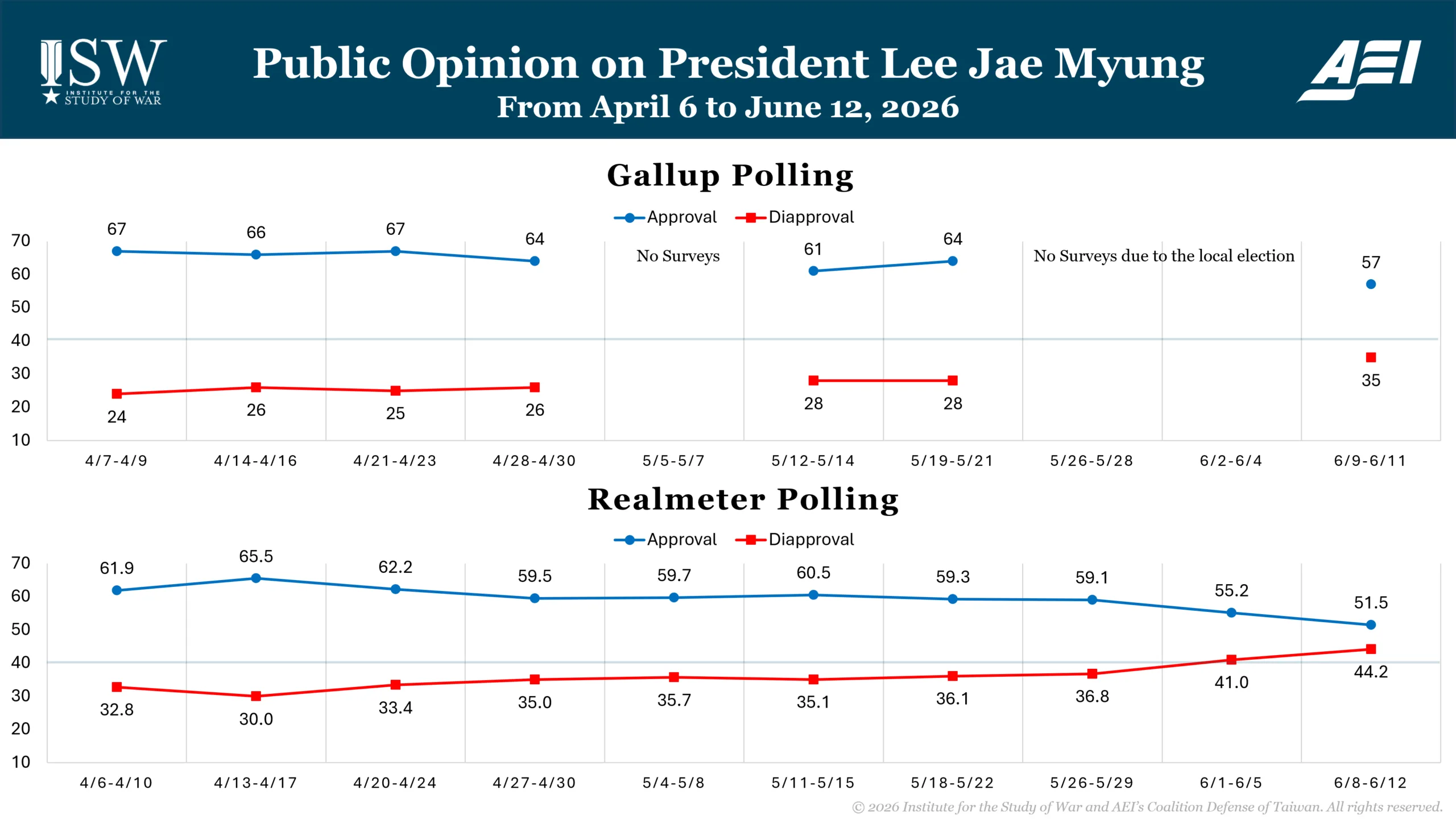
South Korean President Lee Jae Myung is facing a decline in support despite the ruling Democratic Party (DP) victories during the June 3 local elections. Lee’s approval ratings likely dipped in the second week of June primarily due to the political fallout and controversies surrounding the June 3 local elections. Realmeter reported that Lee’s approval rating dropped to 51.5 percent; a 3.7 percentage point decrease from the first week of June.[56] Lee’s disapproval rating, conversely, rose by 3.2 percentage points to 44.2 percent.[57] Realmeter attributed this decline largely to South Korea’s recent economic downturn, which has included a higher currency exchange rate and inflation.[58] The Korean Won to US Dollar exchange rate has risen steadily over the past year, peaking at 1,559.5 won to one US dollar on June 5, an increase from the 1,363.5 won to one US dollar rate recorded at the time of Lee’s inauguration a year ago.[59] This marks the highest exchange rate since March 10, 2009, when exchange rates reached 1,561 won to one US dollar, during the global economic crisis triggered by the subprime mortgage market.[60] This trend could further decrease Lee’s approval ratings if the low value of Korean Won increases import market prices.
Realmeter also noted that public backlash over the National Election Commission’s (NEC) mismanagement of the June 3 local elections heightened public pressure on the Lee administration to account for its actions.[61] The NEC prepared ballots for only 50 percent of the total eligible voters at 91 polling stations, heavily impacting and delaying the Seoul mayoral election, in particular.[62] The incident triggered a conservative protest against the NEC, as these ballot shortages occurred mostly in conservative strongholds.[63] The conservative opposition People Power Party (PPP) is expanding its political offensive to condemn the administration’s election management failures.[64] Lee posted on X (formerly Twitter) on June 10 that he accepts the public’s judgment regarding his declining approval ratings, appearing to acknowledge the rising negative trend based on economic and political events.[65] Realmeter also reported that a cross-over phenomenon in party support ratings occurred for the first time since Lee’s inauguration in June 2025.[66] Realmeter stated that support for the ruling DP fell to 38 percent from last week’s 41.8 percent, while the opposition PPP rose 3.2 percentage points to 44.3 percent.[67] Gallup also reported declining approval ratings for both Lee and the DP, though the PPP’s ratings have not yet overtaken the DP.[68]
Counter-North Korean Coalition Building Efforts
South Korean President Lee Jae Myung joined European Union (EU) leaders in condemning North Korea, marking the strongest statement by Lee toward North Korea to date and signaling pushback against PRC and Russian support for the Kim regime. The June 10 South Korea-EU joint statement condemned North Korea’s support for Russia’s war in Ukraine and called for the immediate halt of North Korea’s nuclear and missile programs.[69] Lee and the European leaders reaffirmed their commitment to the denuclearization of North Korea.[70] The statement emphasized that substantive improvements in North Korea’s human rights situation are essential and urged Pyongyang to grant international and humanitarian organizations access to North Korea.[71] North Korea on June 13 denounced the South Korea-EU joint statement as a violation of its sovereignty and described the Lee administration’s policy of “peaceful coexistence” as a “façade.”[72]
The language of the joint statement appears softer than that of the 2023 version issued under the Yoon Suk-yeol administration. The 2023 joint statement explicitly called for the “complete, verifiable, and irreversible denuclearization (CVID)” of North Korea and described the regime’s missile launches as “illegal” and “reckless.”[73] The 2026 joint statement referred to the “complete denuclearization” of North Korea and expressed “serious concern” about North Korean missile programs.[74]
The language in the statement represents the Lee administration’s strongest condemnation of North Korea since it took office in June 2025, however. Lee has prioritized diplomatic outreach and de-escalatory measures to initiate engagement with North Korea. South Korea’s MOU has reduced its emphasis on North Korean human rights issues consistent with this approach, including by decreasing the number of references to “human rights” in the 2025 Unification White Paper compared with previous editions, likely to avoid provoking a negative response from North Korea.[75] This shift comes as both Russia and the PRC have increased their support for North Korea, most recently reflected by the May 16 Russia-PRC joint statement calling for the removal of Western sanctions on the regime and CCP General Secretary Xi Jinping’s June 8-9 state visit to Pyongyang.[76] Lee likely assesses that near-term engagement with North Korea remains difficult and may view closer alignment with the broader international consensus less costly for South Korea. The statement does not necessarily indicate a policy change, however, as the MOU continues to pursue alternative avenues of engagement and seeks to reopen channels of communication with the regime.[77]