
ZUF-NSCN-IM: Fractured Peace
The resurgence of armed confrontations between the Zeliangrong United Front (ZUF) and the National Socialist Council of Nagalim-Isak-Muivah (NSCN-IM) signals the re-emergence of one of Manipur’s most enduring intra-Naga rivalries. Although both organisations remain engaged in separate peace processes with the Government of India (GoI), recurrent gunfights across Tamenglong, Noney and Kangpokpi Districts indicate that negotiated arrangements have done little to resolve competing territorial claims and political rivalries on the ground. Rather than representing isolated incidents, the recent clashes reflect a broader pattern of persistent armed competition that continues to undermine stability in western Manipur.
The latest confrontation occurred on July 5, 2026, when suspected cadres of NSCN-IM and the Zeliangrong United Front-Kamson (ZUF-K) allegedly attacked Thingkhongjang, a Kuki village in Kangpokpi District, Manipur, injuring two civilians and setting several houses ablaze. The injured were identified as Lamneingah Kipgen (8) and Nengneichong Kipgen (56), both of whom sustained bullet injuries. While local residents alleged the involvement of NSCN-IM and ZUF-K cadres, Security Forces (SFs) had not officially confirmed the identity of the attackers.
The July 5, attack followed another major confrontation on June 26, 2026, when suspected cadres of ZUF-Jenchui Kamei faction (ZUF-JK) and NSCN-IM exchanged fire at Kaiphundai Village under the Tousem Police Station in Tamenglong District, after NSCN-IM cadres allegedly ambushed a ZUF-JK hideout. The gun battle reportedly lasted around 30 minutes, forcing villagers to flee and disrupting traffic along the strategically significant Imphal-Jiribam Highway, before SFs restored order. Although no casualties were reported, the incident highlighted the continued operational capability of both organisations despite their respective peace engagements.
The exchange of fire triggered a fresh war of words between the two rival outfits. On June 28, 2026, NSCN-IM accused ZUF-JK of violating the Cessation of Operations (CoO) Agreement by attacking its cadres, extorting commuters along National Highway-37 in Tamenglong District, and failing to return to its designated camp after the March 20, 2026, clash. Rejecting accusations of any provocation on its part, NSCN-IM maintained that its cadres had fired only warning shots on June 26, and alleged that ZUF-JK was acting as a proxy of GoI.
The June 26, encounter was only the latest in a series of clashes that have accelerated since late 2024. On March 20, 2026, cadres of the two outfits exchanged fire at the same Kaiphundai village. Eleven days earlier, on March 9, suspected cadres of NSCN-IM and the ZUF-JK fought for nearly an hour at Taodaijang village under the Khoupum Police Station in Noney District, compelling residents to seek shelter in safer locations. A video circulating on social media later purportedly showed ZUF cadres occupying a strategic NSCN-IM camp, underscoring the increasingly territorial character of the rivalry.
The conflict has simultaneously acquired wider security implications. On June 13, 2026, a Kuki village volunteer was killed near Lasan Kuki-Zo village in Kangpokpi District. Local organisations alleged the involvement of cadres belonging to NSCN-IM and ZUF-K, though official confirmation remained unavailable. Just days earlier, on June 5, 2026, three civilians were killed and seven houses were burned in Loibol Khullen village in Kangpokpi. Kuki organisations accused NSCN-IM and ZUF-K of carrying out the attack. While investigations continue, such allegations suggest that the long-running ZUF-NSCN-IM rivalry is increasingly intersecting with Manipur’s wider ethnic conflict, raising the possibility that intra-Naga militant competition could acquire broader communal dimensions.
The growing insecurity also triggered a strong public response from the Kuki-Zo community. On July 4, 2026, thousands of people participated in a protest rally organised by the Committee on Tribal Unity (CoTU) in Kangpokpi District, demanding stronger security measures and action against NSCN-IM and ZUF. CoTU blamed the two outfits for the recent attacks on Kuki-Zo villages, including Phaimol in Kamjong District on July 1, and Leikot in Noney District on July 2, and urged the State and Union Governments to review the operational freedom accorded to NSCN-IM under the ceasefire arrangement.
According to partial data compiled by the South Asia Terrorism Portal (SATP), since the formation of ZUF on February 25, 2011, at least 30 armed confrontations have taken place between ZUF and NSCN-IM, resulting in 42 fatalities, including 20 ZUF cadres, 15 NSCN-IM cadres, six militants whose organisational affiliation could not be established, and one civilian caught in the crossfire. After witnessing four fatal encounters during 2023, the rivalry entered another active phase from 2024 onwards. Eight additional confrontations were reported between March 2024 and June 2026, indicating that while recent engagements have generally produced fewer fatalities, both organisations continue to retain the capacity and intent to employ violence in pursuit of territorial and political objectives.
The geographical spread of the violence is equally significant. While earlier confrontations were concentrated largely in Tamenglong District, recent incidents have increasingly occurred across Noney and Kangpokpi, reflecting an expansion of the conflict zone. The repeated disruption of movement along the Imphal-Jiribam Highway, one of Manipur’s principal supply routes, further demonstrates that the implications of the rivalry extend well beyond the immediate areas where gunfights occur.
Unlike many insurgent rivalries driven primarily by personal leadership disputes, the conflict between ZUF and NSCN-IM is rooted in competing political visions. ZUF emerged in February 2011, after a group of NSCN-IM deserters joined former NSCN-K cadres to establish an organisation dedicated to protecting the interests of the Zeliangrong community inhabiting parts of Manipur, Assam and Nagaland. Rejecting the broader Naga nationalist framework advocated by NSCN-IM, the organisation demanded the integration of Zeliangrong-inhabited areas into a separate administrative arrangement within the Union of India. NSCN-IM, by contrast, has consistently pursued the objective of integrating all Naga-inhabited areas under its concept of Greater Nagalim. These competing visions have translated into an enduring struggle for political legitimacy, territorial influence and organisational dominance across Zeliangrong areas.
The rivalry has periodically produced intense violence. Some of the deadliest confrontations occurred during the early years following ZUF’s formation, including the October 2011 clash at Leishok village in Tamenglong District that reportedly killed six NSCN-IM cadres; and the September 2012 encounter in Tamenglong District in which six militants lost their lives. Although the overall intensity subsequently declined, the renewed frequency of clashes since late 2023 suggests that the underlying causes of the conflict remain unresolved.
Several developments appear to have contributed to the latest resurgence. First, both organisations continue to compete for influence over Zeliangrong-inhabited areas where questions of political representation, ‘taxation’ networks and organisational legitimacy remain contested. The competition has intensified as both groups seek to reinforce their local support bases while negotiations with the Government remain inconclusive.
Second, the prolonged nature of ongoing peace processes has created uncertainty rather than resolution. NSCN-IM has remained under a ceasefire arrangement with GoI since 1997 and continues negotiations initiated under the 2015 Framework Agreement. ZUF, meanwhile, entered into a Cessation of Operations (CoO) Agreement with the Central and Manipur Governments on December 27, 2022. Under the Agreement, the outfit agreed to renounce violence and participate in the democratic process under mutually agreed ground rules.
The CoO Agreement, however, failed to produce organisational cohesion. Within days of its signing, a dissident faction publicly rejected the surrender of arms and reaffirmed its commitment to the Zeliangrong homeland movement. The subsequent emergence of references to ZUF-K/JK in several incidents during 2026 indicates that organisational fragmentation has persisted despite the peace process. Such fragmentation has historically complicated conflict resolution across Northeast India, where agreements with one faction frequently generate breakaway organisations that reject negotiated settlements and continue armed activities.
A third factor has been the deteriorating security environment in Manipur since the outbreak of ethnic violence in May 2023. The prolonged conflict has stretched the capacities of the State’s security apparatus and weakened governmental authority across several hill districts. Under such conditions, insurgent organisations have found greater operational space to revive dormant rivalries and consolidate territorial influence. Although the ZUF-NSCN-IM conflict predates the present ethnic violence by more than a decade, the changing security environment has created new opportunities for armed mobilisation.
The allegations surrounding the June 2026 incidents in Kangpokpi illustrate the dangers of this evolving situation. If longstanding intra-Naga rivalries increasingly overlap with the wider Meitei-Kuki conflict, localised militant confrontations could assume broader ethnic dimensions, further complicating security management and peace-building efforts. Such developments would represent a significant deterioration from earlier years, when the conflict largely remained confined to competition between rival insurgent organisations.
The persistence of armed confrontation also raises important questions regarding the implementation of ceasefire and CoO arrangements. While such agreements have undoubtedly contributed to a substantial decline in insurgent violence across the Northeast, they have frequently allowed participating organisations to retain armed structures, preserve command hierarchies and maintain influence over local populations. Consequently, rival groups continue to possess the capability to engage in armed confrontation despite their formal participation in peace negotiations.
The ZUF-NSCN-IM rivalry exemplifies this contradiction. Nearly three decades after NSCN-IM entered into a ceasefire with GoI and more than three years after ZUF signed its CoO Agreement, both organisations continue to engage in periodic armed clashes. The recurrence of such incidents indicates that the enforcement of agreed ground rules remains inconsistent and that existing monitoring mechanisms have been insufficient to prevent renewed violence.
The renewed confrontation between ZUF and NSCN-IM illustrates a broader challenge confronting conflict management in India’s Northeast. The Government has achieved considerable success in reducing the overall intensity of insurgency through sustained security operations and negotiated settlements. Nevertheless, the persistence of violent competition among organisations participating in peace processes demonstrates that ceasefire agreements alone cannot resolve deeply embedded political disputes or dismantle rival militant infrastructures. As long as armed groups retain weapons, preserve parallel organisational structures and continue to compete for territorial and political influence, periodic outbreaks of fratricidal violence are likely to persist. The recurring clashes across western Manipur thus serve as a reminder that durable peace will ultimately depend not only on negotiated agreements, but also on effective disarmament, rigorous enforcement of ground rules and credible political settlements capable of addressing the competing aspirations that continue to fuel armed mobilisation.
The First 100 Days – Promise, Pace and a Test of Governance
On March 27, 2026, President Ram Chandra Paudel appointed Balendra ‘Balen’ Shah Prime Minister following the Rastriya Swatantra Party’s (RSP) decisive victory in the March 5, 2026, parliamentary elections. On the same day, Shah unveiled a 15-member Cabinet, the smallest in recent years, comprising largely first-time ministers and technocrats. The Government emerged from the political upheaval triggered by the September 2025 Gen-Z protests, which culminated in the collapse of the preceding administration amid widespread public anger over corruption, unemployment, governance failures and chronic political instability. Riding a near two-thirds parliamentary majority and unprecedented public goodwill, the Shah Government entered office promising to dismantle entrenched patronage networks, restore administrative accountability and redefine governance through transparency, technological innovation and institutional reform. The completion of its first 100 days on July 5, 2026, provides an opportunity to assess whether these promises have translated into measurable institutional change or remained largely declaratory.
Unlike its predecessors, whose tenure was dominated by coalition bargaining and frequent cabinet reshuffles, the Shah administration did not face an immediate struggle for political survival. Instead, its principal challenge lay in converting the political legitimacy acquired through the Gen-Z movement into durable institutional reform. The Government moved quickly to distinguish itself from previous administrations by projecting administrative discipline, fiscal restraint and decisiveness. At its first Cabinet meeting on March 27, 2026, it approved a 100-point governance roadmap, prioritising bureaucratic rationalisation, digitalisation of public services, restructuring of public institutions, implementation of the recommendations of the Gauri Bahadur Karki Commission into the September 2025 violence, and merit-based appointments across the civil service. The smaller Cabinet itself was projected as a break from Nepal’s long-standing practice of accommodating coalition partners through oversized ministries and politically negotiated portfolios.
Three months later, however, implementation remained uneven. While ministries announced reforms in passport issuance, driving licences, online grievance redressal and digital public services, many initiatives remained confined to policy announcements or pilot implementation. Proposals to reduce the number of ministries, restructure public enterprises and depoliticise the civil service required legislative amendments and administrative restructuring that had yet to commence. Even where improvements were visible – such as extended office hours in selected government departments and faster delivery of certain administrative services – they reflected incremental administrative adjustments rather than systemic transformation. Consequently, the Government’s first 100 days were characterised less by institutional restructuring than by the articulation of an ambitious reform agenda.
The administration’s anti-corruption campaign nevertheless emerged as the defining feature of its first 100 days. Acting on the recommendations of the Gauri Bahadur Karki Commission, Police arrested former Prime Minister K.P. Sharma Oli from his residence in Gundu, Bhaktapur, and former Home Minister Ramesh Lekhak from Suryabinayak, Bhaktapur, on March 28, 2026, in connection with culpable homicide charges arising from the alleged suppression of the September 2025 Gen-Z protests. Investigations were also initiated against several politicians, former ministers and businesspersons over allegations of corruption, abuse of office and money laundering, while the Government ordered reviews of major public procurement decisions taken under previous administrations, including the controversial electronic passport contract. Collectively, these measures reinforced RSP’s image as a political force prepared to confront entrenched political interests that successive governments had largely avoided.
The campaign, however, also generated concerns regarding executive overreach. The Nepali Congress (NC) and the Communist Party of Nepal-Unified Marxist-Leninist (CPN-UML) described the arrests of Oli and Lekhak as politically motivated, arguing that the Government had sought to secure political advantage through executive action before judicial processes had run their course. Courts subsequently ordered the release of Oli, Lekhak, and former Energy Minister Deepak Khadka, strengthening opposition claims that due process had been compromised. Criticism also extended beyond Parliament. Editorials in Nepali Times, including 100 Days of Balenism (June 26, 2026) and Performance vs Process (June 27, 2026), argued that the increasing reliance on ordinances, pressure on constitutionally independent institutions during the passport procurement investigation, and the concentration of decision-making within the Prime Minister’s Office risked weakening the rule of law and institutional accountability that the Government itself had pledged to strengthen. The debate thus shifted from whether corruption should be investigated to whether anti-corruption could legitimately be pursued at the expense of constitutional process.
These concerns increasingly dominated parliamentary proceedings. On May 14, 2026, legislators from the NC and the CPN-UML repeatedly obstructed proceedings in the House of Representatives (HoR) after Prime Minister Shah declined to respond personally to debates on the Government’s annual policy and programme. Opposition leaders accused the Prime Minister of avoiding parliamentary scrutiny despite enjoying a commanding legislative majority. NC President Gagan Thapa argued that electoral legitimacy could not substitute for constitutional accountability and cautioned against confusing popular support with executive authority. Opposition members similarly criticised the Government’s growing reliance on ordinances, contending that executive convenience was replacing legislative deliberation despite the absence of coalition constraints. The repeated disruptions reflected a broader political strategy aimed at reframing the debate from corruption and administrative reform to constitutional governance and institutional accountability.
The Government also confronted early challenges to its own reformist credentials. On April 9, 2026, Labour Minister Deepak Sah resigned following allegations that he had used his office to facilitate the continuation of his wife, Junu Shrestha, on the Health Insurance Board. Acting on the recommendation of the RSP’s Central Disciplinary Commission, which concluded that Sah had violated party rules governing the misuse of public office, Prime Minister Shah accepted his resignation. Less than two weeks later, on April 22, 2026, Home Minister Sudan Gurung came under scrutiny over his alleged links with controversial businessman Deepak Bhatta, who is under investigation for money laundering. Although neither controversy threatened the Government’s parliamentary majority, both dented the RSP’s carefully cultivated image as an uncompromising anti-corruption movement. They also demonstrated that the standards of accountability the Government sought to impose upon Nepal’s traditional political parties would inevitably be applied to its own leadership.
The Government’s commitment to accountability was itself subjected to institutional scrutiny during the review period. On July 1, 2026, the National Human Rights Commission (NHRC) sought clarification from RSP following media reports that party memberships had allegedly been issued to persons below the age of 18. In a statement issued the same day, the Commission disclosed that it had formally written to the party seeking an explanation and relevant records after taking cognisance of the reports. Although the inquiry remains inconclusive, the episode underscored that the standards of transparency and legal compliance advocated by the RSP would increasingly be tested against its own organisational practices. More broadly, it reflected the willingness of constitutional oversight bodies to subject the new political establishment to the same level of scrutiny traditionally reserved for Nepal’s mainstream parties.
The Shah Government also initiated a series of politically significant proposals aimed at restructuring the state. At the RSP’s General Convention in June 2026, the party endorsed a comprehensive constitutional reform agenda, including the abolition of provincial governments established under the 2015 Constitution, arguing that the existing federal structure had generated administrative duplication, fiscal burdens and overlapping jurisdictions without substantially improving governance. The proposal, while consistent with RSP’s longstanding advocacy for a leaner state, immediately triggered criticism from federalist parties, constitutional experts and provincial leaders, who argued that dismantling provincial institutions would require extensive constitutional amendments and risk reopening debates that had largely been settled following the promulgation of the Constitution. Although no legislative initiative have yet been introduced, the proposal highlighted the Government’s willingness to challenge fundamental features of Nepal’s post-2015 constitutional settlement.
Foreign policy, by contrast, reflected continuity tempered by cautious recalibration. The Shah Government avoided any formal departure from Nepal’s long-standing policy of maintaining balanced relations with India and China. Nevertheless, its diplomatic style differed noticeably from previous administrations. Unlike successive CPN-UML and Communist Party of Nepal-Maoist Centre (CPN-Maoist Centre) governments, which cultivated close party-to-party ties with the Communist Party of China (CPC) alongside official diplomatic engagement, the RSP government largely confined its interaction with Beijing to state institutions, reflecting both the party’s non-ideological orientation and the absence of historical political linkages with the CPC. Chinese interest in the new dispensation was evident even before the Government assumed office, when a CPC delegation visited Kathmandu on March 17, 2026, to assess the evolving political situation and prospects for bilateral cooperation. Beijing subsequently congratulated RSP on its electoral victory and reiterated its willingness to deepen bilateral relations, but also adopted a cautious approach towards a government whose foreign-policy priorities remained uncertain.
This caution was particularly evident in relation to the Belt and Road Initiative (BRI). During Foreign Minister Shishir Khanal’s visit to Beijing (June 14 to 17, 2026), Nepal reaffirmed its commitment to expanding bilateral cooperation; however, the Nepali readout omitted any reference to the BRI, despite the Chinese side reiterating its readiness to advance “high-quality” BRI cooperation. No major Chinese-funded infrastructure projects were approved, accelerated or cancelled during the Government’s first 100 days, nor did Kathmandu initiate any review of ongoing projects inherited from previous administrations. Beijing also refrained from commenting publicly on the arrests and investigations involving senior UML and Maoist leaders, treating the developments as Nepal’s internal affairs, while prioritising continuity in bilateral relations over established political partnerships. Taken together, these developments suggest not a strategic shift away from China, but an effort to de-politicise Nepal-China relations by replacing party-centric engagement with a more institutional state-to-state framework.
The Government’s approach towards India similarly displayed continuity, though accompanied by a more assertive diplomatic style. Kathmandu reiterated its commitment to maintaining close cooperation with New Delhi across trade, connectivity and security while simultaneously emphasising greater policy autonomy and sovereign equality in bilateral engagement. Prime Minister Shah’s preference for institutional rather than personality-driven diplomacy, including his reluctance to follow established conventions of frequent bilateral political engagement during the Government’s initial months, generated considerable media speculation in both countries. Nevertheless, no substantive deterioration occurred in bilateral cooperation. Existing mechanisms relating to cross-border infrastructure, trade and energy continued to function, indicating that stylistic changes in diplomacy had not translated into a fundamental reorientation of Nepal’s foreign policy.
Beyond individual policy initiatives, the Shah Government’s first 100 days may signify a broader transition in Nepal’s political evolution. For nearly three decades, successive governments derived their legitimacy from coalition arithmetic, historical political movements and elite accommodation. By contrast, RSP has sought to derive legitimacy primarily from administrative performance, anti-corruption and direct public engagement. This represents a significant departure in the basis of political authority. At the same time, the administration has increasingly concentrated political decision-making within the Prime Minister’s Office, relied extensively on executive directives and ordinances, and demonstrated limited tolerance for institutional delay. While these methods have accelerated decision-making, they have also generated concerns regarding the erosion of parliamentary deliberation, judicial oversight and constitutional safeguards. The central tension of the Government’s first 100 days, therefore, lies not between reform and continuity, but between administrative expediency and institutional process.
Overall, the Shah Government has unquestionably altered the tone and pace of governance in Nepal. Compared to its predecessors, it has demonstrated greater political coherence, administrative urgency and a willingness to confront entrenched political interests. Equally, however, many of its flagship reforms remain at the level of policy declaration, while several high-profile interventions have generated sustained parliamentary, judicial and civil society scrutiny. The Government’s principal achievement during its first 100 days has therefore been to reshape Nepal’s political discourse rather than its institutions. Whether this marks the beginning of durable democratic renewal or the emergence of a more centralised model of executive governance will depend, not on the speed with which reforms are announced, but on the extent to which they are implemented through transparent institutions, constitutional safeguards and the rule of law. That question is likely to define Nepal’s political trajectory well beyond the Shah Government’s first 100 days.
Jamaat-e-Islami: Political Belligerent
On June 29, 2026, eight people were injured in a clash between leaders and activists of the Bangladesh Nationalist Party (BNP) and Jamaat-e-Islami (JeI) and its student’s body Islami Chhatra Shibir (ICS), in the Jundah Bazar area of the Barisal Union in the Palashbari Sub-District of Gaibandha District.
On June 11, 2026, a clash took place between BNP and JeI leaders and activists over the occupation of a commercial area in the Chhota Shimultala paan market of the Palashbari Municipality in the Palashbari Sub-District of Gaibandha District.
On June 2, 2026, BNP worker Rana Mia was stabbed to death by Mohammad Mahin, the son of a JeI leader, Mofidul Islam, at Madhyapara village in Char Ishwardia, Mymensingh District. Mofidul Islam is a member of the executive committee of the Mymensingh Metropolitan Jamaat.
On May 20, 2026, three people were injured in a clash between BNP and JeI leaders and activists in the Purbadhala Sub-District of Netrokona District, over the leasing of temporary Qurbani (Eid-ul-Azha) cattle markets.
On May 17, 2026, clashes took place between the Chhatra Dal, the BNP’s students wing, and ICS-backed students at the Dhaka University of Engineering and Technology (DUET) campus in Gazipur District, over the appointment of Professor Mohammad Iqbal of Shahjalal University of Science and Technology as the new Vice-Chancellor (VC) of DUET. At least 20 people from both sides, as well as the Police, were injured in the clash.
On April 23, 2026, cocktail bomb explosions occurred, along with clashes and chases, between leaders and activists of Chhatra Dal and ICS, over dominance at the Ishwardi Government College in Pabna District. Several people, including Ishwardi Government College Chhatra Dal President Khalid Bin Parthib, were injured.
On April 21, 2026, a clash occurred between leaders and activists of Chhatra Dal and ICS at Government City College in Chittagong District, injuring at least 20 people.
On March 31, 2026, there was an incident of shooting at the house of Mohammad Mohsin, General Secretary of the Chittagong South District Chhatra Dal, in the Kanchana area of Satkania Sub-District in Chittagong District, led by Abu Taher, the JeI Chief of the Union.
The latest monthly report of the Human Rights Support Society (HRSS), released on July 2, 2026, for the month of June 2026, noted that nine people were killed and 346 injured in 58 incidents of political violence across the country in June, among which eight BNP-Jamaat clashes killed two people and injured 36.
Apart from violent clashes with BNP members and its student’s body, the Jamaat has continued with its process of consolidation as a potent socio-political and religious body.
As reported on May 20, 2026, Jamaat is stepping up the activities of its youth unit across Bangladesh, to strengthen its organisational base among young people and increase their involvement in political and social initiatives. As part of this effort, Jamaat reconstituted the committee of its Dhaka North Metropolitan Youth Unit on May 19, 2026. Within Jamaat, however, members of ICS traditionally move directly into the parent party after their student years. As a result, party activists have long argued for expanding the role of the youth unit as an intermediate platform for the entry of young people into the party.
Earlier, Jamaat backed organisations did win a number of crucial university elections, showcasing the party’s successful youth outreach. On September 10, 2025, in the Dhaka University Central Students’ Union (DUCSU) election, the ICS-backed United Students’ Alliance secured 23 out of 28 seats. On September 16, 2025, ICS won its second significant victory in the Jahangirnagar University Central Student Union polls, securing 20 of 25 seats. In the Chittagong University Central Students’ Union (CUCSU) election on October 15, 2025, the ICSp-backed panel won 24 out of 26 posts, including Vice President and General Secretary. On October 16, 2025, in the Rajshahi University Central Students’ Union (RUCSU) election, the ICS-backed panel swept the polls, securing 20 out of 23 central posts, including the Vice President and General Secretary positions.
It is useful to recall that, following the results of the 13th National Elections, declared on February 13, 2026, the Jamaat’s altered position in Bangladeshi politics became dangerously prominent. Once a marginal parliamentary force, the Jamaat emerged as the main opposition. Out of 297 results declared, the BNP-led alliance won 212, with BNP alone winning 209 seats, and the Gano Odhikar Parishad, the Bangladesh Jatiya Party (BJP) and the Ganosamhati Andolan securing one seat each. The Jamaat-e-Islami-led alliance secured 77 seats, with JeI winning 68, the National Citizen Party (NCP) six, Bangladesh Khelafat Majlis two, and Khelafat Majlis one. Crucially, nearly 39 per cent of Jamaat’s victories, or 26 seats in total, came from BNP and Awami League strongholds, 14 in BNP bastions and 12 in Awami League citadels.
Moreover, the Jamaat’s central leadership questioned this result and tried to provoke public outrage over alleged rigging. In one such statement, on June 20, 2026, JeI Chief Shafiqur Rahman alleged widespread irregularities in the national election:
We don’t want disorder in the country… With immense pain in our hearts, we accepted the election results. But let no one think that we accepted them out of fear; we did so to prevent the country from descending into a civil war… We will not be intimidated by anyone’s threats. We will not bow to injustice. Our leaders, even in defeat, stood on the gallows with quiet smiles and taught us that, if necessary, we must be prepared to sacrifice ourselves for the nation.
Further, trivializing the Jamaat’s role in the 1971 genocide, the Appellate Division of the Supreme Court, in the full text of a verdict as reported on May 12, 2026, voiced ‘repentance’ over its earlier judgment, which had upheld the conviction and death sentence of Jamaat leader ATM Azharul Islam (now the elected lawmaker from Rangpur-2) in a case filed over crimes against humanity committed during Bangladesh’s 1971 Liberation War. The verdict stated,
This Division [Appellate Division] acknowledges, with a profound sense of judicial responsibility, that in its earlier adjudication, it failed to give due and dispassionate consideration to the evidentiary deficiencies and the broader context in which the allegations of crimes against humanity were framed against the appellant… The earlier judgement regrettably fell short of the high standards of scrutiny and fairness mandated in criminal proceedings of such grave nature.
This verdict is a complete reversal of the non-negotiable approach of the Awami League government with respect to the 1971 War Crimes. 50 Jamaat leaders had been indicted by the International Crimes Tribunal (ICT) for war crimes committed during the 1971 Liberation War. Among these, prominent leaders were convicted and hanged, including JeI politician Abdul Quader Mollah (hanged in 2013), Ameer Matiur Rahman Nizami (hanged in 2016) and JeI Secretary General Ali Ahsan Mujaheed (hanged in 2015). Ghulam Azam was sentenced to 90 years in prison, while Delawar Hossain Sayedee’s death sentence was commuted to life imprisonment. Both died while serving their jail terms.
Since its political resurgence, the Jamaat is trying to assert itself in the financial sector in Bangladesh. On May 25, 2026, JeI criticised the appointment of a new Chairman at the Islami Bank Bangladesh Limited (IBBL), accusing the government of undue interference. JeI Secretary General Mia Golam Porwar declared that a series of reckless decisions by the government were putting the country’s banking system and financial sector at risk. Golam Porwar further stated that the newly appointed Chairman was a “known associate of the fugitive Awami fascists… Appointing such a person is akin to inviting disaster.” Earlier, on April 13, Jamaat Chief, Shafiqur Rahman accused BNP of destabilising institutions, including the Bangladesh Bank and alleged that BNP had abandoned reform commitments and was attempting to re-establish “fascism”. Historically, IBBL and Jamaat had an association, as Mir Quasem Ali (a senior Jamaat leader, former President of ICS, and a notorious Al-Badr commander) was the founding Vice Chairman of IBBL in the year 1983.
On June 9, 2026, Jamaat presented a BDT 839.505 billion ‘Shadow Budget’ to assert that the BNP government’s approach suffered from corruption, political patronage, and weak financial management. Such a move is unprecedented in Bangladesh. The ‘Shadow Budget’ was presented by Jamaat’s Dhaka-12 MP, Saiful Alam Khan Milon, at an event titled “People-Oriented Budget Proposal 2026-2027”, held at Al-Falah Auditorium in Dhaka city’s Moghbazar area. The main aim of the ‘Shadow Budget’ was to challenge the ruling BNP-led government, portraying its budget as less people-friendly while positioning Jamaat’s vision as more equitable and reform-oriented. Later, on June 12, 2026, Jamaat’s Secretary General, Mia Golam Porwar outlined the party’s formal position, warning that a lack of good governance and accountability would increase corruption, waste of resources and misuse of public funds.
In Bangladesh’s current political scenario, JeI is determined to expand its influence, to consolidate support and dominate the political narrative, even as liberal and democratic voices face progressive marginalization.
Weekly Fatalities: Major Conflicts in South Asia
June 29 – July 5, 2026
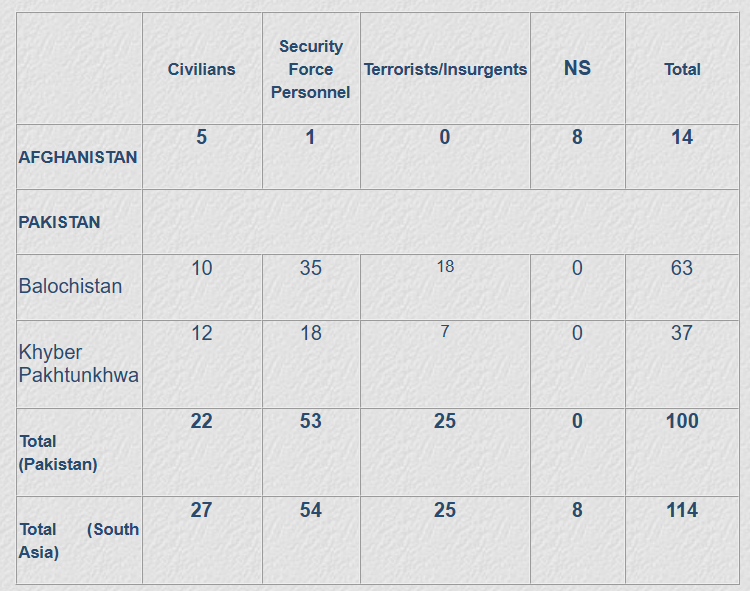
Provisional data compiled from English language media sources.