
SOUTH ASIA INTELLIGENCE REVIEW Volume 25 No. 4
Khyber Pakhtunkhwa: Quadcopter Proliferation
On July 11, 2026, a school teacher, Shaukat Armani, was killed while two of his nephews sustained injuries following a suspected Tehreek-e-Taliban Pakistan (TTP) quadcopter drone strike on his residence in the Ladha area of South Waziristan District of Khyber Pakhtunkhwa (KP).
On July 7, 2026, one civilian was killed and four were injured after terrorists carried out a quadcopter drone attack in the Baka Khel area of Bannu District in KP.
On July 7, 2026, one soldier was killed while another 16 personnel sustained injuries in a drone attack at the Army’s 64 Wing Headquarters in the Mangochar area of Kalat District in Balochistan.
On July 5, 2026, three civilians were killed and four, including women and children, were injured, in a quadcopter drone strike by unidentified terrorists targeting a residence in the Barmal area of South Waziristan District in KP.
On July 5, 2026, three civilians, including a five-year-old child, were injured after terrorists carried out a quadcopter drone attack in the Narmi Khel area of Baka Khel tehsil (revenue unit) in the Bannu District of KP.
On July 5, 2026, one person was killed and at least ten were injured when a drone flown from an unidentified location crashed in the Kalat District of Balochistan.
On July 5, 2026, two children were injured in a quadcopter drone strike by unidentified terrorists, reportedly targeted a residential house in the Nargasi area of Wana tehsil in the South Waziristan District of KP.
On July 2, 2026, three civilians, including two children, were killed and another eight were injured, after a quadcopter drone operated by unidentified terrorists crashed into a civilian residence during a failed attempt to target a Security Forces (SFs) check post in the Shin Kot area of Bajaur District in KP.
On July 2, 2026, SFs intercepted and downed a quadcopter drone near the 134 Wing of the Pishin Scouts in the Pishin town (Pishin District) of Balochistan.
On July 1, 2026, two civilians sustained injuries in a quadcopter drone strike at the Hormuz village of Mir Ali tehsil in the North Waziristan District of KP.
During the first 12 days of the current month, at least 10 terrorist-orchestrated quadcopter drone attacks were reported, resulting in nine fatalities and 51 persons injured. According to partial data compiled by the South Asia Terrorism Portal (SATP), Pakistan’s tribal areas of the KP and Balochistan provinces have already recorded a total of at least 60 incidents of quadcopter drone attacks, resulting in 36 deaths and over 178 persons injured, so far, in 2026 (data till July 12, 2026). During the corresponding period of the previous year, a total of at least 13 such incidents were recorded, resulting in 13 deaths and over 10 persons injured. The whole of 2025 reported 49 incidents of quadcopter drone attacks resulting in 46 deaths and over 81 persons injured.
Since the first media-reported quadcopter drone strike on October 21, 2024, a total of 110 such attacks have been recorded, resulting in 89 fatalities and injuries to more than 259 persons. The first reported incident occurred when SFs used a quadcopter drone to target TTP and Lashkar-i-Islam (LI) hideouts in the hilly terrain of Peer Mela in the Tirah Valley of Khyber District in KP. The strike reportedly killed at least 15 militants. Although there was no official confirmation regarding the number of injured, unnamed officials, citing local sources, claimed that around 15 militants, including a local ‘commander’, were also wounded in the attack.
Quadcopter drones can be equipped to carry a variety of payloads, with their carrying capacity is determined by size, design, and intended purpose. Consumer-grade quadcopters generally have a payload capacity of a few kilograms, making them suitable for surveillance and the delivery of small payloads. In contrast, larger industrial-grade quadcopters are capable of transporting substantially heavier loads, with some advanced models able to carry payloads weighing several hundred kilograms.
Although Pakistan’s tribal areas have witnessed counter-terrorism operations for over two decades, the use of quadcopter drones by both Security Forces (SFs) and militant groups is a relatively recent development. While the Pakistan Army has accused militants of employing quadcopters to target SFs, it has simultaneously integrated the technology into its own counter-terrorism operations. Some of the notable instances in which the Army has used quadcopters to target militants include:
On March 30, 2026, at least 10 TTP cadres were killed in an SF quadcopter drone strike when a group of TTP cadres tried raising a flag on a school in the Bara tehsil of Khyber District in KP.
On January 8, 2026, four Balochistan Liberation Front (BLF) cadres were killed in a quadcopter drone strike carried out by SFs on the group’s camp in the Zamuran area of Buleda tehsil in the Kech District of Balochistan.
On December 14, 2025, a top ‘commander’ of the Hafiz Gul Bahadar faction of TTP, Maulvi Insafullah, who was responsible for the assassination of the Assistant Commissioner of North Waziristan District, was killed along with two of his aides in a quadcopter drone strike in the Mamadkhel area of Bannu District in KP.
On December 10, 2025, at least eight terrorists were killed and another four sustained injuries in two quadcopter drone strikes carried out by SFs in the Mohmand District of KP.
On February 16, 2025, a local ‘commander’ of the Hafiz Gul Bahadar (HGB) faction of TTP, Shaheen Wazir, was killed in the Shaktu area of South Waziristan District in an SF quadcopter strike.
On February 12, 2025, at least five terrorists were killed in an SF projectile strike by quadcopter, in the Draban area of Dera Ismail Khan District.
On November 29, 2024, SFs used a quadcopter to neutralise seven terrorists during an operation in the Bakka Khel area of Bannu District in KP.
The increasing use of quadcopter drones has evidently emerged as a double-edged sword. While enhancing SF operational capabilities, their employment in counter-terrorism operations has also been accompanied by a disturbing pattern of civilian collateral damage since March 2025. Some of the notable earlier incidents involving civilian casualties resulting from drone strikes include:
On March 29, 2025, a drone strike in the Katalang area of Mardan District killed 11 civilians, including two children. Local witnesses attributed the strike to SFs, but the Government denied the use of drones in the operation.
On May 19, 2025, a quadcopter attack in the Hurmuz village of North Waziristan District killed four children from a single family and left another five seriously injured. Villagers alleged that the attack was conducted by SFs, but the military and the Federal Ministry of Interior denied SF involvement and put the blame on TTP and its allied groups.
On September 17, 2025, four people, including two women and a man from the same family, were killed while another five were injured in a drone strike by the Army near the Tarasani causeway in the Zehri tehsil of Khuzdar District in Balochistan.
On October 1, 2025, at least four people were killed in a military drone strike in the Noorgama area of Zehri tehsil in the Khuzdar District of Balochistan.
The South Asia chapter of Amnesty International on June 25, 2025, issued a strongly worded statement against the use of drones in civilian areas, and has called upon the Pakistani state to initiate independent and transparent investigations into each incident, to prosecute those responsible in accordance with national and international law, and to provide compensation and rehabilitation to the affected families. Isabelle Lasseur, Deputy Regional Director, Amnesty International, observed:
Drone and quadcopter attacks resulting in civilian deaths constitute a serious violation of international humanitarian law. When homes, playgrounds, and ordinary people become targets, the legal and moral implications are severe.
A worrisome issue in these drone attacks is the recurring pattern of child casualties. While the Pakistan Government seeks to shed responsibility, terming these causalities ‘collateral damage’, the Army claimed SFs had been “falsely implicated”.
Recently, on July 8, 2026, a leaked audio message purportedly featuring former KP Chief Minister Ali Amin Khan Gandapur surfaced on social media, in which he criticised the provincial government’s handling of the deteriorating security situation, particularly the increasing use of drone strikes. He asserted that drone attacks were on the rise across KP and contended that the provincial administration had failed to address the issue effectively. Stressing that official silence did not negate the occurrence of such incidents, he remarked, “If we are silent over drone strikes, it doesn’t mean they are not happening.” He further alleged that the strikes were causing civilian casualties and maintained that the provincial government could not evade responsibility for the resulting loss of civilian lives.
The growing use of quadcopter drones in KP highlights a dual challenge for Pakistan’s security apparatus. While the State has largely avoided addressing questions of accountability arising from SF drone operations, it has also struggled to develop an effective response to the increasing use of quadcopters by terrorist groups. This capability gap was acknowledged by KP Inspector General of Police (IGP) Zulfiqar Hameed on March 27, 2025, when he stated that the provincial Police lacked the modern equipment required to counter the evolving terrorist threat. Pointing to militants’ access to sophisticated weaponry, including quadcopters, he observed:
They have acquired the latest US weapons and modern gadgets. They’re carrying out quadcopter attacks. If we don’t advance, how will we fight back, since we don’t have anti-quadcopter technology?
Since the beginning of 2025, the increasing use of quadcopter drones by terrorist groups in the southern Districts of KP has provided them with a tactical advantage over the security apparatus. Recognising the emerging threat, KP Police established the country’s first Unmanned Aerial Vehicle (UAV) Division on March 6, 2025. The force also deployed anti-drone guns across several Districts and later installed dedicated counter-drone systems in Peshawar and Bannu District to strengthen defensive capabilities. These measures appear to have produced tangible results. On July 7, 2026, during a law-and-order review meeting at the Central Police Office chaired by Provincial Police Chief Zulfiqar Hameed, officials disclosed that the KP Police had thwarted 341 terrorist drone attacks during the first six months of 2026 through the use of modern counter-drone technology.
The weaponisation of quadcopters has emerged as one of the latest tactical additions in the arsenal of terrorist groups. Once primarily associated with photography, agriculture, and commercial applications, these inexpensive and easily accessible platforms are increasingly being adapted to conduct low-cost, high-impact attacks.
The rising incidence of quadcopter attacks in the southern Districts of Khyber Pakhtunkhwa (KP), particularly Bannu, Tank, North Waziristan, and South Waziristan, reflects a significant tactical evolution in militant operations, rather than a broader strategic shift. Recognising the growing threat, the KP Police recently further upgraded their surveillance and counter-drone capabilities. On July 7, 2026, KP IGP Zulfiqar Hameed distributed 76 state-of-the-art surveillance drones to representatives of 27 District Police formations and seven specialised Police units, to enhance intelligence-gathering and operational preparedness.
Despite the distribution of 76 state-of-the-art surveillance drones to strengthen aerial monitoring, three drone attacks have already been recorded since, underscoring the persistence and evolving nature of the threat. Whether these enhanced surveillance capabilities will translate into a measurable improvement in the Khyber Pakhtunkhwa security establishment’s ability to detect, deter, and neutralize such attacks remains to be seen.
Narco Peril
On June 26, 2026, Bangladesh’s Home Minister, Salahuddin Ahmed said the government was set to amend the law to equip officials of the Department of Narcotics Control (DNC) with modern firearms, to effectively combat drug-related crimes. Salahuddin Ahmed also announced plans to establish advanced drug-testing laboratories in every district across the country.
Later, a June 28, 2026 report noted that DNC, in its 2025 annual report, disclosed that seizures of Yaba and other amphetamine-type stimulant (ATS) tablets rose by 90.58 per cent in 2025, compared to the previous year. The report shows law enforcement agencies seized 43,562,811 ATS tablets in 2025, up from 22,857,751 in 2024. In 2023, the seizure stood at 42,977,219 tablets. The report further stated that cannabis remained the most prevalent drug in the country, accounting for more than 50 to 60 per cent of cases detected by DNC in 2025.
Further, the DNC report identified 25 districts across Bangladesh as the country’s most drug-prone regions: Cox’s Bazar, Chattogram, Cumilla, Brahmanbaria, Narshingdi, Faridpur, Gazipur, Narayanganj, Tangail, Mymensingh, Rajshahi, Natore, Naogaon, Pabna, Sirajganj, Bogura, Joypurhat, Dinajpur, Kurigram, Lalmonirhat, Rangpur, Satkhira, Jashore, Kushtia and Chuadanga. It also listed several vulnerable trafficking points along the western, northern and southeastern borders. In the southeast, Teknaf, Cox’s Bazar, Shahporir Island, St. Martin’s Island, Ukhiya and other coastal and border points remain critical.
In addition, as reported on June 28, 2026, Mohammad Badruddin, Additional Director (Intelligence) at DNC headquarters, observed that the rise in seizures was linked to an increase in the supply of and demand for Yaba. Mohammad Hasan Maruf, DNC Director General, further noted that supply had increased as Myanmar’s rebel groups were using Yaba as a “narco-currency”, adding, “With limited access to conduct operations inside Myanmar territory, we conduct drives whenever we receive information about smuggling.”
Moreover, as reported earlier, on June 18, 2026, Border Guard Bangladesh (BGB) claimed record Yaba seizures, including approximately 2.8 million tablets seized between July 15 and September 15, 2025. The estimated price per Yaba tablet would be approximately BDT 314 per pill, about USD 2.8-2.9 per tablet. A contingent of the Bangladesh Navy, during a special drive in the Hnila Union of Teknaf Sub-District in Cox’s Bazar District, seized approximately 500,000 Yaba tablets valued at around BDT 250 million. This places the estimated price of a single Yaba tablet at about BDT 500, or roughly USD 4.5.
Yaba is an illicit stimulant drug that typically contains methamphetamine and caffeine compressed into a small tablet. It originated in Southeast Asia and is particularly prevalent in countries including Myanmar, Thailand, and Bangladesh.
A July 2, 2026, report noted that Yaba use was increasing in Bangladesh due to its relatively low cost, easy availability, and trafficking from Myanmar. Large quantities of the drug continue to be manufactured in Myanmar, particularly in militia-controlled regions of Shan State, where production sites are difficult to monitor. Large industrial-scale methamphetamine laboratories are concentrated in Shan State and neighbouring regions. This state is recognized as the primary production hub for drugs. A majority proportion of methamphetamine (the core substance for Yaba) and, consequently, most Yaba, is manufactured in illicit laboratories located in the northern areas of Shan State. A UN report, titled Synthetic Drugs in East and Southeast Asia: Latest Developments and Challenges, 2025, noted that the production and trafficking of methamphetamine in Shan State had significantly increased since 2021, though exact quantities were not mentioned in the report.
Another province of Myanmar, the Chin State situated along Myanmar’s northwestern frontier with India and close to Bangladesh, facilitates movements of people, weapons and illicit drugs, according to a June 18, 2026, report. Since Myanmar’s 2021 military coup, the region has become one of the country’s most active conflict zones, characterized by intense fighting between the military junta and a diverse array of resistance organizations. The Chin State has emerged as an important trafficking corridor, with vast quantities of methamphetamine tablets and crystal meth move through Chin’s mountainous terrain toward Bangladesh.
The Arakan Army (AA) has been deeply involved in this entire scenario. Leveraging its connection to other armed ethnic groups involved in the drug trade in Shan State, AA, taps into existing smuggling networks and production centres. Once synthetic drugs reach Rakhine State, AA recruits Rohingyas to smuggle the merchandise into Bangladesh. A September 8, 2025, report noted that AA-linked cross-border suppliers were working with transnational syndicates and hundreds of carriers, across 17 routes.
Explaining the AA-Rohingya-Yaba nexus, on September 14, 2025, Ramu Sector Commander, Colonel Mohiduddin Ahmed stated,
Rohingyas are the main traffickers of Yaba. They move the drugs very fast, which makes it difficult to catch them. Some unscrupulous people in our country, driven by their own interests, are bringing Yaba from Myanmar’s Arakan Army into Bangladesh… Because of strict surveillance along the Ukhiya-Teknaf border, traffickers are becoming active on sea routes. It’s estimated that nearly 80 percent of drugs enter Bangladesh through the coasts of Maheshkhali, Banshkhali, Kutubdia, Anwara, and Kuakata. From these routes, drugs are not only spreading inside Bangladesh but also being smuggled to other countries, which is a grave threat to our youth and economy.
Rohingya refugee camps have been hotbeds of Yaba storage, especially in the Kutupalang and Balukhali areas, both in Cox’s Bazar District, where small huts are used as Yaba storehouses. In 2025, Human Rights Watch documented cases in which Rohingya armed groups recruited children to smuggle Yaba, across checkpoints, noting, “[Children] are in this small area, with no certificates, no future. Ask them about their dreams and they might laugh. [Armed groups are] the way to status and some money.” The involvement of political figures of this area in the Yaba trade is a further concern. As reported on April 22, 2026, Bangladesh authorities have named Abdur Rahman Bodi, widely known as the ‘Yaba Godfather’, an Awami League leader and former Member of Parliament (MP) of Cox’s Bazar’s Ukhia-Teknaf constituency, as a key player in Yaba trafficking. His name appeared on a list of suspected Yaba smugglers prepared by DNC in 2014. However, the agency didn’t pursue the investigation.
A February 27, 2026, report noted that an uninterrupted and massive flow of drugs into Bangladesh had turned more than 8.3 million people into drug addicts, leading to a wide range of socio-economic problems, including a spike in violent crimes. Indeed, large-scale street operations conducted by the Dhaka Metropolitical Police in the month of June, 2026 highlight the close correlation between Yaba trafficking and illegal firearms ownership. In a single month, the Police arrested 555 people, filed 354 drug cases, seized over 233,000 Yaba tablets, along with multiple foreign pistols and locally-made weapons.
The institutional vacuum in Myanmar and the vulnerable nature of the Bangladesh-Myanmar border have created a precarious condition in Bangladesh. The situation is complicated further by the presence of Rohingyas, and their active participation in the narcotics trade. Despite strong and sustained action by DMC, the disorders in Myanmar make it unlikely that this pernicious commerce can be brought to an end in the foreseeable future.
Weekly Fatalities: Major Conflicts in South Asia
July 6-12, 2026
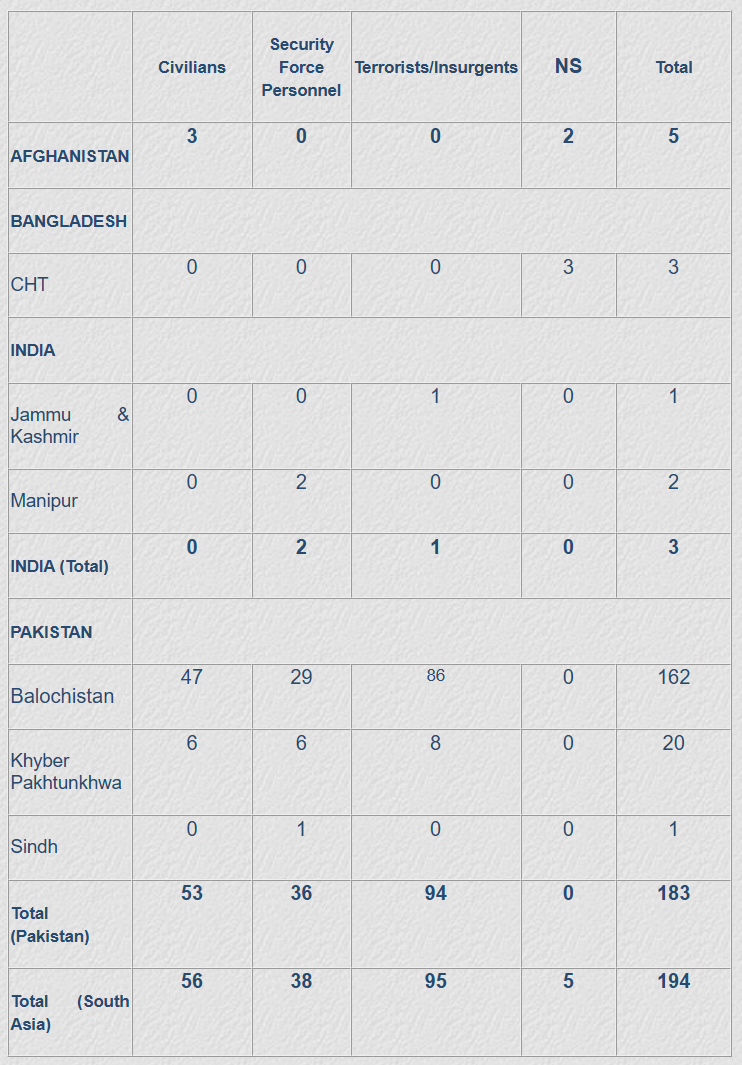
Provisional data compiled from English language media sources.