
South Asia Intelligence Review
Tormenting Baloch Women
On August 27, 2026, the Balochistan Government announced bounties, ranging from 1 million to 1.5 million rupees, on nine Baloch women, for their alleged linkages to Fitna al Hindustan (A state term for Baloch insurgents. These women hail from Gwadar, Jiwani and Turbat. The announcement was made by Babar Yousafzai, Adviser on Media Affairs to the Balochistan Interior Minister, who said the Government considered the women highly wanted and urged members of the public to provide information to the authorities. Officials added that the identities of informants would be kept confidential. A poster published by the Government identified the suspects as Hanifa Bibi, daughter of Sher Muhammad; Ayesha, daughter of Abdul Rasheed; Iqra, daughter of Ali; Ruqayya, daughter of Waleed; Hafsa, daughter of Iqbal; Zahra, daughter of Malik Muhammad; Amina, daughter of Abdul Rashid; Zareena, daughter of Wahid Baksh; and Aziza, daughter of Ibrahim.
This announcement came at the heels of recent cases of “enforced disappearances” of Baloch women, and appeared to be intended to distract attention from these state atrocities.
On August 23, 2026, a 20-year-old woman, Safia Baloch, the daughter of Abdul Khaliq, a student and resident of the Killi Zayak area of Basima in the Washuk District of Balochistan, was “forcibly disappeared” by personnel of the Counter Terrorism Department (CTD) and Inter-Services Intelligence (ISI) from provincial capital Quetta at approximately 1:00 a.m.
On August 5, 2026, a 17-year-old woman, Aqsa, was “forcibly disappeared” along with her father, Abdul Qudoos Zarakzai, by Security Forces (SFs) during a raid on a residential quarter in the Civil Colony of Khuzdar District in Balochistan. At approximately 10 p.m. in the night, personnel from CTD and plainclothes officials carried out a joint raid and took away Abdul Qudoos Zarakzai and Aqsa.
On July 30, 2026, three Baloch women, identified as Rafia Bibi, Tania and Javeria, who belong to the Nechari tribe, were reportedly detained at the Lak Pass FC checkpoint near Quetta and later “forcibly disappeared”. Their family said no information had been provided about their whereabouts and that they had not been informed of the reasons for their detention.
In a statement citing the “enforced disappearance” of Safia Baloch, Dr. Shalee Baloch, an organizer of the Baloch Women’s Forum (BWF), stated on August 26, 2026, that the continued abduction and enforced disappearance of Baloch women had reached an “alarming and intolerable” level. In her statement, Dr. Shalee named several women, Habiba, Mahjabeen, Nasreena, Humaira, Najma and now Safia Baloch, who represented a growing pattern of Baloch women being forcibly disappeared. Dr Shalee added that the targeting of Baloch women reflected a “colonial logic of domination”, alleging that militarisation, arbitrary detention, surveillance, collective punishment and intimidation have historically been used to subjugate colonized peoples.
Organisations including the Voice for Baloch Missing Persons (VBMP) and the Human Rights Council of Balochistan (HRCB) have repeatedly raised concerns over women who they say were detained by SFs and intelligence agencies and subsequently remained unaccounted for, with some later being presented before the media as suicide bombers after months of detention. In recent years, the Baloch Yakjehti Committee (BYC) and other Baloch human-rights groups have documented what they described as an increase in enforced disappearances involving women, and have repeatedly called for detainees to be produced before courts if there are criminal charges against them.
According to an HRCB report released on August 27, 2026, 23 women have been “forcibly disappeared” by SFs between January and July 2026. According to rights organizations, these incidents mark a critical and dangerous escalation in the region, where enforced disappearances historically targeted men, but have increasingly targeted women directly. HRCB and other human rights organizations have raised an alarm over these abductions, which targeted women from diverse backgrounds, including human rights activists, healthcare workers, students, and housewives.
Earlier, on January 13, 2026, BYC released a report highlighting the pattern of enforced disappearances of Baloch women and girls across Balochistan during 2025, emphasising the use of collective punishment and gender-based human rights violations. Titled Enforced Disappearances of Baloch Women in 2025: Collective Punishment and Gender-Based Human Rights Violations in Balochistan, the report noted that at least 12 women and girls were forcibly disappeared across different Districts of Balochistan over the course of the year. BYC underlined that these cases did not represent isolated incidents but pointed to a systematic practice in which enforced disappearance is used as a tool of repression. The report states that the victims included female students, woman health workers, minor girls, and an eight-month pregnant woman. In several instances, multiple members of the same family were targeted during single operations, causing long-term psychological, social, and economic harm to entire families and communities.
Over the years, enforced disappearances in Balochistan have predominantly targeted men, leaving women to bear the social, economic, and psychological consequences within their families and communities. Since 2025, however, the pattern appears to have shifted, with women increasingly emerging as direct targets of state action. This development marks a significant expansion in the nature and scope of alleged State repression in Balochistan.
Forced confessions have become a recurring practice used by the state in Pakistan to shape public narratives around dissent in Balochistan. Women are first subjected to enforced disappearance, held in custody for prolonged periods without due process, and exposed to coercion and abuse. After weeks or months in detention, they are suddenly brought before the public, often through staged appearances or recorded videos, to “confess” to acts they have consistently denied. The case of Mahal Baloch was one of the earliest examples of this pattern. In February 2023, Mahal Baloch was taken into custody by CTD during a late-night raid on her home in the Satellite Town of Quetta, without a warrant. Authorities later claimed she had been arrested with explosives and accused her of links to militant activity, including involvement in a suicide attack, allegations her family strongly denied. Despite being kept on physical remand for fifty-five days, authorities failed to present any substantial evidence against her. Instead, a video later surfaced in which she appeared to “confess” to militant involvement. This statement was made while she remained in police custody, not before a court of law.
The participation of some Baloch women in insurgent groups, including female fidayeen (suicide) attacks on SFs and state establishments, has forced to government to resort to its ‘regular’ method of disappearances targeting women, which it has been following with Baloch men since decades. The first use of female suicide bombers by the Baloch insurgent groups was reported in April 26, 2022, when the Baloch Liberation Army (BLA) carried out a suicide attack at the Confucius Institute at the University of Karachi, which resulted in the deaths of five persons, including three Chinese nationals, their Pakistani driver and a security guard. While claiming responsibility for the attack, BLA released the image and name of the attacker, female suicide bomber Shaari Baloch aka Bramsh, who was a member of BLA’s Majeed Brigade, a suicide squad. She had joined Majeed Brigade two earlier ago.
The second woman suicide attack came on June 24, 2023, when a BLA-Majeed Brigade bomber, Sumaiya Qalandrani Baloch, attacked a VIP Army convoy that was going from Turbat Airport to the Inter-Services Intelligence (ISI) headquarters in the Turbat city of Kech District. The attack resulted in the death of one FC trooper and injuries to another five.
On August 26, 2024, a third female suicide attack was reported when BLA-Majeed Brigade suicide bomber Mahal Baloch carried out a car-bomb attack at the gate of an FC camp in the Bela area of Mastung District.
The fourth female suicide attack was reported on March 3, 2025, when Majeed Brigade suicide bomber Mihikan Baloch attacked a military convoy on the national highway near the Mughalzai area of Kalat District, resulting in the death of FC trooper Attaullah, and injuries to four others.
The last female suicide attack in this series was on November 30, 2025, when Majeed Brigade suicide bomber Zareena Rafiq aka Tarang Maho attacked the FC Headquarters in the Nokundi area of Panjgur District, resulting in the death of one FC trooper and injuries to another seven.
While the participation of a small number of Baloch women in insurgent attacks has drawn attention, women in Balochistan have also become increasingly visible in non-violent political activism over the past decade, particularly around the issue of enforced disappearances and extra-judicial killing. They have led prolonged protests over “missing family members,” relatives they accuse security agencies of forcibly disappearing. Hundreds of women and family members undertook a massive march covering roughly 1,000 miles from Turbat town (Kech District) in Balochistan to Islamabad, and staged sit-ins outside the Islamabad Press Club, demanding the recovery of missing persons, drawing national attention. BYC, a civil rights movement founded by Dr. Mahrang Baloch, was led the effort. Protesters faced Police blockades, tear gas, water cannons, and temporary detentions upon reaching the capital. Despite of state atrocities, Dr. Mahrang Baloch and Sammi Deen Baloch organized and spearheaded these non-violent demonstrations.
Mahrang Baloch founded BYC in July 2018, as a grassroots movement advocating the rights of the Baloch community, with a particular emphasis on mobilising women and the families of individuals allegedly subjected to forcible disappearances. In its annual report released on February 3, 2026, BYC documented 1,223 cases of forcible disappearances and extrajudicial killings across Balochistan and adjoining regions during 2025, including affected areas in Sindh and Punjab. On August 26, 2026, the Baloch National Movement’s (BNM) human rights wing, PAANK (Tr: Shield or Protection), reported at least 556 people were forcibly disappeared and 227 others were subjected to extrajudicial or custodial killings across Balochistan between January and June 2026. A PAANK statement added that a further 171 individuals were released during the same six-month period, describing the figures as amounting to an average of roughly 93 enforced disappearances and 38 killings every month. The Human Rights Council of Balochistan (HRCB) recorded 1,455 disappearances, with 1,052 persons remaining missing. The Voice for Baloch Missing Persons (VBMP) estimates that more than 7,000 persons have disappeared since the insurgency began, even as its continuous protest against enforced disappearances in Quetta had reached 6,207 consecutive days by June 26, 2026.
While describing the growing involvement of Baloch women in the Baloch resistance movement, BYC leader Sammi Deen Baloch told Arab News in an interview on February 25, 2025:
We see that our men, our brothers and sons, were systematically taken from their homes, from educational institutions, dragged away while they slept at night. In such circumstances, the only option left for Baloch women was to take this fight into their own hands, to step forward and lead the battle for justice themselves.
This shift among Baloch women, from the quiet grief to active resistance, has significantly altered the nature of the state’s response. Rather than addressing the underlying drivers of Baloch resentment, the SFs have increasingly sought to suppress dissenting voices among women, treating their growing mobilisation as a security challenge rather than a manifestation of longstanding political and social grievances.
Meghalaya: New Drug Frontier
On August 10, 2026, the Anti-Narcotics Task Force (ANTF) of Meghalaya Police arrested two alleged drug traffickers and recovered 32.64 grams of heroin during two intelligence-based operations at Umiam in Ri-Bhoi District, Meghalaya. Allan Marwein was arrested with 10.93 grams of heroin after allegedly returning to Shillong from Guwahati, while Jaziel Nongjop Syiem was apprehended later in the night with 21.71 grams of heroin concealed in soap cases.
On August 8, 2026, the ANTF, in coordination with the West Jaintia Hills Police, arrested Robert Nongrum and Batskhemlang Jarain and recovered 48.78 grams of heroin at Phramer along National Highway-06 in the Laskein Block of West Jaintia Hills District. The operation followed intelligence that the two were transporting narcotics in a passenger bus travelling from Silchar in Assam, towards Shillong.
On July 6, 2026, ANTF personnel arrested Rahim Ali and Jaibanu, a husband-and-wife duo, and recovered 116 vials containing 14.42 grams of heroin at Lum Survey in Shillong, East Khasi Hills District. The operation was conducted as part of a joint anti-infiltration and anti-narcotics drive in the East Khasi Hills.
On June 22, 2026, ANTF arrested Sabina Begum and Viru Singh after recovering 16.1 grams of heroin, 47 coloured vials containing heroin, and a mobile phone, at Lum Survey in Shillong. Begum was originally from Sonitpur District in Assam. Police initiated an investigation into the suspected supply network.
On June 16, 2026, ANTF arrested three alleged drug traffickers, Sahidul Hussain, Saddam Hussain and Rashidul Hoque, and seized 53 grams of heroin, two motorcycles and three mobile phones, at Tikrikilla in the West Garo Hills District. All three were residents of Goalpara District, Assam. Meghalaya Police disclosed that the three were suspected members of a larger organised interstate drug-trafficking network, and initiated an investigation into its forward and backward linkages.
The most consequential seizure this year occurred on March 6, 2026, when ANTF and the East Jaintia Hills Police intercepted a Tata Sumo at Ratacherra and recovered 10.145 kilograms of crystal methamphetamine and 203.7 grams of heroin. Valued at approximately INR 511.3 million, it was described as the largest-value narcotics recovery by the Meghalaya Police. Two persons were arrested. Preliminary investigation indicated an interstate and cross-border trafficking network.
These cases point to an increasingly complex narcotics economy in Meghalaya. The State is exposed to multiple trafficking corridors rather than a single route. The Silchar–Jaintia Hills–Shillong axis is particularly visible. On the other hand, the August 8, 2026, interception of a bus travelling from Silchar towards Shillong and the earlier seizure at Ratacherra highlight the importance of the Assam-Meghalaya road network. Umiam, meanwhile, has emerged as an important interception point on the Guwahati–Shillong corridor. The June Tikrikilla arrests involving three residents of Goalpara further underline the role of Assam-based networks and facilitators.
The source of the drugs is more complicated. Meghalaya’s geographical position within the wider Northeast places it along trafficking flows that connect Myanmar-bordering States, including Manipur and Mizoram, with Assam and other parts of the region, creating an important transit environment. In May 2026, the Meghalaya High Court was informed that the Narcotics Control Bureau (NCB) had detected trafficking of methamphetamine from Silchar in Assam, towards Mawsynram in Meghalaya, with further cross-border linkages. The same proceedings recorded that the Border Security Force (BSF) had registered narcotics-related cases following seizures in February 2026. NCB also highlighted the operational relevance of the Barak Valley for narcotics trafficking in the region.
The composition of the seizures also indicates a diversification of the market. Heroin remains the most frequently encountered substance in the publicly reported 2026 cases, but the March seizure of more than 10 kilograms of crystal methamphetamine demonstrates the State’s exposure to synthetic drugs and larger consignments. Earlier enforcement operations had also resulted in seizures of pharmaceutical drugs, as well as Yaba and cannabis.
In January 2026 , Meghalaya Police disposed of narcotics previously seized in 58 NDPS cases, including 183.28 grams of heroin, 8.721 kilograms of Yaba tablets, 296.79 kilograms of ganja, 2,793 bottles of codeine-based cough syrup and 534 R-7 tablets [a high-grade brand of Yaba (methamphetamine and caffeine) pills], with an estimated value of INR 91.1 million. These were recovered in seizures prior to January 2026, but the diversity of substances illustrates the breadth of the problem.
The available evidence does not, at present, establish the involvement of a specific insurgent organisation in Meghalaya’s narcotics trade. Nor is there sufficient evidence to conclude that the Hynniewtrep National Liberation Council (HNLC) controls or finances the trafficking networks detected by ANTF. The more discernible structure is that of fluid, profit-oriented criminal networks involving suppliers, interstate couriers, local distributors, transporters and receivers. In several cases, Police have explicitly referred to “larger organised” or “interstate” networks and initiated forward and backward-linkage investigations.
The principal security concern is therefore the possible consolidation of Meghalaya as both a consumer market and a distribution hub. In a May 21, 2026, report, Meghalaya Director General of Police (DGP) Idashisha Nongrang expressed concern that “Meghalaya at one point of time was just a transit route. Now we are becoming more and more of a consumer state.” She expressed particular concern over the Garo Hills, where drug-related activity was increasing, and stated that narcotics entering the region were primarily coming through Assam, rather than directly from Bangladesh. DGP Nongrang’s assessment is particularly significant in light of the June arrest of three Assam residents in Tikrikilla, West Garo Hills District, who Meghalaya Police suspected were part of a larger organised interstate trafficking network.
This shift has implications beyond conventional law enforcement. Once a transit corridor develops a stable consumer market, trafficking networks can acquire incentives to establish local distribution chains and develop relationships with local facilitators. The repeated seizures in Lum Survey and the wider Shillong urban area suggest the emergence of such a retail layer. In the June 22, 2026, operation at Lum Survey, Police noted that three narcotics-trafficking cases had already been registered in the locality in 2026, with seven persons arrested, most of them reportedly from Assam. At the same time, the June 16, 2026, arrest of three residents of Assam’s Goalpara District in Tikrikilla, West Garo Hills District, and Meghalaya Police’s assessment that they were suspected to be part of a larger organised interstate drug-trafficking network, indicate that local markets are being connected to external supply networks.
The scale of the challenge is also reflected in the available official data. Data reported by Drug Law Enforcement Agencies (DLEAs) to NCB and cited by the Union Ministry of Home Affairs (UMHA) show that Meghalaya recorded seizures of 5,096.694 kilograms of narcotic substances in 2024, in addition to 308 units and 534.9 litres of other substances, compared with 1,391.956 kilograms in 2023, indicating a substantial increase in the recorded quantity seized. Official consolidated data for Meghalaya for 2025 and January-August 2026 is not yet publicly available in a comparable state-wise format. Meghalaya Police, however, reported that narcotics worth more than INR 4.12 billion had been seized in the State between 2020 and 2025, involving 1,061 arrests in 603 cases (this figure is cumulative and 2025 seizures are not separately available). Enforcement activity continued into 2026, with Meghalaya Police reporting its largest-ever NDPS seizure on March 6, 2026, in East Jaintia Hills.
The institutional response has consequently begun moving towards a network-based approach. Meghalaya constituted its ANTF in 2023 and established a dedicated ANTF Police Station in 2025. NCB informed the High Court of Meghalaya that the Narco-Coordination Centre (NCORD) mechanism operates at State and district levels, and that the Union Government had provided INR 8.35 million to Meghalaya under the Assistance to States/Union Territories Scheme for Narcotic Control. On August 2, 2026, NCB and the Meghalaya Police held a Joint Coordination Committee meeting involving ANTF, Customs, Income Tax, Subsidiary Intelligence Bureau (SIB), Special Branch, National Investigation Agency (NIA), Enforcement Directorate, Directorate of Revenue Intelligence, Drug Controller, Assam Rifles, BSF and Central Reserve Police Force (CRPF). Such coordination has become necessary because narcotics trafficking is an increasingly diverse financial and logistical enterprise. Seizure of couriers without tracing financiers, suppliers, transporters, digital communication and proceeds risks merely replacing one layer of a network with another.
The demand side requires an equally sustained response. Meghalaya’s Drug Reduction, Elimination and Action Mission (DREAM) has sought to combine enforcement with prevention, rehabilitation and community participation. In April 2026, DREAM expanded interventions in the Garo Hills, including plans for a rehabilitation centre in collaboration with the Baptist Church, and coordination involving Police, district administrations, Non-Governmental Organisations (NGOs), faith-based organisations and civil society. In June 2026, the State’s Nasha Mukt Bharat Abhiyaan (Drug Free India Campaign) activities included awareness programmes, street plays, youth engagement and community outreach. The community dimension is particularly important in Meghalaya, where traditional institutions, churches, educational institutions and civil society organisations retain considerable social influence. DREAM’s proposed expansion of detoxification and rehabilitation facilities across districts is as important as the expansion of ANTF operations.
The present threat remains manageable, but the direction of the trend is concerning. The combination of interstate trafficking, synthetic drugs, local distribution networks and rising consumption creates the conditions for a more deeply rooted organised-crime ecosystem. Meghalaya’s immediate priority, consequently, is to prevent the transition from a transit State to an established narcotics market. Sustained interdiction, disruption of criminal finances, stronger border and highway surveillance, inter-State intelligence coordination and community-based prevention will determine whether the State can contain the problem before trafficking networks acquire a durable local infrastructure.
Weekly Fatalities: Major Conflicts in South Asia
August 31 – September 6, 2026
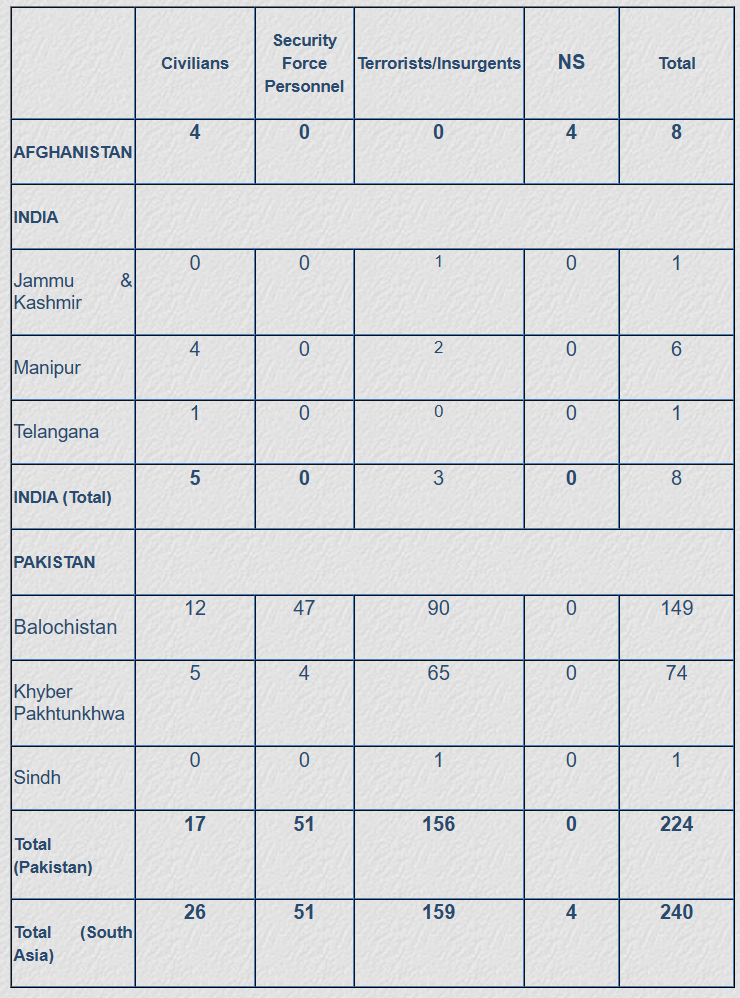
Provisional data compiled from English language media sources.